

If someone you love is dying, or you are preparing honestly for your own death, the question is not whether mindfulness sounds wise. The question is what you can actually do when breath becomes uncertain, speech may fail, and fear crowds the room.
That is not the time to introduce an elaborate technique. Dharmic practice offers a more workable approach: train one familiar remembrance until attention knows how to return to it, then protect that simplicity at the bedside. No forcing, no spiritual examination, and no demand that dying look serene.
The final moment is trained long before the final breath
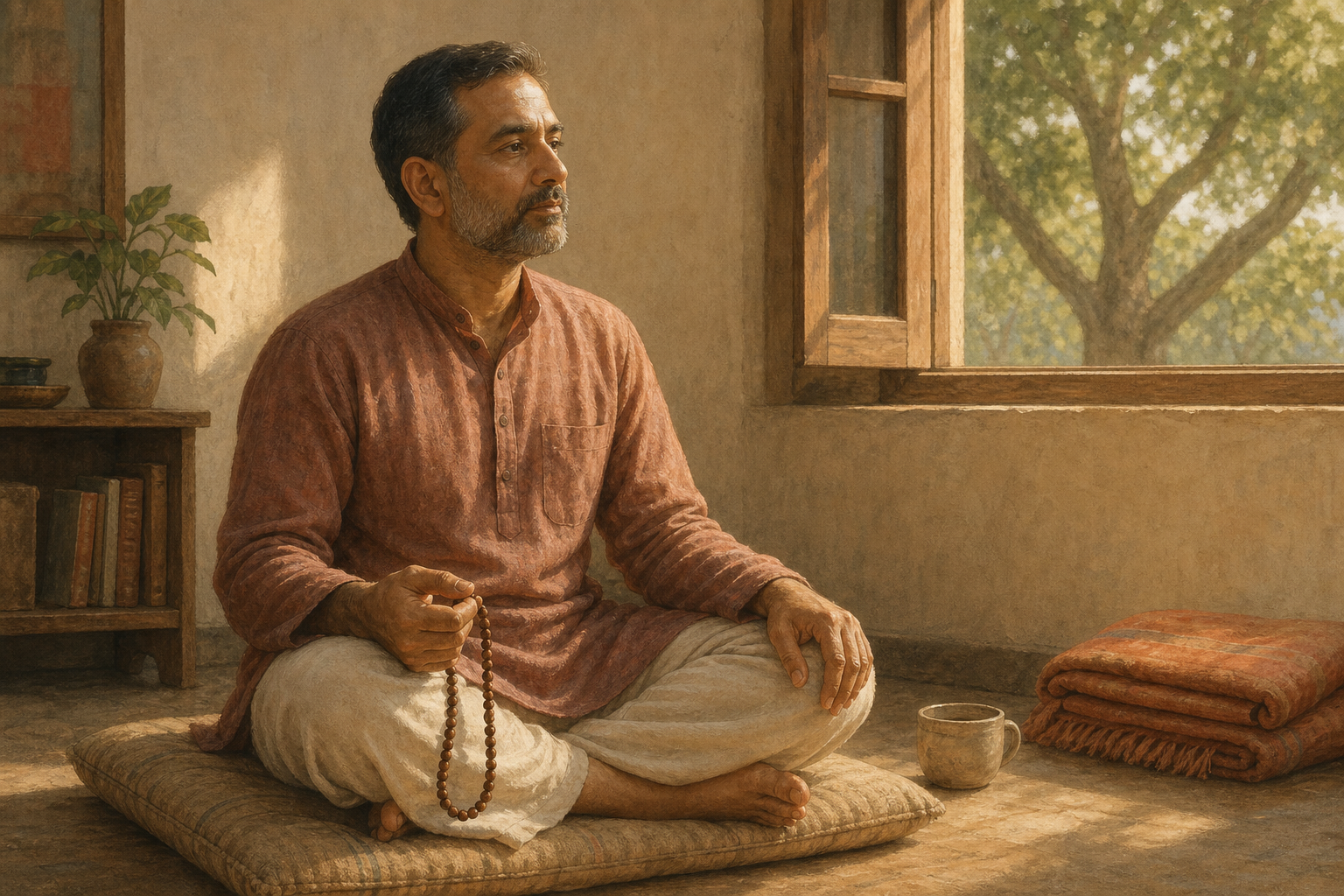
The Hindu understanding of mindful dying rests on two teachings that must remain together. Bhagavad Gita 2.20 describes the Atman as unborn, undying, and unchanged by the body’s death. Bhagavad Gita 8.6 teaches that consciousness inclines toward what it holds in remembrance. One teaching addresses what you truly are; the other addresses how the conditioned mind moves.
This makes the final remembrance neither a superstition nor a last-second password. It is the ripening of attention. A mind repeatedly trained in japa, dhyana, devotion, and discernment is more likely to return to its familiar center when ordinary control weakens. The important question is therefore not, “What thought can I manufacture at death?” It is, “Where am I teaching my mind to rest now?”
The distinction matters because fear can turn spiritual practice into another form of control. You cannot guarantee a particular final thought by gripping the mind more tightly. You can cultivate a deep tendency toward the sacred. The practice is returning, not commanding.
The image of a dying Guru attending completely to a ripe mango makes this tangible. The fruit is not a charm. Its fragrance, texture, and sweetness gather breath, sensation, and awareness into one undivided act. The ordinary moment becomes a complete sadhana because nothing in it is resisted or grasped.
In that Hindu frame, immortality does not mean keeping the body alive indefinitely. It means recognizing the Atman, which is not confined to the body’s passage through time. The mango’s sweetness points beyond itself: an experience becomes amrita when attention is no longer scattered between craving, fear, memory, and anticipation.
Other Dharmic paths train this threshold in their own doctrinal languages. Buddhist maranasati brings death into contemplation so that clinging and heedlessness can be seen clearly; it should not be recast as an Atman practice, because Buddhist teachings on anatta reject a permanent self. Jain samayik cultivates equanimity, restraint, and detachment within a discipline shaped by ahimsa. Sikh simran keeps awareness with the Naam in devotion. The practical convergence is steady remembrance and reduced grasping. The metaphysical teachings remain distinct.
Choose the language of the dying person’s actual path. A Hindu who has spent a lifetime with an Ishta Devata does not need an improvised mixture of traditions at the bedside. A Sikh devoted to the Naam does not need someone replacing simran with an unfamiliar exercise. Familiarity is part of the practice.
Build a practice that remains usable when control diminishes
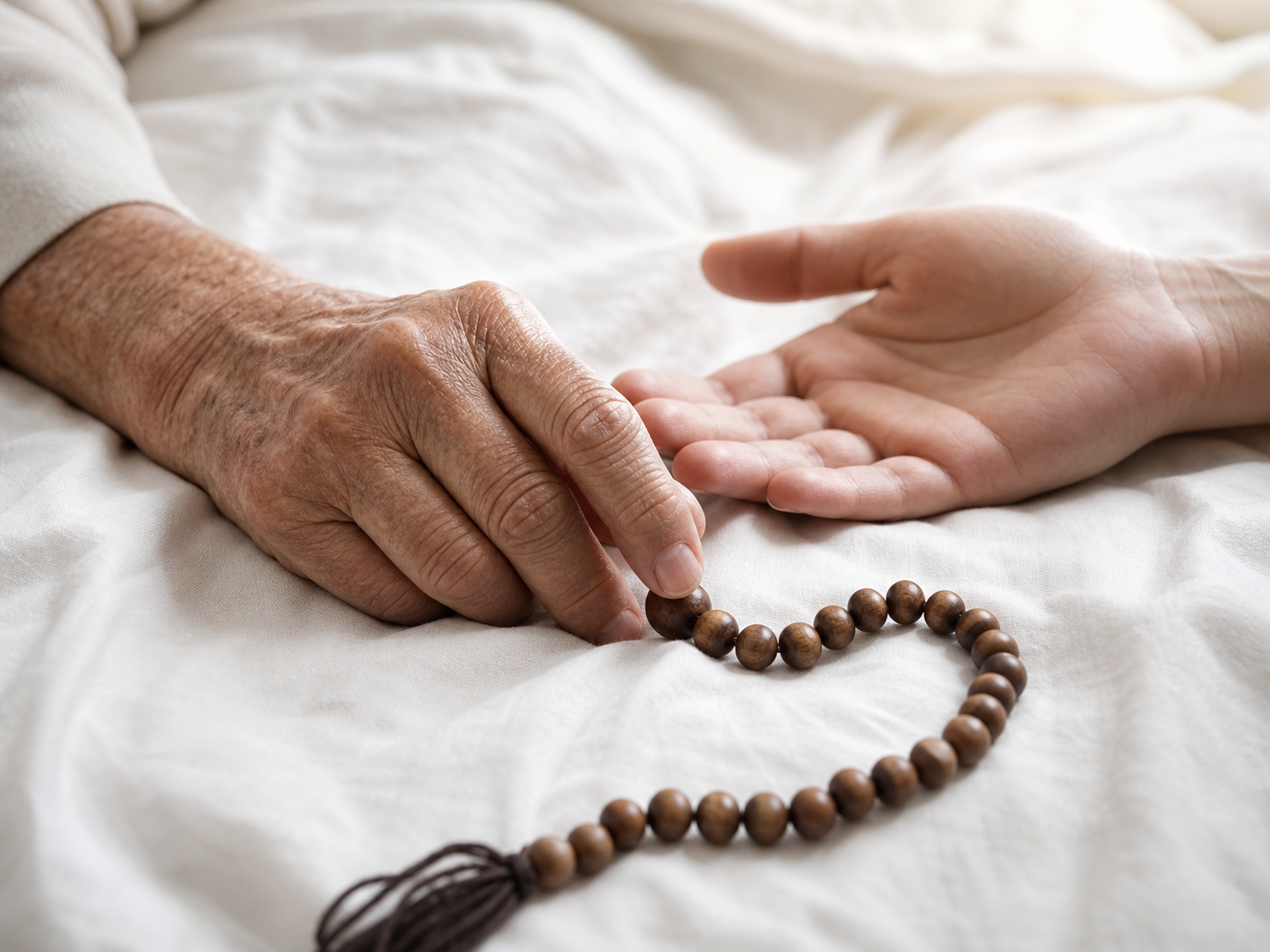
A death practice that exists only in theory will be difficult to retrieve under pressure. Build it into ordinary transitions: waking, eating, becoming upset, ending the day, and returning home after work. These moments reveal whether remembrance has become a habit or remains an occasional idea.
- Choose one primary anchor. Use a mantra, a sacred name, the Naam, a brief prayer, or natural breath awareness consistent with your tradition. You may have many beloved practices, but identify the one you would want when words and energy are limited. Constantly changing the anchor prevents familiarity from deepening.
- Learn it while calm. Sit without trying to manufacture a special state. Notice the inhalation and exhalation as they occur. If it is comfortable during ordinary practice, allow the exhalation to become slightly softer and longer. Do not strain, retain the breath, or turn breathing into a test of achievement.
- Move japa from sound toward inward remembrance. Begin audibly when that helps attention gather. Continue more quietly, then mentally. This progression matters because the voice may eventually be weak or unavailable while inward remembrance remains meaningful.
- Use the first bite of a meal as attention training. Pause before eating. Feel one natural breath, notice fragrance and texture, and receive the first taste without simultaneously speaking, scrolling, or reaching for the next bite. The aim is not culinary intensity. It is learning how to let the senses serve one-pointed awareness instead of dispersing it.
- Practice returning during minor distress. When irritation or worry appears, notice where the mind goes before you redirect it. Then return to the chosen name, mantra, or breath without scolding yourself. Recovery from distraction is the repetition that matters; a practice tested only in ideal conditions has not yet become dependable.
- Lighten unfinished emotional burdens. Ask forgiveness where it is appropriate, offer it where you genuinely can, and stop feeding grievances that repeatedly seize attention. Kshama does not require renewed contact with someone unsafe, denial of wrongdoing, or abandonment of proper boundaries. It means refusing to make resentment the mind’s permanent dwelling.
- Join remembrance to seva and study. Regular service loosens the habit of organizing life around the narrow self. Short, consistent engagement with the Bhagavad Gita, the Upanishads, or the texts of your own lineage gives remembrance a clear object. Sporadic intensity is less useful than a practice that reliably returns.
Then write a short spiritual-care note. Name the mantra, sacred name, verse, or prayer you prefer; the language in which you want it spoken; whether you also value silence; who should lead; and which practices you do not want imposed. Keep the note with your end-of-life wishes and share it with the people most likely to be present. A family should not have to resolve these questions in the most emotionally difficult hour.
Measure this practice by its availability, not by dramatic experiences. Can you remember the anchor after receiving difficult news? Can you return after anger without turning the practice into self-punishment? Can you take one complete bite without reaching mentally for the next thing? Those are practical signs that attention is being trained.
At the bedside, protect attention instead of staging a ceremony

If you are accompanying a dying person, your role is not to produce a perfect spiritual ending. It is to preserve dignity, reduce unnecessary disturbance, follow the person’s wishes, and make familiar remembrance available. Clinical comfort and spiritual care belong together; mindfulness is not a substitute for medical or hospice support.
- Begin with the person’s known wishes. If they can communicate, ask a simple question: “Would you like the Name, a verse, or quiet?” Do not demand a theological discussion. If they cannot answer, use the preferences they expressed earlier rather than treating silence as permission for whatever others want.
- Simplify the room. Reduce competing conversations, arguments, phones, and unnecessary movement. This does not require sterile silence. It means that the dying person should not have to navigate several voices, instructions, and rituals at once.
- Offer one familiar practice. Recite the chosen mantra, Naam, prayer, or passage at an unhurried pace. Leave space between repetitions. More volume and more words do not create more devotion.
- Follow the breath; do not command it. A companion may rest attention on the person’s natural rhythm, but should not insist on deep inhalations, breath retention, or controlled pacing. The daily practitioner may have trained with gentle breath awareness; the dying person should not be made to perform a breathing exercise.
- Let touch remain consensual and simple. If the person welcomes it, a hand held quietly may communicate steadiness better than repeated instruction. If touch is unwanted or its welcome is unknown, remain present without imposing it.
- Do not make the dying person comfort the family. Avoid questions such as “Are you at peace?” or “Can you see the Divine?” These can turn an intimate threshold into an examination. Say what releases obligation: “We are here. You do not need to answer. We will keep the remembrance with you.”
- Keep clinical care in place. Pain, breathlessness, confusion, or visible distress should be brought to the care team, not interpreted as a failure of meditation. Do not withhold prescribed comfort care in the hope of obtaining a more visibly conscious death.
Do not copy the mango teaching as a literal feeding ritual. If the person has difficulty swallowing, has been told not to eat or drink, or cannot safely indicate consent, follow the care team’s guidance. The mango represents total attention to the experience that is actually present. It does not require placing fruit in the mouth of a dying person.
Ritual can still be deeply appropriate when it belongs to the person’s life. A lamp where permitted, a familiar image, scripture recitation, japa, simran, or quiet companionship can help maintain continuity. The deciding test is not whether a practice appears traditionally impressive. Ask whether it is familiar, wanted, and gentle enough for this moment.
A difficult death is not evidence of spiritual failure

The desire for a lucid and peaceful death can quietly become a cruel standard. Bodies may be in pain. Medication may affect responsiveness. Confusion or agitation may arise. Death may come suddenly, without time for a chosen mantra or gathered family. None of this gives observers the right to judge the person’s faith, inner awareness, karma, or spiritual destination.
Mindfulness is lucid participation in reality, not control over the appearance of reality. A peaceful face may console those watching, but it is not a certificate of liberation. An unsettled body is not proof of an unsettled Self. Keep metaphysical confidence separate from speculation about another person’s unseen state.
This is also why Bhagavad Gita 8.6 should not be weaponized against the dying or the bereaved. The teaching on remembrance directs the living toward sustained practice. It does not authorize relatives to inspect the last seconds, identify a stray word or expression, and pronounce a spiritual verdict. The broad tendency of a life cannot be reduced to a spectator’s reading of one involuntary moment.
If fear appears in your own practice, do not treat it as disqualification. Notice its bodily and mental movement, return to the anchor, and let the return be gentle. Abhaya is not denial that the body dies. In the Hindu understanding, fearlessness grows as identity shifts from the perishing form toward the imperishable Atman. In devotional paths, it also grows through trust: you are not manufacturing the Divine presence but learning not to turn away from it.
For companions, grief can coexist with steadiness. You do not need to suppress tears to maintain a sacred atmosphere. You do need to avoid making your grief another task for the dying person. Let japa or quiet breath awareness hold you so that your presence asks less of them.
After the death, do not convert the final moments into a family dispute about who recited correctly, what the person should have said, or whether the room was spiritual enough. Continue the practices of prayer, remembrance, compassion, and service according to your tradition. Their value does not depend on reconstructing a flawless scene.
Key takeaways
- Final remembrance is cultivated through repeated attention during life, not improvised as a last-second mental command.
- Choose one primary anchor from your actual tradition and practice returning to it during ordinary distraction and distress.
- Record your spiritual-care wishes: the preferred mantra, Naam, prayer, language, degree of silence, and person who should lead.
- At the bedside, simplify the environment, offer one familiar practice, follow natural breath, and preserve medical comfort.
- Dharmic traditions share disciplines of remembrance, equanimity, and reduced clinging, but their teachings on Self and liberation should not be collapsed into one doctrine.
- A difficult, medicated, confused, or sudden death is not proof of spiritual failure and must never become grounds for judging the deceased.
You can begin before the next meal. Choose the name, mantra, prayer, or breath practice you want to know by heart. Pause for one natural breath, receive the first bite with complete attention, and return when the mind wanders. Then write your bedside preferences while you can still speak for yourself. The final moment cannot be scheduled, but the direction of attention can be trained today.