-
Vermilion Box (Sindoor Dabi): Goddess Lakshmi’s Grace, Prosperity Rituals, and Living Heritage

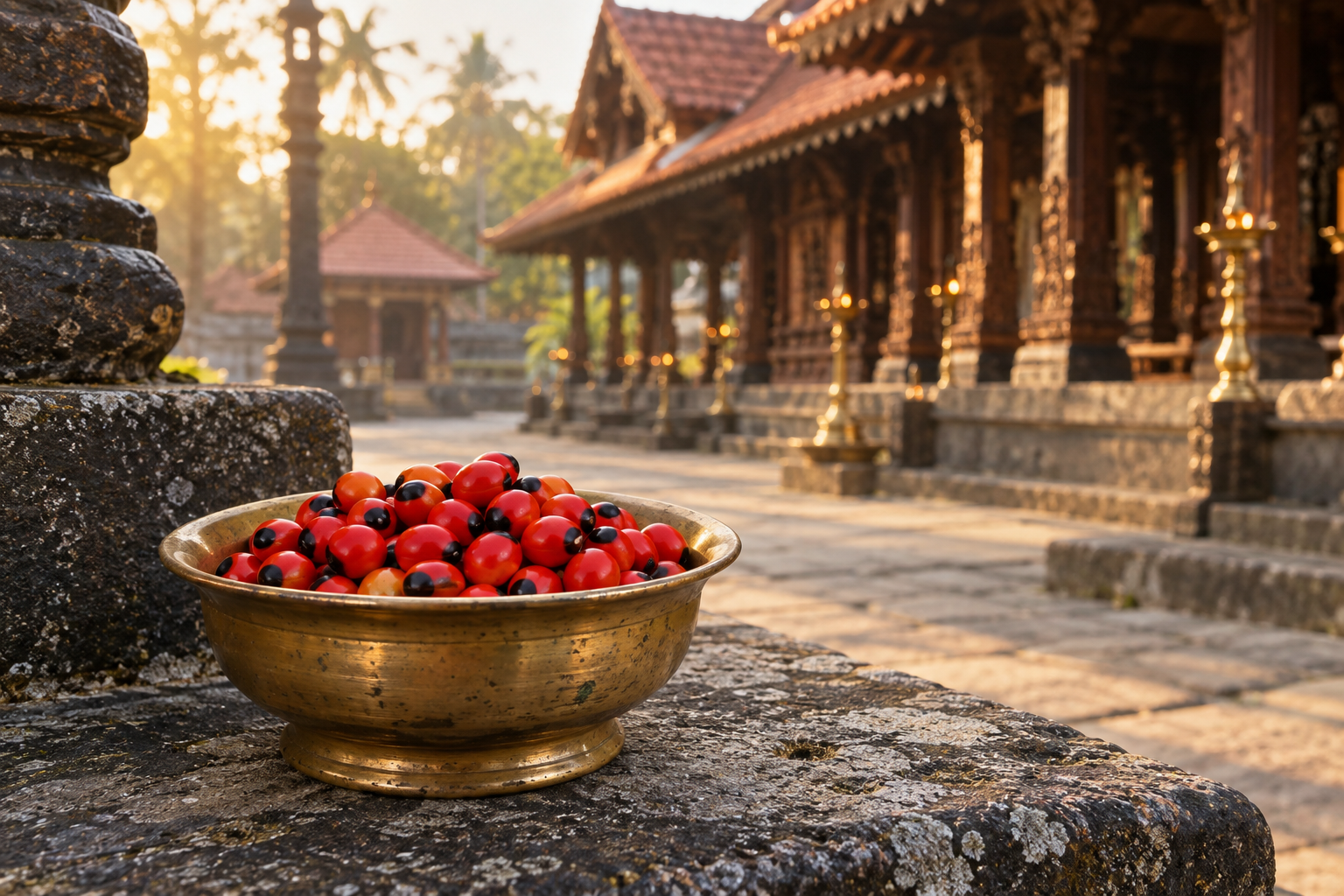
The Vermilion Box (Sindoor Dabi) is a living symbol of Goddess Lakshmi’s grace in Hindu homes, especially in Bengal and eastern India. This long-form exploration traces its ritual role in Panchopachara and Shodashopachara, its association with the sacred feminine, and its regional craft vocabularies. Readers learn how red—through kumkum or sindoor—visualizes ethical prosperity, and how…
-
Overcoming Egoism and Lethargy in Kali-Yuga: Bhagavad Gita Guidance for Humility and Seva

Egoism and lethargy are two subtle forces that derail spiritual progress in Kali-Yuga. Drawing on Bhagavad Gita teachings and parallel insights from Buddhism, Jainism, and Sikhism, this article explains how false ego (ahankara) reframes practice around I and mine, while tamasic inertia fosters delay and neglect. It then offers an integrated, practical program that combines…
-
Unshakable Safety in Saranagati: Why Krishna’s Protection Surpasses All Obstacles

This essay examines the Vaishnava doctrine of saranagati—surrender to Krishna—as an intellectually rigorous and ethically disciplined path to unshakable protection. Anchored in Bhagavad Gita assurances (4.11, 9.22, 18.66) and illuminated by case studies such as Gajendra, Draupadi, Prahlada, and Govardhana, it shows how divine shelter operates within, not outside, responsible agency. The six limbs of…
-
Mastering Bhakti Yoga: How Loving Krishna Transforms Stress into Unshakable Peace

Bhakti yoga reframes modern stress by transforming daily work into purposeful seva anchored in Bhagavad Gita teachings. Regulated living in eating, sleep, speech, and activity cultivates sattva and aligns with contemporary research on circadian health. Japa and kirtan enhance attentional control and calm the nervous system, supporting wiser choices in work and relationships. A practical…
-
Jnana–Karma Samuccaya Vada in Vedanta: Unifying Knowledge and Action on the Path to Moksha

Jnana Karma Samuccaya Vada explains how knowledge (jnana) and action (karma) can operate together on the path to moksha without diluting the distinctive role of each. Drawing on the Bhagavad Gita, Brahma Sutra, and classical Vedanta, it clarifies why Advaita treats karma as preparatory, how Bhedabheda argues for a robust synthesis, and how Vishishtadvaita and…
-
From Reactivity to Freedom: Dharmic Wisdom on Maya, Attention, and Inner Mastery

Modern life conditions people to react incessantly; dharmic traditions explain this reflex as a misperception of appearances—Maya in Hinduism, avidyā and dependent origination in Buddhism, mithyātva and kashāyas in Jainism, and the pull of Maya away from Naam in Sikhism. Rather than denying experience, these lineages teach methods to recalibrate perception and lengthen the gap…
-
June 4, 2026 Panchang (IST): Clear Tithi Timings, Auspicious Windows, Nakshatra & Rashi Guidance

Thursday, 4 June 2026 (IST) features Krishna Paksha Chaturthi until 20:25 IST, after which Krishna Paksha Panchami begins. This guide explains how tithi boundaries are calculated, why they can fall at any time, and how to use them for planning. It outlines proven methods for deriving Abhijit Muhurat, Brahma Muhurta, Rahu Kalam, Yamaganda, Gulika Kala,…
-
Does Time Flow or Does Space Evolve? A Profound Reconciliation of Relativity and Dharmic Wisdom

This comprehensive analysis reconciles a popular paradox: modern physics is said to claim that time changes while space is constant, whereas ancient dharmic texts appear to say the opposite. Clarifying the science, general relativity treats spacetime as dynamic, with evolving spatial geometry and observer-dependent time. Clarifying the traditions, Hindu, Buddhist, Jain, and Sikh sources distinguish…
-
Vaidyo Narayano Harihi Explained: Sacred Medicine, Divine Healer, and Dharmic Healthcare Ethics

‘Aushadhi Jahnavi Toyam Vaidyo Narayano Harihi’ teaches that medicine should be received as sacred like Ganga’s waters and the physician honored as an instrument of Narayana. The phrase aligns with Ayurveda’s chikitsa chatushpada, where physician, medicine, attendant, and patient together determine outcomes. By sacralizing treatment, patients cultivate trust and clarity, which modern psychoneuroimmunology suggests can…
-
Is the Universe an Illusion? A Rigorous Vedic Guide to Maya, Vedanta, and Liberation

Vedic scriptures call the world an “illusion” not to deny its existence, but to redefine reality with precision. Advaita Vedanta distinguishes absolute reality (Brahman) from empirical, dependent reality (the cosmos as mithyā) and explains how māyā and avidyā generate the appearance of multiplicity. Upanishadic teachings, supported by the Bhagavad Gita, show why the world is…
-
End Painful Relationship Cycles: A Science-Backed, Dharmic Blueprint for Safe, Lasting Love

This research-informed reflection maps how repeating relationship patterns emerge and how they can be interrupted with awareness, boundaries, and compassionate practice. It explains the mechanics—attachment templates, intermittent reinforcement, people-pleasing, and nervous system dysregulation—through accessible, real-world moments. Practical micro-interventions are offered, including journaling, emotion labeling, assertive “no,” and values-based scheduling of self-expanding activities. A brief, four-step…
-
Work Without Motive: Sri Sri Ravi Shankar on Intuition, Nishkama Karma, and Flow States

This article unpacks the axiom “the best work comes out when you work without any motive” through Sri Sri Ravi Shankar’s description of intuition as a “sudden sprout of thought,” the Bhagavad Gita’s Nishkama Karma, and insights from modern psychology. It distinguishes non-attachment from aimlessness, showing how purpose can remain strong while egoic craving for…
-
Unlocking Innate Bliss: A Cross-Dharmic Guide to the Self and the Veils of Matter

Human beings everywhere seek happiness because, as Vedanta-sutra affirms—anandamayo ‘bhyasat—consciousness is intrinsically blissful. This essay maps the beginning of spiritual knowledge across Hinduism, Buddhism, Jainism, and Sikhism, showing how each tradition diagnoses the veils of matter and mind and prescribes ethical and contemplative methods to remove them. Readers learn the shared language of gross and…
-
Pancha Kosha Demystified: An Upanishadic, Cross-Dharmic Guide to the Five Sheaths and Practice

Pancha Kosha—the Upanishadic model of five sheaths—offers a precise map from gross to subtle embodiment for Yoga, meditation, and Vedantic inquiry. This article clarifies each sheath, explains why some teachers highlight an ecological “first body,” and shows how Pancha Kosha Viveka aligns inner practice with environmental responsibility. It integrates comparative insights from Buddhism, Jainism, and…
-
Asitanga Bhairava Unveiled: Iconography, Mantras, and the Sacred Power of the Golden Lord

Asitanga Bhairava, the Golden Lord of the First Octet, embodies a luminous, eastward guardianship that unites protection with awakening. This long-form exploration decodes his iconography—golden hue, trident, drum, skull-bowl, and threshold placement—so readers can recognize and interpret the form in temples and texts. It clarifies how attributes map to disciplined practice, turning weapons into inner…
-
How One Gita Bridged Burma and New York: A Transformative Journey of Language, Bhakti, and Unity

A real-world case links New York City’s street book distribution to community transformation in Burma (Myanmar) through a single Bhagavad Gita. Burmese doctors, initially drawn by the Dasavatar image that includes Lord Buddha, passed the text to a Hindu colleague aligned with Sankharacharya, and it eventually reached a college student seeking to learn English. Through…
-
Morning Class on SB 10.6.10: Pūtanā, vātsalya-rasa, and the life-changing power of divine grace

Delivered on 27 May 2026, this Melbourne morning class examines Śrīmad Bhāgavatam 10.6.10 within the broader Pūtanā narrative to illuminate how divine grace transforms karma through the aesthetics of vātsalya-rasa. The analysis connects Gaudiya Vedānta insights to the Bhagavad-Gītā’s vision of devotion reshaping destiny. Ethical nuances of intention, compassion, and communal responsibility are explored alongside…
-
Lead with Devotion, Live Unattached: Dhruva Maharaja’s Lessons in Bhagavatam 4.12 (10–16)

Bhagavatam 4.12 (10–16) presents Dhruva Maharaja as a saint-king who unites devotion with rāja-dharma, demonstrating how to lead decisively while remaining inwardly detached. The passage operationalizes the Bhagavad-Gita’s counsel to act and remember simultaneously, turning smaraṇaṁ into a discipline that purifies action at its source. Readers gain a practical, stepwise protocol—establish attention with śravaṇa-kīrtana, return…
-
Azhwars and Ramanujacharya: Timeless Bhakti, Living Vedanta, and the Path of Grace

This comparative study explores how the Azhwars and Ramanujacharya jointly shape the Sri Vaishnava tradition by uniting ecstatic devotion with systematic Vedanta. It situates the Azhwars’ Divya Prabandham and Ramanuja’s Viśiṣṭādvaita within one inclusive, Ubhaya Vedanta canon that values both Tamil and Sanskrit revelation. Readers gain a clear map of similarities—Vishnu’s supremacy, Sri’s compassion, bhakti…