-
Guard Your Mind: ‘Wicked Company’ Beyond People and the Power of Satsanga

Hinduism teaches that “wicked company” is not limited to immoral people; it includes any influence—media, habits, spaces, and routines—that disturbs clarity and weakens ethical resolve. This piece clarifies the concepts of satsanga and asatsanga and shows how association functions as a practical psychology of liberation across Hinduism, Buddhism, Jainism, and Sikhism. Readers gain a clear…
-
Kubera and Pluto Compared: Wealth, Underworld, and Shared Ethics Across Civilizations

This comparative study examines Kubera in Hinduism and Pluto in Roman mythology to show how both embody wealth rooted in the earth and bounded by moral law. It clarifies their distinct roles—Kubera as lord of prosperity and guardian of the north, Pluto as ruler of the underworld—and explains how each tradition links abundance with duty.…
-
Panchapreta Unveiled: Tantric Symbolism of Five Corpses and the Living Power of Shakti

Panchapreta—“the Five Corpses”—is a Tantric teaching that uses paradox to convey a clear metaphysical insight: without Shakti, even exalted divine functions are inert. Framing the Pancha Brahma of creation, preservation, dissolution, concealment, and grace, the image portrays the Goddess as the living Power that animates all forms. Rather than morbid, the “corpse” metaphor is a…
-
Reverence and Bhakti in Practice: H.H. Guru Prasad Swami’s ISKCON Dwarka Teaching on Offense-Free Devotion

H.H. Guru Prasad Swami’s class at ISKCON Dwarka Temple examined a key verse from Sri Caitanya-caritamrita on avoiding offenses to the Lord and the Vaishnavas. The talk explained why offense-free devotion is essential for steady progress in bhakti and spiritual advancement. It modeled reverence for sacred texts—printed and digital—showing how careful etiquette shapes inner life.…
-
WSN October 2025: Powerful Sankirtan Achievements, Temple Leaders, and Global Outreach

WSN October 2025 showcases a strong month of sankirtan outreach, with Mayapur, Mumbai-Juhu, and Los Angeles leading large temples and London-Soho, Bengaluru-South, and Baroda topping the medium category. Atlanta Krishna Life, Surat, and Chandigarh excelled among small centers, while Baltimore, Winnipeg, and Ottawa led the maha-small group. More than 385,000 literatures were distributed, expanding access…
-
Nothing to Lose or Gain: Advaita’s Liberating Insight and Unity of Dharmic Paths

This post explores the Advaita insight that there is nothing to lose or gain because a single, supreme truth pervades all. It shows how this view aligns with the Upanishads and the Bhagavad Gita’s ideal of equanimity. It highlights convergences across Buddhism, Jainism, and Sikhism, emphasizing unity in spiritual diversity. Readers gain practical ways to…
-
Feathers of Wisdom: Timeless Dharmic Lessons on Fierce Love and Graceful Detachment

A parent bird teaching its young to fly offers a vivid lesson in loving deeply while letting go with grace. Viewed through dharmic ethics, the scene reflects Aparigraha, Ahimsa, and Dharma, showing how care and freedom can coexist. Hindu, Buddhist, Jain, and Sikh perspectives converge on this principle through Bhakti and Vairagya, Metta and Upekkha,…
-
When Brahma Created Termites: Vishnu’s Decapitation and the Awe-Inspiring Rise of Hayagriva

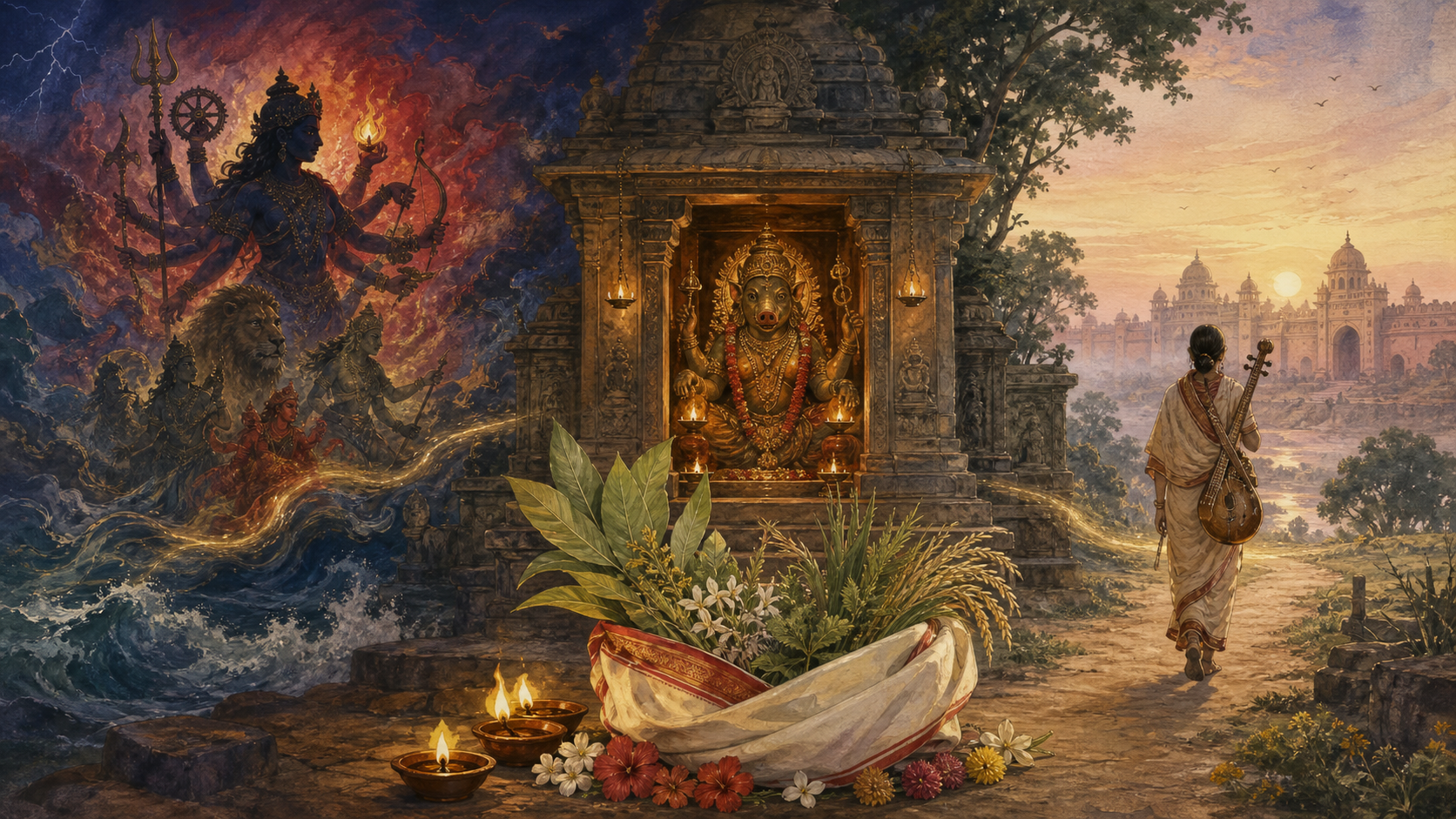
This article explores the Purāṇic narrative in which Brahma creates termites to awaken Vishnu, leading to the unexpected decapitation that culminates in Vishnu’s horse-headed form, Hayagriva. It clarifies major variations found in Hindu scriptures, highlighting how yajna, vigilance, and knowledge restore cosmic order. Readers gain a nuanced, academic account that remains emotionally resonant: small causes…
-
Vaikuntha Ekadashi Upavasam: The Purana Legend, Profound Fasting Benefits, and Dharmic Unity

Vaikuntha Ekadashi Upavasam is revered in the Puranas for its power to purify the heart and deepen devotion to Lord Vishnu. The classic legend of Murasura explains why this Ekadashi fast is considered uniquely transformative. Many devotees report lightness, clarity, and steadier meditation when observing the vrata with a sattvic approach. Temple practices such as…
-
Unlocking Abundance and Serenity: The Profound Significance of Kamalatmika Mahavidya

Kamalatmika Devi, the Kamala Mahavidya, is venerated as a radiant form of Mata Lakshmi who unites prosperity with inner serenity. Her golden iconography—lotuses and gentle elephants—symbolizes purity, auspicious growth, and steady blessings grounded in dharma. In practice, devotees associate her worship with harmonizing Shukra (Venus), especially on Fridays, emphasizing ethical living, charity, and mindful mantra…
-
Dhanu Sankranti 2025: Auspicious Date, Punyakalam Timings Guide, Meaning & Rituals

Dhanu Sankranti 2025 falls on 16 December, marking Surya’s transit into Dhanu Rashi and the start of Dhanurmasam. The auspicious Punyakalam and Mahapunyakalam cluster around the exact Sankranti moment, which varies by location and time zone. Readers learn how to determine local Shubh Muhurat via Panchang guidance and how to align pre-dawn worship with Dhanurmasam…
-
Vaikunta Ekadashi 2025 (Mukkoti Ekadashi): Sacred date, regional calendars, rituals, and meaning

Vaikunta Ekadashi (Mukkoti Ekadashi) falls on 30 December 2025, aligning with Margazhi Masam (Tamil), Dhanu Masam (Malayalam), and Paush Month (other regional Hindu calendars). The observance follows standard Ekadashi practices—fasting as health allows, Vishnu Sahasranama, japa, and reflective study. Many temples ceremonially open the Vaikunta Dwaram (Sorga Vasal), offering a powerful symbol of entry into…
-
Bhagavad Gita for Business and Startups: Dharma-Driven Strategies for Ethical, Resilient Growth

The Bhagavad Gita offers a rigorous, purpose-first framework for business development that integrates dharma, Karma Yoga, and Buddhi Yoga into daily leadership. It reframes performance as excellence in process rather than fixation on outcomes, strengthening clarity, resilience, and ethics. Decision-making improves through disciplined discernment, supported by mindfulness and reflective practice. Ethical business—rooted in ahimsa—builds trust,…
-
Lal Kitab Guidance for Shukra in the 4th House: Remedies to Restore Harmony at Home

Lal Kitab views Shukra (Venus) in the 4th house through themes of home, mother, property, and emotional grounding, recommending remedies that are ethical, symbolic, and context-sensitive. Classical notes caution against covering an existing well during construction, a reminder to respect domestic sanctity and natural water sources. Rather than instilling fear, this guidance invites ecological care…
-
Why Imperfect Work Matters: Reclaiming Humanity and Connection in the Age of AI Perfection

Perfectionism intensifies in an AI-driven culture that prizes polish, yet evidence shows imperfection strengthens authenticity and human connection. A simple woodworking example illustrates how visible flaws can signal care, process, and individuality, qualities machines cannot replicate. The most resonant creative outputs are often those nearly withheld for being “not ready,” revealing readiness as a mirage.…
-
From Kurukshetra to Baghdad: Battle‑Tested Gita Wisdom for a Soldier’s Resilience

A vivid account shows how Bhagavad Gita functions as a battle-tested guide for cognition and conduct under fire and in recovery. Arjuna’s Dharma-Sankata and Vishada mirror a soldier’s moral paralysis, reframed through Svadharma and Apad-Dharma to enable ethical action. In deployment, Karma Yoga becomes practical: act fiercely without attachment to violence, to safeguard Dharma. Post-deployment,…
-
When Nature Seems Cruel: Dharmic Insights on Karma, Order, and Compassionate Living

Nature can feel harsh—earthquakes, storms, and predation challenge the heart and mind. Dharmic traditions explain these realities through r̥ta, karma, pratityasamutpada, Anekantavada, and hukam, framing the world as an interdependent order rather than random cruelty. This perspective affirms compassion and service: reduce suffering, strengthen disaster resilience, and care for ecosystems. It also cautions against romanticizing…
-
Who Created Brahma? Unveiling Devi, the Supreme Mother and Cosmic Source of All

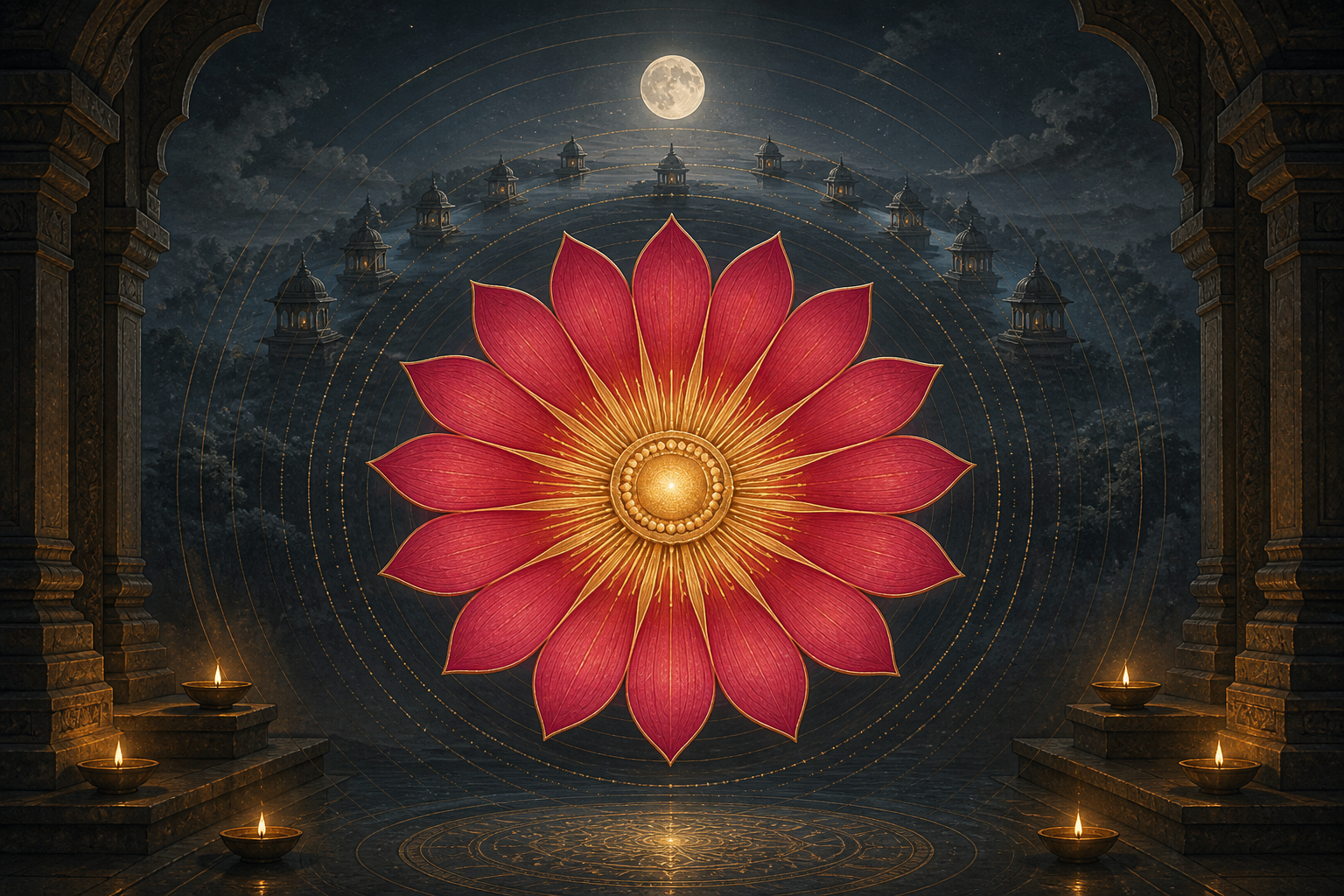
Hindu cosmology addresses the classic question—who created Brahma?—by pointing to Devi, the Divine Mother, as the primordial creative potency (Shakti) behind all manifestation. Purāṇic narratives and Vedic philosophy converge on a hierarchy of emanation rather than a simplistic creator-of-creator chain. Symbols like the lotus and the Śri Yantra, and texts such as the Devi Mahatmya…
-
When Srila Prabhupada Met Allen Ginsberg: A Transformative Kirtan at Ohio State University

A rare joint program at Ohio State University brought Srila Prabhupada and Allen Ginsberg onto the same stage, drawing a crowd of about 2,000. An eyewitness recalls Srila Prabhupada’s striking humility toward Sriman Allen Ginsberg before the program, setting a respectful tone of dialogue. Ginsberg’s bohemian reflections contrasted with traditional parampara, highlighting the breadth of…
-
Astonished in Vrndavan: Uddhava’s Joy and the Power of Spontaneous, Selfless Bhakti

Uddhava’s experience in Vrndavan illustrates how pure bhakti evokes both astonishment and deep joy. The mood of Vrndavan centers on a natural, spontaneous attraction to Krsna, where each devotee’s unique offering coexists without rivalry or hierarchy. This non-competitive spirit models unity without uniformity and aligns with the shared values of dharmic traditions. It offers a…