-
Society, Friendship, and Love: Unmasking Maya and Embracing Dharmic Unity

This reflection clarifies why Srila Prabhupada described “Society, Friendship and Love” as a gift of maya when driven by clinging, not by dharma. It explains maya as misidentification with roles and relationships, then shows how Hinduism, Buddhism, Jainism, and Sikhism converge on transforming attachment into compassionate engagement. Readers gain a practical framework—seva, satsang, japa or…
-
Ego and the Vast Cosmos: A Dharmic Reflection on Humility, Unity, and Inner Freedom

This reflection explores how Hindu philosophy situates ahankara (ego) within the vast Brahmanda, revealing the fragility of pride and the wisdom of non-attachment. It connects Vedantic insights with parallel teachings in Buddhism, Jainism, and Sikhism, emphasizing a shared dharmic commitment to humility, compassion, and Aparigraha. Readers gain practical pathways—japa, pranayama, dāna, mettā, Naam Simran, and…
-
The Divine Paradox of Ganesha on a Mouse: Transformative Symbolism to Conquer Ego

The iconic image of Lord Ganesha seated on a small mouse conveys a profound lesson: wisdom governs and transforms ego rather than destroying it. In Hindu symbolism, Ganesha embodies discernment while the mouse represents restless impulses, illustrating mastery of mind through knowledge. This insight harmonizes with Buddhist mindfulness, Jain aparigraha, and Sikh teachings on overcoming…
-
Experience the Divine Everywhere: Applying Bhagavad Gita Wisdom in Everyday Life
Bhagavad Gita teaches that the Divine pervades all, and this can be experienced through a disciplined union of Bodha (insight) and Vyavahara (lived practice). A simple, relatable analogy—the house of wooden objects—shows how shared essence and distinct functions coexist. Practical methods such as mindful breathing, silent japa, and small acts of seva make awareness tangible…
-
Tara Devi Mahatmyam: Fear-Dispelling Power and Cross-Traditional Significance of Tara Mahavidya
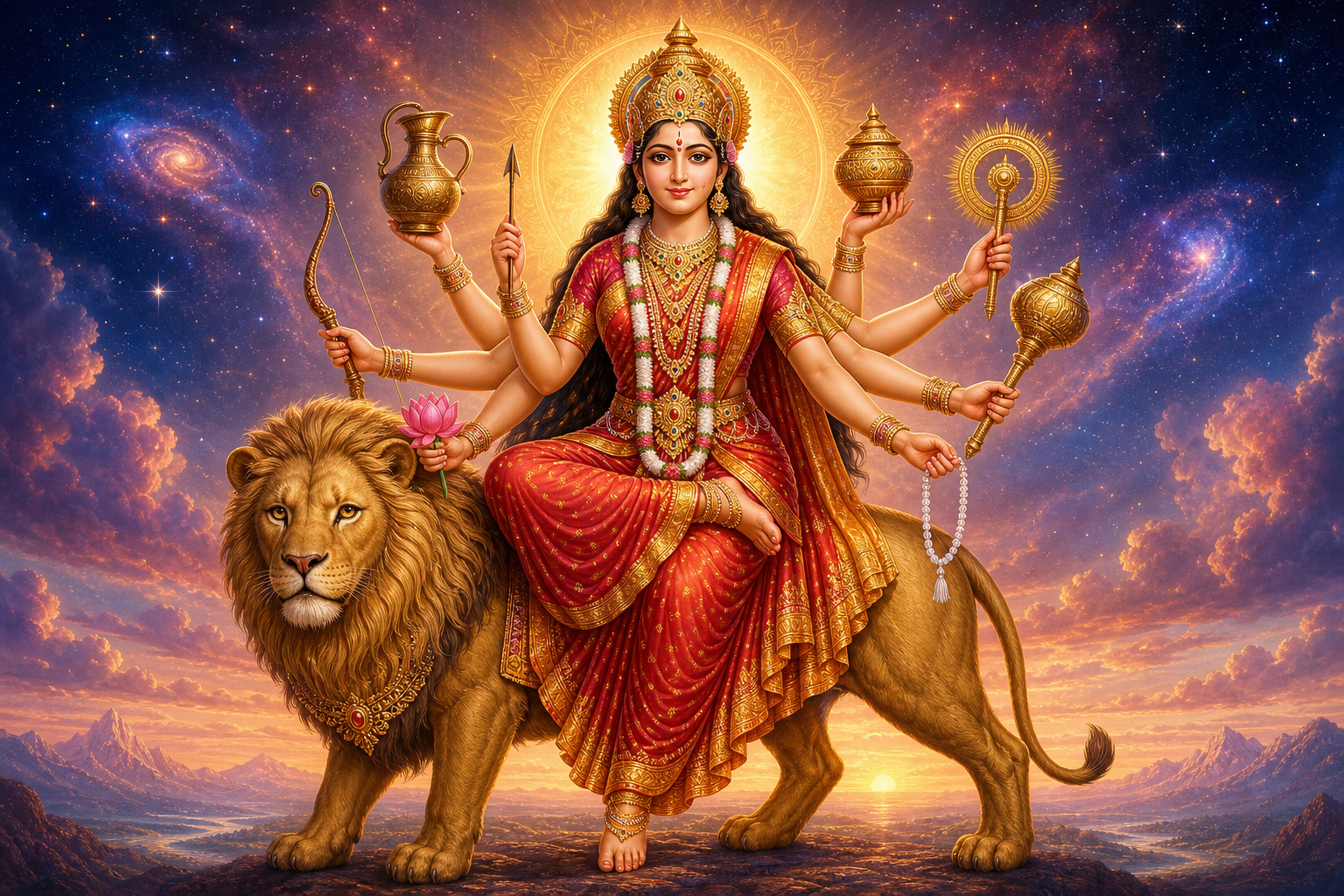
Tara Devi, one of the Dasamahavidyas and a manifestation of Durga Devi, is honored for fear-dispelling power and liberating wisdom. The Adbhuta Ramayana recalls Tara within the Goddess’s cosmic play, celebrated after Kali’s defeat of a powerful asura. Shakta Tantra presents Tara as both fierce and compassionate, associated with insight (jnana), transcendent speech (vak), and…
-
Anagha Devi, Shakti of Lord Dattatreya: Radiant Grace of the Divine Mother

Anagha Devi is honored as the Shakti of Lord Dattatreya, radiating the Divine Mother’s compassionate energy in the Datta tradition. Her iconography—especially the vessel of divine nectar and luminous countenance—symbolizes healing, insight, and protection. The name “Anagha,” meaning “stainless,” points to an ethical ideal that inspires purity of intention and dharmic conduct. Devotional practice emphasizes…
-
Matangi Mahatmyam: Unlocking Matangi Mahavidya’s Blessings for Wisdom, Music, and Protection

Matangi Mahatmyam presents Matangi Mahavidya as a unifying synthesis of Parvati’s protective grace and Saraswati’s luminous wisdom. Venerated for education, music, knowledge, and courage, Matangi guides seekers toward clarity, refined speech, and ethical action. Devotees commonly report enhanced focus, creativity, and calm through steady remembrance, study, meditation, and music. The Devi’s blessings are associated with…
-
Shiva’s Calm Power: Patience and Compassion as a Motivating Force for Dharmic Life

Lord Shiva, revered in Shaivism as a supreme and guiding presence, embodies calmness, patience, and compassion that motivate ethical living and inner transformation. While his fierce aspect is often emphasized, scriptural narratives highlight Ashutosh—“easily pleased”—whose impartial grace extends even to antagonists, inviting self-correction and growth. Contemplating Shiva’s meditative stillness helps transform anger into tapas and…
-
Rama’s Darbha Sayana: Sacred Patience and Yoga Nidra Before Crossing the Ocean

This post explores Darbha Sayana Murthy, the Ramayana moment when Sri Rama, seeking to cross the ocean to Lanka, prays to Varuna and rests in Yoga Nidra on a bed of darbha grass. Readers learn the ritual significance of darbha (kusa) in Vedic practice and how Yoga Nidra symbolizes restful awareness and ethical clarity. The…
-
Dhanurmasam 2025–2026 (Margazhi): Auspicious Dates, Rituals, and a Sacred Dawn Guide

Dhanurmasam (Margazhi) in 2025–2026 begins on 16 December 2025 with Dhanur Sankramanam and concludes on 14 January 2026 at Makara Sankranti. The month is traditionally revered in the Vaishnava tradition for predawn worship, Tiruppavai recitation, and disciplined devotional practice. Across Tamil regions, Margazhi also highlights kolams, bhajans, Arudra Darshan, Pavai Nombu, and Katyayani Vratam. The…
-
Vritrasura Samhara Murthy: Indra’s Vajrayudha, Dharma, and the Defeat of Obstruction

Vritrasura Samhara Murthy honors Indra’s decisive victory over Vritrasura with the Vajrayudha and the restoration of dharma. The narrative portrays Vritra as a symbol of obstruction and Indra as a restorer of cosmic order. Read through a dharmic lens, this tale aligns with Buddhist, Jain, and Sikh teachings on overcoming inner afflictions and ego. The…
-
Dec 16, 2025 Panchang: Krishna Paksha Dwadashi Timings, Auspicious Muhurat, Ritual Insights

December 16, 2025 falls on Krishna Paksha Dwadashi in the Daily Hindu Calendar, lasting all day until 12:17 AM on December 17, when Krishna Paksha Trayodashi begins. The day supports gentle rituals, parana for those who observed Ekadashi, and acts of charity. Readers gain clear tithi timings for planning puja and family observances with confidence.…
-
Mahant Mukesh Nath Reaffirms Sanatan Dharma’s Timeless Power and Dharmic Unity in Udaipur

Delivered in Udaipur on Dec 09, 2025, the address by Mahant Mukesh Nath Maharaj reaffirmed Hindutva as the living expression of Sanatan Dharma—an inclusive civilizational ethos rooted in dharma, ahimsa, karuna, and seva. The message emphasized unity among Hinduism, Buddhism, Jainism, and Sikhism, highlighting shared ethical foundations that strengthen religious pluralism in India. By linking…
-
Stay Compassionate Without Self-Destructing: Evidence-Based Boundaries for Toxic Relationships

Kindness can coexist with clear boundaries. This analysis presents a real-world scenario in which compassion collided with chronic disrespect, and it distills four practical lessons for maintaining empathy without enabling toxic behavior. It explains why transactional kindness backfires, how kindness functions as an expression of identity, and when withdrawing or pausing generosity is both healthy…
-
Jatamandala: Unlocking the Sacred Halo of Shiva’s Locks and Dharmic Cosmic Symbolism

Jatamandala, from Sanskrit “jata” (matted hair) and “mandala” (circle), is a defining feature of Lord Shiva’s iconography that represents concentrated spiritual energy and cosmic order. Seen most vividly in Nataraja bronzes and paintings, it encircles the head like a radiant halo and anchors attributes such as the crescent moon and the descent of the Ganga.…
-
Ashtavakra’s Quiet Revolt Against Hustle Culture: Timeless Dharmic Wisdom for Inner Freedom

This essay explores how Ashtavakra’s Advaita teaching offers a precise, compassionate alternative to hustle culture. Rather than glorifying strain, the Ashtavakra Gita centers the unchanging witness (atman), enabling action without anxiety and excellence without exhaustion. The discussion connects this orientation to shared principles across Buddhism, Jainism, and Sikhism—mindful awareness, aparigraha, anekāntavāda, Naam Simran, and seva—highlighting…
-
From Flight to Fortitude: Prince Uttara’s Mahabharata Lesson on Pride, Guidance, and Courage

Prince Uttara’s story in the Mahabharata reveals how fear can yield to courage when guided by humility and mentorship. Set during the Virata Parva, the episode exposes the brittleness of pride built on bravado and the strength that comes from accepting instruction. Brihannala (Arjuna in disguise) reframes crisis as training, modeling the guru–shishya ethos. The…
-
Paryavartanakam Explained: Hinduism’s Warning Against Denying Food and the Power of Compassion

Paryavartanakam, described within Hindu ethical thought, warns against the grave act of denying food to the hungry and elevates anna-dāna as sacred duty. Purāṇic narratives such as those in the Garuḍa Purāṇa frame Naraka as a mirror of karmic consequence, not mere punishment. This teaching aligns with a wider dharmic consensus: Buddhist dāna, Jain ahiṃsā…
-
Srila Prabhupada’s Kolkata–Nabadwip Journey: Moving Lessons in Bhakti, Safety, and Dialogue

This account, as narrated by H.G. Kusha Mataji, revisits Srila Prabhupada’s December 7 journey through Kolkata and Nabadwip, highlighting devotion, safety, and respectful dialogue amid bustling Indian rail travel. It shows how Achyutananda and Ramanuja exemplified the Guru–Shishya Relationship through attentive, practical care. A courteous philosophical exchange with Bengali gentlemen models reasoned, compassionate discourse rooted…