-
From Suffering to Serenity: Hindu Wisdom on Impermanence through a Cosmic Lens

This essay explores how Hindu philosophy, in conversation with Buddhism, Jainism, and Sikhism, reframes suffering through the recognition of impermanence and the expansion of consciousness. It explains how Avidya and Maya narrow attention to transient desires and how practices like dhyana, pranayama, Karma Yoga, and Bhakti restore clarity. Drawing on the Upanishads and the Bhagavad…
-
Rama–Sita and Shiva–Shakti: Sankhya’s Purusha–Prakriti and the Promise of Wholeness

Sankhya’s vision of Purusha (consciousness) and Prakriti (primordial nature) is illuminated by the sacred unions of Rama–Sita and Shiva–Shakti. These symbols present wholeness as a harmonious interplay rather than a clash of opposites. The essay connects Ardhanārīśvara, Maryāda-Puruṣottama, and Shakti’s resilience to psychological integration and ethical balance. Parallels from Buddhism (prajñā–upāya), Jainism (jīva–ajīva and the…
-
Break Free from Social and Religious Guilt: Dharmic Wisdom for Calm, Authentic Living

This article examines how Dharmic wisdom helps individuals release social and religious guilt without rejecting tradition. It explains how context-sensitive dharma and intention (bhava) guide ethical choices more reliably than fear-driven conformity. Drawing on Hinduism, Buddhism, Jainism, and Sikhism, it highlights inclusive practices such as karma yoga, mindfulness, pratikraman, ahimsa, ardas, and seva. Readers learn…
-
Living Liberation Now: Hindu Moksha (Jivanmukti) and Parallels in Buddhism, Jainism, Sikhism

Hindu thought presents moksha as jivanmukti—liberation achievable in this lifetime—grounded in the Upanishads and the Bhagavad Gita. This living freedom is described as a state beyond pleasure and pain, where equanimity and compassion guide daily action. Multiple pathways—jnana, bhakti, karma, and raja yoga—offer complementary means to stabilize insight. The vision aligns with dharmic parallels: Buddhist…
-
Shiva Needs Shakti: Devi Upanishad’s Powerful Lesson on Consciousness and Energy

The Devi Upanishad teaches that Shiva (pure consciousness) and Shakti (dynamic energy) are inseparable, revealing that true power arises from their sacred union. This insight reframes metaphysical power as integrative, not hierarchical: awareness without energy remains inert, and energy without awareness lacks direction. Everyday experience reflects this balance, where clarity must meet purposeful action to…
-
Beyond Labels: Why Modern Identity Feels Hollow—and Dharmic Wisdom to Reclaim Self

Modern life intensifies an identity crisis by tying self-worth to body, mind, and social labels that constantly change. Dharmic traditions respond with a unifying insight: mistaking transient attributes for the true self leads to instability and division. Vedanta, Buddhism, Jainism, and Sikhism differ in doctrine yet converge on loosening attachment to narrow identities. Practical disciplines—mindfulness,…
-
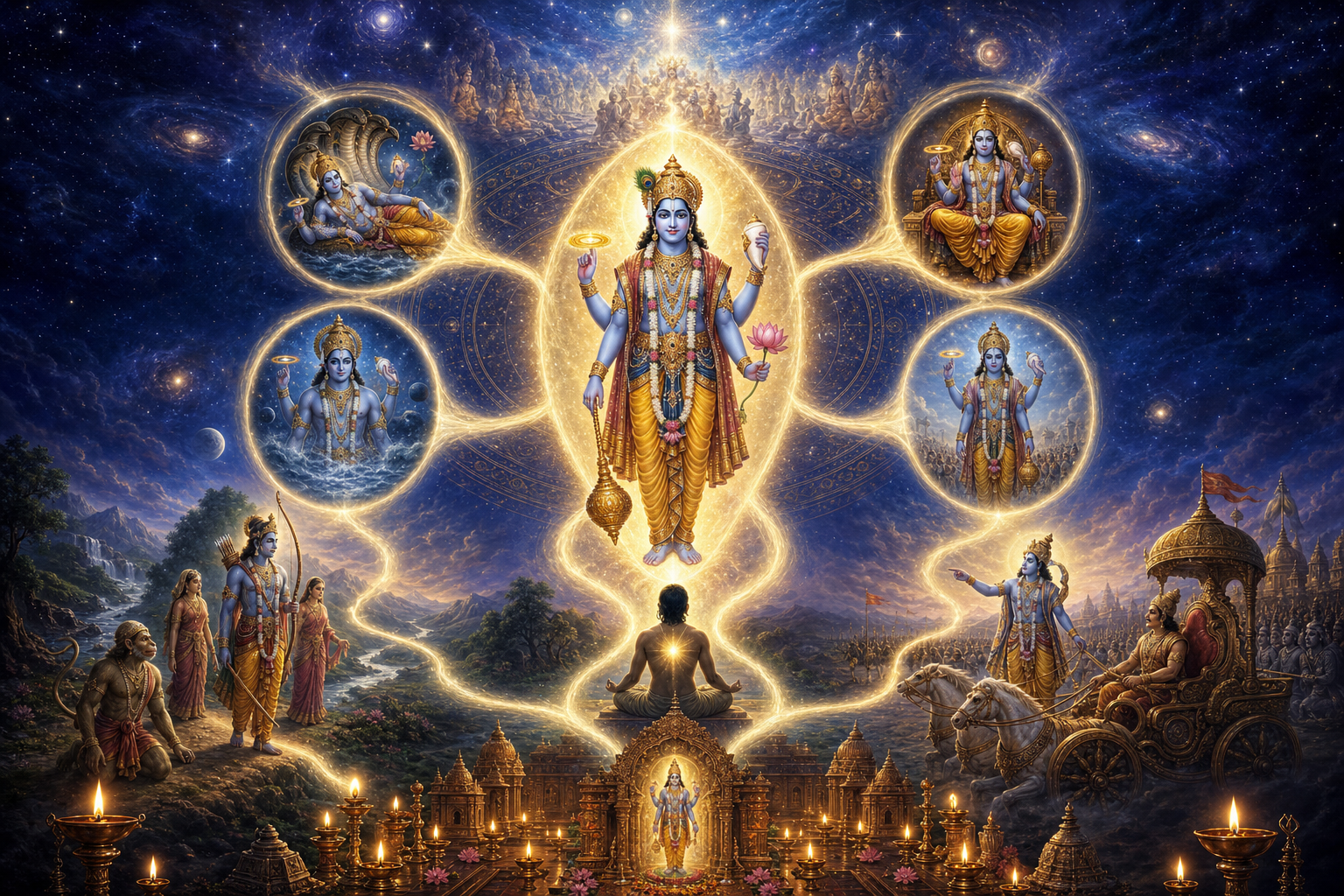
Supersoul and Free Will: How Krishna Guides Choices, Karma, and Spiritual Growth

Hindu philosophy holds that Krishna as the Supersoul (Paramatma) guides from within while fully honoring human free will. When intentions lean toward material aims, inner guidance equips practical intelligence for success, while karmic responsibility remains. When the focus turns spiritual, discernment and compassion deepen, aligning choices with dharma and lasting well-being. Practices across dharmic traditions—japa…
-
Dhritarashtra’s Locked Room: A Powerful Dharmic Lesson on Attachment, Denial, and Freedom

The Mahabharata’s portrait of Dhritarashtra reveals how attachment (moha) and denial create a self-made prison that undermines ethical judgment. This analysis clarifies the difference between ignorance and active refusal to see, mapping the locked-room metaphor onto everyday life, leadership, and responsibility. It highlights convergence across Hinduism, Buddhism, Jainism, and Sikhism on freeing oneself from clinging…
-
Jnana vs. Karma in Hinduism: How Knowledge and Selfless Action Unite on the Path to Moksha

Hindu philosophy does not set Jnana Yoga and Karma Yoga in opposition; it unites them. Knowledge clarifies purpose, while selfless action purifies the mind—together advancing dharma and moksha. The Bhagavad Gita models this synthesis, showing how insight and responsibility reinforce each other. Household duties, honest work, and seva become extensions of spiritual practice when guided…
-
Across Lifetimes: Hindu Dharma on Reincarnation, Karma, and the Healing Art of Letting Go

This essay presents a clear, academically grounded account of Hindu teachings on reincarnation (samsara), karma, and moksha, showing how death functions as a transition rather than an end. Scriptural perspectives from the Upanishads and the Bhagavad Gita frame the atman as enduring across lifetimes. The discussion explains karma as a moral law that affirms agency,…
-
Pasha and Ankusha in Hindu Iconography: Powerful Symbols of Guidance and Restraint

Hindu iconography uses the pasha (noose) and ankusha (elephant goad) to teach a complete ethic of spiritual control—restraining harm while guiding the seeker toward dharma. The pasha symbolizes compassionate containment and moral accountability; the ankusha conveys gentle yet firm redirection of mind and senses. Grounded in Āgamic, Purāṇic, and Śilpa-śāstra traditions, these attributes appear with…
-
Iccha Mrityu in Hinduism: The Awe-Inspiring Power to Choose Death with Conscious Grace
Iccha Mrityu—“death by will”—is a profound Hindu concept linking ethical living, yogic mastery, and fearless acceptance of mortality. The Mahabharata’s account of Bhishma illustrates this ideal with clarity and dignity. Rather than endorsing self-harm, texts frame conscious dying as a rare fruit of disciplined practice and deep realization. Parallels across dharmic traditions—Buddhist parinirvana, Jain Sallekhana,…
-
Protect Your Sacred Energy: Hindu Wisdom to Resist Attention Hijacking in the Digital Age
Ancient Hindu concepts such as prāṇa, indriya-nigraha, pratyāhāra, and dhyāna provide a clear framework to understand how the attention economy drains energy and clarity. Read with Buddhist sati, Jain samayik, and Sikh simran, these ideas form a unifying dharmic ethic that protects attention as sacred. The article outlines practical, low-friction habits—breath-before-click, notification pruning, device-free zones,…
-
Harihara’s Sacred Synthesis: Uniting Vishnu and Shiva as a Living Symbol of Oneness

Harihara, the composite form of Vishnu (Hari) and Shiva (Hara), embodies Hinduism’s profound principle of unity in diversity. Its iconography fuses preservation and transformation, offering a clear ethical model: protect what is essential while courageously renewing what has run its course. The image resonates with non-dual insights, Bhakti devotion, and plural worship centered on Ishta,…
-
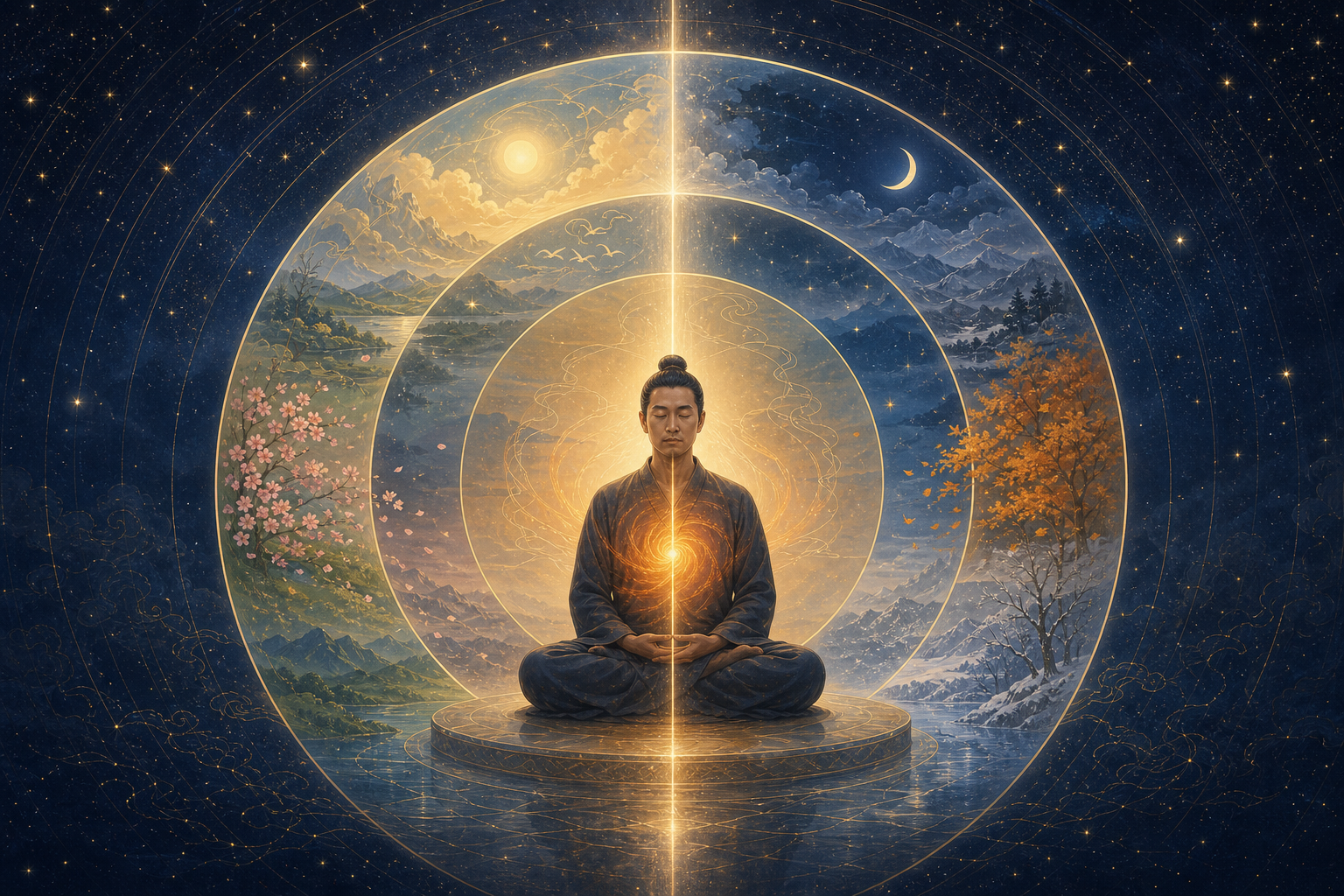
Kalachakra in Pancaratra: Decoding Vishnu’s Six-Spoked Wheel of Time and Cosmic Order

This article explores Kalachakra—the six-spoked wheel of time—in the Pancaratra teachings of Vaishnavism, showing how it frames time as a sacred, ordered reality upheld by Bhagavan Vishnu. It explains how the spokes are read through six seasons, six transformations, or six existential waves, each illuminating the rhythm of change and renewal. The piece outlines Pancaratra’s…
-
Chaitanya Mahaprabhu’s Bold Science of Consciousness: Ending Ego’s Grip and Social Strife

This essay presents Sri Chaitanya Mahaprabhu’s rigorous analysis of consciousness as a practical science aimed at social harmony. It identifies ahankara—misidentification of self with matter—as the root cause of unrest, not a mere symptom. Drawing on Sri Brahma Samhita and the Bhagavatam, it situates the problem and solution within Vedic philosophy. It then shows how…
-
Leave Work at Work: Dharma, Vairagya, and Peaceful, Sustainable Work‑Life Balance in Hindu Thought

Leaving work at work reflects the Hindu synthesis of dharma and vairagya: act with full integrity, then release attachment to results. Grounded in Bhagavad Gita 2.47 and Karma Yoga, it cultivates mental clarity, prevents burnout, and improves ethical decision-making. Simple rituals—end-of-day summaries, mindful commutes, brief pranayama, and digital sunsets—reduce rumination and restore balance. The insight…
-
Reclaim Consciousness with Timeless Hindu Wisdom: Upanishadic Insights for a Unified Dharma

Hindu philosophy presents consciousness as the essence of existence, summarized by the Mandukya Upanishad’s “Ayam atma brahma.” This post clarifies how witnessing awareness (sakshi) and the four states culminating in turiya offer a practical framework for modern life. It outlines accessible methods—pranayama, mantra japa, and meditation—to improve focus, emotional balance, and resilience. Ethical foundations (yama…
-
Guard Your Mind: ‘Wicked Company’ Beyond People and the Power of Satsanga

Hinduism teaches that “wicked company” is not limited to immoral people; it includes any influence—media, habits, spaces, and routines—that disturbs clarity and weakens ethical resolve. This piece clarifies the concepts of satsanga and asatsanga and shows how association functions as a practical psychology of liberation across Hinduism, Buddhism, Jainism, and Sikhism. Readers gain a clear…
-
Mahabharata’s Hidden Heroes: Shadow Diplomats, Espionage, and Dharma in Ancient Bharata

This exploration of the Mahabharata uncovers a disciplined intelligence culture—spies, envoys, and shadow diplomats—operating within a clear ethical framework. It highlights how Vidura-niti and Udyoga Parva illustrate protocols for reconnaissance, negotiation, and moral restraint. Readers gain insights into how Sri Krishna’s Diplomacy prioritized peace through precise knowledge and timing. The narrative shows intelligence as a…