-
From Restless Longing to Inner Guru: Bridging the Finite Self and the Infinite in Kali Yuga

This long-form exploration presents a clear, academic guide to bridging the finite self and Infinite Reality in Kali Yuga through the Inner Guru, or antaryāmin, while honoring unity among Hinduism, Buddhism, Jainism, and Sikhism. It integrates the Bhagavad Gita’s Karma, Bhakti, Jñāna, and Rāja Yoga with cross-traditional practices like ethical steadiness, meditation, mantra-japa, and seva.…
-
Why Shiva Rarely Holds the Lotus: Decoding Shaiva Iconography, Vairagya, and Dharmic Harmony

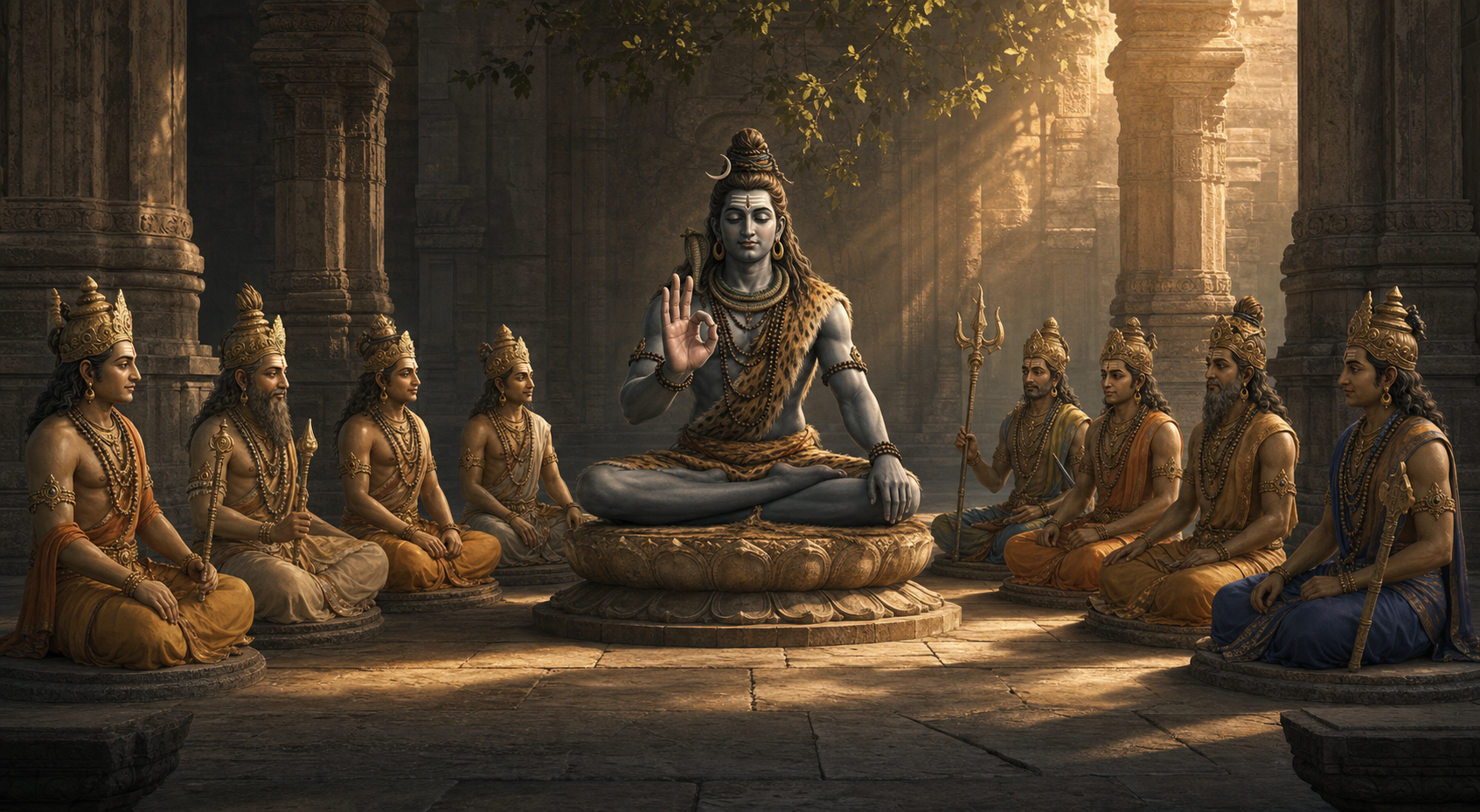
The lotus dominates Indic sacred art, yet Shiva is rarely defined by it. This essay explains why by tracing Shaiva iconography prescribed in Agamas and Shilpa Shastras, where trishula, damaru, vibhuti, rudraksha, Nandi, and the aniconic linga carry the core theological message. It contrasts the lotus’s semantics of purity, abundance, and preservation—with Vishnu, Lakshmi, and…
-
Beyond Death’s Arrow: How Arishtanemi’s Tapas in the Mahabharata Reveals Deathless Dharma

This essay examines how the Mahabharata’s doctrine of tapas frames spiritual discipline as “divine protection,” reading the image of going beyond death’s arrow as a technical claim about fearlessness and clarity. It situates Ariṣṭanemi (Neminātha in Jain tradition) within a shared Dharmic milieu, linking ahiṃsā and aparigraha to the epic’s tapas-centered ethic. Drawing on Shanti…
-
Are Animals and Plants Free from Karma? A Dharmic Deep Dive into Choice and Consciousness

Do animals and plants accrue karma like humans? This comprehensive, dharmic analysis explains why many Vedantic interpretations hold that animals and plants seldom generate fresh, morally binding karma, while humans—endowed with reflective awareness—carry heavier responsibility. It synthesizes perspectives from Hinduism, Buddhism, Jainism, and Sikhism, showing a shared insight: karmic weight scales with intention and choice.…
-
Skull Symbolism in Tantra: Decoding Kali, Bhairava, Chinnamasta to Cut Through Ego and Fear

Skull imagery in Tantric art is often misunderstood as morbid when it functions as a precise spiritual pedagogy that cuts through ego, pride, and pretension. This long-form analysis decodes the kapala, mundamala, and self-decapitation motifs across Shiva, Bhairava, Kali, and Chinnamasta, and situates them within the historical currents of Shaiva–Shakta Tantra and Vajrayana Buddhism. The…
-
Shattering the Illusion of Chains: Advaita Vedanta’s Guide to the Ever‑Free Self
Advaita Vedanta proposes a radical clarity: in ultimate truth there is neither bondage nor liberation; the Self (Atman) is ever-free, and only ignorance creates the sense of captivity. This article explains the logic of avidya and adhyasa, distinguishes empirical from absolute perspectives, and shows how moksha functions as recognition rather than attainment. Drawing on the…
-
Draupadi’s Two Boons and a Refusal: Dharma’s Quiet Triumph over the Kuru Court in the Mahabharata

The Dyuta Sabha in the Mahabharata showcases Draupadi’s precise ethical reasoning and strategic restraint: she accepts two boons from Dhritarashtra to restore the Pandavas’ freedom and dignity, then refuses a third to avoid greed. This analysis clarifies the legal-dharmic core of her challenge to the Kuru court—capacity and consent—while situating the episode in Sabha Parva…
-
Decoding ‘nirvisesa-sunyavadi-pascatya’: healing impersonalism and honoring dharmic unity

The phrase “nirvisesa-sunyavadi-pascatya” is re-examined here through a unifying, academically grounded lens that emphasizes healing relational impersonalism rather than targeting fellow dharmic traditions. Readers gain a clear philological and historical context for the phrase alongside an inclusive account of Advaita’s nirvisesha and Buddhism’s sunyata. The analysis distinguishes metaphysical methods from interpersonal attitudes, showing how personalism…
-
Beyond Temple Walls: Powerful Lessons on Sadhana, Seva, and Guru-Dharma Across Dharmic Traditions

A historic 1983 letter read in the Dallas temple frames the temple as a training ground, not a compulsory residence, affirming that disciplined sadhana and seva can flourish inside or beyond ashram walls. Placed in a broader Dharmic context—Hinduism, Buddhism, Jainism, and Sikhism—the message supports a living synergy between institutions and householders. The analysis maps…
-
Own Your Dharma with Clarity and Courage: A Dharmic Antidote to Social Comparison

This comprehensive essay examines a core Dharmic counsel—do not get lost in others’ ideals—and explains why it is vital in an age of social comparison. Drawing from the Bhagavad Gita, Upanishads, Yoga Sutra, Buddhist teachings, Jain Anekantavada, and Sikh principles, it presents a practical, ethical, and context-sensitive framework for staying aligned with one’s svadharma. Readers…
-
Beyond the Senses: Unveiling Brahman and the Limits of Perception in Hindu Thought

This article explores why, in Hindu philosophy, ultimate reality (Brahman) cannot be captured by the senses or by conceptual thought, and how Vedanta uses shabda-pramana and Upanishadic teaching to reveal the Self. It clarifies the roles of pratyaksha, anumana, and shabda in Indian epistemology, showing why the senses are necessary yet insufficient. It integrates Advaita…
-
Goddess Kali’s Fearless Paradox: Creator, Destroyer, and Tantric Symbolism of Transformation

Goddess Kali unites the roles of creator, destroyer, and transformer, encoding a precise Śākta metaphysics within striking iconography. Readers gain a clear, research-informed guide to her symbols—from the muṇḍamālā and cremation ground to abhaya and varada mudrās—and how each maps to ethical action and psychological resilience. The narrative situates Kali within scripture (Devī Māhātmya, Kālīkā…
-
Ishavasya Upanishad on Lobha: Renounce to Rejoice, Practice Aparigraha, Heal Society

The Ishavasya Upanishad opens with a concise yet sweeping ethic that links metaphysics to daily conduct: if all is pervaded by the sacred, then enjoyment must be tempered by renunciation and freedom from greed. This piece unpacks the opening mantra philologically and philosophically, clarifying how “tena tyaktena bhuñjīthā” can mean both to enjoy and to…
-
Goat Horns in Hinduism: Fearless Strength, Agni’s Fire, and the Sacred Path of Inner Ascent

Goat horns serve as a compact teaching in Hindu symbolism, fusing Agni’s purifying fire, Kshatra-dharma’s disciplined courage, and yoga’s inner ascent. Philological nuances (ajā, chāga, meṣa, śṛṅga) and Vedic references frame the motif’s depth and legitimacy. Iconography, temple architecture, and ritual soundscapes reinforce an upward vector from density to clarity, akin to kundalinī rising along…
-
Unveiling Lingasthala: Shiva as Infinite Brahman in Virashaiva Philosophy and Lived Practice

This essay explores how Virashaiva (Lingayat) philosophy recognizes Shiva as the infinite Brahman and makes that insight tangible through linga-centered practice. It clarifies Lingasthala as the field of realization anchored in the Shatsthala path, the Panchacharas, and the Ashtavaranas. It links Upanishadic non-duality with Shaiva devotion, explains the Lingodbhava narrative, and shows how saguna worship…
-
Sri Aurobindo’s Inner Yajna: How Heart-Centered Worship Outshines Outer Rituals

Sri Aurobindo distinguishes outer ritual from inner yajna and shows why inner worship transforms consciousness more reliably than external observance. Drawing on Vedic philosophy, the Bhagavad Gita, and integral methods from Karma Yoga, Bhakti, Jnana, and Raja Yoga, the discussion explains how sacrifice progresses from the gross to the subtle, purifying manas, buddhi, and chitta.…
-
Nature Is Pure: Sacred Dharmic Ecology, Waste Ethics, and Human Responsibility in Hindu Thought

This article presents a rigorous Dharmic ecology framework: nature is inherently pure and self-regulating, while stagnation and filth arise when human systems block ecological flows. Drawing on Hindu philosophy (ṛta, pañca-mahābhūtas, śauca, aparigraha, ahimsa) and allied insights from Buddhism, Jainism, and Sikhism, it maps timeless ethics to contemporary tools like life cycle assessment, material flow…
-
Rethinking Death and Consciousness: Rigorous Evidence for Reincarnation and Dharmic Convergence

Modern neuroscience commonly assumes that consciousness ends at death, yet decades of rigorous field research—initiated by Ian Stevenson at the University of Virginia—has documented hundreds of cross-cultural cases suggestive of reincarnation. The strongest reports involve young children who spontaneously recount verifiable details of a previous life, exhibit phobias or behaviors matching the prior death, and…
-
Beyond Fear: Dharmic Pluralism in Hinduism—Ishta, Gita, Upanishads—Uniting Diverse Paths

This analysis explains how Hinduism replaces fear-based religious identity with a rigorous philosophy of unity-in-diversity grounded in the Upanishads and the Bhagavad Gita. It details the Ishta principle, panchayatana-puja, and the four yogas as practical engines of pluralism that honor individual temperament while aiming at a shared telos. It situates Hindu pluralism within the broader…
-
Shreyas vs Preyas: Katha Upanishad’s Timeless Guide to What Truly Lasts in Life

The Katha Upanishad presents a precise framework for choosing between what is permanent (śreyas) and what is fleeting (preyas), dramatized in the dialogue between Naciketas and Yama. It clarifies how prosperity and pleasure can be integrated under dharma and directed toward moksha, rather than rejected. The chariot allegory offers a technical model of inner governance—senses,…