-
Shravan Somwar Vrat 2026: Essential Dates, Calendar Guide and Shiva Puja Practice

Shravan Somwar Vrat 2026 falls on 3, 10, 17 and 24 August under the North Indian Purnimanta calendar. Maharashtra, Gujarat, Goa, Karnataka, Andhra Pradesh and Telangana generally observe it on 17, 24 and 31 August and 7 September under the Amanta calendar. This guide explains the astronomical and regional calendar logic behind that difference. It…
-
Yogini Ekadashi: Powerful Fasting Wisdom to Seek Lord Krishna’s Mercy

Yogini Ekadashi is a sacred Hindu fasting day observed on the Krishna Paksha Ekadashi of Ashadha month and dedicated to Lord Vishnu and Lord Krishna. Its traditional story of Hemamali, Kubera, and Sage Markandeya teaches that distraction from dharma can be healed through repentance, discipline, and devotion. The vrata emphasizes fasting, japa, scriptural reflection, restraint…
-
Ashada Amavasya 2026: Powerful Rituals, Dates, and Ancestral Significance

Ashada Amavasya 2026 is a spiritually significant No Moon day connected with Pitru Tharpan, Pinda Pradhan, Deep Puja and regional vrata traditions. In 2026, it falls on July 14 according to many North Indian Hindi calendars and on August 12 according to Marathi, Kannada, Gujarati and Telugu calendars. The difference comes from regional lunar reckoning…
-
Sri Radha’s Tears: A Powerful Meditation on Ecstatic Love and Bhakti Rasa

Sri Radha’s tears represent one of the most moving symbols in the Bhakti Tradition, revealing how divine love can transform the heart, body, and consciousness. This reflection explains the theological meaning of tears in Radha-Krishna devotion, especially through the concepts of bhava, prema, rasa, and viraha. It clarifies that ecstatic love is not emotional display,…
-
Six-Hour Kirtan at ISKCON Alachua: A Powerful Window Into Living Bhakti

The June 2026 six-hour kirtan broadcast from ISKCON Alachua Hare Krishna Temple offers a meaningful glimpse into living bhakti and the devotional culture of Krishna consciousness. It highlights the role of sacred sound, especially the Hare Krishna maha-mantra, as a disciplined practice of remembrance, community, and spiritual focus. The Alachua temple’s rural setting, daily worship…
-
Powerful WSN May 2026 Insights: ISKCON’s Global Sankirtan Milestone Inspires Devotion

The May 2026 World Sankirtan Newsletter highlights ISKCON’s continuing global commitment to book distribution and devotional education. It records a close annual points competition among Bhrgupati Prabhu, Paramesvara Prabhu, and Mahotsaha Prabhu, with Bhrgupati Prabhu leading at the age of 74. The newsletter also identifies top-performing large, medium, small, and maha-small temples across India, Europe,…
-
Badahari Dasa at Alachua: A Powerful Sunday Feast Reflection on Bhakti

This rewritten feature presents the June 21, 2026 Sunday Feast lecture by Badahari dasa at the Hare Krishna Temple in Alachua, Florida, in a clearer and more contextual form. It explains why Sunday Feast lectures are important in the Hare Krishna and Gaudiya Vaishnava tradition. The post situates the recording within the practices of bhakti,…
-
Manusmriti on Dharmayuddha: Powerful Ethical Rules for Righteous Warfare

Dharmayuddha, or righteous warfare, is one of the most demanding ethical ideas in ancient Indian thought. The Manusmriti presents war not as a space beyond morality, but as an arena where restraint, justice, and honor remain binding. Its rules prohibit cruel weapons and forbid attacks on the wounded, disarmed, surrendering, sleeping, frightened, or helpless. This…
-
Gajendra’s Lesson: How Family Life Becomes a Powerful Path to Spiritual Perfection

Śrīmad-Bhāgavatam 8.2.30 uses the struggle between Gajendra and the crocodile to teach a practical science of spiritual strength. The elephant weakens because he is pulled into an unsuitable environment, while the crocodile grows stronger in its natural element. This lesson is especially relevant for householders, who can pursue perfection without artificially imitating renunciation. Family life…
-
Panchopakas in Hinduism: Powerful Unity Behind Five Sacred Paths of Devotion

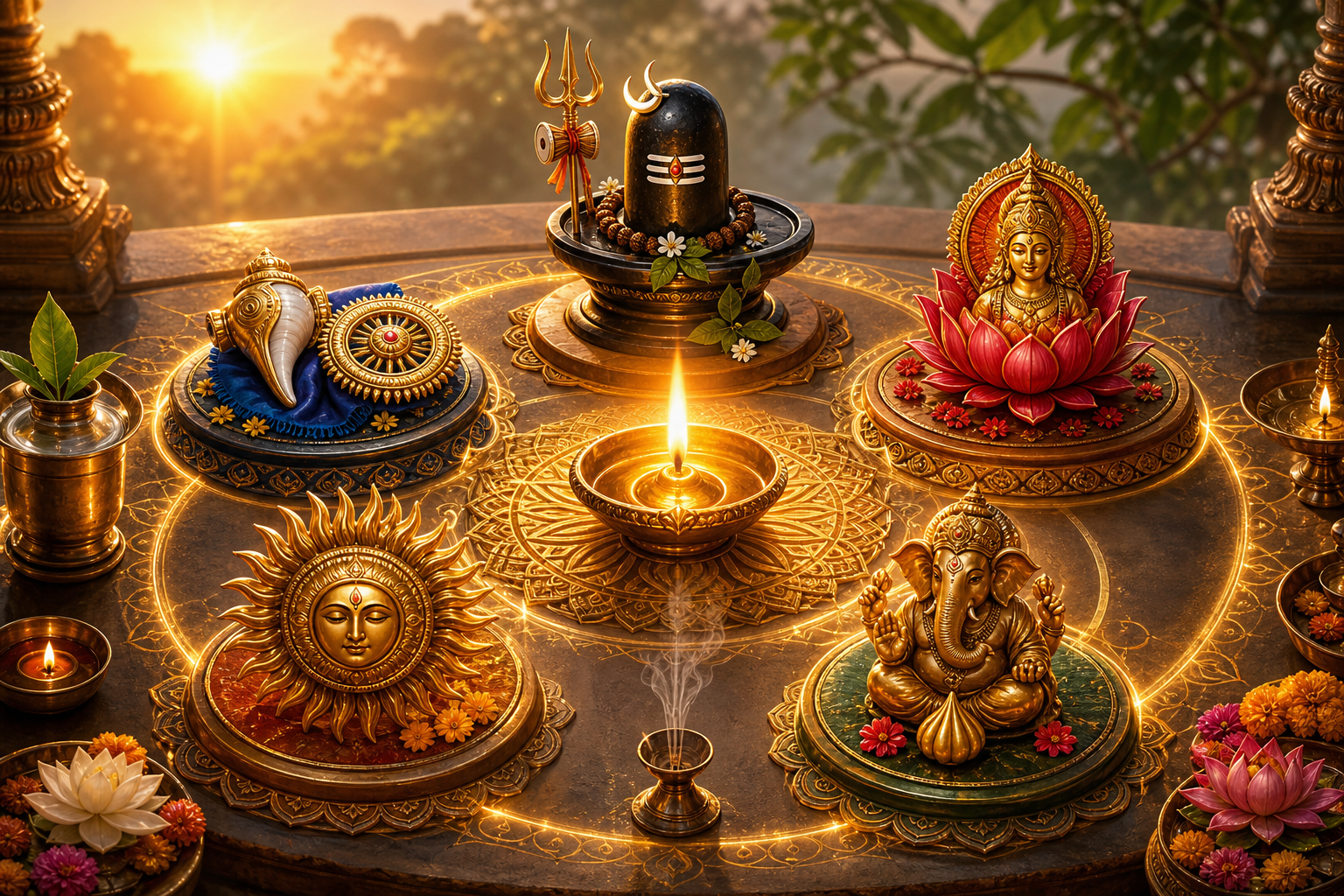
Panchopakas, also understood through Panchopasana and Panchayatana Puja, presents a powerful Hindu model of unity through five sacred paths. It honors Shiva, Vishnu, Devi, Surya, and Ganesha as distinct yet harmonious approaches to the Divine. The concept explains how Hinduism can sustain deep devotional diversity without losing philosophical coherence. It also clarifies the role of…
-
SB 10.7.21 Morning Class: Unveiling Krishna’s Vatsalya Rasa, Trnavarta, and Yogamaya

This morning class situates SB 10.7.21 within the Gokula pastimes of Śrī Kṛṣṇa, clarifying how Trnavarta’s ‘whirlwind’ is overcome by the yogamāyā-governed ‘weight’ (gurutva) of divine presence. Drawing on Gaudiya Vaiṣṇava commentaries, it shows how vātsalya-rasa eclipses overt majesty, allowing love to be the primary mode of realization. The analysis integrates philological, theological, and psychological…
-
Hands Folded in Eternity: Anjali Mudra in Hindu Sculpture, Sacred Geometry, and Living Devotion

Anjali Mudrahands folded in reverenceis one of the most legible and enduring motifs in Hindu sculpture and a living gesture across dharmic traditions. This article explains its iconographic grammar, showing how sculptors use symmetry, proportion, and subtle hand morphology to communicate devotion with clarity. It traces the gesture’s historical spread from Sanchi and Ajanta through…
-
Periya Karuppar Unveiled: The Unyielding Sentinel and Living Guardian of Tamil Villages

Periya Karuppar“the Great Dark One”is a living guardian deity of Tamil Nadu whose shrines anchor ethics, oath-taking, and social order at village thresholds. Rooted in the Ayyanar–Karuppar protective complex, his iconography (aruval, sword, staff, and dog) encodes lawful strength and vigilance. Rituals such as arul vaaku, boundary offerings, and community vows function as social technologies…
-
When Bonds Must End: A Dharmic Guide to Karma, Duty, and Unsalvageable Relationships

Not every relationship can or should be saved. A dharmic lensgrounded in Hinduism’s concepts of dharma, karma, and sambandhaclarifies when compassionate separation is ethically warranted. Drawing on the Bhagavad Gita, Dharmashastra, and resonances with Buddhism, Jainism, and Sikhi, this article offers a structured decision framework: prioritize non-harm, truth, responsibility, and long-term growth. It outlines concrete…
-
Unveiling the Sixteen Akarshini Shaktis: Magnetic Powers of the 16‑Petal Sri Chakra

The sixteen Akarshini Shaktis on the 16-petalled lotus of the Sri Chakra (Mahameru) encode a complete grammar of attraction that gathers desire, cognition, ego, the five senses, and subtle faculties back toward the Divine Center. Placed in the second avaranaSarvasha-Paripuraka Chakrathese Shaktis transform outward compulsion into inward integration. The sequence from Kāmakārṣiṇī through Ātmakārṣiṇī and…
-
June 25, 2026 Panchang Guide: Auspicious Ekadashi Timing, Good Time, Nakshatra, Rashi

Thursday, June 25, 2026 in the Hindu calendar features Shukla Paksha Ekadashi tithi through about 9:14 PM IST, transitioning to Dwadashi thereafter. Because Ekadashi is present at sunrise, the fast is observed on June 25, with parana on June 26 during Dwadashi after sunrise and outside Hari Vasara. The day’s good time (Shubh Muhurat) includes…
-
Śrīmad Bhāgavatam 3.26.37 Decoded: Kapila’s Sāṅkhya and Mastery of the Working Senses

Śrīmad Bhāgavatam 3.26.37 offers a precise Sāṅkhya blueprint for understanding embodied agency by enumerating the core functions of the working senses. The opening, “ŚB 3.26.37 cālanaṁ vyūhanaṁ prāptir …”, signals a fivefold map of actionmovement, manipulation, acquisition, elimination, and procreationeach ethically regulable. Read with Kapila’s wider ontology, the verse becomes a practical guide to mastering…
-
Thiruvannamalai Aadi Pooram 2026: Awe‑Inspiring 10‑Day Brahmotsavam Dates, Rituals, and Travel Insights

Aadi Pooram at Thiruvannamalai’s Arunachaleswarar Temple culminates on 14 August 2026, anchored by a 10‑day Brahmotsavam that venerates Sri Unnamulai Amman with precise Agamic rites. This guide explains the festival’s calendrical basis in Aadi Masam and the Pooram (Poorva Phalguni) nakshatra, the structure of Brahmotsavam from Dhwajarohanam to Dhwajavarohanam, and the central role of abhishekam…