
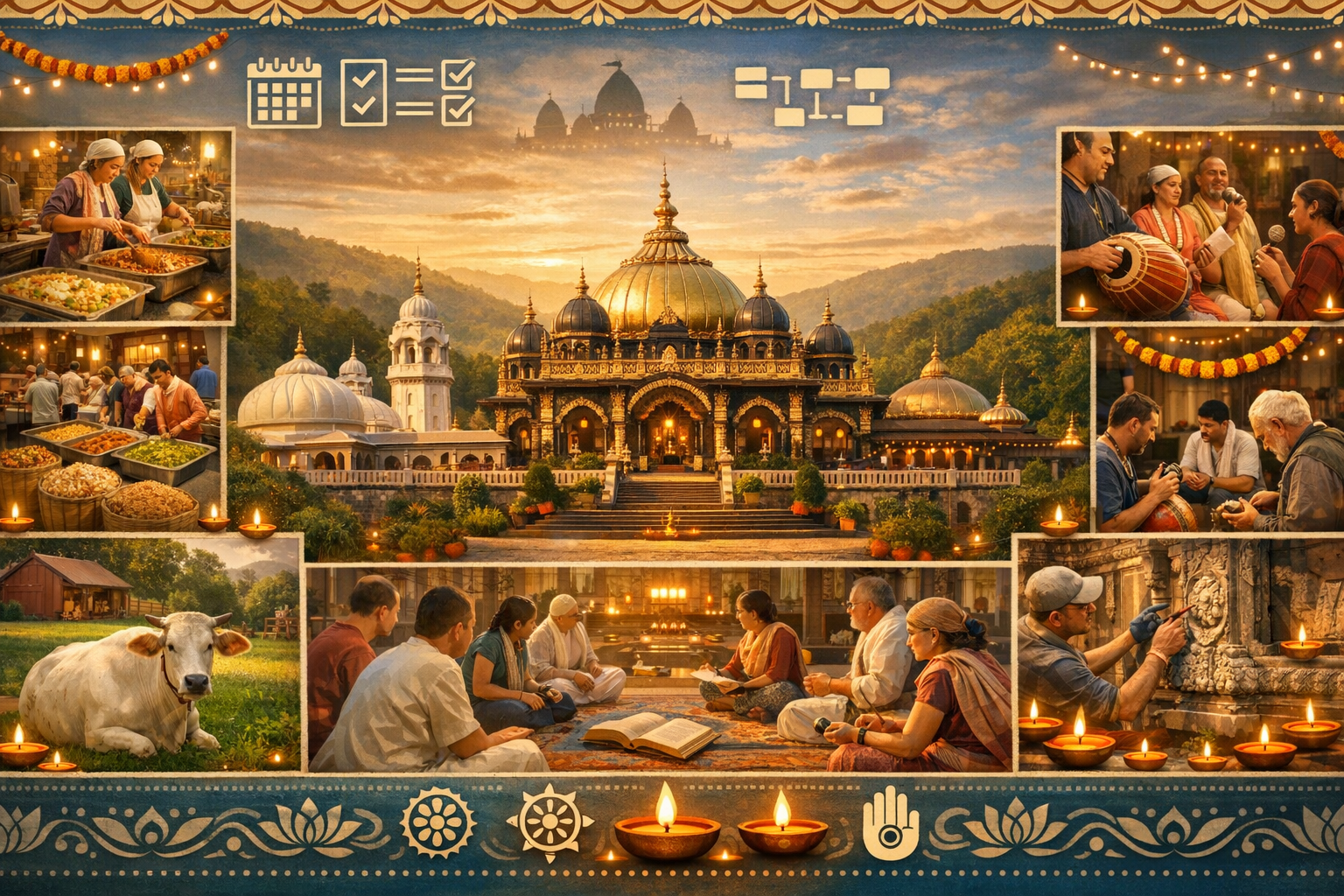
The third issue of the New Vrindaban community newsletter offers a clear, structured snapshot of a living temple-town where devotion, culture, and service intersect. Situated in the Appalachian hills of West Virginia, this ISKCON (International Society for Krishna Consciousness) community continues to function as a vibrant center of Hare Krishna spirituality, community engagement, and cultural heritage stewardship. The newsletter consolidates updates that help residents, volunteers, and well-wishers understand how festival planning, seva, education, and infrastructure advance together to sustain a resilient, welcoming dharmic ecosystem.
New Vrindaban is widely known for the Sri Sri Radha Vrindaban Chandra Temple and the Palace of Gold, both emblematic of Vaishnava devotion and craftsmanship. The community’s evolution since the late 1960s reflects a steady commitment to bhakti, kirtan, and sacred hospitality, while embracing practical governance, transparent communication, and thoughtful preservation of sacred spaces. In this context, the newsletter functions as a knowledge bridgeorganizing many moving parts into an accessible, reader-friendly format.
Editorially, the third issue aligns with three recurring pillars: seva-led governance, liturgical coordination for the Hindu festival calendar, and lifelong learning in the bhakti tradition. Readers gain a synthesized view of how volunteer teams, scheduling, and resource stewardship connect to day-to-day temple operations and long-term initiatives. The tone is factual and purposeful, enabling stakeholders to understand not only what is happening, but also why each initiative matters for collective well-being.
Festival readiness is a prominent thread. In communities shaped by Vaishnava practice, events such as Janmashtami, Ratha Yatra, Kartik (Damodara month), and Diwali typically serve as spiritual high points, drawing pilgrims, families, and students of Hindu culture. Consistent with that ethos, the newsletter distills how kirtan ensembles, altar services, and volunteer logistics cohere around the liturgical cycle. By highlighting timelines, teams, and seva opportunities, such issues help transform inspiration into organized participation.
Lifelong learning remains integral to the Hare Krishna Movement. The newsletter’s education-focused updates generally spotlight study groups in Bhagavad-Gita and Srimad-Bhagavatam, kirtan training, Sanskrit and mantra recitation, youth engagement, and community-led seminars. These strands embody the Guru–Shishya tradition while incorporating contemporary modalitiesreading circles, accessible syllabi, and digital archivingso that learning is systematic, intergenerational, and welcoming to newcomers.
Seva and community welfare are treated as practical expressions of bhakti. Typical strands covered in recent issues include prasadam preparation and distribution, farm-to-altar agriculture, and cow care (goshala) initiativeseach woven into a coherent view of temple ecology. The newsletter helps the community see how individual acts of service contribute to shared resilience: a kitchen rota fulfilled, a garden bed maintained, an altar offering preparedsmall pieces culminating in collective harmony.
Heritage conservation and infrastructure stewardship are also central. Maintenance of sacred architecture, artisan repairs, and landscape care around the Palace of Gold and the temple complex are documented with an eye toward continuity, safety, and cultural value. This approach underscores that devotional life and cultural heritage are mutually reinforcing: well-cared-for spaces protect living traditions; living traditions, in turn, justify and sustain preservation work.
The newsletter’s framing implicitly advances unity across dharmic traditionsHinduism, Buddhism, Jainism, and Sikhismby centering shared values such as ahimsa, dana, seva, satsang, and disciplined practice. While rooted in Vaishnava bhakti, New Vrindaban’s emphasis on community service, contemplative practice, and ethical living resonates with the broader dharmic family. Readers familiar with Buddhist sangha, Jain vrata and ahimsa, or Sikh kirtan and seva will recognize convergences that strengthen interfaith understanding without diluting distinct identities.
From a governance perspective, the newsletter models clarity. Community calendars, volunteer workflows, and process notes (where provided) improve predictability, reduce duplication of effort, and encourage accountability. In doing so, the publication supports a cycle of continuous improvement: transparent planning enables broader participation; broader participation enhances the quality and stability of devotional life and heritage care.
Emotionally, the narrative of New Vrindaban remains grounded in lived experience. Families often describe the soundscape of evening kirtan, children joining lamp-offerings, and shared meals as markers of belonging and spiritual grounding. Pilgrims and guests speak of the Appalachian quietude offset by vibrant temple lifean interplay that turns a visit into reflection, and reflection into renewed purpose. The newsletter channels these sentiments into actionable pathways for engagement, making inspiration tangible.
In sum, the third issue of the New Vrindaban community newsletter demonstrates how an ISKCON temple-town advances devotion, education, cultural heritage, and community engagement in concert. It documents continuity, enables collaboration, and gently expands the circle of carewithin the Hare Krishna community and across the wider dharmic tapestry. Readers come away with a practical understanding of how festivals, learning, seva, and preservation are thoughtfully orchestrated to nurture both spiritual depth and social cohesion.
Inspired by this post on Dandavats.
