
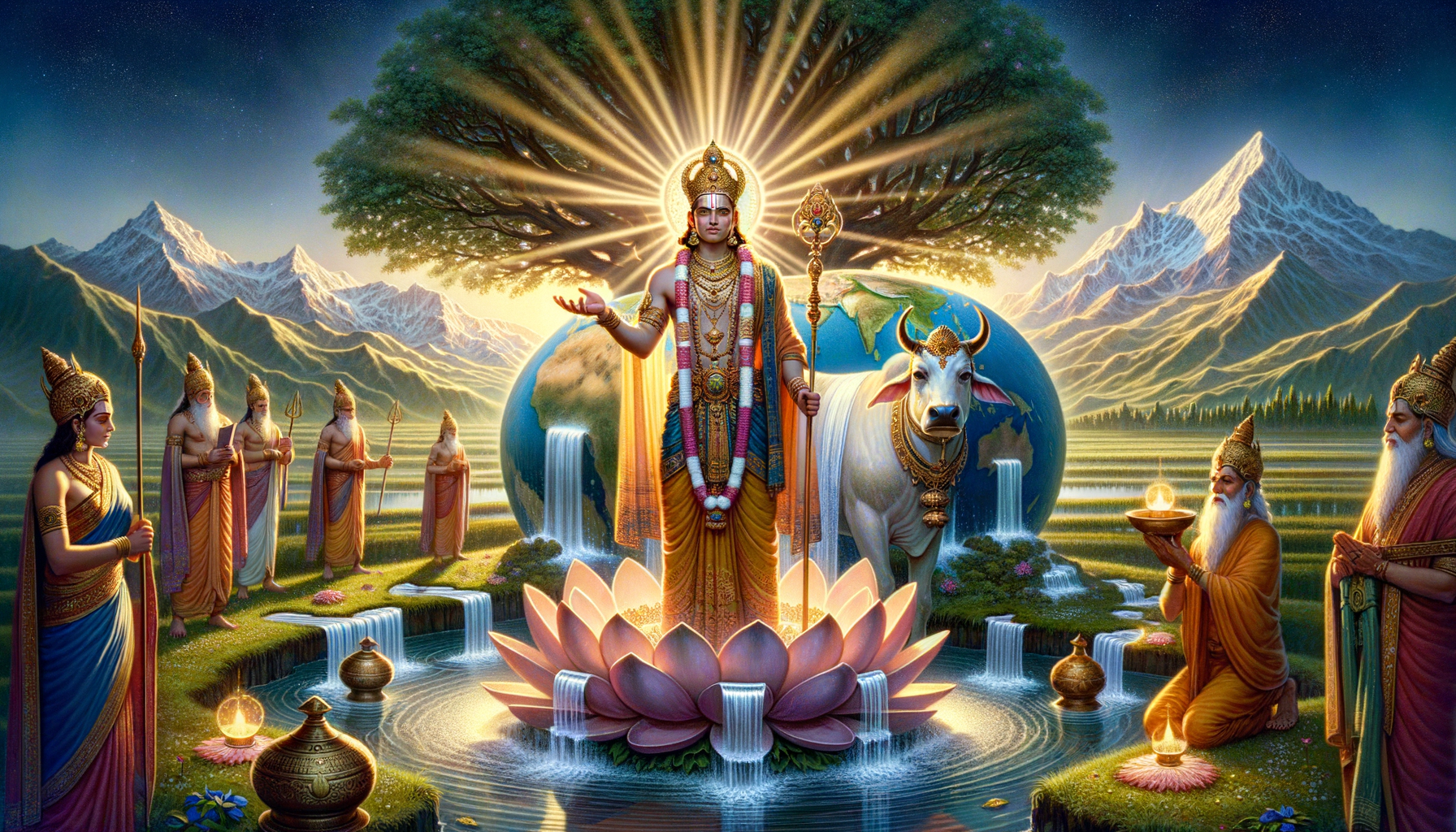
A luminous episode from the Brahma Purana records an event described as among the rarest in Hindu history: all rivers and oceans assembled to anoint a sovereign. Set in the Dhruva lineage, the narrative begins with King Anga, renowned for piety and adherence to dharma, and his son Vena, who tragically failed to inherit his father’s virtues. The contrast frames a crucial inquiry into leadership, ethics, and the restoration of social order.
Vena’s rule, marked by adharma, compelled sages to intervene for the welfare of the realm. Through ascetic power, they neutralized tyranny and, in a striking act of symbolic purification, “churned” Vena’s bodyfirst producing a being associated with the Nishada lineage and ultimately bringing forth Prithu, the paradigmatic righteous king. This Puranic motif emphasizes the transformative potential of wisdom-guided action when governance strays from moral law.
As Prithu assumed righteous intent, the Earth (Prithvi) appeared in the form of a cow, a powerful symbol across dharmic traditions. The tale recounts Prithu’s pursuit of Earth not as conquest, but as a plea and compact: prosperity must be unlocked responsibly, with stewardship, gratitude, and restraint. Earth agreed to yield bounty when approached with care, resulting in the “milking” of resources through lawful meansa vivid allegory for sustainable abundance grounded in dharma.
The coronation that followed is the narrative’s most extraordinary moment. Rivers and oceans arrived with their waters to perform Prithu’s abhisheka, signifying a universal sanction of kingship. This rajyabhisheka, sanctified by the confluence of all waters, conveys that legitimate sovereignty in the Puranas is not merely political; it is cosmic, ethical, and ecological, harmonized with the rhythms of nature and the consent of the sacred geography of Bharatavarsha.
In the wider Puranic corpus, Prithu’s reign becomes synonymous with rajadharmajust governance, equitable distribution, and protection of the vulnerable. The Earth-as-cow imagery aligns with a shared dharmic ethic: compassion, non-violence, and responsible care for all living beings. Such values resonate across Hinduism, Buddhism, Jainism, and Sikhism, where righteous leadership is measured by service (seva), truth (satya), and restraint (ahimsa) in thought and action.
Readers often encounter a sense of awe at the image of moving watersmighty rivers and vast oceansconverging to bless a ruler. The scene evokes humility before the natural world and invites reflection on interdependence: just as rivers feed life, ethical governance must nourish society. The narrative’s emotional force lies in its quiet insistence that authority draws legitimacy from alignment with dharma and reverence for Mother Earth.
Viewed through a contemporary lens, the story proposes a blueprint for leadership: cultivate virtue, heed wise counsel, restore balance, and steward resources with long-term care. It underscores a principle common to dharmic traditionsthat prosperity achieved without harmony invites decline, while prosperity sought through justice endures. The Brahma Purana thus preserves not only a sacred tale but a pragmatic ethic for community, ecology, and statecraft.
Ultimately, the account of Prithu’s anointing by all waters affirms unityof nature with society, of ethical law with political power, and of diverse spiritual paths with a shared moral horizon. By honoring the Earth and centering dharma, the narrative offers a unifying vision that strengthens bonds among Hindu, Buddhist, Jain, and Sikh communities, encouraging collective commitment to righteous living and compassionate governance.
Inspired by this post on Hindu Pad.
