
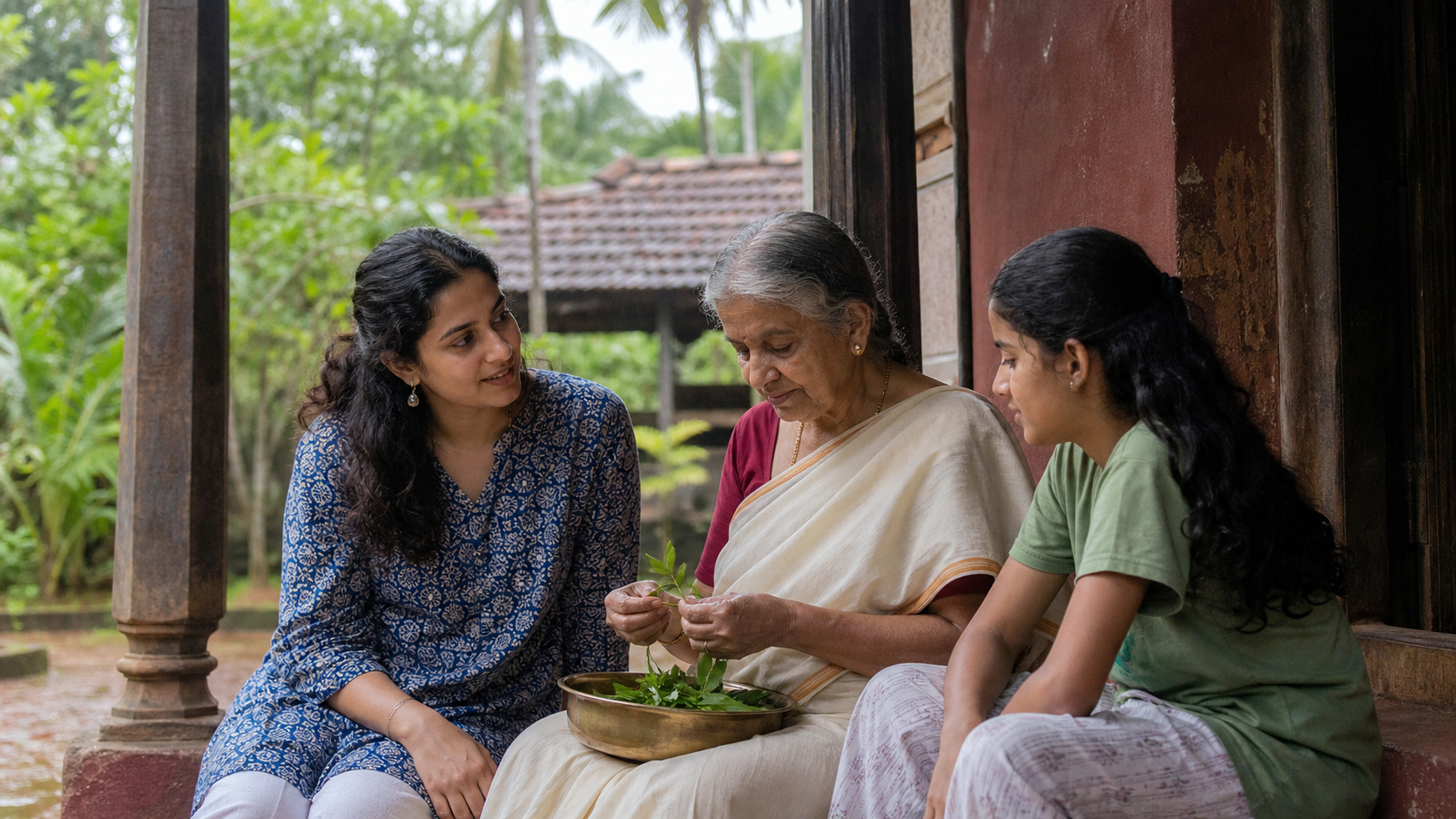
You may call Kerala home and still feel uncertain when you return. Perhaps your Malayalam is hesitant, younger relatives know the place better than you do, or you need someone to explain what happens in the kitchen and temple. None of that cancels your connection. It tells you where the work of belonging begins.
You do not have to prove that you are sufficiently Malayali. You do need to move beyond ancestry as a label. If you participate in household life, learn the meanings behind family practices and accept a share of responsibility for carrying them forward, Kerala becomes more than the place your family came from.
Stop treating authenticity as a test you might fail
The same Kerala that is a celebrated destination for travellers can be an ancestral home entered through family routines, local temples and everyday Hindu practice. The difference is not whether you were born there. It is whether you approach the place primarily as scenery to consume or as a network of relationships to which you belong.
A useful way to understand that relationship is through three layers: inheritance, familiarity and responsibility. Inheritance gives you family names, memories and places. Familiarity comes from repetition: hearing the language, learning the food, revisiting a temple and recognising what grows behind the house. Responsibility begins when you help preserve knowledge, maintain relationships and make room for the next generation.
This distinction matters if you grew up outside Kerala. Your inheritance can be real even when your familiarity is incomplete. Do not exaggerate what you know, but do not disown your heritage merely because someone else speaks more fluently or remembers more customs. Say plainly, “This is part of my family, and I am learning how to care for it.” That is more honest than either performing expertise or standing at a distance.
Before your next visit, make two mental columns. In the first, place what you have inherited: the ancestral locality, family deity, household names, festival memories and recipes. In the second, place what you still need to learn. That second column is not evidence against your belonging. It is your agenda.
Let the household become your first cultural classroom
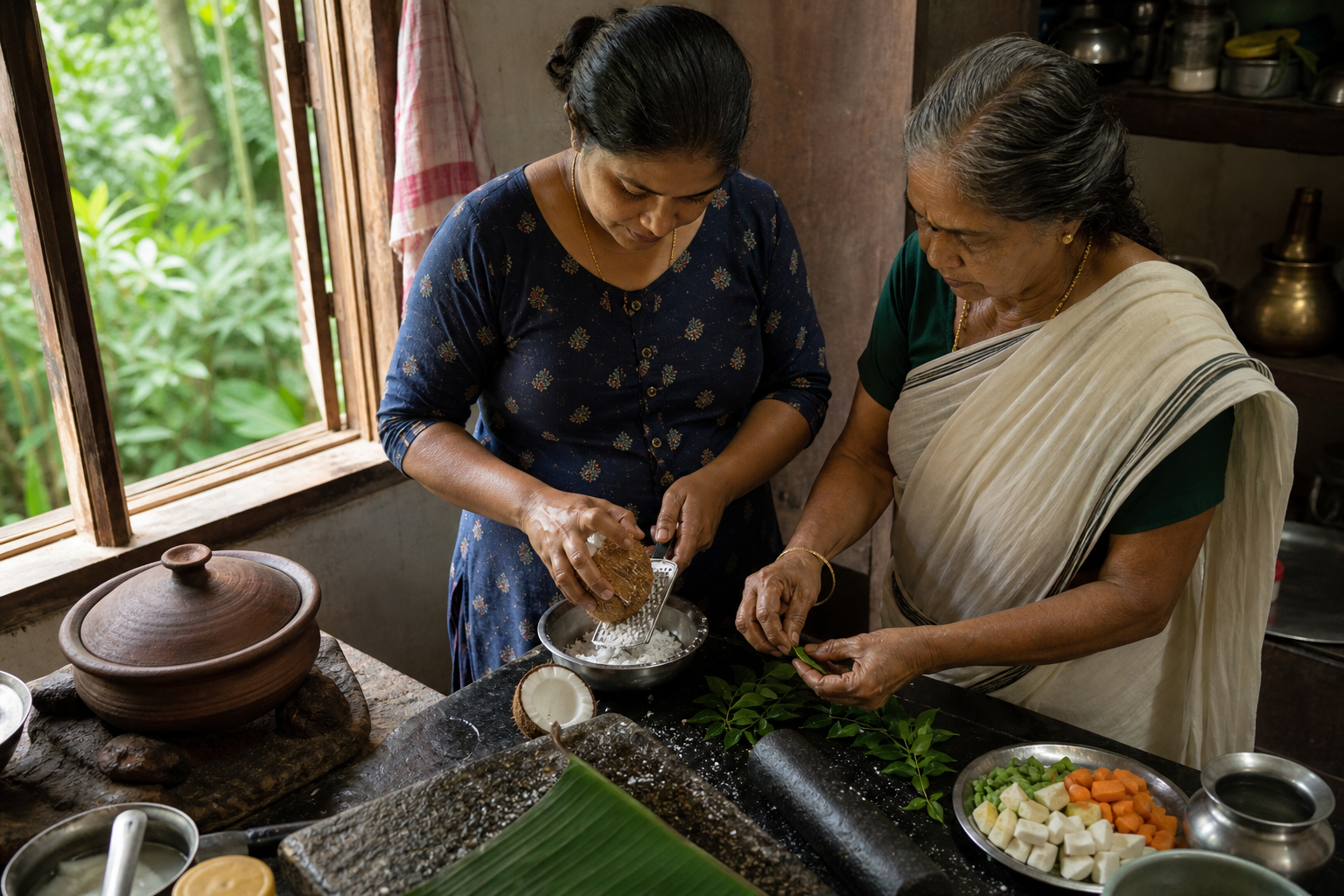
Family culture is often stored in actions that nobody has formally documented. A homecoming in Kerala can move from drawing water from a well and eating idiappam with vegetable ishtu to identifying backyard plants and helping open a jackfruit. Each task carries vocabulary, technique, memory and an understanding of the land. If you only arrive for meals and photographs, much of that knowledge remains invisible.
Give one ordinary morning to the household before filling the visit with outings. Ask where water comes from, what is harvested in that season, who prepares which dish and which jobs have to be completed before breakfast. Offer to help. The goal is not to stage a rustic experience. It is to notice the skill behind work that a visiting relative can easily take for granted.
When someone opens a jackfruit, for example, the lesson is larger than the taste. You encounter the use of coconut oil against the sticky latex, the separation of fruit and seeds, the handling of a traditional cutting tool and the cleaning required afterward. If an aruvamanai or another exposed blade is involved, observe first and use it only under the guidance of someone experienced. Cultural enthusiasm does not make a sharp tool safer.
Ask four kinds of questions as you watch: What is this called here? Why is it done in this order? Who taught you? What has changed since you were young? The first question gives you vocabulary. The second reveals technique. The third identifies a line of transmission. The fourth prevents you from mistaking one family’s present-day method for an unchanging rule across Kerala.
Keep a family glossary rather than a generic list of “Kerala traditions.” Record the names your relatives actually use for tools, plants, preparations and observances. Note variations without correcting them into a supposedly pure form. A grandmother’s raw mango chutney, an uncle’s way of judging when a jackfruit is ready and the family name for a backyard plant are valuable precisely because they are situated knowledge.
Do not romanticise labour while learning from it. The person cooking for the family is not a cultural exhibit, and remarkable physical ease developed through repetition should not hide the work involved. Help with preparation and cleanup. If you request a recipe or demonstration, ask at a convenient time. Participation creates reciprocity; observation alone can leave the household serving your curiosity.
Enter temple time instead of collecting temple sights
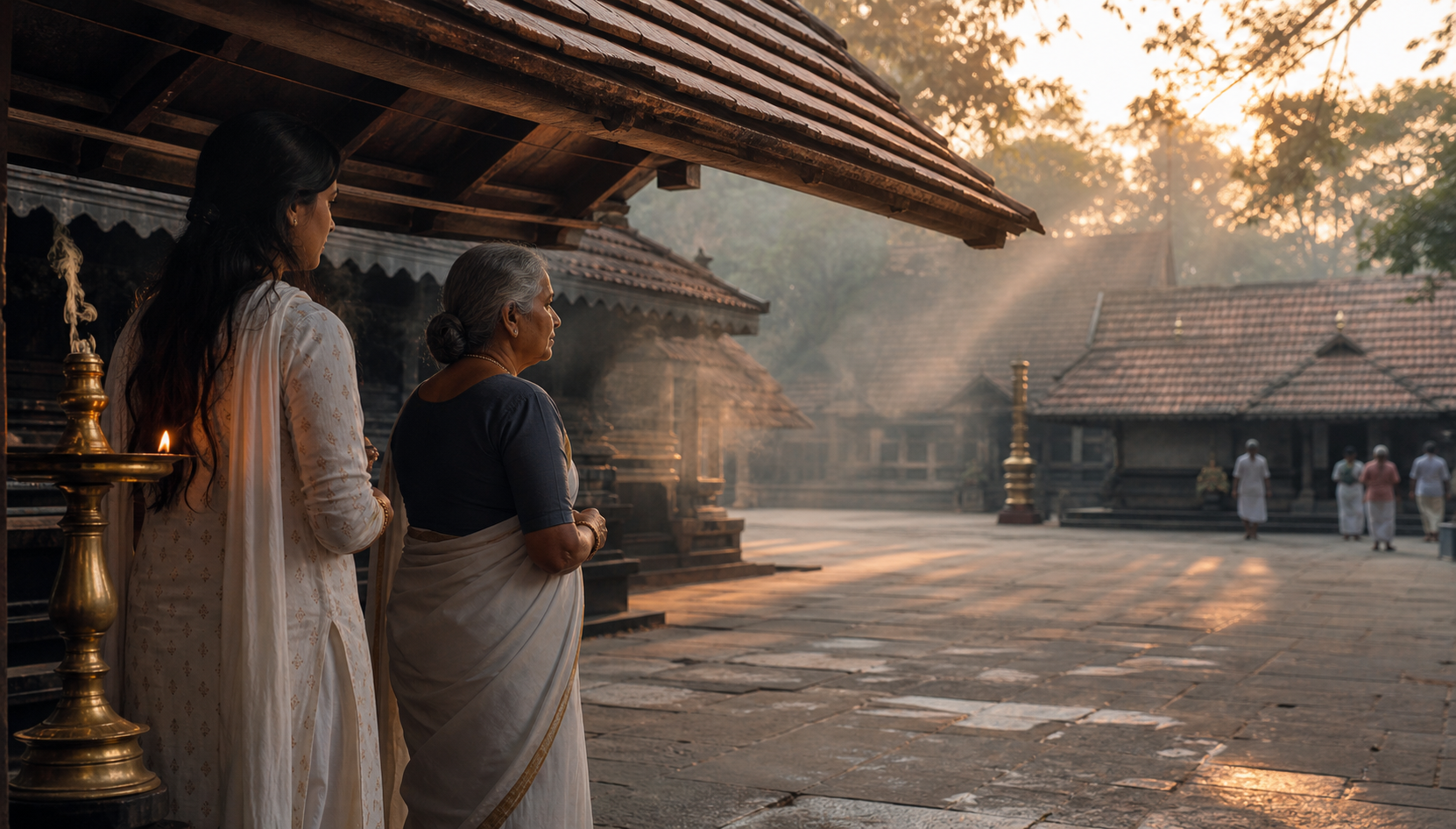
A family temple visit can teach you how dharma orders a day. At Kerala temples, practices such as walking barefoot, making pradakshinas and taking darshan are not separate attractions. They form a sequence of embodied attention. The walking, waiting and repetition are part of the encounter, not delays before the “main” moment.
Ask your family about the visit before you leave home: What clothing is appropriate? Are there entry restrictions? Which shrine does the family approach first? Is an offering customary? Where must a phone or camera remain put away? Customs and access rules can differ by temple, so family memory should be checked against the instructions at the temple itself.
Once inside, follow the order rather than rushing toward the most visually impressive shrine. Notice how relatives prepare, where they pause, whether they circumambulate and how they leave. Ask for explanations afterward if conversation would disturb worship. You will remember more when you understand the sequence than when you accumulate disconnected names.
Named places can also connect family geography with the intellectual history of dharma. Visits associated with Vadakunaathan, Poornathrayeesha or the Kerala memory of Adi Shankara should lead beyond pride in proximity. Write down the question that the place raises for you. If Adi Shankara’s name is present in family memory, for instance, let that become a reason to study Advaita Vedanta rather than merely a prestigious name attached to Kerala.
The practical test is simple: after the visit, can you explain one practice more clearly than before? You need not deliver a lecture. You should be able to tell a younger relative what your family did, in what order and why the action mattered to those performing it. That is how a temple visit becomes transmissible memory.
Turn the return journey into an ongoing relationship
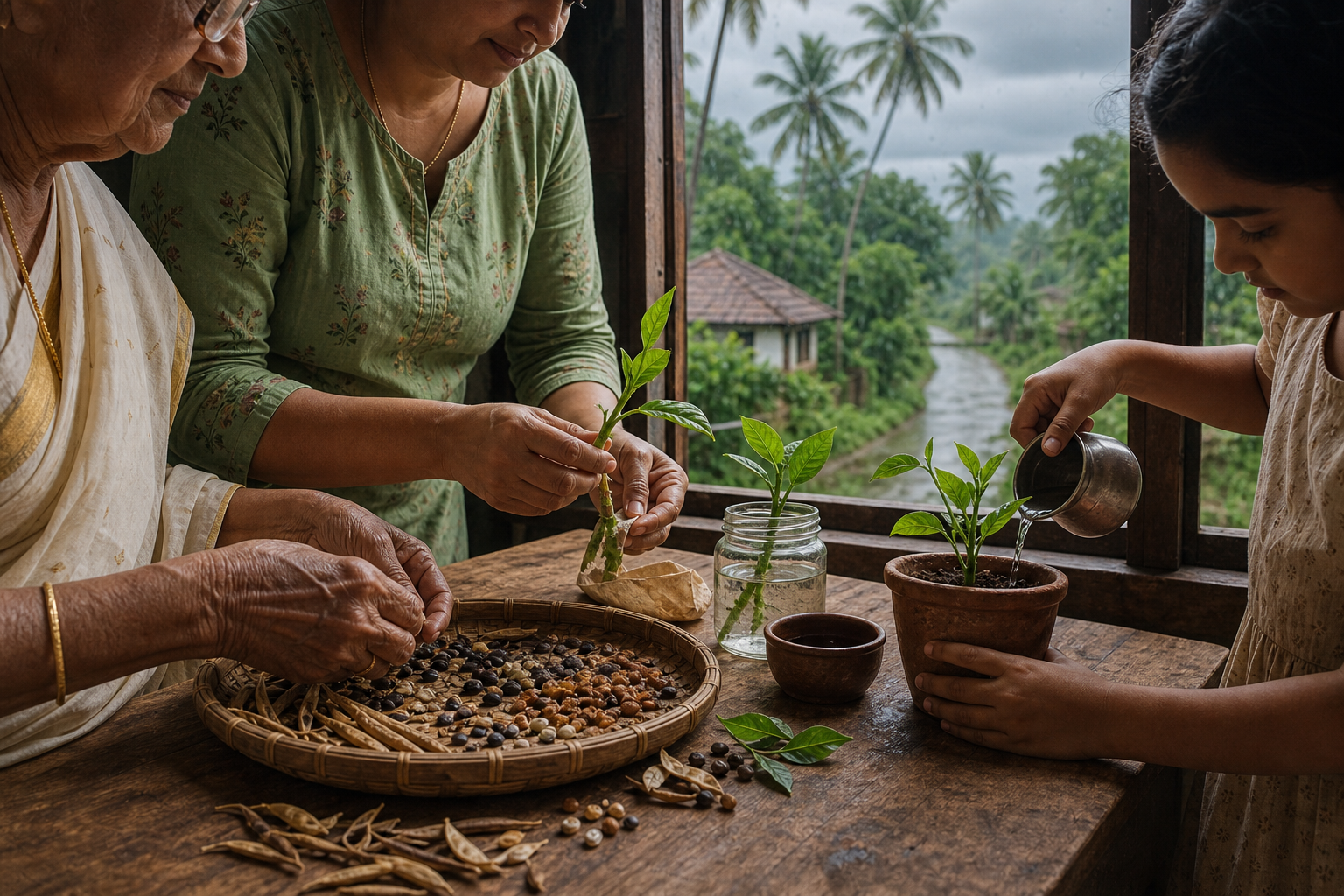
Cultural belonging weakens when it exists only during travel. The solution is not to reproduce an ancestral Kerala household perfectly in another country. It is to choose practices that can survive honestly within your actual life.
Onam shows how that continuity can work. Even at a distance, family and community networks circulate pookalam designs, boat-race videos and ideas for a sadhya. These visible elements can open the door, but the festival becomes more than seasonal decoration when you also learn who taught your family to observe it, which preparations matter in your household and whom the celebration brings together.
Build continuity around one practice you can repeat. You might learn a family dish well enough to prepare it without turning every step into an emergency call. You might maintain a small pookalam tradition, study the meaning of a temple observance, learn the Malayalam names of foods already cooked at home or schedule a regular conversation with the relative who holds family history. A modest practice sustained with care is more valuable than an elaborate display abandoned after one season.
Use the period after your visit to complete the following cycle:
- Preserve: Write down the names of people, places, dishes, plants, tools and observances while the context is still clear.
- Verify: Send your notes to the relative who taught you. Ask what you misunderstood and whether a spelling or relationship needs correction.
- Practise: Choose one action you can repeat at home rather than waiting for the next flight to Kerala.
- Return: Share the finished recipe, labelled photograph, family tree or transcription with the people who supplied the knowledge.
- Transmit: Invite a child, sibling or cousin to participate so that the knowledge does not end as your private archive.
Ask permission before recording a person, photographing worship or publishing family material. A memory entrusted to you is not automatically public content. If relatives prefer that a ritual, story or image remain within the family, respecting that boundary is itself part of responsible belonging.
Reciprocity also means remaining present when there is no festival. Call to ask about the household, not only for a recipe. Learn the names of relatives beyond the branch you already know. Contribute to the upkeep of shared memory by labelling old photographs, confirming relationships and returning copies to family members. Home becomes credible when your connection places some claim on your time and care.
Key takeaways
- You can claim an ancestral connection without pretending to possess local knowledge you have not yet learned.
- Treat household work as cultural instruction: participate, ask for names and methods, and help with cleanup.
- At a temple, learn the family’s sequence of practice and follow current on-site rules rather than approaching the visit as sightseeing.
- Record family-specific knowledge instead of generalising one household’s customs to all of Kerala.
- Choose a repeatable practice after returning home, then verify and share what you learned with the relatives who taught you.
- Measure belonging by reciprocity and responsibility, not by photographs, consumption or a performance of perfect authenticity.
Before your next return, choose one person to learn from, one place to understand and one practice to carry forward. Arrive ready to help. Leave with something verified, repeatable and shared. That is how Kerala remains home across distance and generations.
References
