
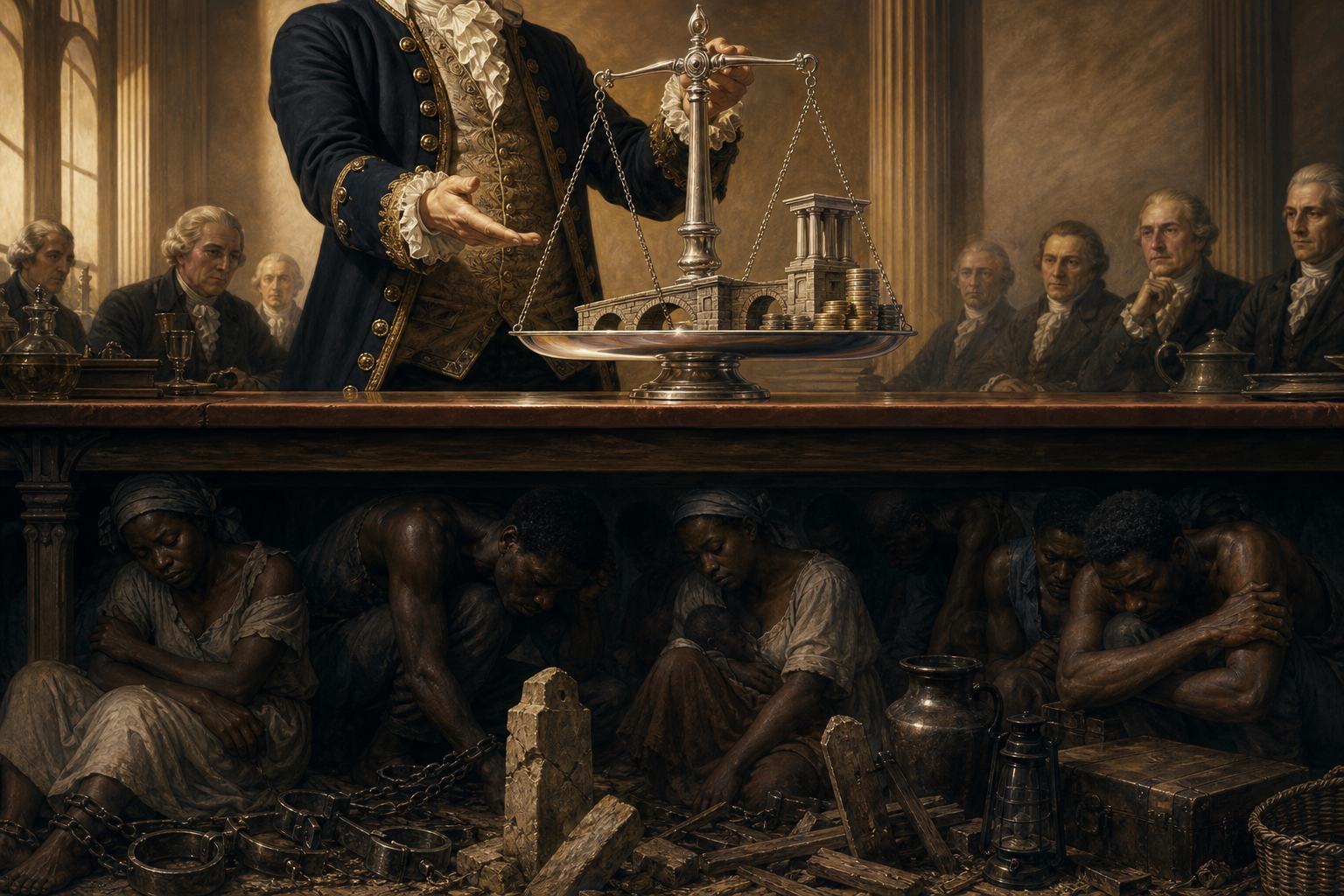
When you meet the claim that empire brought order, or that slavery became humane when it was regulated, the trap is to argue only about whether some benefit existed. That concedes the colonizer’s frame. Ask first what had to disappear from the sentence for the benefit to sound decisive: consent, coercion, dispossession, or the right of a people to govern themselves.
This distinction will help you read colonial-era writing, textbook passages, museum captions, political speeches, and online arguments more carefully. You don’t have to deny every administrative outcome attributed to an empire. You have to stop a claimed outcome from quietly becoming a moral title to rule.
The first move is to replace the moral question

A defense of domination rarely begins with the blunt proposition that domination is good. It begins by substituting a more convenient question for the difficult one.
On St. Helena, George Annesley, better known as Viscount Valentia, praised the island’s slave laws while objecting that rules concerning Christian instruction, marriage, and emancipation had not been enforced as intended. The central question was therefore treated as an administrative one: were enslaved people being governed properly?
The prior question was more fundamental: by what right was one person held as the property of another? Once that question is displaced, stricter management can masquerade as moral progress. The condition of bondage remains, but the debate moves to whether the bondage is orderly, improving, or economical.
You can detect this substitution by restoring the missing verbs. Words such as “instruction,” “marriage,” “security,” and “stability” sound benign in isolation. Ask who instructed whom, who compelled whom to marry, who was prevented from leaving, and whose possession was being secured. Grammar is not a minor matter here. A sentence that names benefits while hiding actors can make coercion look like a condition of nature.
Then separate two questions that colonial apologetics habitually merge. The first is whether a particular rule reduced some harm. The second is whether the ruling institution possessed a legitimate right to impose the system. A less brutal rule may matter to the person suffering under it, but mitigation does not convert ownership into consent. Benevolence describes how power is exercised; legitimacy asks where the power came from.
Paternalism makes domination sound like a service

The St. Helena rationale offers a compact example of imperial paternalism. Enslaved people were represented as morally deficient subjects who required instruction. Their rulers, meanwhile, appeared as guardians trying to improve them. Once this guardian-and-ward relationship is accepted, continued control can be presented as a duty rather than an interest.
The details reveal how the mechanism worked. Religious teaching was expected to produce moral discipline. Marriage was to be required rather than left to personal choice. An owner’s decision to emancipate an enslaved person was supposed to be conditional on financial security being given to the East India Company. Valentia objected that freed people in old age could become an expense to the Company when that security had not been provided.
Notice the sequence. The institution first restricts freedom. It then interprets the condition of the restricted person as evidence of moral or administrative deficiency. Finally, it proposes more supervision as the remedy. The coercive institution becomes both the alleged cure and the authority that decides whether the cure has succeeded.
Valentia hoped proper teaching would turn the enslaved person into a “valuable member of society”. The decisive word is “valuable.” Valuable according to whom, and for what purpose? A colonial order commonly measured human beings by their usefulness to the order itself: their discipline, productivity, conformity, and cost to the governing institution.
This criticism does not require you to claim that religious instruction, marriage, or moral education can never be good. It requires you to preserve the difference between a practice freely embraced and the same practice imposed within bondage. The alleged goodness of an activity cannot supply the consent that coercion removed.
When you encounter a paternalistic defense, perform one simple test: remove the promised improvement and ask whether the institution would still possess the right to control the person. If the defense cannot answer without returning to claims about the subject’s backwardness, immaturity, or future usefulness, it is reasoning in a circle. Domination is being justified by a deficiency defined by the dominator.
Conquest turns an admitted wrong into a prosperity ledger
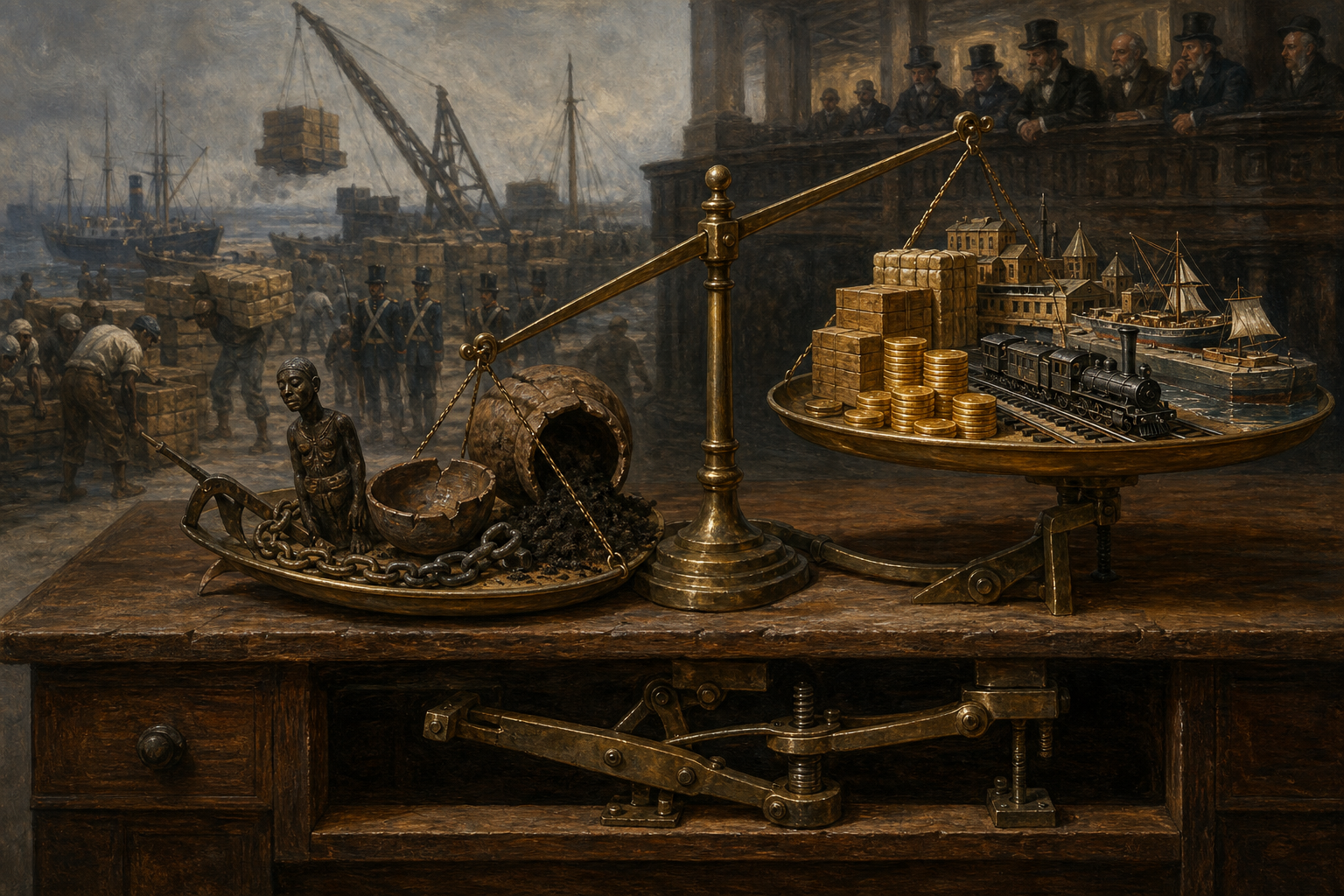
The same moral grammar scales from slavery to territorial empire. Reflecting on the Battle of Plassey, Valentia acknowledged that British power had relied on a treaty with a person he called a traitor in order to depose a sovereign. He then treated the question of right as something no longer worth determining. What mattered instead was that Plassey had made the British “masters of Bengal” and had secured prosperity for Britain.
That progression contains four distinct moves. A questionable act is admitted, which gives the appearance of candor. The question of legitimacy is then sealed safely in the past. The resulting imperial gains are entered as evidence in favor of conquest. Finally, the colonized are described as beneficiaries: Valentia claimed that Hindus had reason to rejoice because warfare had been removed from their homes.
The last move is especially important. An imperial advocate first deprives a population of political agency and then speaks on its behalf. Gratitude is assigned to the conquered without requiring their consent, testimony, or preferred alternatives. The claim of benefit becomes another exercise of the authority being defended.
You do not need to prove that every consequence of foreign administration was harmful in order to reject this logic. A beneficial consequence, even when established, does not retroactively create a right to depose, occupy, or govern. Keep two ledgers instead. In the legitimacy ledger, examine authority, consent, treaty, betrayal, and autonomy. In the consequences ledger, examine benefits, injuries, their distribution, and the identity of those allowed to define them. An entry in one ledger cannot simply cancel an entry in the other.
Follow the security calculation
Security language provides another useful clue. Valentia assessed St. Helena through the East India Company’s maintenance costs, the inadequacy of the garrison, and the need for stronger fortifications to prevent the possession from being lost. The object being secured was not merely human safety. It was imperial control of a strategically useful island.
Whenever “order,” “peace,” or “security” appears in a defense of empire, supply the missing object. Security for residents is not identical to security for revenue, shipping, territory, or the ruling institution. Resistance may appear as disorder when the thing being protected is foreign possession. At the same time, you should not automatically romanticize every resistance or deny that disorder can harm ordinary people. Separate the safety of inhabitants from the security of an imperial title, and demand evidence for each.
Key takeaways: five questions that expose the argument
Use these questions in sequence when you assess a defense of slavery, conquest, or colonial administration:
- Could the affected person or community refuse? If refusal brought punishment, continued bondage, or political coercion, the alleged improvement was not freely accepted.
- What was the original question of right? State it before discussing benefits. Ask who authorized the ruler, owner, or occupying power.
- Who defined the benefit? Distinguish what the governed people sought from what their rulers declared valuable on their behalf.
- Which actions have been hidden by abstract nouns? Replace “pacification,” “instruction,” and “stability” with concrete actors and verbs.
- Whose order was secured? Identify whether the protected object was human life, local autonomy, imperial revenue, strategic territory, or the governing institution itself.
Failure on one of these questions does not automatically prove that every factual claim in the defense is false. It tells you exactly where the reasoning is incomplete. That precision is more useful than calling everything propaganda. You can acknowledge a narrow fact while refusing the moral conclusion smuggled into it.
A Dharmic reading restores agency without inventing innocence

A Dharmic response does not require a fantasy of a flawless precolonial Bharat. Indigenous rulers, institutions, and customs remain open to moral judgment. The essential correction is that British conquest cannot be installed as the sole standard by which everyone else’s civilization, order, or human worth is measured.
Hindu, Buddhist, Jain, and Sikh communities must be approached as agents with their own institutions, disagreements, ethical vocabularies, and capacities for reform. They were not inert populations waiting for an imperial power to make them valuable. Recovering agency also means refusing to flatten distinct Dharmic traditions into one convenient colonial category. Solidarity need not erase plurality.
For your own notes, attribute every claim of colonial benefit to the person making it. Write, for example, “Valentia claimed that Hindus benefited from British rule,” not “Hindus benefited from British rule.” That small grammatical correction preserves the difference between historical testimony and established fact. It also prevents an imperial spokesman from becoming the unmarked voice of the people he presumed to describe.
A useful Dharmic standard asks whether power respects dignity, plurality, autonomy, and responsibility for the means it uses. Prosperity for the dominant party is not enough. Order created through dispossession cannot excuse itself merely by calling the dispossessed peaceful, improved, or grateful. Nor should an anti-colonial reading reserve scrutiny only for outsiders; moral seriousness requires applying the same questions of dignity and accountable power to our own institutions.
The next time you meet the claim that conquest delivered order, write two labels beside it: “claimed outcome” and “right to rule.” If only the first has been supplied, you have not yet been given a defense of empire. You have been given the imperial advocate’s preferred account of what should count.
References
