

When suffering corners you, every available choice can feel morally stained. Confront the wrong and you may intensify conflict. Stay silent and you may abandon someone who needs protection. Accept what happened and it can feel as if you are excusing it. Resist, and anger may begin deciding for you.
Your immediate question is rarely a grand philosophical one. It is usually: What is dharma here, and what should I do next? Hindu, Buddhist, Jain, and Sikh traditions do not collapse that question into a single slogan. They offer a disciplined sequence: see suffering without evasion, protect life, examine causes, reduce harm, fulfill legitimate duty, serve, repair what you can, and release your demand to control every result.
Do not ask karma to do compassion’s job

If a person has lost safety, health, shelter, livelihood, or someone they love, the first duty is not to explain why it happened. The first duty is to meet the suffering in front of you. That may mean food, protection, medical help, patient listening, a community kitchen, practical advocacy, or rebuilding. Dharmic language becomes distorted when it is used to stand above another person’s pain instead of entering into service.
Karma describes causation and moral consequence; it is not permission to blame a victim or declare every present condition deserved. Effects emerge through many causes across time, and present choices can redirect what follows. That is why karma does not amount to fatalism. The useful karmic question is not, What must this person have done? It is, Which causes are operating now, and which of them can we change?
Buddhist dependent origination sharpens that inquiry. An event does not arise in isolation; it depends on conditions. Instead of reducing a crisis to one villain, one failure, or one cosmic explanation, look for the chain that keeps producing harm. Fear may feed rumor, rumor may feed hostility, hostility may feed retaliation, and retaliation may renew fear. You may not be able to remove the whole chain, but you can stop supplying one of its conditions.
Jain Anekantavada adds another safeguard: your first view is rarely the whole view. Ask what the affected person sees, what a neutral observer sees, what evidence contradicts your preferred explanation, and whose cost your solution hides. Many-sided inquiry does not mean that truth is unknowable or that wrongdoing should be excused. It means certainty must be earned before you impose irreversible consequences.
Sikh seva brings the inquiry back to action. Acceptance of hukam is not an instruction to watch suffering passively. It places what cannot be controlled within a larger order while directing your available strength toward courageous service. Hindu lokasangraha makes a closely related ethical demand: act in a way that helps uphold the wider world rather than merely protecting your comfort or reputation.
If someone may harm themselves or another person, cannot remain safe, or needs urgent medical care, treat that as an emergency rather than a test of spiritual endurance. Contact appropriate local emergency or crisis support. Prayer, japa, meditation, and counsel from a trusted spiritual teacher can accompany professional care; they should not replace it.
Separate what must be accepted from what must be changed

Much confusion in a moral crisis comes from treating acceptance and action as opposites. They operate on different parts of the situation. You accept the reality already present so that you can act on the reality still open to change.
The fact: accept reality without approving it
Acceptance begins with accurate recognition: the loss occurred, the betrayal happened, the storm arrived, the decision has consequences, or your power is limited. Denial consumes energy while reality continues. Acceptance ends the argument with what is already true; it does not pronounce the event good, deserved, or beyond moral judgment.
Within Hinduism’s cyclical vision, creation, sustenance, and dissolution belong to the movement of existence. Sikh recognition of hukam likewise asks the mind to stop demanding that reality conform to personal preference. These frames can steady you during unavoidable loss, but they must not be used to romanticize pain. A flood may belong to nature’s processes while failures of planning, construction, stewardship, or relief remain human responsibilities. Recognizing order and accepting responsibility are compatible.
The conditions: change what is still changeable
After naming the fact, identify the conditions that can still be influenced. You cannot reverse yesterday’s injury, but you may be able to prevent another one. You cannot abolish grief by argument, but you can end a grieving person’s isolation. You cannot command a final outcome, but you can gather reliable information, protect someone vulnerable, conserve resources, offer shelter, correct a falsehood, or refuse to continue a harmful pattern.
This is where dependent origination becomes practical. Look upstream. If the visible crisis keeps recurring, ask what keeps recreating it: an incentive, an unchallenged habit, missing safeguards, possessiveness, fear, careless consumption, a humiliating social dynamic, or silence around misconduct. Relief deals with present pain. Dharma also asks whether you are willing to alter the conditions that will produce tomorrow’s pain.
Your part: define duty at a human scale
Svadharma directs attention to your actual responsibilities, relationships, abilities, and position. It is not a license to solve every problem, nor a demand to hide inside a social role. A parent, physician, soldier, neighbor, public official, monk, and bystander do not carry identical duties. Their common obligation is to avoid using role as an excuse for cowardice, cruelty, or indifference.
Emergency conditions may also alter what responsible duty requires. Apad-dharma recognizes that a rule suitable for ordinary circumstances may need careful adaptation when life, safety, or social order is in immediate danger. That flexibility is calibrated duty under distress, not freedom from ethical limits. An emergency can change the available means; it does not turn domination, revenge, or personal advantage into dharma.
Put the crisis on paper in three short statements. Under Already true, name the facts you cannot reverse. Under Still changeable, name the conditions open to influence. Under Mine to do, write one action that fits your role and capacity. If the last statement is vague enough to mean everything, narrow it until it can guide your next conversation, decision, or act of service.
Use each tradition’s lens without erasing its differences
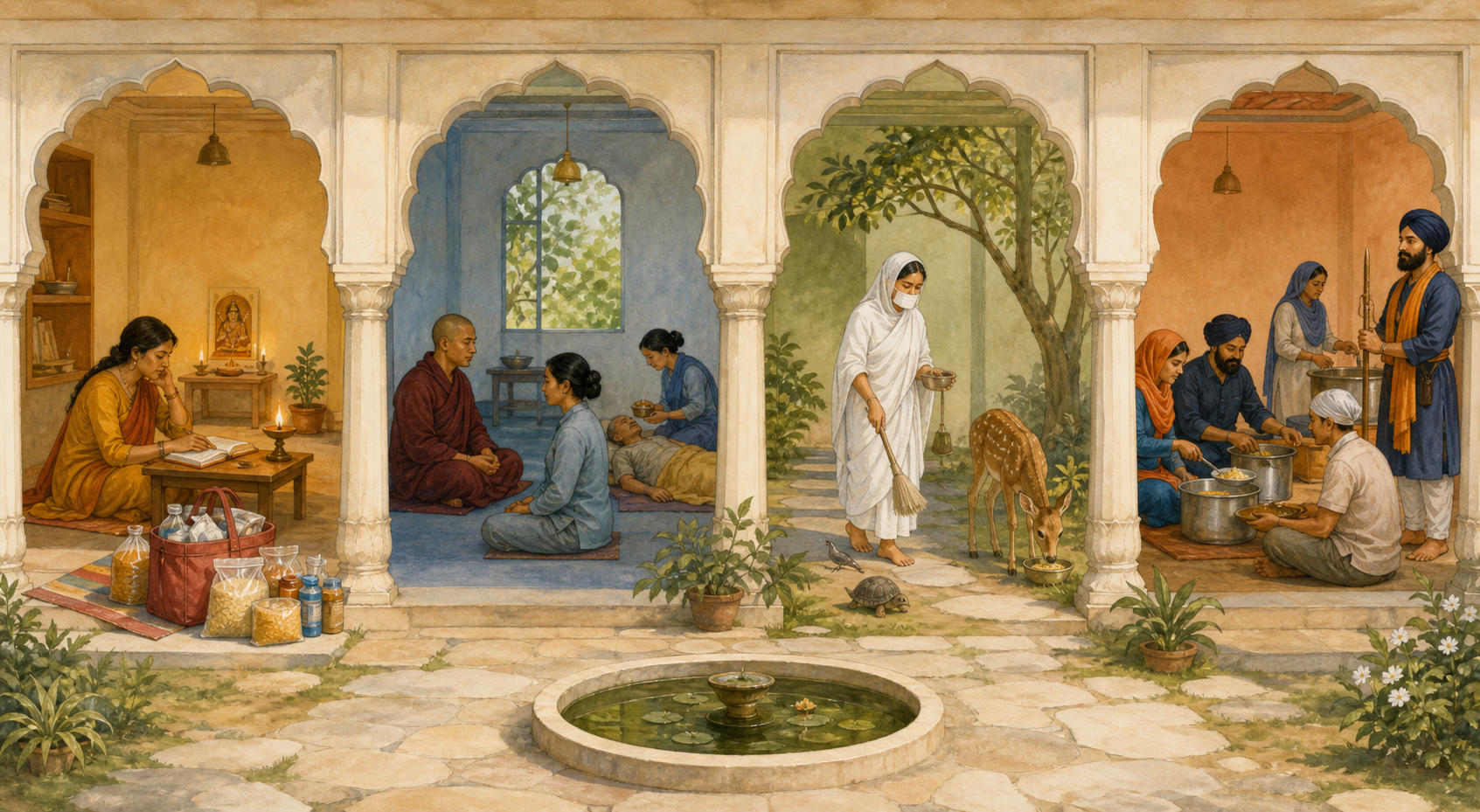
The Dharmic traditions share ethical ground, including restraint, compassion, disciplined practice, responsibility, and service. They do not make identical metaphysical claims, and they do not always draw the same boundary around permissible coercion. You will reason more honestly if you let each path contribute its own question instead of forcing them into an artificial sameness.
| Dharmic lens | Question to ask in a crisis | Common misuse to avoid | Practical direction |
|---|---|---|---|
| Hindu dharma, svadharma, Karma Yoga, and lokasangraha | What action fits my legitimate duty and helps sustain life, order, and the wider good? | Treating role as blind obedience, or treating nonattachment as indifference to results | Act diligently, protect the vulnerable, review consequences, and surrender possessiveness over the final outcome |
| Buddhist dependent origination, mindfulness, and upekkha | Which conditions are generating suffering, and which condition can be weakened now? | Confusing equanimity with emotional numbness or avoiding necessary intervention | Observe without immediate aversion, interrupt the causal chain, and respond without feeding hatred |
| Jain ahimsa, Aparigraha, and Anekantavada | Which workable choice minimizes injury, grasping, and one-sided certainty? | Claiming complete knowledge from one perspective or letting attachment disguise itself as principle | Seek missing viewpoints, reduce avoidable harm, restrain retaliation, and take no more than the situation requires |
| Sikh hukam, seva, and the Sant-Sipahi ideal | What must be accepted, and where does courageous service begin? | Using surrender as passivity or courage as permission for hostility | Serve directly, defend those at risk, and combine spiritual steadiness with disciplined action |
These lenses often converge on conduct even where their philosophies remain distinct. Mindfulness and upekkha steady attention. Ahimsa tests the harm built into your means. Aparigraha exposes attachment to control, status, possessions, and victory. Seva asks whether anyone is actually being helped. Svadharma asks whether the action is yours to undertake. Karma Yoga asks whether you can perform it fully without making the result an extension of your ego.
If you are rooted in one sampradaya or lineage, let its teachings govern your practice. Use the other lenses as questions, not as decorations. A Hindu account of Atman should not be presented as Buddhist doctrine; Jain ahimsa should not be diluted merely to make it resemble a warrior ethic; Sikh hukam should not be reduced to passive acceptance. Unity is strongest when it does not demand theological vagueness.
When you remain unsure, seek counsel from someone who combines scriptural understanding with knowledge of the actual situation. A teacher who does not understand the facts may spiritualize preventable harm. An expert who sees only tactics may miss the moral injury a technically successful decision can create. Sound counsel must be both ethically serious and reality-based.
Test the action before you call it dharma
A strong emotion can borrow sacred vocabulary very quickly. Anger calls itself courage. Fear calls itself prudence. Attachment calls itself loyalty. Withdrawal calls itself peace. Before acting, state the decision as a verb: report, refuse, intervene, leave, forgive, defend, disclose, wait, serve, or repair. Then test that action rather than defending a flattering description of yourself.
Reality. What do you know directly, what have you inferred, and what remains uncertain? Separate evidence from motive-reading. If a missing fact could reverse your decision, obtain it before taking an irreversible step. If delay itself exposes someone to serious harm, protect first and investigate through appropriate channels at the same time.
Responsibility. Who is entrusted to your care, what promises have you made, and what authority do you actually possess? Svadharma begins with real obligation, not imagined heroism. Do not seize control merely because you feel strongly. Do not hide behind a narrow job description when a vulnerable person plainly needs the protection your role exists to provide.
Harm. Compare the foreseeable harm of acting with the foreseeable harm of refusing to act. Ahimsa requires more than keeping your own hands visibly clean. Inaction can leave another person carrying a preventable cost. At the same time, a good end does not make every means acceptable. Consider severity, reversibility, who bears the risk, and whether a less harmful method could still protect what matters.
Motive. Ask what you would still choose if no one praised you, your opponent was never humiliated, and you received no personal advantage. A protective action may require firmness. It ceases to be protective when another person’s suffering becomes part of the reward. The Gita’s battlefield discipline and the Sikh Sant-Sipahi ideal both join courage to moral restraint: action is directed toward protection and order rather than conquest or malice.
Means and limits. Decide in advance what you will not do, who can review your judgment, and what condition ends the intervention. Boundaries matter most when fear and anger are high. If you are considering physical force, self-harm, illegal retaliation, or another irreversible act, stop improvising and involve lawful, emergency, medical, or other qualified support appropriate to the danger.
Release. Karma Yoga does not mean caring less about consequences. It means doing the work that belongs to you without claiming ownership of every factor or making victory the measure of your worth. You remain responsible for preparation, method, correction, and repair. You release the fantasy that sincerity gives you command over every outcome.
A useful final test is whether you could describe your action without an enemy label. Can you name the person or principle being protected, the harm being prevented, the boundary on your response, and the point at which you would stop? If you can describe only whom you want to defeat, anger may have replaced dharma as the governing force.
Some choices remain tragic even after careful discernment. Dharma is not a promise that the right action will feel clean, win approval, or prevent every loss. It is a commitment to act faithfully under imperfect conditions and to remain accountable afterward. Moral seriousness includes the willingness to revisit your judgment when new facts appear.
After the crisis, tend the mind without making it your identity

The external crisis may end while the mind continues replaying it. Memory, grief, vigilance, anger, and doubt can turn the inner world into another battlefield. The Bhagavad Gita describes the mind as restless and difficult to steady. Its distinction between Kshetra, the field of body and mind, and Kshetrajna, the knower of that field, offers a precise practice: a painful mental event is occurring within awareness, but it does not exhaust the identity of the person who knows it.
This Sakshi, or witness, perspective is not a demand to suppress emotion. It changes your relationship to emotion. Instead of saying, I am nothing but this fear, notice, Fear is present in the field. Instead of obeying every angry image, observe it as a movement of mind. That shift can create enough space for the next responsible action, and it is central to the Gita-based reconstruction of meaning after trauma.
Other Dharmic practices cultivate related steadiness without requiring identical accounts of the self. Buddhist mindfulness notices sensations, thoughts, and impulses without immediately clinging to or resisting them; upekkha preserves balance without erasing compassion. Jain Aparigraha asks whether you have begun to possess the grievance and build your identity around it. Sikh prayer, sangat, and seva resist the isolating tendency to make private pain the boundary of the world.
Use a short evening review after a difficult decision. Name the fact without embellishment. Notice the strongest reaction in the body and mind. Identify the duty you fulfilled or avoided. Name any repair that remains. Then choose the next bounded action and leave the rest for the next period of discernment. This prevents reflection from becoming endless self-prosecution.
Witness consciousness and nonattachment do not erase accountability. If your action caused avoidable harm, dharma may require acknowledgment, apology, restitution, changed conduct, or acceptance of legitimate consequences. Spiritual language that protects the ego from repair is another form of attachment.
If distress remains intense, repeatedly disrupts sleep or ordinary functioning, drives harmful substance use, damages relationships, or leaves you unable to stay safe, seek a licensed mental health professional, preferably one familiar with trauma. A trusted acharya, granthi, monk, counselor, or sangat can support meaning, practice, and community. Clinical care can address symptoms and safety. These forms of help can work together, but neither should impersonate the other.
Key takeaways
- Meet urgent suffering with protection and service before offering a theory about why it happened.
- Use karma to examine causes and responsibility, never to assign cosmic blame to a person in pain.
- Separate the irreversible fact, the changeable conditions, and the action that genuinely belongs to your role.
- Test a proposed action through reality, responsibility, foreseeable harm, motive, limits, and willingness to repair.
- Do not confuse acceptance with approval, ahimsa with passive abandonment, courage with hostility, or nonattachment with indifference.
- After acting, steady the mind through disciplined practice, honest review, community, repair, and professional help when safety or functioning is affected.
When the next moral crisis arrives, begin with three lines: what is already true, what can still change, and what is yours to do. Then take the smallest clear action that protects life, reduces avoidable harm, and can withstand honest review. Dharma becomes visible not in a perfect explanation of suffering, but in the quality of the next act.
References
- CoHNA — From Kurukshetra to Baghdad: Battle-Tested Gita Wisdom for a Soldier’s Resilience
- DharmaRenaissance Blog — When Nature Seems Cruel: Dharmic Insights on Karma, Order, and Compassionate Living
