

You may know a Goddess’s name and still be unsure what it means to say that she belongs to a place. Is that phrase only devotional shorthand, a claim about local history, or a public obligation?
The distinction matters when you plan a puja, teach a younger generation, write about local heritage, visit a shrine, or speak in the name of a community. A regional Goddess should not become a mascot detached from worship. Her civic significance is preserved when sacred memory produces responsible conduct.
When “our Goddess” describes a covenant, not possession
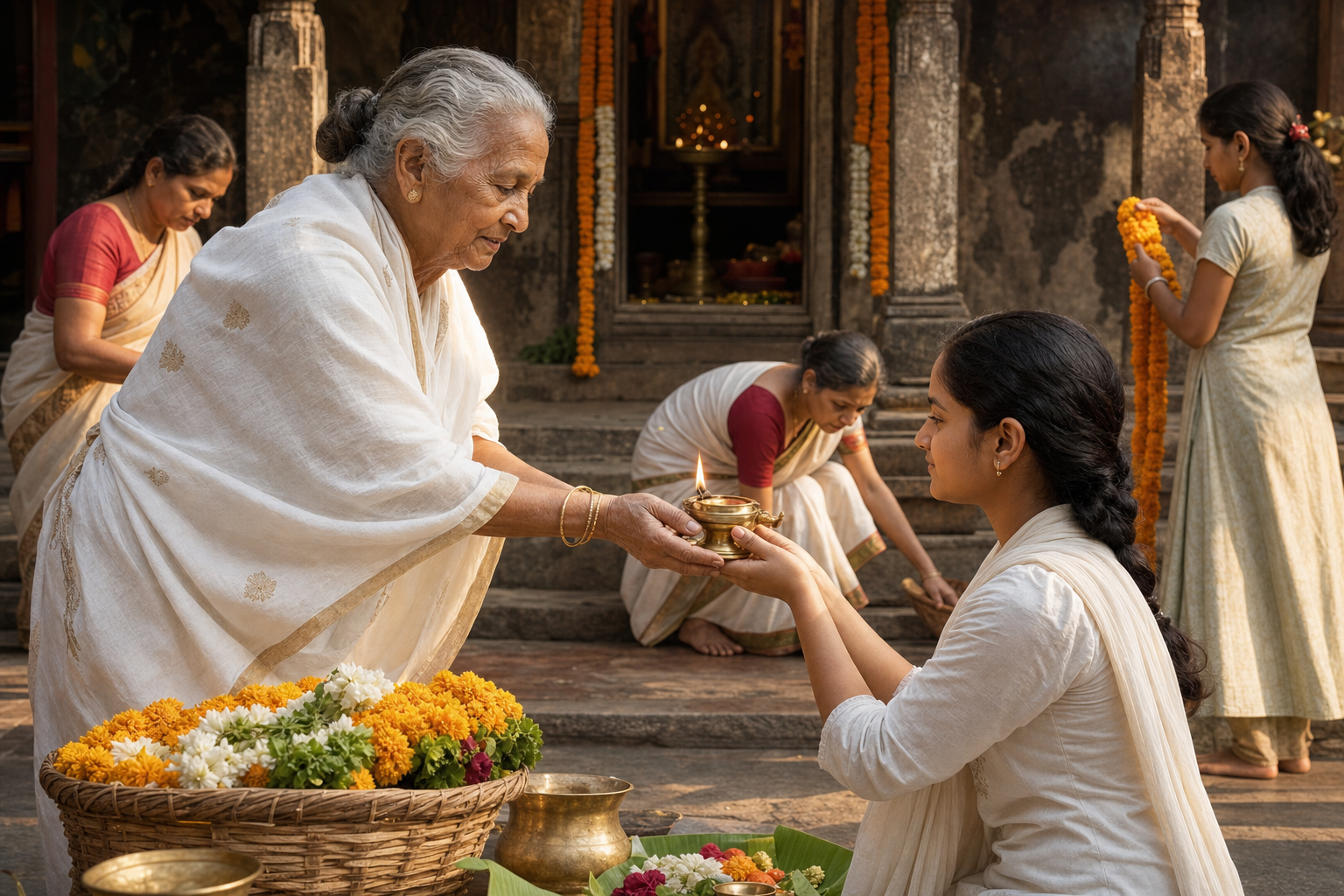
Sacred civic identity is the shared memory, moral vocabulary, and pattern of public action that grows around a sacred relationship. It does not require every resident to perform the same ritual. Nor does it give a city ownership over the divine. It means that generations have learned to understand their place, their duties, and sometimes their character through a particular form of Devi.
The name Kali Kalkattewali makes this relationship unusually clear. The title means the Lady of Calcutta, but it carries more than a geographical label. It expresses belonging, guardianship, and a bond between Kali and Kolkata’s collective life. The local title does not reduce the universal Goddess to a municipal symbol. It makes the relationship between Shakti and one particular place intelligible.
Khodiyar Mata shows why “regional” must not be mistaken for narrow or socially exclusive. Her veneration is rooted in western India, yet communities across Gujarat and Rajasthan share reverence for her. A tradition can be intensely local while crossing occupational, caste, and community boundaries. Its rootedness gives people a meeting ground; it need not build a wall.
If you need to explain your own region’s sacred identity, begin with three sentences:
- Name the Goddess exactly as the community invokes her, including the local epithet rather than replacing it with a generic label.
- Name the places, narratives, and practices through which the relationship has been inherited.
- Name the duty that follows from the relationship: protection, gratitude, courage, service, restraint, or care for a sacred landscape.
If you can supply only the first sentence, you have a slogan. If you can supply all three, you have the beginning of a civic tradition.
The sacred city is a network, not a pin on a map

A major temple may anchor a sacred geography, but it does not create that geography alone. The living network also includes routes, waterways, markets, workshops, household shrines, recitations, offerings, festivals, and acts of service.
In Kolkata, Kalighat and Dakshineswar are major spiritual anchors. Yet the civic relationship with Kali also runs through the Adi Ganga, historic ghats, the Kalighat bazaar, Kumartuli’s artisan workshops, neighborhood processions, and household lamps. During Kali Puja and Durga Puja, worship, craftsmanship, music, darshan, seva, and shared food bring that network into public view. For a time, the city functions as a distributed sacred space rather than as an audience gathered around one monument.
Khodiyar Mata’s regional network is carried through a different combination of forms. Her Katha has continued through manuscripts, temple recitations, oral retellings, household vrata, and community gatherings. The lesson is practical: sacred geography is sustained not only by where people travel, but also by how memory travels between temple, home, text, voice, and festival.
You can assess a local tradition with a four-layer audit:
- Sacred anchors: Which temple, shrine, riverbank, grove, or other place does the community regard as essential? Who maintains its ritual integrity?
- Connective routes: Which procession paths, pilgrimage approaches, ghats, lanes, or markets join sacred space to ordinary life? Are those routes treated with care outside festival days?
- Keepers and makers: Which priests, reciters, artisans, musicians, cooks, volunteers, and family custodians carry the tradition? Are they consulted and materially supported?
- Household and service practices: What can a family actually do – light a diya, hear a Katha, keep a suitable vrata, prepare a shared meal, or undertake seva – so that identity is lived rather than merely displayed?
Choose one neglected item in each layer before adding another stage, banner, or publicity campaign. A festival with impressive decoration but weakened recitation, under-supported artisans, unmanaged offerings, or no household continuity may be popular without strengthening the tradition that gave it meaning.
Keep the inheritance precise, but do not freeze it
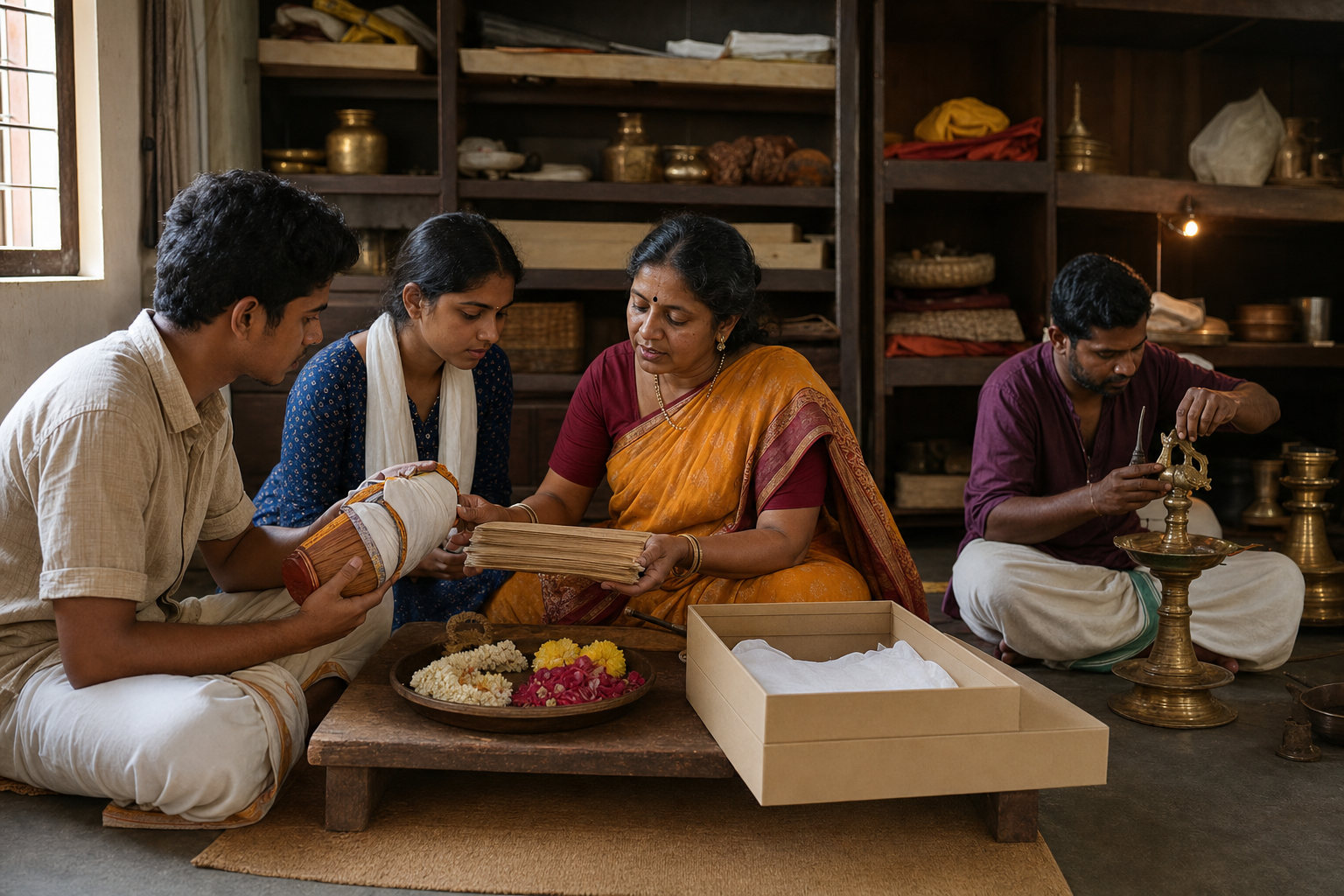
A living tradition needs both fidelity and room to breathe. Treating every inherited feature as interchangeable dissolves its character. Treating every later expression as illegitimate turns continuity into museum display.
The useful distinction is between sacred core and civic expression. The core includes the local name, central Katha, iconographic grammar, customary ritual, sacred places, and the authority of those who maintain them. Civic expression includes contemporary art, music, public service, educational programmes, neighborhood organization, and new media used to transmit the inheritance.
Kali’s iconography demonstrates why precision matters. Her sword can signify the cutting of ego; the severed head, the defeat of ignorance; the skull garland, time and impermanence; and her position over Shiva, the inseparability of Shakti and consciousness. These are not decorative accessories that can be assigned any convenient meaning. At the same time, Kumartuli’s artisans create images that can be classical and contemporary. Materials and artistic language may change while the theological structure remains recognizable.
The nineteenth-century life of Dakshineswar offers another form of responsible development. Rani Rashmoni’s temple complex created an institutional center, Ramakrishna’s tapasya presented Kali as the compassionate Mother as well as the fierce divine power, and Vivekananda carried a universal spiritual vocabulary into a wider arena. Temple, spiritual practice, and interpretation strengthened one another; expansion did not require the local form to disappear.
Khodiyar devotion gives the same principle a narrative form. The Katha has remained morally centered on steadfastness, protection of the vulnerable, gratitude, and maternal compassion while passing through written, oral, temple, and household settings. The medium can change without changing the ethical center.
Before approving a festival programme, exhibition, school presentation, or social-media campaign, ask five questions:
- Does it use the correct local name and identify the relevant place or lineage?
- Does it distinguish inherited custom from a new artistic or organizational choice?
- Have ritual custodians and traditional makers been consulted about elements that should not be altered?
- Does symbolism remain connected to spiritual discipline, or has it been reduced to spectacle and branding?
- What practice will the audience carry home after the event ends?
This review leaves room for creativity while preventing novelty from being misrepresented as ancient custom.
Make guardianship visible in public conduct
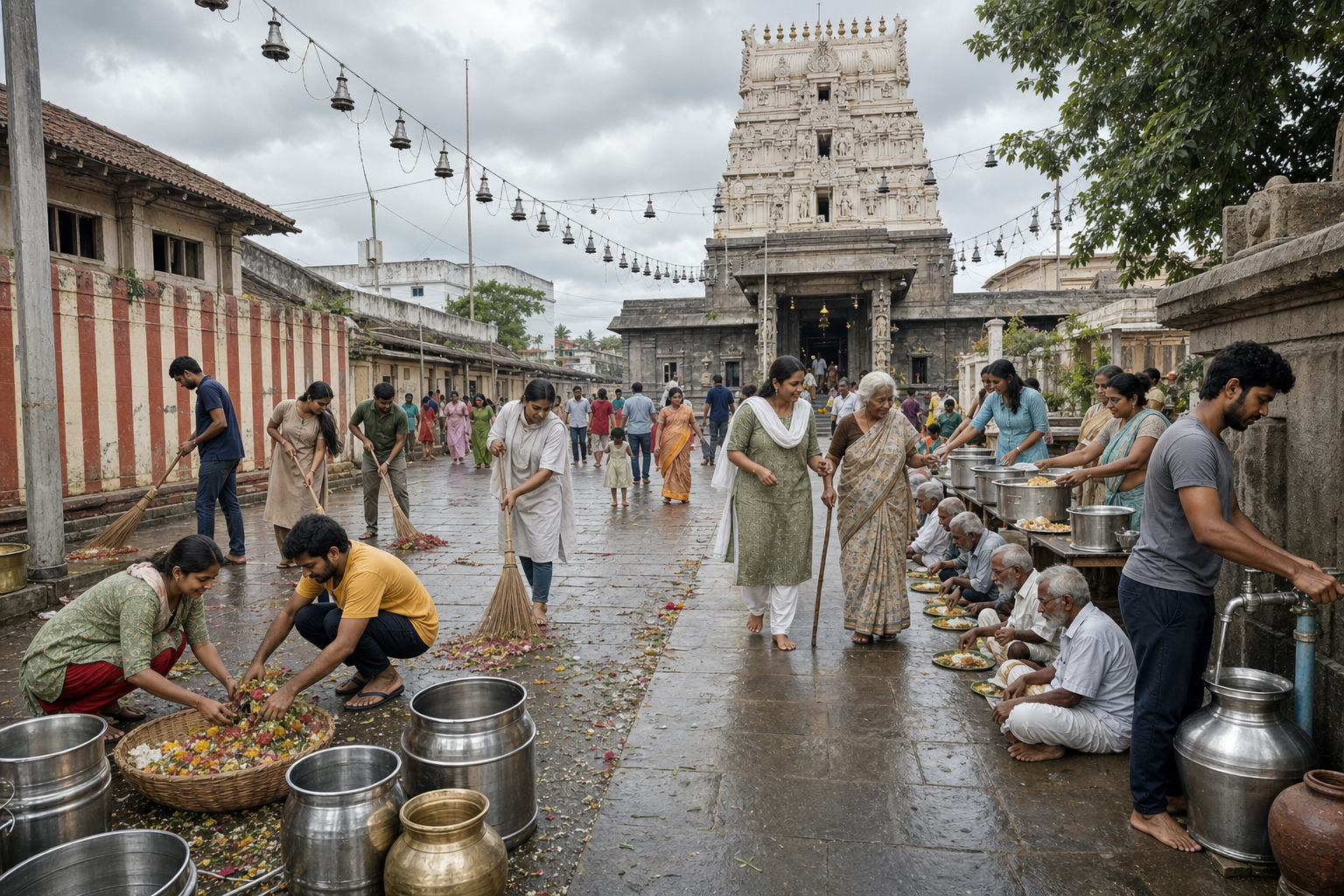
Calling a Goddess the guardian of a city creates a reciprocal obligation. Devotees cannot plausibly celebrate divine protection while neglecting the shrine environment, the people who sustain worship, or the vulnerable neighbors whom the tradition tells them to protect.
Give every festival duty an owner
Kolkata’s sacred civic ethos becomes tangible through mindful queueing, appropriate offerings, support for artisans, neighborhood philanthropy, and seva during pujas. These actions are not peripheral conveniences. They are ways of translating reverence into the conduct of a city.
A local organizing committee can make that translation concrete by assigning four responsibilities before discussing decorative extras:
- Ritual integrity: confirm the sequence, recitation, offerings, and temple customs with those responsible for worship.
- Darshan and route order: plan queues, procession movement, volunteer roles, and respectful access so that devotion does not produce needless disorder.
- Ecological care: identify accepted offerings, provide a clear way to handle remnants, and leave the shrine, route, and nearby water cleaner than the event found them.
- Livelihood and seva: budget for traditional makers and reciters, then connect the gathering to a specific act of food service, assistance, or protection for people in need.
The point is not to convert worship into a civic project plan. It is to prevent public scale from weakening sacred intention. Organization should protect the conditions in which darshan, hospitality, and self-discipline remain possible.
Build Dharmic unity without claiming false sameness
Regional Goddess traditions often unite people because they allow several forms of participation. Khodiyar Mata is revered among Charan, Rajput, Bania, Brahmin, Ahir, Bharwad, Patel, Bhoi Gurjar, Devipujak, and Luhar-Suthar communities. Their social histories do not become identical when they stand before the same Mother. Shared reverence creates a common moral center without erasing difference.
Kolkata offers another pattern. Shakta, Shaiva, and Vaishnava streams can meet around the Mother’s grace. Buddhist traditions may recognize a resonance with feminine wisdom expressed through Tara, while Jain and Sikh communities can participate in the city’s life through service, dialogue, and cultural solidarity. Spiritual resonance and civic cooperation coexist with distinct traditions; neither requires a claim that everyone performs the same worship or holds the same theology.
When you organize an inclusive observance, work with three circles of participation:
- Ritual participation belongs to those who freely undertake the worship and follow its customary discipline.
- Shared ethical action can include anyone committed to service, compassion, protection of the vulnerable, ecological care, or support for cultural livelihoods.
- Respectful civic presence allows neighbors of different paths to honor the community’s heritage without being asked to make a theological declaration.
This is stronger than ceremonial claims that all paths are simply the same. Dharmic unity matures when people cooperate in righteous action, understand where genuine affinities exist, and remain honest about difference.
Key takeaways for a living sacred civic identity
- A local title should express relationship and responsibility, not ownership or branding.
- Map the complete sacred network: anchors, routes, makers, household practices, and seva.
- Protect the local name, Katha, iconography, customs, and custodial authority while allowing responsible artistic and civic adaptation.
- Judge a public celebration partly by its conduct: orderly darshan, appropriate offerings, ecological care, fair support for cultural workers, and service to others.
- Build unity through shared reverence and ethical action without pretending that distinct Dharmic traditions are interchangeable.
Begin with one walk through your own sacred geography. Visit the shrine, trace one route, speak respectfully with a custodian or maker, and identify one duty the public celebration currently neglects. Make the next observance repair that gap. A sacred civic identity endures when people can see devotion becoming care.
References
- DharmaRenaissance Blog – Khodiyar Mata Jayanti 2026: Timeless 8th-Century Katha, Vrat Significance, and Dharmic Unity
- DharmaRenaissance Blog – How Kali Kalkattewali Became Kolkata’s Soul: History, Symbolism, and Sacred Identity
