
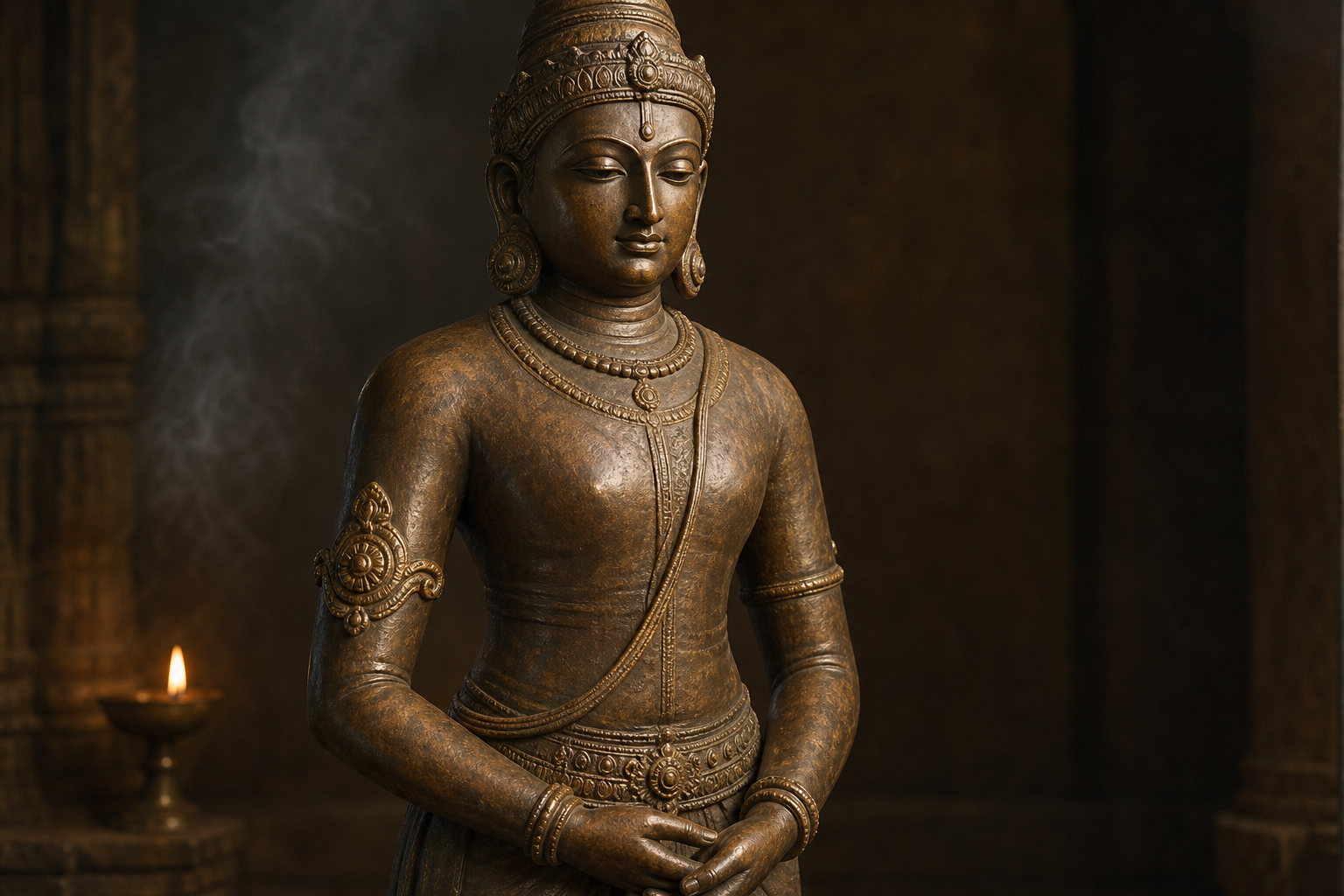
You are standing before a temple image, museum sculpture, or bronze murti, and a small band around the figure’s upper arm catches your eye. Is it simply jewelry, a sign of royalty, a protective emblem, or a clue to the figure’s identity? With the angada, the answer can be all four – but only if you read placement, form, material, and context together.
Start with one practical rule: do not isolate the ornament from the body wearing it. The angada belongs to a visual system. Its position tells you what kind of ornament it is; its motifs suggest a mood or protective function; its craftsmanship points toward a medium and regional tradition; and the identity of the wearer determines what its power means.
First locate the armlet on the sacred body
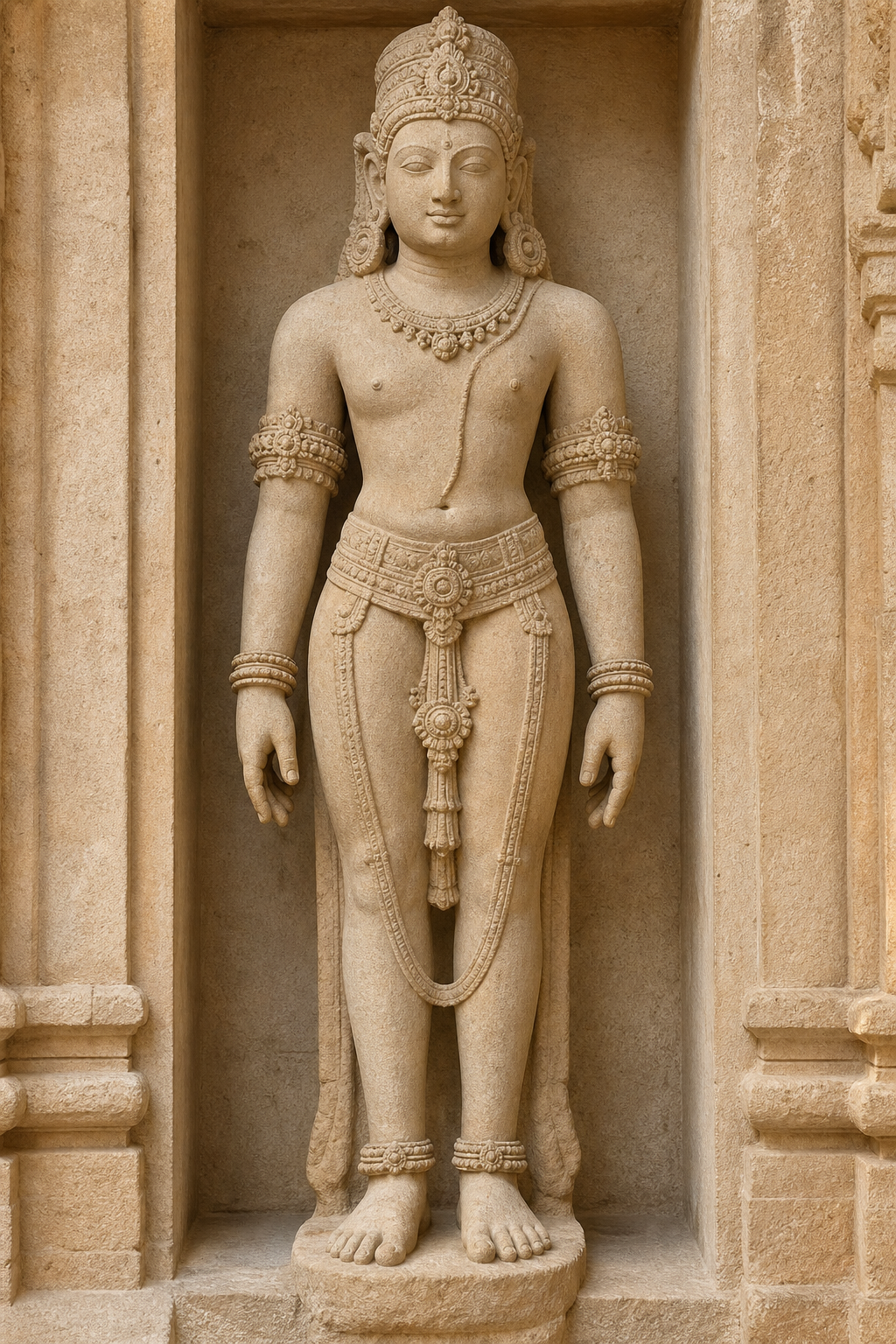
The angada is worn at the bahu desha, the upper arm. That placement distinguishes it from bracelets and other ornaments at the wrist. This sounds elementary, but it prevents a common mistake: treating every decorated band on an image’s arm as the same object.
Begin at the shoulder and move downward. An ornament encircling the fleshy part of the upper arm is the object under consideration. A band at the wrist belongs to another category. In the terminology used here, angada identifies the upper-arm ornament and keyura the wrist ornament. You will, however, encounter regional and textual traditions that reverse, overlap, or blend these terms. Treat that variation as a warning against relying on a label without checking the object’s physical position.
Next, look at the complete arrangement of adornment. Compare the upper-arm band with the wrist ornaments, necklaces, sacred thread or upavita, crown, belt, anklets, weapons, mudras, and posture. The combination matters more than any isolated jewel. A heavily adorned standing deity, a minimally ornamented ascetic form, and an ornamentless Jina may occupy the same temple complex while presenting sharply different relationships to worldly authority.
The angada’s location also explains much of its symbolism. The upper arm is where intention becomes directed action: it lifts, protects, draws a bow, holds an attribute, offers blessing, or subdues disorder. Encircling that part of the body gives the ornament the character of a binding or consecration. Strength is present, but it is strength placed under a vow. For a dharmic viewer, this is the crucial distinction between power and righteous power.
When you examine an image, therefore, ask a better question than “What does this jewel mean?” Ask: “What kind of action has been entrusted to this arm?” The answer may be protection, teaching, compassion, cosmic movement, royal guardianship, or the defeat of adharma. The armlet helps make that action legible.
Read shape, terminals, and material as separate layers
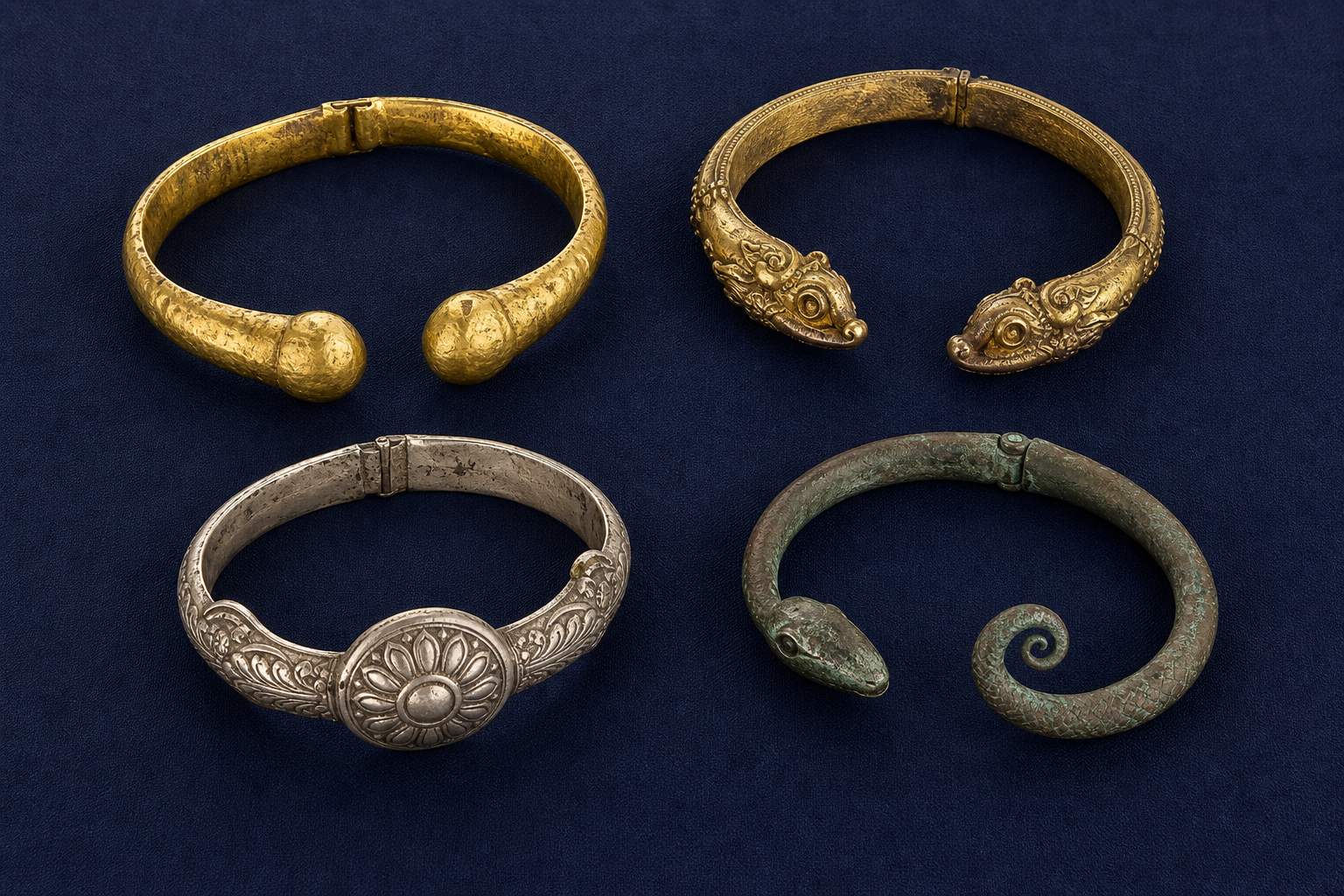
An angada does not carry a single fixed message. Its visual grammar has several layers, and you should inspect each one before drawing a conclusion.
- Profile: Is it a straight band, a row of beads, a rounded coil, or a V-shaped form?
- Terminals: Do the ends resemble leaves, makaras, yalis, masks, serpents, or simple clasps?
- Centre: Is there a lotus-like medallion, a simulated gem setting, or no dominant centre at all?
- Construction: Does it look like a continuous band, a hinged object, tied strands, or an ornament held by opposing terminals?
- Surface: Is the treatment smooth, incised, beaded, granulated, pierced, chased, or deeply undercut?
Several recurring forms are especially useful. A banded angada may carry orderly rows of beads. The chevron-shaped or V-shaped vanki creates a strong downward point against the upper arm and is prominent in many South Indian images. A serpentine form evokes naga-like guardianship, while a leaf-ended or floral form can soften the figure’s mood. These are tendencies, not mechanical translations. A floral terminal does not automatically make a figure benign, nor does an animal-headed terminal by itself prove a wrathful identity.
Terminal motifs sharpen the reading. Makara heads, kirtimukha masks, yali scrolls, serpentine forms, and lotus medallions bring different associations into the ornament. A kirtimukha or forceful yali can intensify a protective or martial mood. A lotus or leaf pattern may suit grace, fertility, auspiciousness, or composure. Opposed makara terminals can turn the armlet into a compact field of controlled animal energy.
Material adds another layer, although you must distinguish actual substance from represented substance. A surviving gold armlet, a gilt surface, a copper-alloy sculpture, and a stone carving that imitates gold jewelry are not materially equivalent. Yet all can use the visual language of precious adornment. Gold or gilding can suggest royal and solar radiance. Silver can carry a cooler, lunar quality. Warm copper alloys can reinforce vitality and martial presence.
Simulated gemstones demand the same caution. A carved oval or raised boss on stone may represent a gem setting without preserving any gem at all. Within the ornament’s symbolic vocabulary, ruby-like settings can signal energy, emerald-like settings fertility, and sapphire-like settings discipline. Unless pigment, inscription, or surviving material confirms the identification, describe what you can actually see: a cabochon-like boss, a jewel setting, or a central medallion. Do not turn a visual resemblance into a material claim.
This layered method keeps interpretation disciplined. First name the observable feature. Then state the association it may carry. Only after that should you relate it to the figure’s theological role. That sequence prevents an attractive motif from becoming an unsupported identification.
Let the wearer’s dharmic role control the interpretation
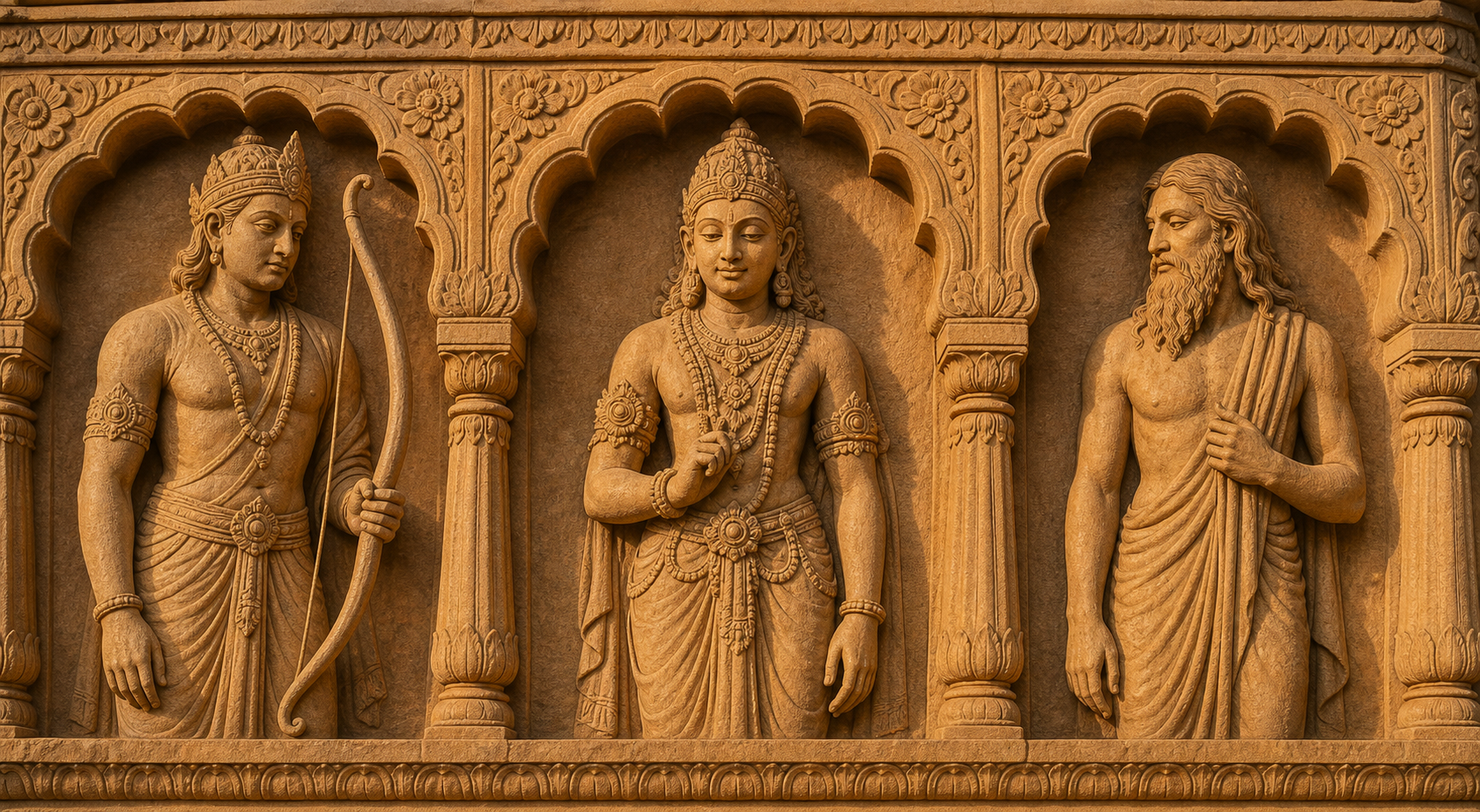
The same upper-arm ornament does not mean exactly the same thing on Vishnu, Durga, a bodhisattva, a Jain attendant, and a Sikh ruler. What travels across these traditions is a shared Indic vocabulary of disciplined power, protection, dignity, and auspicious presence. Each tradition gives that vocabulary its own theological emphasis.
In Vaishnava iconography, an angada on Vishnu or an avatara can express protective sovereignty governed by dharma. On Rama, the ornament belongs naturally to the visual world of the warrior who accepts restraint, duty, and consequence. On Krishna, heroic capacity coexists with grace. Do not read the armlet as mere royal luxury; read it beside the weapon, gesture, posture, and narrative moment.
Shaiva images show why context is indispensable. An ascetic presentation of Shiva may suppress elaborate ornament to foreground detachment. Nataraja, by contrast, can bear pronounced adornment while performing cosmic action. Bhairava may use forceful ornaments and terminals to heighten protective ferocity. The difference is not a contradiction. Shiva’s forms disclose different relations among renunciation, sovereignty, danger, grace, and cosmic responsibility.
In Shakta imagery, especially martial forms of the Devi, the armlet can appear like a consecration of strength at the place from which weapons are wielded. On Durga, it helps frame combat not as uncontrolled violence but as action directed against adharma. Look for agreement among the armlet, weapons, facial expression, stance, and the movement of attendant figures. If those elements point in different directions, preserve the ambiguity rather than forcing a simple label.
Mahayana bodhisattvas such as Avalokiteshvara, Maitreya, and Manjushri are often richly adorned. Their armlets communicate a regal presence placed in the service of awakening and compassionate responsibility. Here adornment does not necessarily imply attachment to luxury. It distinguishes the active, accessible bodhisattva ideal from the visual language of complete renunciation.
That contrast becomes particularly useful in Jain settings. Jinas are generally presented without ornaments, making renunciation and spiritual victory visible through restraint. Yakshas, Yakshis, and other attendants may wear armlets and fuller adornment. If you encounter an ornamented figure in a Jain sculptural program, do not identify it as a Jina on the strength of sanctity or central placement alone. Check the bodily treatment, attributes, attendants, and the wider iconographic arrangement.
Sikh historical art and regal portraiture carry the armlet into another setting through the bazuband. There it can support a language of valor, protection, and dignified martial bearing. The continuity is cultural and visual, not proof that every community assigns the ornament an identical doctrine.
This cross-dharmic range teaches a useful discipline: similarity of form does not erase difference of meaning. Hindu deities, Mahayana bodhisattvas, Jain attendant figures, and Sikh martial portraits participate in a related material culture, but the figure’s identity, religious setting, and ethical role must lead your interpretation.
Craftsmanship can reveal how and where an image was made
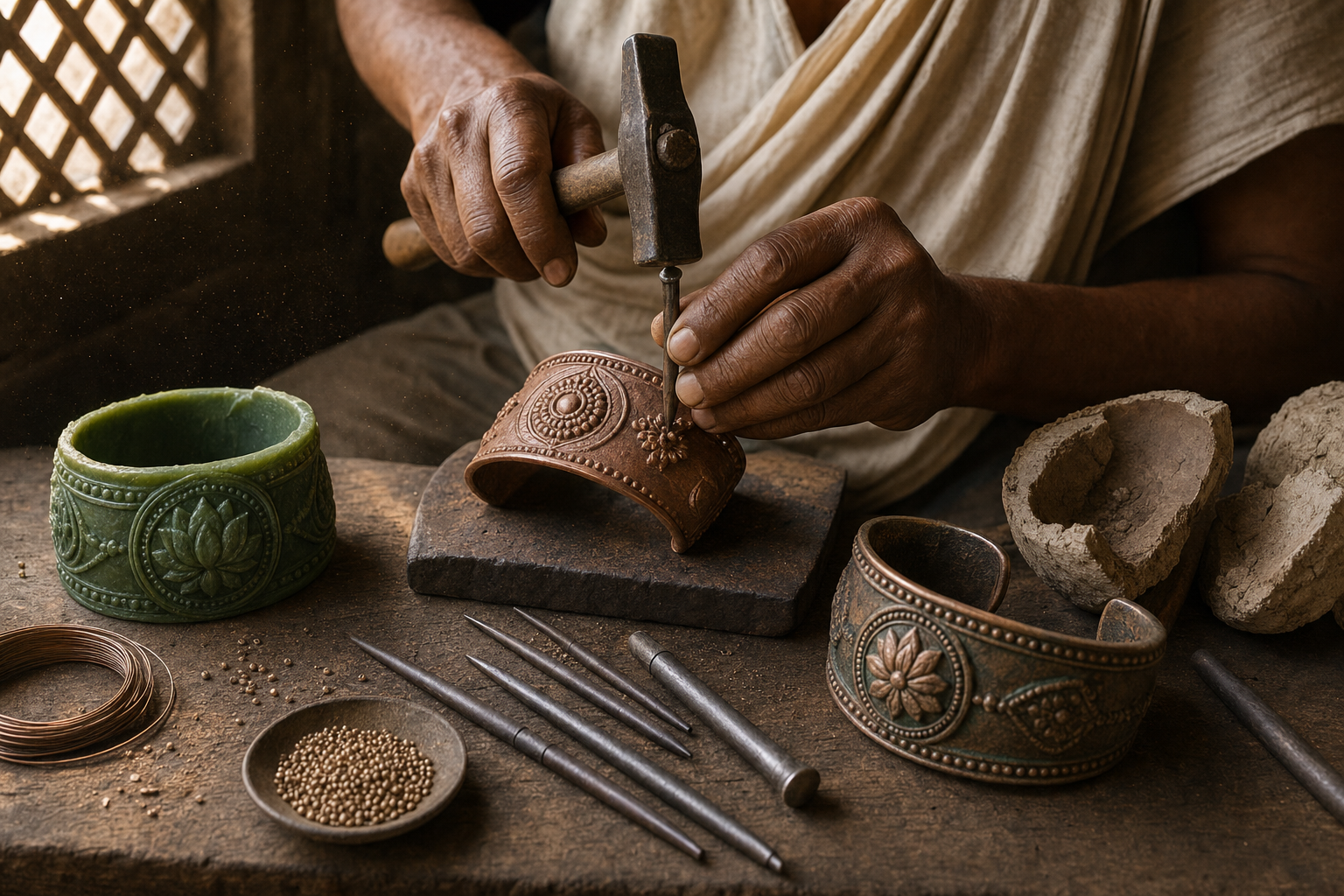
Once you have read the symbolism, turn to manufacture. The angada is often small enough to be overlooked but detailed enough to expose the habits of a workshop. Its edges, bead rows, recesses, and terminals preserve choices made by a modeller, caster, carver, painter, or later restorer.
On metal images, especially South Indian ritual bronzes, armlet details can be established during lost-wax modelling and refined after casting through chasing and incision. The ornament therefore participates in the anatomy from the beginning; it is not necessarily an accessory attached after the body was completed. On a well-resolved bronze, watch how the band follows the curve of the arm without making the limb look stiff. The balance among width, curvature, and shoulder mass is part of the sculptural achievement.
Stone reverses the technical problem. A carver must create the illusion that a band rests on living flesh while leaving enough material to prevent fragile edges from breaking. High-relief beads, projecting finials, pierced-looking gaps, and undercut borders show how far the workshop pushed the stone. Hard granite generally encourages broader, more durable treatment; softer and finer-grained carving stones permit lace-like borders and deeper recesses.
Painting creates jewelry without physical relief. Murals and manuscript images may use highlights, fine lines, dots, and colour changes to imitate filigree, granulation, metal shine, or gemstone settings. When you compare a painted angada with a carved one, compare the function of the detail rather than expecting identical technique: both can separate the ornament from the skin, mark its centre, and direct the eye toward the active arm.
Regional patterns can support an attribution, but no armlet should date a sculpture by itself. Use these features as clues to test against anatomy, drapery, crown type, pedestal, attributes, stone, casting method, and documented provenance:
- Mathura and Gupta traditions: Look for rhythmic bead-strand bands that remain harmonious with soft bodily modelling and composed poses.
- Gandharan bodhisattvas: Cabochon-like settings and scrollwork can reflect classical visual influences translated into Buddhist devotional imagery.
- Pala-Sena Bengal and Bihar: Lush continuous bands and lotus-centred designs can accompany richly ornamented bodhisattvas and goddesses.
- Kalinga traditions of Odisha: Emphatic terminals and crisp foliated scrolls can make the upper-arm ornament unusually assertive.
- Chalukya and Hoysala carving: Deep undercutting and fine borders can give the armlet a lace-like character, especially where the stone permits minute detail.
- Kakatiya and Vijayanagara traditions: Pronounced vanki profiles, sometimes joined to makara or yali finials, can reinforce the energy of goddesses and royal figures.
- Chola bronzes: Carefully scaled V-shaped armlets can preserve the flow of a lithe arm while adding majesty, especially in images of Nataraja and Parvati.
The most defensible observation is comparative: “This V-shaped profile and these animal terminals resemble a regional pattern.” The least defensible is absolute: “This motif proves the sculpture came from one dynasty.” Style moves through pilgrimage, patronage, imitation, portable objects, and later restoration. Let the angada narrow a question, not close it prematurely.
Use a repeatable method in temples, museums, and performances
You do not need specialist equipment to make a useful first reading. You need a consistent order of attention. On your next encounter, work through these steps:
- Locate it. Confirm that the band sits on the upper arm rather than the wrist. Record the terminology used on the label, but do not let the label override the physical evidence.
- Describe before interpreting. Note whether the cross-section is flat, rounded, beaded, coiled, or V-shaped. Record the centre, terminals, and visible clasp or continuity.
- Identify the medium. Separate actual gold, silver, copper alloy, stone, pigment, and gilding from simulated jewels or metalwork carved into another material.
- Read the whole figure. Check posture, expression, weapons, mudras, crown, necklaces, sacred thread, wrist ornaments, attendants, and pedestal.
- Test the religious role. Ask whether the figure is a deity, avatara, bodhisattva, Jina, attendant, donor, ruler, dancer, or guardian. Let that role qualify the ornament’s meaning.
- Compare regional habits. Use the armlet’s profile and workmanship alongside anatomy, drapery, stone, and other ornaments. Phrase your conclusion as a probability when provenance is uncertain.
- Check condition. Missing beads, broken terminals, dark patina, ritual coatings, and aggressive cleaning can alter what you see. An apparently plain band may once have carried much finer detail.
Condition deserves special attention because projecting beads and clasp edges are vulnerable. On stone, weathering can flatten a once-complex terminal. On bronze, patination and ritual accretions can obscure chasing or simulated granulation. These changes are not merely defects. In a living temple, accumulated ritual material may also testify to continued worship. Documentation and minimal intervention preserve more information than an attempt to make every surface look newly made.
The angada also survives outside fixed sacred images. Bharatanatyam, Kuchipudi, and Odissi costume use upper-arm ornaments to sustain recognizable silhouettes of divinity, heroism, and royal bearing. Wedding bajubands and vankis can carry the same vocabulary into a vow-centred human setting. When you see these forms in performance or ceremony, compare their placement and profile with temple imagery. You are watching material culture move between murti, body, ritual, and memory.
Key takeaways
- The angada belongs on the upper arm, but terminology such as angada and keyura can vary across regions and texts.
- Shape, terminal motif, represented material, wearer, and religious setting must be read together.
- The ornament commonly joins bodily strength to protection, vow, sovereignty, compassion, or disciplined action; it does not signify brute force alone.
- Similar armlets appear across Hindu, Buddhist, Jain, and Sikh visual cultures, but formal continuity does not make their meanings identical.
- Workshop technique and regional style can support attribution, yet an armlet by itself cannot securely date or identify an image.
- Wear, patina, breakage, and ritual accretions may conceal details while preserving evidence of an object’s history.
The next time an armlet appears in a temple niche, museum case, dance costume, or family ceremony, pause at the upper arm. Name what you can actually see, relate it to the figure’s action, and keep certainty proportional to the evidence. That small discipline turns an overlooked ornament into a precise way of reading how dharmic culture binds strength to responsibility.