
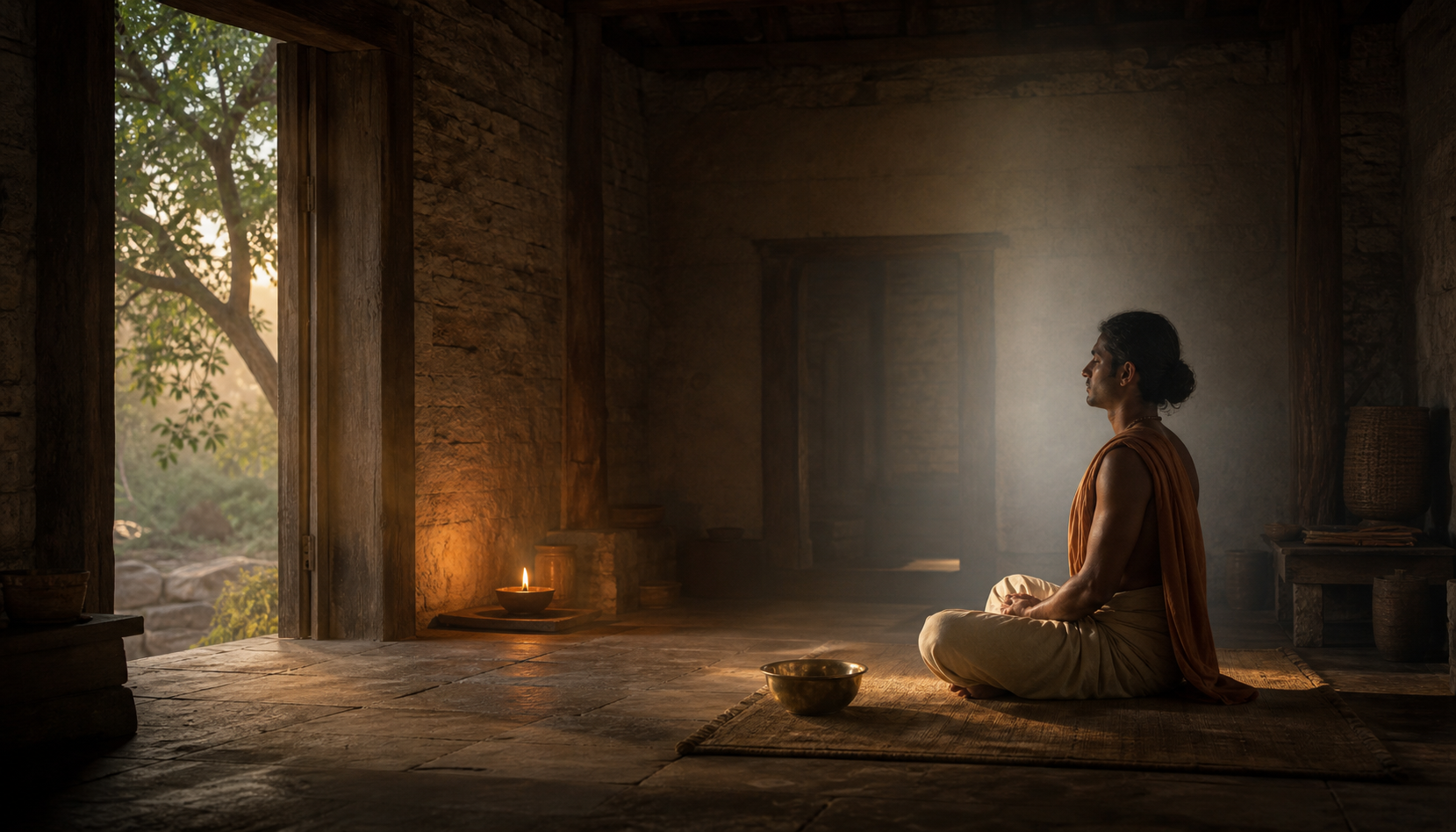
You may have come to the Maitri Upanishad after learning that Yoga has eight limbs, only to find six listed here in an unfamiliar order. Nothing is missing. You are looking at a compact map of interior practice, designed to carry attention from restless embodiment to direct knowledge of the Self.
The useful question is therefore not which list is correct. Ask what obstruction each limb removes. Breath is steadied, the senses lose their grip, attention gathers, discernment becomes exact, and contemplative knowledge ripens beyond concepts. Read that way, sixfold Yoga becomes a method you can actually follow rather than another list to memorize.
Why six limbs are enough for this interior journey
The Maitri, also called the Maitrāyaṇīya Upanishad, belongs to the Maitrāyaṇīya branch of the Krishna Yajurveda. Traditional memory places its wisdom in Vedic antiquity, while modern textual scholarship generally locates its formation between the fourth and second centuries BCE, with possible additions in the early centuries CE. Manuscripts may contain six or seven lessons, and their vocabulary and arrangement can vary. That layered transmission explains why translations do not always look identical.
This matters when you study the six limbs. Do not silently rearrange them merely because another yogic system uses a sequence you know better. In the Maitri sequence, dhyāna appears before dhāraṇā. Read the terms within this teaching’s own movement: entering contemplation, stabilizing it, examining experience through discriminative inquiry, and finally passing beyond merely conceptual knowledge.
The sequence is not presented as a complete inventory of every ethical, bodily, devotional, or social discipline a seeker could need. Its concern is narrower and deeper: how a time-bound, sense-driven mind becomes capable of recognizing ātman as Brahman. The six limbs form the contemplative core of that movement.
This focus also clarifies the Maitri Upanishad’s place within the wider Dharmic family. Its concern with suffering has a clear resonance with Buddhist analysis; its restraint and interior purification can speak to Jain practice; and its orientation toward the One can enter a fruitful conversation with Sikh remembrance. Yet shared disciplines should not be used to erase doctrinal distinctions. The Upanishadic path affirms ātman, whereas Buddhist teachings on anattā deny a permanent self. Respectful comparison begins by preserving that difference.
How each limb prepares the ground for the next
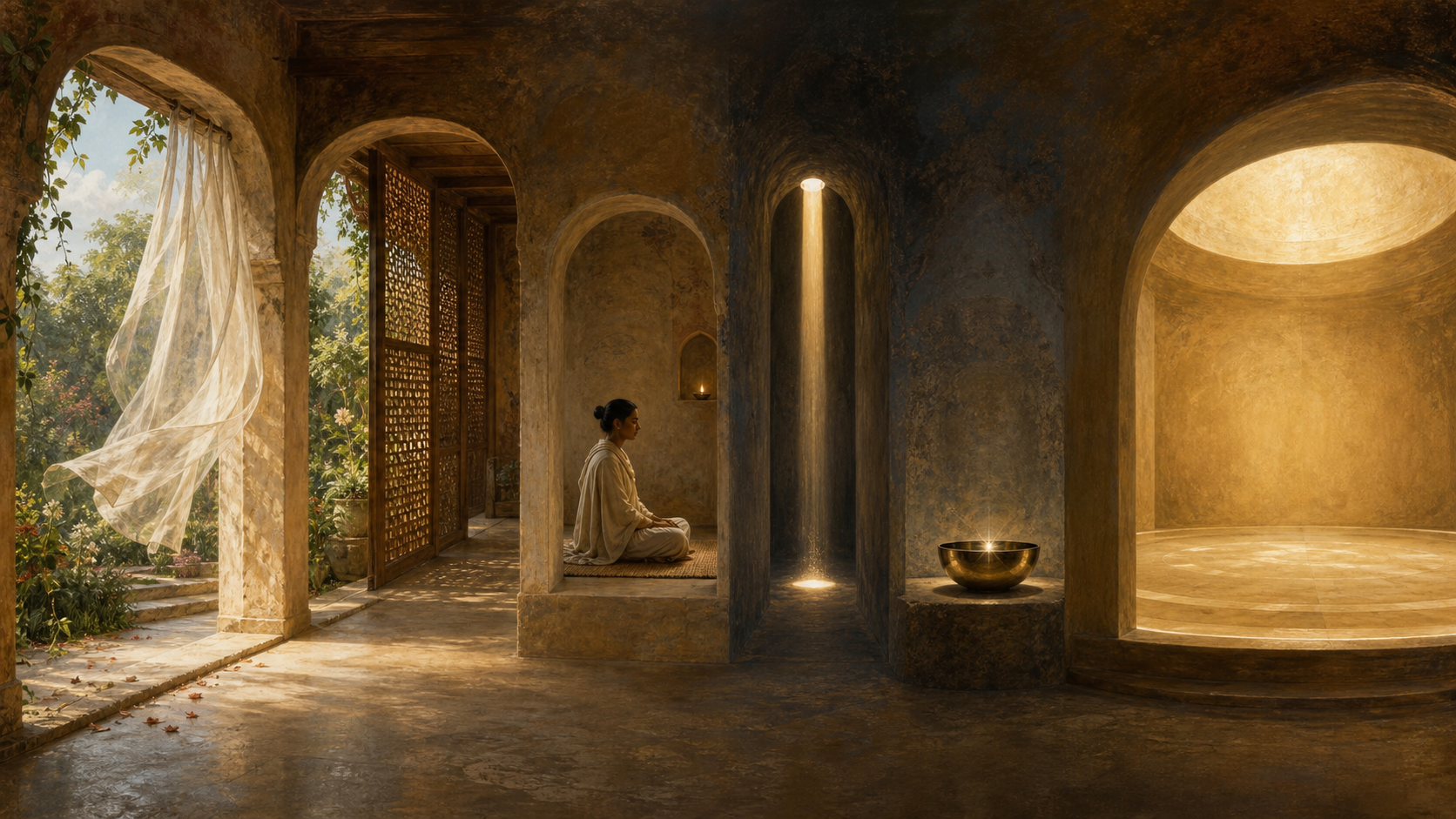
- Prāṇāyāma regulates the breath. Agitation rarely remains confined to thought; it appears in hurried, uneven, or effortful breathing. Gentle regulation gives attention a steadier bodily foundation. Traditional practice can include measured inhalation, retention, and exhalation, but strain is not a sign of progress. If regulation produces dizziness, pain, air hunger, or panic, stop and return to ordinary breathing. Forceful retention belongs under qualified guidance, especially when a health condition may be affected by breath practice.
- Pratyāhāra loosens sensory compulsion. Withdrawal does not require hating the world, suppressing perception, or pretending that sounds have disappeared. Let the senses register what is present without turning every sight, sound, or sensation into a command. The practical test is simple: can a sound occur without your mind having to pursue its cause?
- Dhyāna establishes contemplative continuity. Attention now stays with a chosen support instead of repeatedly beginning again. Om is especially important here because sound, breath, awareness, and meaning can converge in a single practice. You are not repeating a syllable merely to crowd out thought. You are letting praṇava orient the mind toward Brahman.
- Dhāraṇā stabilizes what dhyāna has opened. The boundary between these two terms can appear differently across translations, so avoid forcing an artificial distinction. For practice, treat dhyāna as entering sustained contemplation and dhāraṇā as holding attention steady when memory, planning, sensation, or fantasy tries to carry it away.
- Tarka discriminates the enduring from the transient. This is not debate for its own sake. It is contemplative inquiry applied to immediate experience. A sensation changes; a thought changes; a mood changes. What knows those changes? Tarka keeps meditation from becoming passive pleasantness because it asks what, within experience, is actually real and enduring.
- Samādhi is unitive absorption. Here knowing is no longer confined to thinking about ātman and Brahman. The division between knower, knowing, and known falls away in direct apprehension. Calmness may support this movement, but calmness alone is not samādhi. Do not mistake temporary relief, blankness, or reduced thought for realization.
The limbs work by dependency. Breath regulation supports sensory independence. Sensory independence makes continuity of attention possible. Stable attention gives inquiry enough clarity to penetrate appearances. Discernment then prepares the surrender of conceptual division. If your mind is scattering during inquiry, return to the earlier condition that has not yet been established; do not answer instability by asking a more elaborate philosophical question.
A careful daily way to practise the sequence
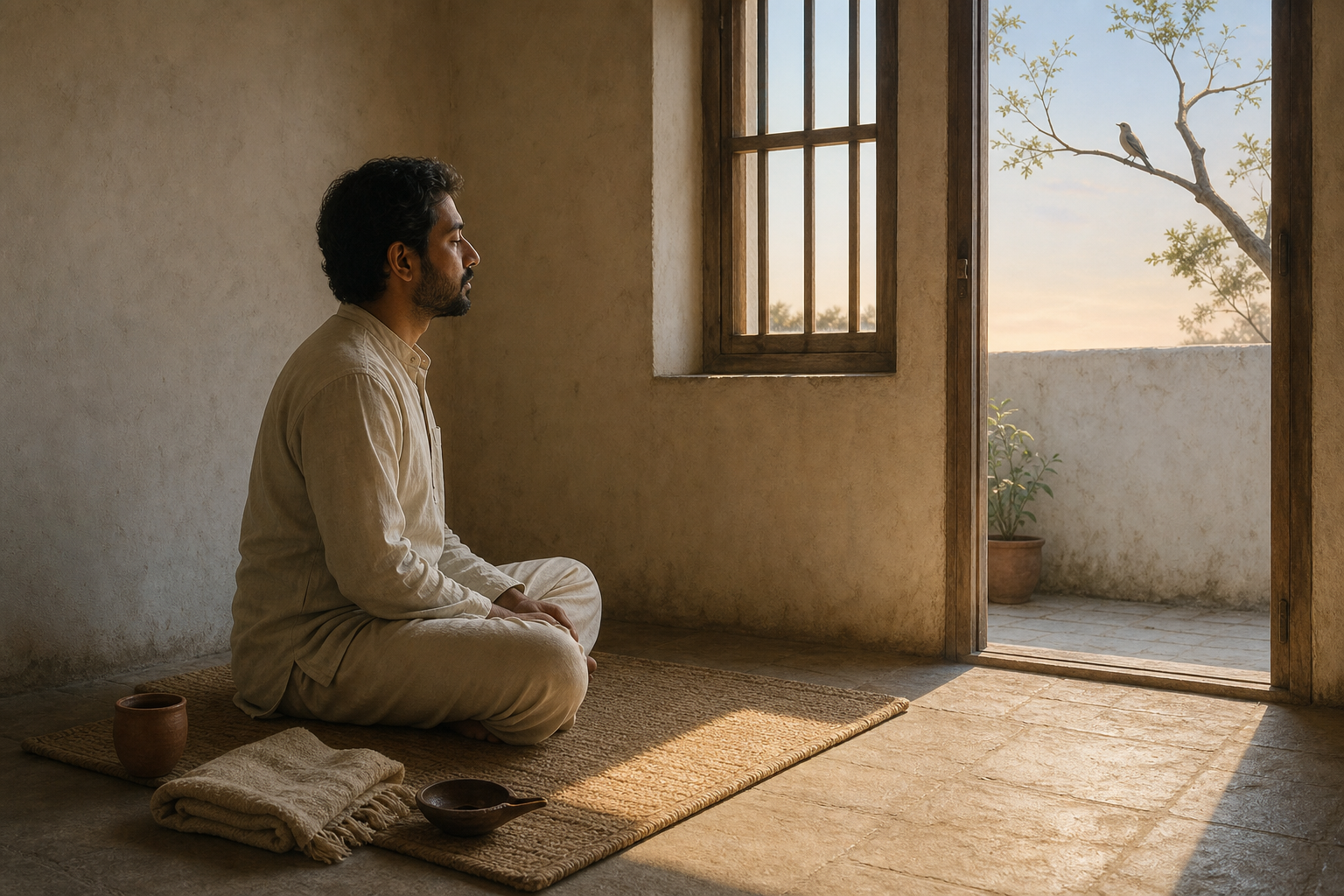
You do not need to simulate an advanced state or compress the whole path into one dramatic sitting. A simple contemporary adaptation can let you encounter the logic of all six limbs. Use it as an introductory discipline, not as a substitute for a competent teacher or sustained study.
- Begin with prāṇāyāma. Sit in a position that is stable enough not to demand constant correction. Let the breathing settle, then follow each inhalation and exhalation without imposing an aggressive ratio. Soften unnecessary effort in the jaw, throat, shoulders, and abdomen. The aim is collectedness, not endurance.
- Move into pratyāhāra. Put alerts and devices beyond reach before closing or softening the eyes. Notice sound, contact, temperature, and bodily sensation, but do not elaborate them into stories. When attention follows an object, acknowledge the movement and release it.
- Enter dhyāna through Om. Repeat Om softly or inwardly. Attend to the sound, its resonance, and the silence into which it resolves. Let its meaning remain present: waking, dream, deep sleep, and the unconditioned ground are not disconnected realities but modes disclosed within awareness.
- Establish dhāraṇā. Keep returning to the same support. Do not change techniques every time the mind becomes bored. A return made without irritation is itself part of concentration. If Om becomes mechanical, recover its contemplative meaning rather than increasing speed.
- Introduce one tarka question. Ask: what changed during this sitting, and what knew the change? Do not produce a rehearsed Vedāntic answer. Examine the arising and passing of an actual sensation, image, memory, or thought. Inquiry is useful only while it sharpens seeing.
- Release the question toward samādhi. After inquiry has done its work, stop manufacturing answers. Rest without pursuing the next thought or claiming an attainment. Samādhi cannot be forced into existence by self-description. End the sitting carefully and notice whether the next ordinary action is less automatic.
Judge the practice by its effect on compulsion, not by how unusual the sitting felt. Can you notice an impulse before obeying it? Can you hear criticism without immediately constructing a defence? Can you recognize a changing mood as changing? These are modest but meaningful indications that breath, withdrawal, concentration, and discrimination are beginning to operate together.
Consistency matters more than intensity. A short, unforced practice repeated faithfully is more aligned with abhyāsa than an occasional session built around strain. When breath is unsettled, simplify the breath. When the senses are agitated, strengthen withdrawal. When attention is dull, recover the meaning of Om. When inquiry becomes verbal argument, return to direct observation.
Use tarka to test the teaching in ordinary life
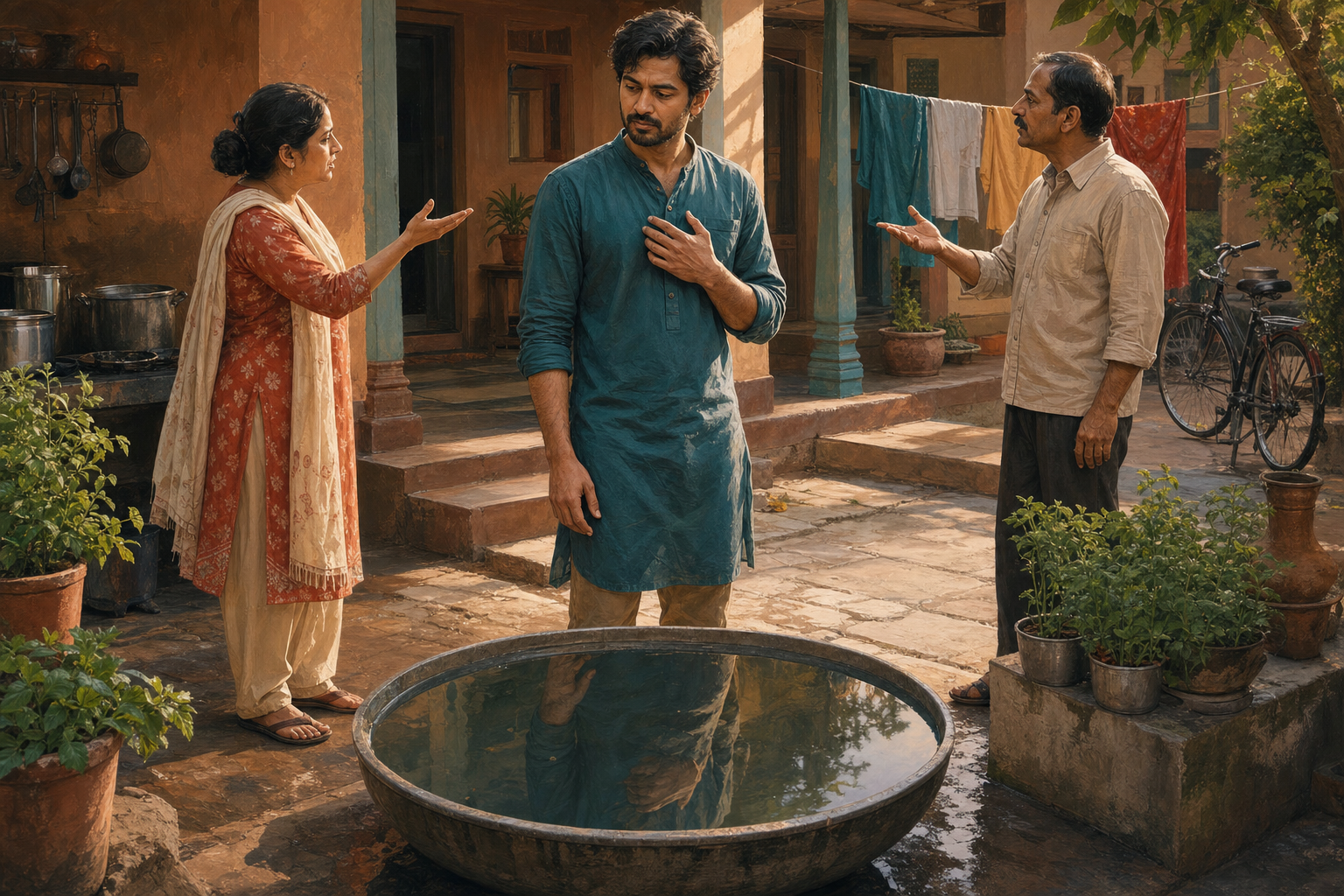
Name the field of suffering before choosing a response
The Maitri tradition recognizes three fields of suffering: adhyātmika, arising within body and mind; adhibhautika, arising through other beings; and adhidaivika, arising from forces beyond immediate control. This classification prevents a common spiritual error: trying to use one interior technique as the answer to every kind of difficulty.
When distress belongs to body or mind, meditation may clarify your relationship to it, but it does not make appropriate care unnecessary. When harm comes through another person, inner equanimity does not eliminate the need for a boundary or practical action. When circumstances cannot be controlled, practice can reveal the difference between the event and the mind’s multiplying resistance. The Maitri path joins knowledge with disciplined practice; it does not ask you to rename avoidance as transcendence.
Separate clock time from the awareness of time
One of the Maitri Upanishad’s sharpest distinctions is between time as the cyclic, measurable order of phenomenal existence and the timeless ground beyond that process. This is not permission to ignore deadlines, ageing, loss, or consequence. It is an invitation to notice that awareness of change is not simply another changing object.
When urgency takes over, separate three things: the task that must be completed, the bodily and mental agitation surrounding it, and the awareness in which both are known. Then do the task. The point is not to deny time but to stop mistaking your deepest identity for the pressure generated within time.
Examine consciousness without chasing a special state
Waking, dream, and deep sleep differ radically in their objects and modes of experience. The Upanishadic inquiry points beyond all three toward turīya, the unconditioned witnessing reality in which the other states arise and subside. Turīya should not be treated as a fourth spectacle to acquire after collecting three ordinary states. It names the ground that is not exhausted by any one of them.
You can bring this inquiry into meditation by noticing every appearance as an appearance: bodily contact, inner speech, remembered image, silence, and even the thought that meditation is going well. Each has a beginning and an end. Tarka asks what their changing character reveals. It does not license the ego to announce that it has become the witness.
This is also why Om is more than a relaxation device. Its contemplative use gathers breath and attention while directing them beyond the shifting states of consciousness. Method and meaning remain joined: yogic discipline steadies the instrument, while Vedāntic discrimination prevents the instrument from becoming the final object of worship.
Key takeaways
- The six limbs are prāṇāyāma, pratyāhāra, dhyāna, dhāraṇā, tarka, and samādhi.
- The sequence is an interior method, not a claim that every other ethical, devotional, or bodily discipline is unnecessary.
- Tarka means contemplative discrimination here, not argument for its own sake.
- Om unites breath, attention, and the inquiry into waking, dream, deep sleep, and the unconditioned ground.
- Samādhi is not interchangeable with calmness, blankness, or temporary relief from thought.
- When a later limb becomes unstable, return to the earlier condition that supports it instead of forcing the practice forward.
At your next sitting, work with the first obstruction that is actually present. Steady an agitated breath, release a compelling sensation, return a scattered attention, or test an assumption that has gone unquestioned. The sixfold path becomes real when each limb answers the condition in front of you.