
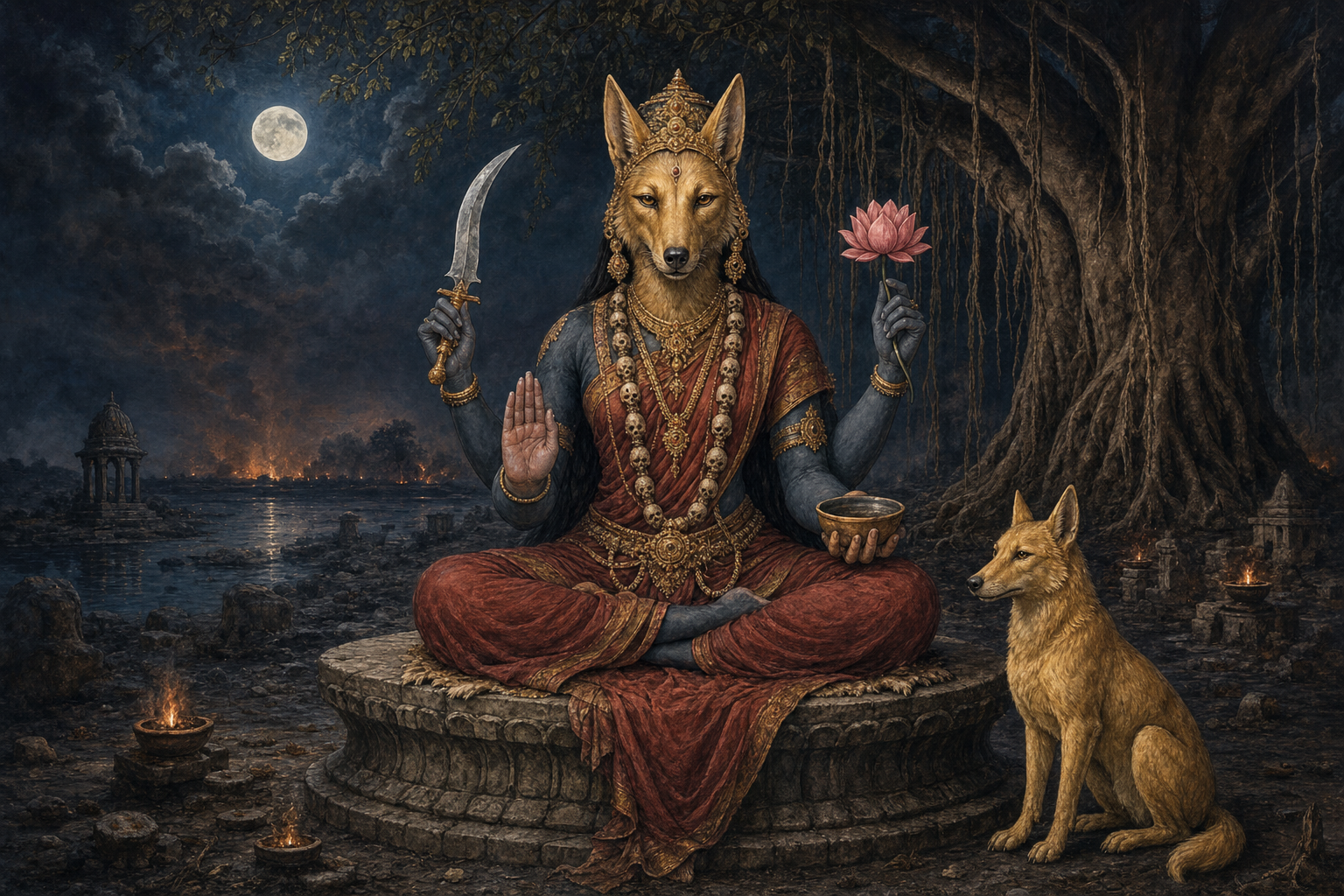
You have found a photograph, sculpture, or village memory associated with a jackal-faced Goddess. A caption calls her Shiyali Kali or Kokmukha Devi. Before you repeat that identification, you need to know what the image actually establishes, what the wider Shakta tradition makes plausible, and where certainty ends.
The responsible answer is rarely a simple yes or no. Shiyali Kali is intelligible within the iconographic world of Kali, Chamunda, the Yoginis, and the cremation ground, but explicit printed attestations of that exact name remain scarce. You can still investigate the form seriously. The key is to keep observation, identification, and interpretation separate.
The name is a valuable lead, not proof of identity
Shiyali plausibly relates to shiyal, the Bengali and Assamese word for jackal. Kokmukha is understood in vernacular or Prakritized usage as a jackal-faced form. That linguistic fit matters, especially when the name survives in eastern Indian speech rather than in a standardized Sanskrit catalogue. It does not, by itself, prove that an unidentified sculpture bears that name.
Rare deities often reach us through several channels at once: a local pronunciation, a priestly memory, a damaged image, a later museum label, or a comparison with better-documented goddesses. Those channels can reinforce one another, but they are not interchangeable. A name remembered by a hereditary priest is evidence about living tradition. An inscription carved on the original pedestal is evidence about the object. A modern caption is a curatorial identification that still needs a basis.
Use three confidence levels whenever you describe a possible Shiyali Kali:
- Secure: the form has a legible inscription, a documented ritual name, or a traceable custodial tradition that identifies it.
- Plausible: the face, attributes, setting, and regional name agree, but no decisive label survives.
- Speculative: the identification rests mainly on resemblance or on a modern reconstruction of Shakta symbolism.
This vocabulary lets you preserve a promising identification without turning a possibility into a fact. Instead of writing that an image is Shiyali Kali, you may need to write that it is a jackal-faced Shakta figure locally identified as Shiyali Kali, or that it is a possible Kokmukha-type Goddess. That small change protects the integrity of both the object and the tradition.
Inspect the whole image before naming the Goddess
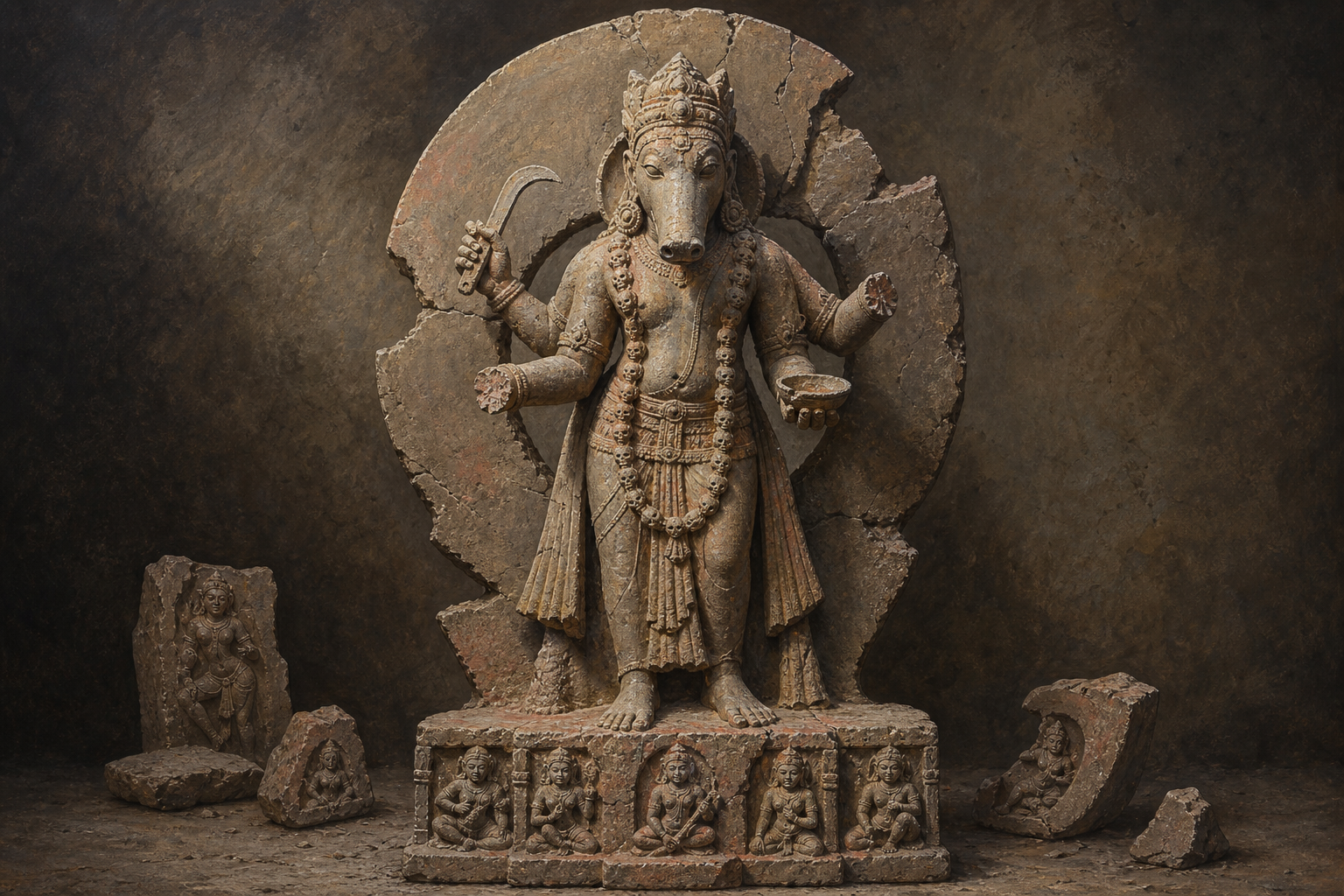
A damaged canid face is easy to misread. Jackal, dog, and wolf features can converge in weathered stone, regional sculptural styles, or photographs taken directly from the front. Examine muzzle length, ear shape, head proportions, and bodily posture together. If possible, compare frontal and profile views rather than relying on one image.
The surrounding field is just as important as the face. A skull-bowl, chopper, corpse, jackal attendant, cremation-ground scene, noose, or drum can place the figure within a fierce Shakta vocabulary. Yet no single attribute settles the name. A jackal standing beside a Goddess is not the same iconographic statement as a Goddess with a jackal face.
| What you observe | What it can support | What it cannot prove alone |
|---|---|---|
| An elongated canid muzzle and prominent ears | A possible jackal-faced or other canid-faced figure | The name Shiyali Kali or Kokmukha Devi |
| Skulls, a corpse, ghouls, or cremation-ground imagery | Association with a fierce, death-facing Shakta setting | One particular Goddess rather than Kali, Chamunda, or a Yogini-related form |
| A skull-bowl, chopper, noose, or drum | Participation in an established fierce-Goddess vocabulary | A fixed canonical set of attributes for Shiyali Kali |
| A jackal attendant | A relationship with charnel-ground and liminal symbolism | That the principal figure is herself jackal-faced |
| A local name preserved by custodians | A living regional identification worthy of documentation | The antiquity of that name unless its transmission can be traced |
| An inscription on the original image or pedestal | The strongest object-specific lead, if legible and correctly read | More than the surviving words actually state |
Also check whether the head belongs to the principal deity, an attendant, a mount, or a damaged figure behind her. Circular Yogini ensembles and crowded sculptural panels can produce misleading crops. A photograph that excludes the base, neighboring figures, or architectural position may remove the very clues needed for identification.
The absence of an unambiguous museum label does not disprove a Kokmukha identification. It also does not authorize certainty. Treat an unlabeled image as an open question and record the features that make the proposed name plausible.
Read the jackal through Shakta symbolism, not modern horror
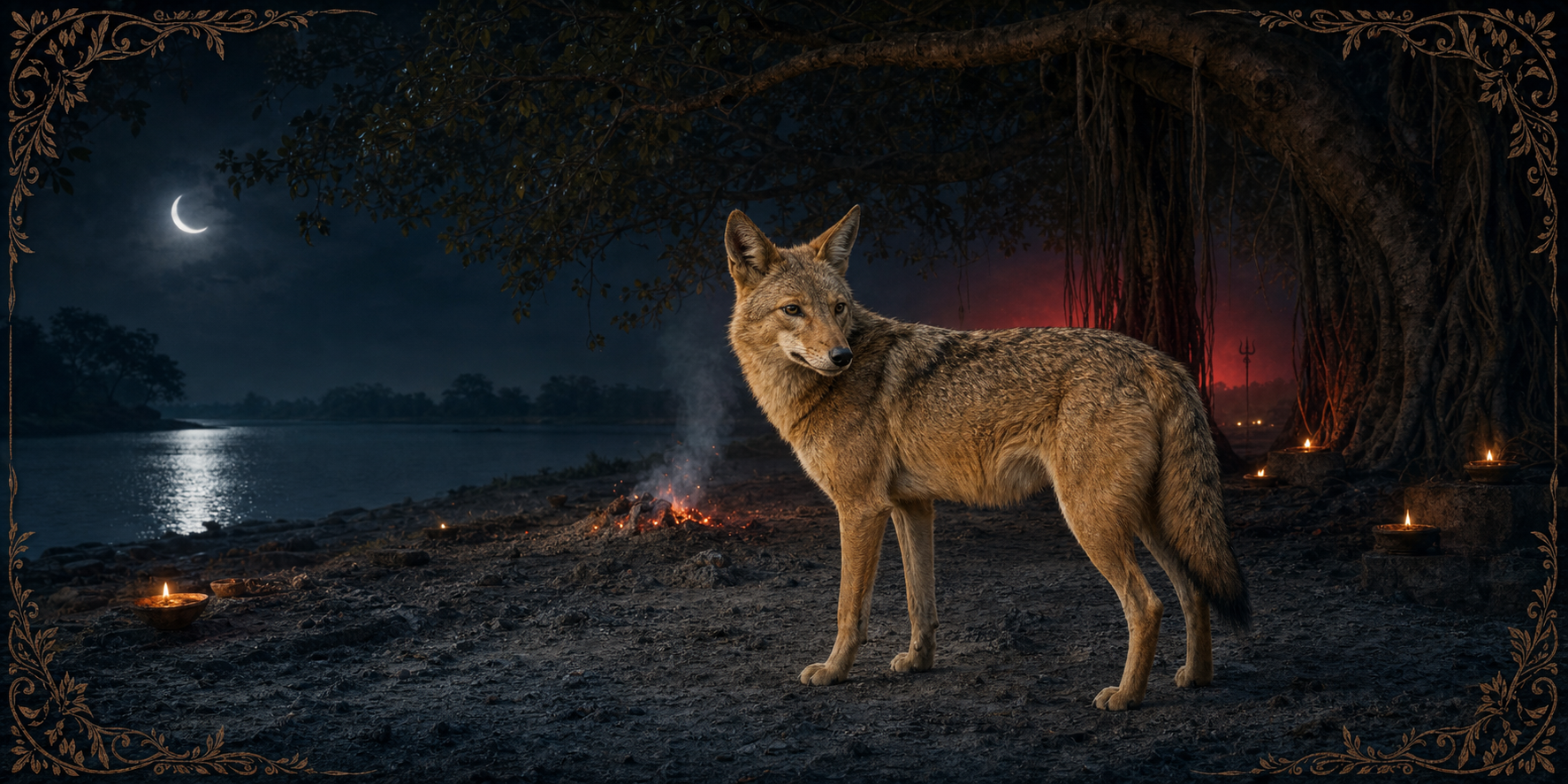
A jackal face can look frightening when it is detached from its Dharmic setting. Within that setting, the animal belongs to a disciplined symbolic language. Jackals move at night, feed at the margins of settlement, and are associated with places where ordinary social life confronts decay. The face therefore directs your attention toward impermanence, dissolution, and the boundaries people prefer not to see.
This is why cremation-ground imagery should not be translated as evil. The shmashana reveals a truth that respectable appearances cannot cancel: every embodied form changes and passes away. Kali does not lose sovereignty at that threshold. She rules there as well. Her fierceness can therefore teach fearlessness through confrontation with the cause of fear, rather than through denial of death.
Chamunda provides the closest comparative anchor. She is associated with jackals, ghouls, emaciation, and the corrosive action of time. That does not make every jackal-linked image Chamunda, nor does it make Chamunda and Shiyali Kali identical. It establishes that a jackal-faced Shakti would belong to an already intelligible theological and visual grammar.
The Yogini traditions widen that grammar. At Hirapur, Bhedaghat, and Mitaoli, animal-faced figures appear within Yogini sculptural programs alongside human-faced forms. Lists and identifications vary, so an animal visage should not be forced into one universal roster of sixty-four names. What the ensembles establish is Shakti expressed through radical plurality: human, animal, beautiful, fierce, recognizable, and enigmatic.
You can read a suspected Shiyali Kali through four connected questions:
- Form: Is the principal face actually canid, and what details distinguish it from nearby figures?
- Setting: Do the base, attendants, weapons, or surrounding scene evoke the cremation ground or another liminal space?
- Function: Does the composition emphasize protection, dissolution, consumption, time, or victory over fear?
- Relationship: Does the image fit more closely with Kali, Chamunda, a Yogini ensemble, or a regional village-Goddess tradition?
Do not jump from visual resemblance to historical borrowing. The jackal-headed Anubis offers a useful comparison because Egyptian religion also placed a canid figure at the boundary of death. That is a cross-cultural analogy, not evidence that one tradition copied the other. Unless a historical chain of contact and transmission is established, keep the comparison at the level of a recurring human intuition about scavenging canids and thresholds.
Distinguish an attested image from an interpretive reconstruction
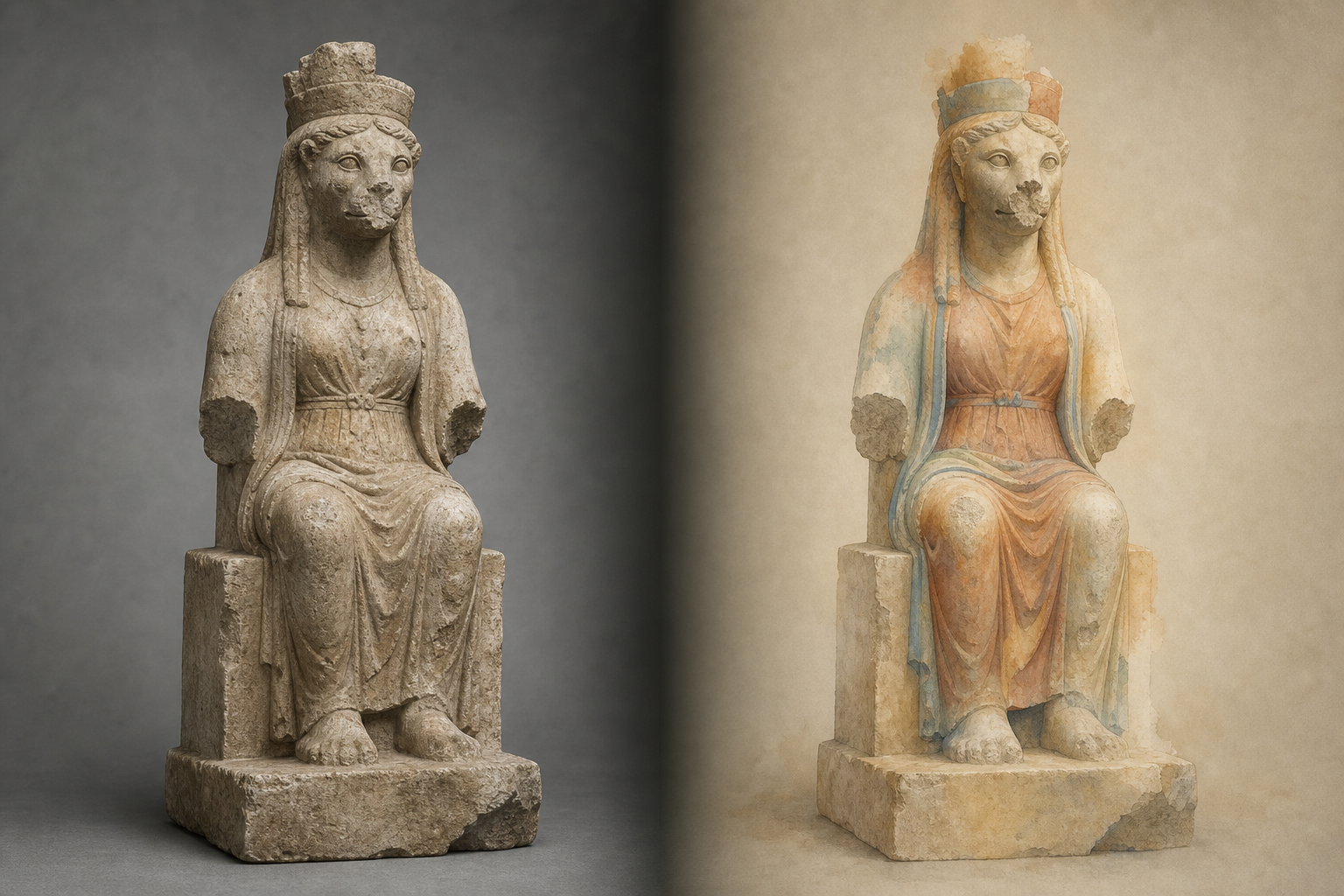
A modern artist could plausibly depict Shiyali Kali with a jackal face, skull-bowl, chopper, drum or noose, jackal attendants, and a corpse beneath her feet. Every element would fit a known Kali or fierce-Shakta vocabulary. The resulting picture would still be an interpretive reconstruction, not a recovered canonical icon.
This distinction matters because rare iconography attracts circular claims. An artist begins with a plausible description. The finished image circulates without its caption. A later viewer then treats the circulating image as proof that the description was ancient and fixed. Within a few repetitions, a careful hypothesis has become an invented certainty.
If you commission, publish, or catalogue a reconstruction, include three statements beside it:
- Identify it plainly as a modern or interpretive reconstruction.
- List which elements come from the broader iconography of Kali, Chamunda, and animal-faced Yoginis.
- State which details remain hypothetical because no securely identified Shiyali Kali image or uniform textual description has been established.
The same discipline applies to spiritual interpretation. You can contemplate the jackal face as a teaching about impermanence, fear, and the inclusion of society’s margins. You should not infer a mantra, initiation, ritual sequence, or cremation-ground practice from iconography alone. Esoteric practice depends on qualified transmission and context; an evocative picture is not ritual authorization.
Rare forms do not become more Dharmic when we manufacture certainty around them. Their recovery becomes stronger when we distinguish inherited memory, comparative reasoning, and creative renewal.
Document a possible Shiyali Kali without stripping away context
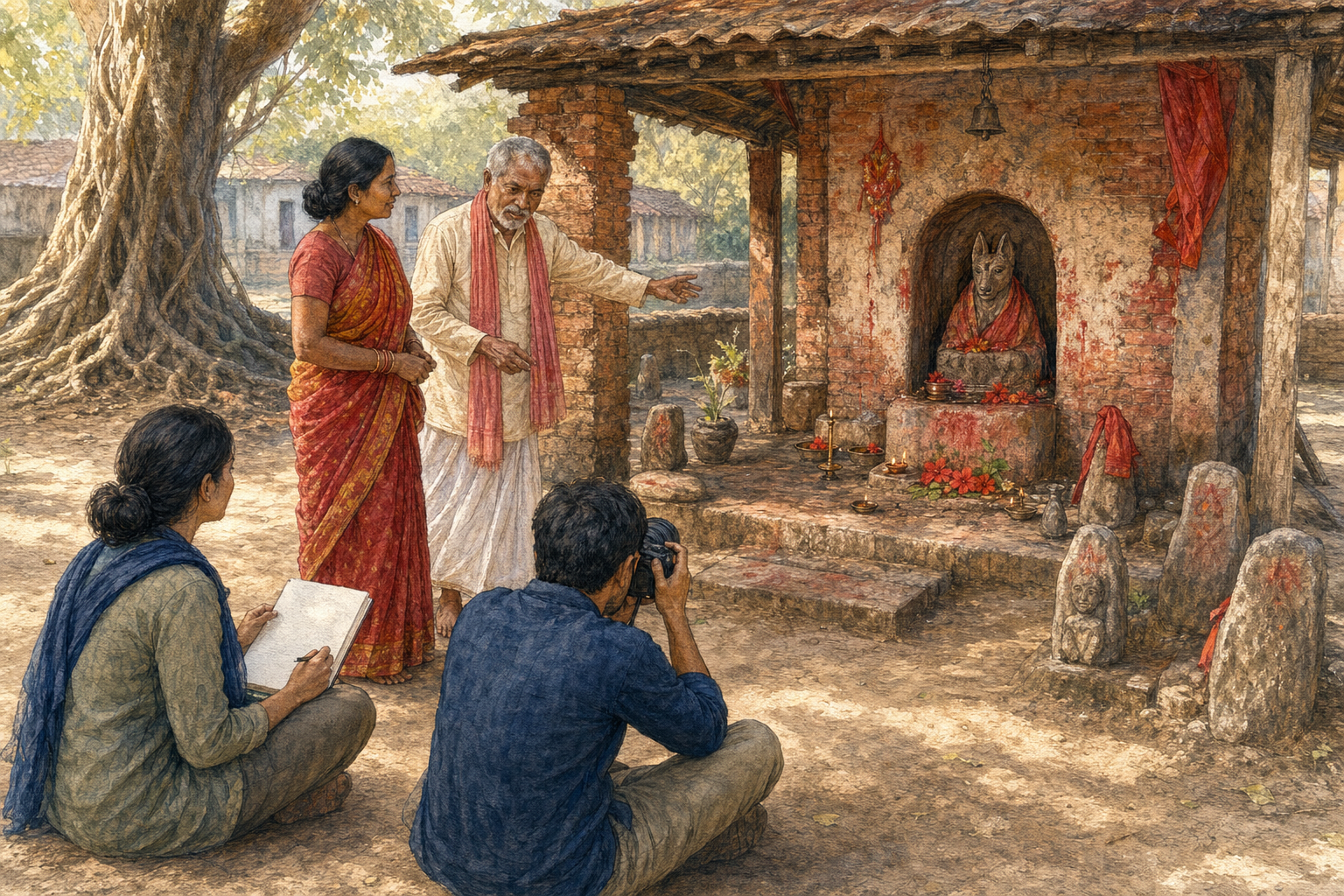
The best next step is often local documentation. Regional shrines, district collections, oral recitations, seasonal observances, and hereditary priestly lineages may preserve information missing from metropolitan catalogues. Approach that knowledge as part of a living community, not merely as raw material for an online identification.
- Ask permission first. Confirm whether photography, measurement, publication, and discussion of the image are acceptable to its custodians.
- Record the object before interpreting it. Photograph the front, both profiles, base, back, attributes, neighboring figures, and any inscription. Include scale and note damaged or restored areas.
- Preserve the exact local name. Write down its pronunciation, script, alternate spellings, language, and the title used by the person who supplied it. Do not silently Sanskritize a regional name.
- Ask non-leading questions. Ask what the deity is called, when she is worshipped, what story is told about her, and how the current custodian learned it. Do not begin by asking whether the figure is Shiyali Kali; that can shape the answer.
- Separate independent testimony. Record the priestly account, village memory, museum description, and your iconographic comparison as distinct entries. Agreement is more meaningful when the accounts have not been blended in advance.
- Check the physical and documentary context. Look for site reports, inscriptional records, district museum catalogues, old photographs, and information about whether the image remains in its original location.
- Publish a confidence label. Mark the identification as secure, plausible, or speculative, and explain in one sentence what would raise or lower that confidence.
Be cautious with the precise location of an uncatalogued or vulnerable icon. If public geolocation could expose it to theft, damage, or intrusive attention, obtain the custodians’ consent before publishing those details. Cultural recovery should strengthen the community that protected the form, not make the object easier to remove from it.
For your own notes, keep two files. The first should contain raw observations, photographs, transcriptions, and attributed testimony. The second should contain comparisons and interpretations. This simple separation prevents a later hypothesis from being mistaken for something visible on the object or remembered by the community.
Key takeaways
- Shiyali Kali or Kokmukha Devi is a plausible jackal-faced Shakta form, but the exact name is sparsely attested in printed material.
- A canid face, cremation-ground imagery, and fierce attributes can support an identification; none of them proves the name by itself.
- Chamunda and the animal-faced Yoginis establish the wider iconographic grammar without making the deities interchangeable.
- The jackal signifies liminality, decay, impermanence, and fear confronted directly; it should not be reduced to a symbol of evil.
- Modern reconstructions must be labeled as reconstructions, especially when their attributes are assembled from related Shakta forms.
- The most useful contribution you can make is a consent-based record that preserves the image, exact local name, custodial account, and degree of certainty separately.
When you next encounter a supposed Shiyali Kali, resist the urge to solve the mystery from one dramatic feature. Record first, compare carefully, and name the limits of the evidence. That method gives a rare form the best chance of re-entering Hindu memory without being simplified, sensationalized, or remade in our own image.