

You wake in a quiet room, notice one unresolved problem, and within moments the mind has issued a verdict. A headache means grave illness. A delayed reply means rejection. Tomorrow’s difficult task means public failure. The fear feels less like a possibility than a fact.
Unless immediate safety requires action, this is not the hour to make decisions about your health, relationships, work, or worth. Your task is smaller: reduce the body’s alarm, separate awareness from the story, and return the problem to daylight.
Why uncertainty feels like certainty at 3 a.m.
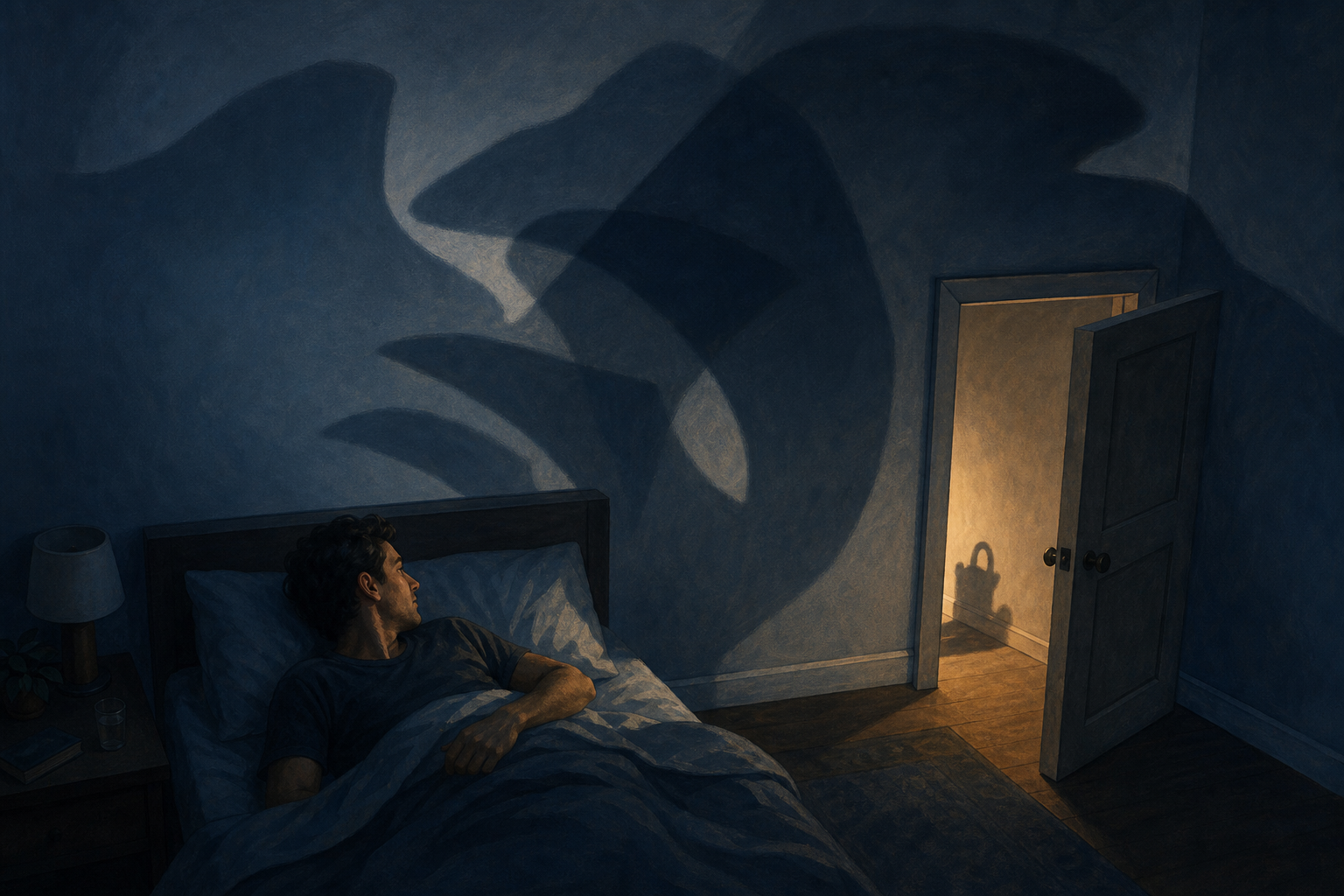
Around 3-4 a.m., body temperature is near its nightly minimum, melatonin remains high, and cortisol begins its pre-dawn rise. Those conditions support sleep, not careful analysis. If you are awake, especially after already losing sleep, attention is more easily captured by danger and flexible reasoning is harder to sustain.
Darkness and silence also remove much of the information that normally corrects an anxious interpretation. The brain still has to explain what is happening, so it leans more heavily on familiar predictions. Threatening predictions receive priority because overlooking danger once carried a greater survival cost than raising a false alarm. The modern mind may apply that ancient bias to an unread message, an uncertain symptom, or an unfinished presentation.
Quiet wakefulness gives self-referential thought more room as well. Memories, imagined futures, old embarrassments, and rehearsed arguments appear without competition from the tasks and sensory demands of daytime. Fatigue weakens your ability to redirect attention, so the same narrative can circle until repetition begins to resemble proof.
The body then supplies apparently confirming evidence. A vividly imagined danger can produce real muscular tension, a faster heartbeat, narrowed attention, and sympathetic arousal. You notice the heartbeat and conclude that something must be wrong; that interpretation produces more alarm, which makes the heartbeat still more noticeable. A harmless awakening has become a self-reinforcing threat loop.
Learn to separate observation from interpretation. My heart is beating quickly may be an observation. Something terrible is happening is an interpretation. I must settle this before I sleep is a demand generated by the anxious state. You do not have to replace the frightening interpretation with a cheerful one. Return to what can actually be verified now.
Key takeaways for your next anxious awakening
- Name the mental process. Silently say, “The mind is making a threat forecast,” or, “Worry is asking for certainty.” This describes what is happening without endorsing the prediction.
- Return to present-tense facts. Notice that you are lying in a bed, the room is quiet, breathing is occurring, and the feared future is not happening in the room. This is accurate thinking, not forced positivity.
- Regulate before you reason. Try a comfortable exhale-emphasized breath. A 1:2 pattern such as inhaling for 4 and exhaling for 8 is one option; a gentle cadence of 4-6 breaths per minute is another. A physiological sigh – a double inhale followed by a long exhale – can also be repeated a few times. Do not strain, and return to natural breathing if you become lightheaded.
- Reassure yourself without agreeing with the fear. Try, “This is frightening, and it does not need a verdict tonight. I can examine it when I am rested.” Validation calms the protective part of the mind without declaring its story true.
- Use a meaningful anchor. Gentle japa, simran, mantra, or simple attention to the breath can give the mind somewhere steady to rest. Use a familiar practice softly; do not turn it into a test that must be performed perfectly.
- Defer decisions, not legitimate responsibilities. If you fear forgetting something important, record a brief neutral reminder and stop there. Do not begin researching symptoms, composing messages, or planning your whole response in bed.
- Change the setting if wakefulness persists. If you have been awake for roughly 15-20 minutes and are becoming more activated, move to a safe, dim, unstimulating place until sleepiness returns. Avoid repeatedly checking the clock to measure the interval.
Do not inspect yourself after every breath to see whether the method has “worked.” That turns calming into another vigilance assignment. The immediate goal is not to command sleep. It is to stop feeding the alarm that makes sleep less likely.
If sleep does not return, protect the bed-sleep connection

Remaining in bed for a prolonged struggle can teach the mind that bed is where problems are investigated. Brief stimulus control after roughly 15-20 minutes of wakefulness interrupts that association. You do not need to monitor the clock precisely; the practical signal is that you feel clearly awake and increasingly engaged with the spiral.
Go somewhere safe and keep the light low. Sit quietly, read something undemanding on paper, or continue a gentle contemplative practice. Work, news, symptom searches, social media, and emotionally charged messages give the mind fresh material and convert a temporary awakening into active daytime. Return to bed when sleepiness, rather than mere frustration, appears.
This is a training principle, not a punishment. If leaving bed would create a fall risk or otherwise be unsafe, adapt it: sit up, change position, or create a quieter zone within reach. Safety takes priority over perfect adherence.
Keep the bed mainly for sleep and intimacy, and anchor a consistent rising time even after a difficult night. These habits help the body distinguish between the place and rhythm of sleep and the activities of worry. They will not guarantee an uninterrupted night, but they reduce the conditions that keep anxious wakefulness rehearsed.
Build the daylight practice that the night cannot build

Give worry an appointment
An anxious mind often returns at night because it does not trust that a concern will receive attention later. In the early evening, hold a short worry appointment. For each concern, write what is known, what is being predicted, what is within your control, and the next available daytime action. Put actionable matters into your normal schedule. Mark the rest as uncertainty rather than disguising it as a problem that more thinking can solve.
This practice does not tell you that every fear is imaginary. A deadline may be real, a relationship may need a conversation, and a symptom may deserve medical evaluation. It tells the mind when and how the matter will be handled. Wise postponement is different from avoidance because it preserves a route to appropriate action.
In the morning, briefly compare what the night predicted with what actually occurred. Do this to calibrate the mind, not to ridicule it. Repeatedly seeing the difference between a possible outcome and a certain outcome weakens the habit of treating nocturnal intensity as evidence.
Reduce the avoidable pressure on sleep
A consistent rising time gives the sleep-wake rhythm a stable anchor. Reducing late caffeine and alcohol removes common contributors to restless or poorly regulated nights. You do not need to turn this into a campaign of moral purity. Notice what you consume, when you consume it, and whether anxious awakenings cluster around a repeatable pattern.
Do not wait until the mind is frightened to learn the witnessing posture. Practise it during ordinary daylight moments: notice a thought, name it as a thought, feel the associated sensation, and refrain from immediately obeying it. Abhyasa – steady repetition – matters because a familiar mental movement is easier to find under fatigue than a technique encountered for the first time in crisis.
Use Dharmic practice as relationship, not suppression
Hindu, Buddhist, Jain, and Sikh traditions are not interchangeable systems. Yet each contains a discipline relevant to this narrow problem. Hindu dhyana and sakshi-bhava cultivate the witness that can observe thought without becoming identical to it. Buddhist sati notices mental events without clinging to them. Jain anupreksha and aparigraha support reflection without possession, while ahimsa governs the manner in which you treat the frightened mind. Sikh simran returns attention to remembrance, while trust in hukam loosens the demand that every uncertainty be controlled before rest is permitted.
The practical movement is similar: awareness notices the thought, declines to fuse with it, and returns to a chosen anchor. The thought may remain present. Success is not its immediate disappearance; success is no longer treating its presence as an order.
If you use mantra, japa, or simran, let the practice accompany the breath rather than bargain with the feared outcome. Repetition is not a guarantee that illness, loss, or failure can never occur. It is a way of remembering that a prediction passing through awareness is not the whole of awareness. If you already belong to a lineage or receive guidance from a teacher, use the practice you know rather than inventing a complicated ritual while distressed.
This is also where ahimsa becomes intimate. Fighting the mind, insulting yourself for being awake, or demanding instant serenity adds aggression to fear. A firmer and kinder response is possible: “You are trying to protect me. There is no useful action available in this bed. We will look again in daylight.” Compassion does not require obedience.
Know when night anxiety needs professional attention

Contemplative practice and sleep habits can help with ordinary anxious awakenings, but they are not substitutes for medical or psychological care. Speak with a primary-care clinician or licensed mental health professional if the episodes keep recurring, create substantial distress, make you dread bedtime, interfere with daytime functioning, or continue despite reasonable self-care. A clinician trained in cognitive behavioural therapy for insomnia can address a persistent pattern of wakefulness and bed-related arousal.
Do not automatically label a new or severe physical symptom as anxiety. Severe chest pain, major difficulty breathing, fainting, new neurological symptoms, or another apparent medical emergency calls for urgent medical assessment. If you are in immediate danger, are thinking of harming yourself, or cannot keep yourself safe, contact local emergency services or go to the nearest emergency department.
Seeking appropriate care is compatible with Dharma. Ahimsa includes protecting your health; humility includes accepting skilled help when a problem exceeds self-practice. Spiritual discipline can shape how you meet treatment without being used to avoid it.
Before bed, place a brief reminder where you can reach it without beginning a search on your phone: name the forecast, state the present facts, lengthen the exhale comfortably, and return the decision to daylight. At 3 a.m., you do not need a final answer about your life. You need a prepared path through a temporary state. Dawn does not require worry’s permission to arrive.
References
