
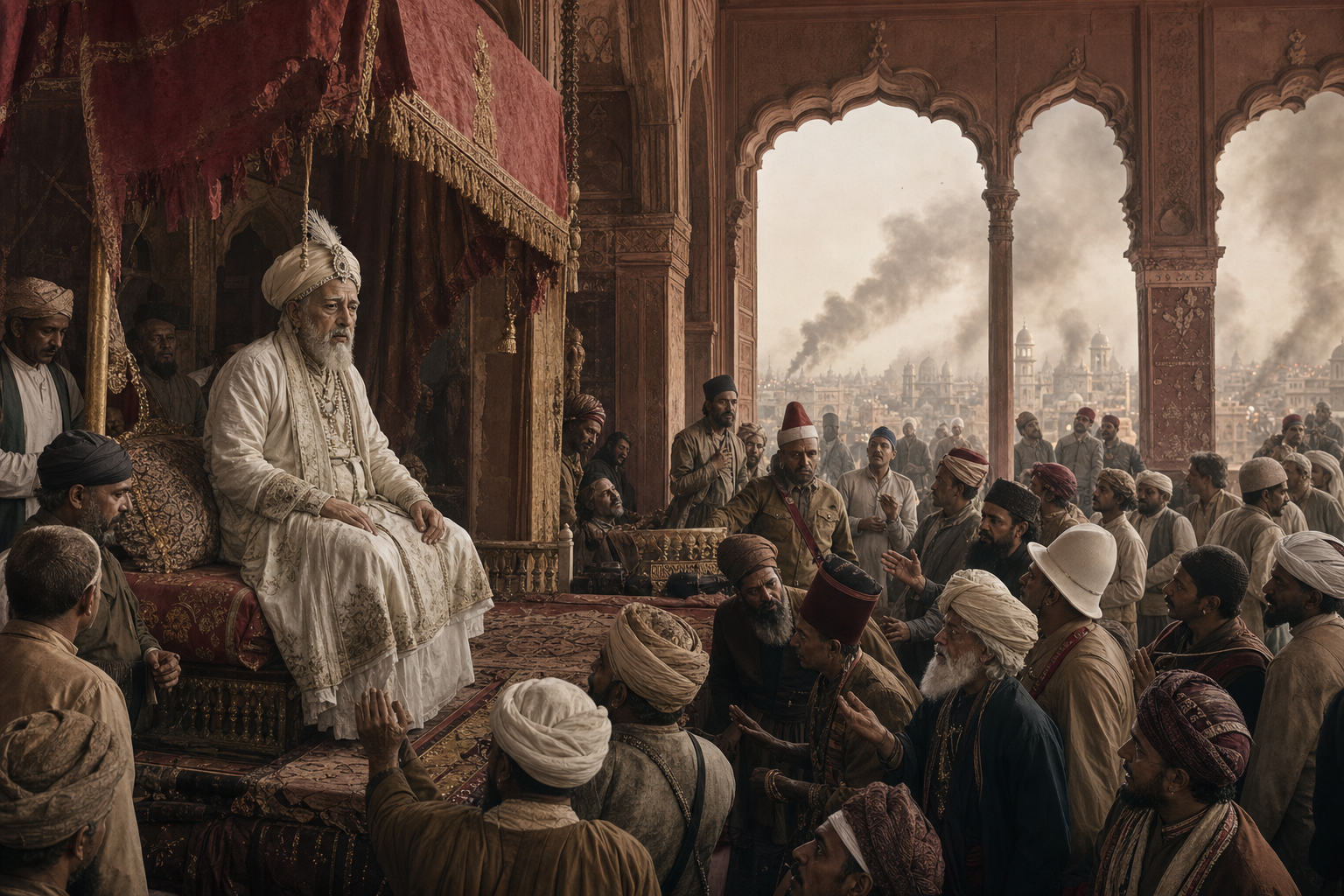
If you are trying to decide whether Bahadur Shah Zafar was the hero of 1857 or the man who betrayed it, start by refusing that forced choice. It asks you to judge a besieged, pensioned monarch as though he had commanded a functioning empire and a disciplined national army.
The more useful question is narrower: what power did Zafar possess, what did he appear to intend, and what consequences can reasonably be traced to his decisions? Judged that way, he was neither the architect of the revolt nor its proven betrayer. He was an elderly symbolic sovereign pulled into an uprising that needed his name but never truly came under his command.
Key takeaways
- By 1857, Zafar was a ceremonial Mughal emperor supported by an East India Company pension, not the ruler of an operational empire.
- The sepoys who entered Delhi proclaimed him emperor because his name could give political legitimacy to a revolt he had not planned.
- He accepted the role reluctantly, issued farmans, allowed coins to be struck in his name, and tried to restore civil administration.
- These acts established the appearance of sovereignty but could not supply unified command, military doctrine, provisions, or reliable logistics.
- Rebel Delhi was divided among regiments, commanders, palace interests, and members of the old nobility. Bakht Khan’s administrative reforms could not fully overcome those fractures.
- Claims involving Zeenat Mahal and possible negotiations with Company officials remain disputed. They do not, by themselves, prove that Zafar deliberately sabotaged the rebellion.
- The strongest verdict is that Zafar lent indispensable symbolic authority to the revolt but lacked the material power to determine its military outcome.
A crown could unite the rebels without commanding them
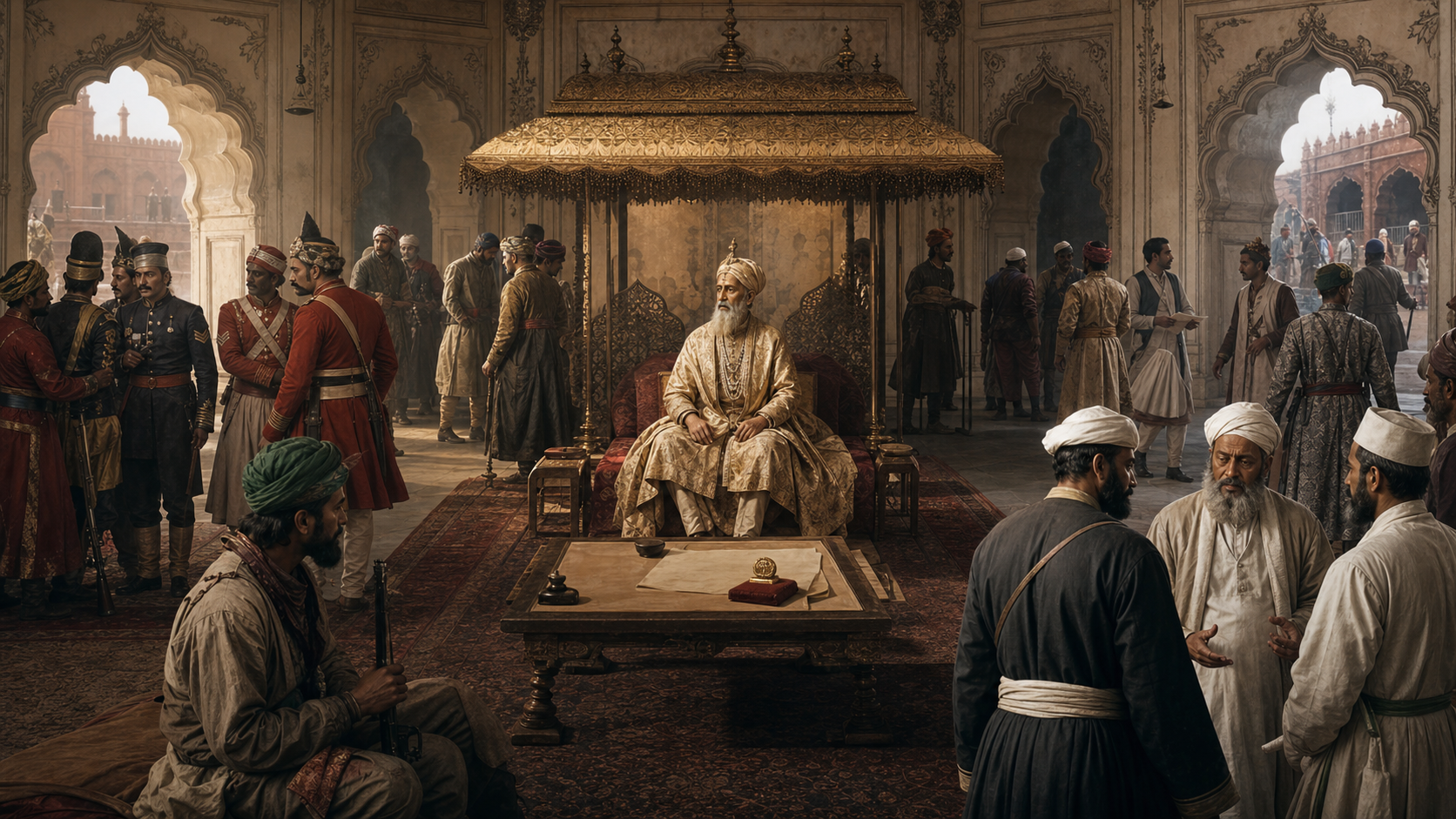
The first distinction you need is between legitimacy and control. Since the British capture of Delhi in 1803, Mughal sovereignty had steadily contracted. The East India Company recognized the emperor as a ceremonial figure and paid him a pension. Zafar retained the aura of the Mughal throne, the cultural influence of his court, and his stature as a poet and patron. He did not possess an independent army or an effective administration extending across Hindustan.
That distinction explains why the rebels needed him. The uprising began among soldiers, but its causes extended well beyond a military quarrel. The cartridge controversy offended Hindu and Muslim religious sensibilities because the cartridges were believed to contain cow and pig fat. The annexation of Awadh in 1856, the Doctrine of Lapse, altered military-service conditions, revenue extraction, and fears of religious and cultural interference had already produced a much wider field of discontent.
For a Hindu reader, the religious affront should not be treated as an embarrassing footnote. Sacred concerns were part of the political reality. Yet reducing the uprising to cartridges alone is just as misleading. Religious injury became explosive because it landed amid dispossession, political annexation, economic pressure, and growing distrust of Company rule.
The sequence matters. The revolt erupted at Meerut on 10 May 1857 and reached Delhi on 11 May. Zafar did not summon the regiments, design their campaign, or prepare Delhi to receive them. Armed men arrived first. A rebel government had to be improvised afterward.
The sepoys then faced a political problem. Separate regimental mutinies could destroy Company authority in particular places, but they did not automatically constitute a new state. The rebels needed a name that soldiers, townspeople, landed interests, and regional leaders would recognize. The Mughal emperor supplied that name.
Proclaiming Zafar emperor therefore did constitutional work even when it did little military work. It converted scattered resistance into something that could claim lawful sovereignty. Proclamations in his name appealed to the protection of established customs and religious practices. Farmans could speak to populations that would not recognize an unknown sepoy committee. Coins struck in his name made an even more tangible claim: Company rule had been displaced and another authority now stood in its place.
But a proclamation is not a supply column, and a coin is not a chain of command. Zafar’s symbolic capital could help answer the question, “In whose name do we resist?” It could not answer who would distribute ammunition, discipline competing regiments, secure provisions, settle disputes among commanders, or direct a sustained defence of Delhi.
Keep that distinction in view whenever you encounter a royal order from rebel Delhi. A document bearing Zafar’s authority shows that his name was being used to govern. It does not automatically prove that he initiated the policy, could enforce it, or controlled the soldiers acting outside the palace.
Put the betrayal charge through three tests
“Betrayal” is a conclusion about conduct, not a synonym for hesitation, defeat, or ineffective leadership. Before accepting it, test the accusation against agency, intent, and effect. This prevents a morally powerful word from doing the work that evidence must do.
Agency: What could Zafar actually command?
Zafar was over eighty, lacked an independent army, and had lived for decades inside a political order controlled by the East India Company. His authority beyond the Red Fort had been largely nominal before the uprising. Once the sepoys occupied Delhi, he also had to reckon with armed regiments that had their own officers, grievances, loyalties, and immediate demands.
Limited agency does not erase moral responsibility. A constrained ruler can still make consequential choices, and Zafar’s decisions should not be immunized from scrutiny merely because his position was difficult. But responsibility must be proportionate to capacity. You cannot reasonably assign him the duties of a supreme commander unless you can also show that the forces obeyed him as one.
The practical question is simple: when Zafar issued an instruction, who was obliged to carry it out, and what means did he have to punish refusal? If that enforcement mechanism is missing, the order demonstrates aspiration more clearly than control.
Intent: Was there a deliberate effort to defeat the revolt?
The record supports reluctance, fear, vacillation, court intrigue, and attempts to preserve order. It does not provide robust, uncontested proof of a settled plan by Zafar to destroy the rebellion from within. He accepted the imperial mantle, sanctioned public acts of sovereignty, and attempted to maintain civic administration. He also faced the prospect of devastating British retaliation against his family, court, and city.
This is where Zeenat Mahal often enters the accusation. She wanted her son, Mirza Jawan Bakht, to succeed Zafar. British intelligence reports later alleged that she explored contact with Company officials to protect his future. The reliability and meaning of those reports remain disputed. Siege intelligence can contain genuine information, deliberate manipulation, misunderstood conversations, or proposals that never became policy.
Even if Zeenat Mahal investigated a private accommodation, two additional links would still have to be established: that Zafar adopted her purpose and that their actions materially sabotaged the rebel defence. Palace anxiety, succession politics, and contingency planning may be unattractive, but they are not automatically identical to operational betrayal.
Watch for a common sleight of hand here. A weak argument begins with an allegation about Zeenat Mahal, treats it as proven, transfers her presumed motive to Zafar, and then makes that motive the cause of Delhi’s defeat. Each step requires its own corroboration. Suspicion cannot simply be carried across all three.
Effect: Did Zafar’s conduct cause the collapse?
A betrayal capable of explaining the outcome should leave a causal trail. You would expect to find a decisive order, disclosure, withdrawal of support, obstruction of a viable strategy, or another act that materially changed the military balance. The better-supported causes of defeat lie elsewhere: inadequate supplies, fractured authority, rivalries within the rebel camp, the absence of a unified military doctrine, and superior British logistics during the siege.
Zafar’s weakness certainly mattered. A symbolic monarch unable to impose discipline could not repair the rebels’ institutional failures. But weakness and treachery are different diagnoses. Calling weakness “betrayal” may satisfy a desire for a single culprit, yet it conceals the organizational defects that actually help explain the outcome.
Applied honestly, the three tests produce a measured verdict. Zafar had some agency but far less than his title implied. His intentions were inconsistent and pressured, not demonstrably directed toward deliberate sabotage. The revolt’s collapse can be explained without making his duplicity the decisive cause. The charge of betrayal therefore exceeds the strength of the evidence.
Why rebel Delhi could not turn legitimacy into victory
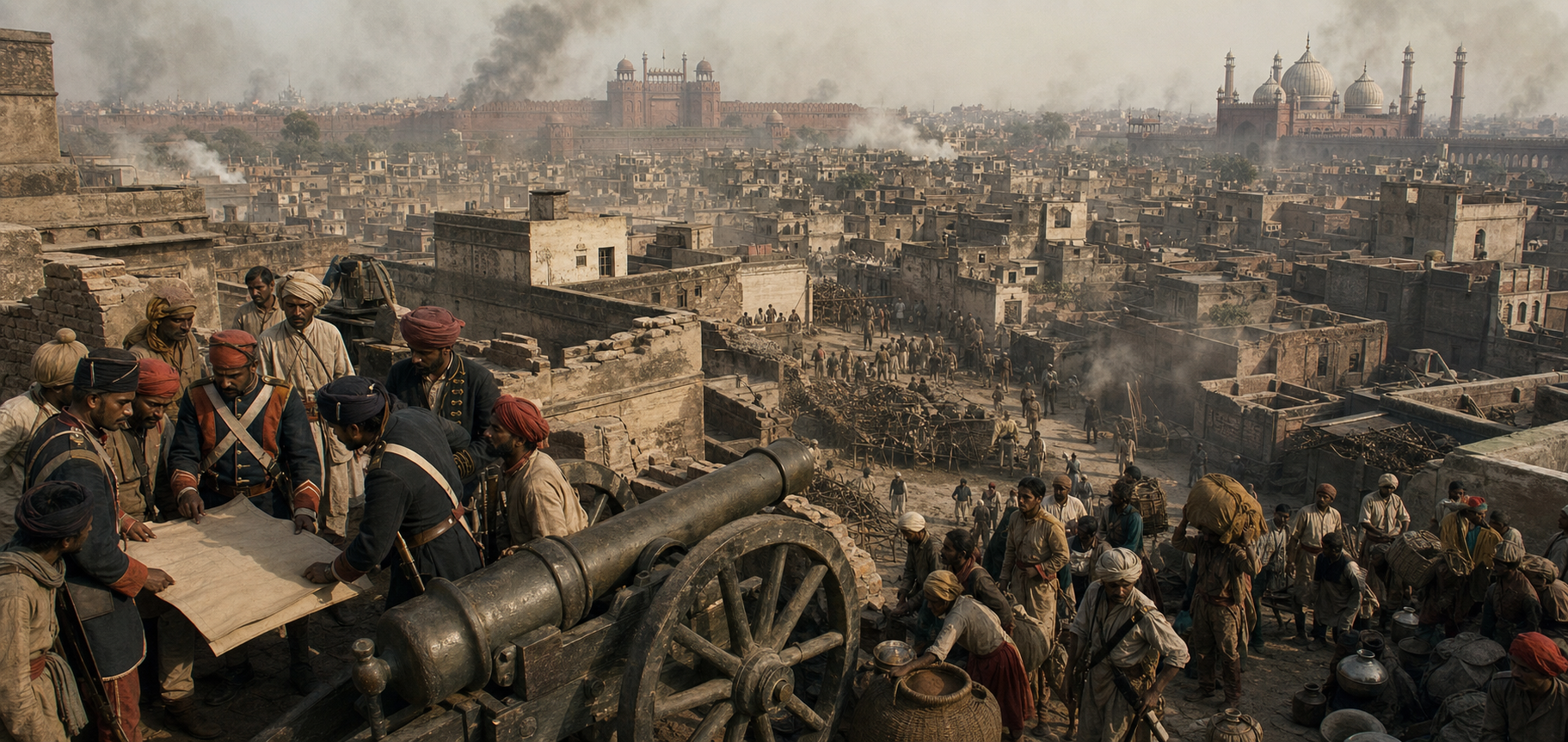
Delhi in 1857 was not a capital executing a prepared war plan. It was a city trying to invent a government while under military pressure. Rebel regiments had arrived from different places with different officers and priorities. Delhi’s established nobility had its own understanding of rank and authority. Palace figures worried about succession and survival. Citizens needed food, security, adjudication, and protection from disorder.
The command structure was therefore less a pyramid than a negotiation. Zafar stood at the symbolic summit, but the regiments retained coercive power. Their commanders could demand royal sanction without consistently accepting royal discipline. The old court could offer administrative habits and prestige, but it could not simply absorb armed formations into a single professional force.
Bakht Khan’s arrival from Bareilly offered a serious attempt to correct this problem. He sought a more rational, council-based system of administration and military decision-making. Yet tensions among sepoy leaders, palace interests, and Delhi’s old nobility limited what institutional reform could accomplish in the middle of a siege.
Notice the timing. The rebels needed central administration after the fighting had begun, not before it. They had to establish authority, organise supplies, reconcile rival commands, and formulate strategy while the enemy was already preparing to retake the city. Political legitimacy had arrived through Zafar’s name, but the machinery required to convert legitimacy into durable power did not exist.
This is the central military lesson of Delhi. Courage and righteousness do not remove the need for logistics. A just resistance can still fail when no authority can reliably coordinate men, provisions, information, fortifications, and strategic priorities. Recognizing that failure does not diminish the sacrifice of those who fought. It takes their struggle seriously enough to ask why valour could not be converted into victory.
The British assault culminated in September 1857. Zafar left the Red Fort and took refuge at Humayun’s Tomb, where he was captured. Several Mughal princes were killed at the Khooni Darwaza by the British officer William Hodson. Zafar was then tried in the Red Fort on charges that included assisting the rebellion and complicity in the killing of Europeans.
Exile completed the destruction of his political world. He was sent to Rangoon, now Yangon, and died there in 1862. The poet who had been used as the living seal of rebel sovereignty ended his life far from Delhi. His later cultural stature should not be confused with military command, but neither should his military impotence obscure what his punishment represented: the colonial termination of the Mughal court as a remaining centre of Indian legitimacy.
When someone attributes Delhi’s fall to one palace personality, compare that claim with the whole operational picture. Ask where the ammunition came from, how orders travelled, who disciplined the regiments, how supplies were allocated, and whether commanders shared a strategy. If those questions remain unanswered, the personal accusation is probably substituting drama for explanation.
How to remember 1857 without surrendering judgment
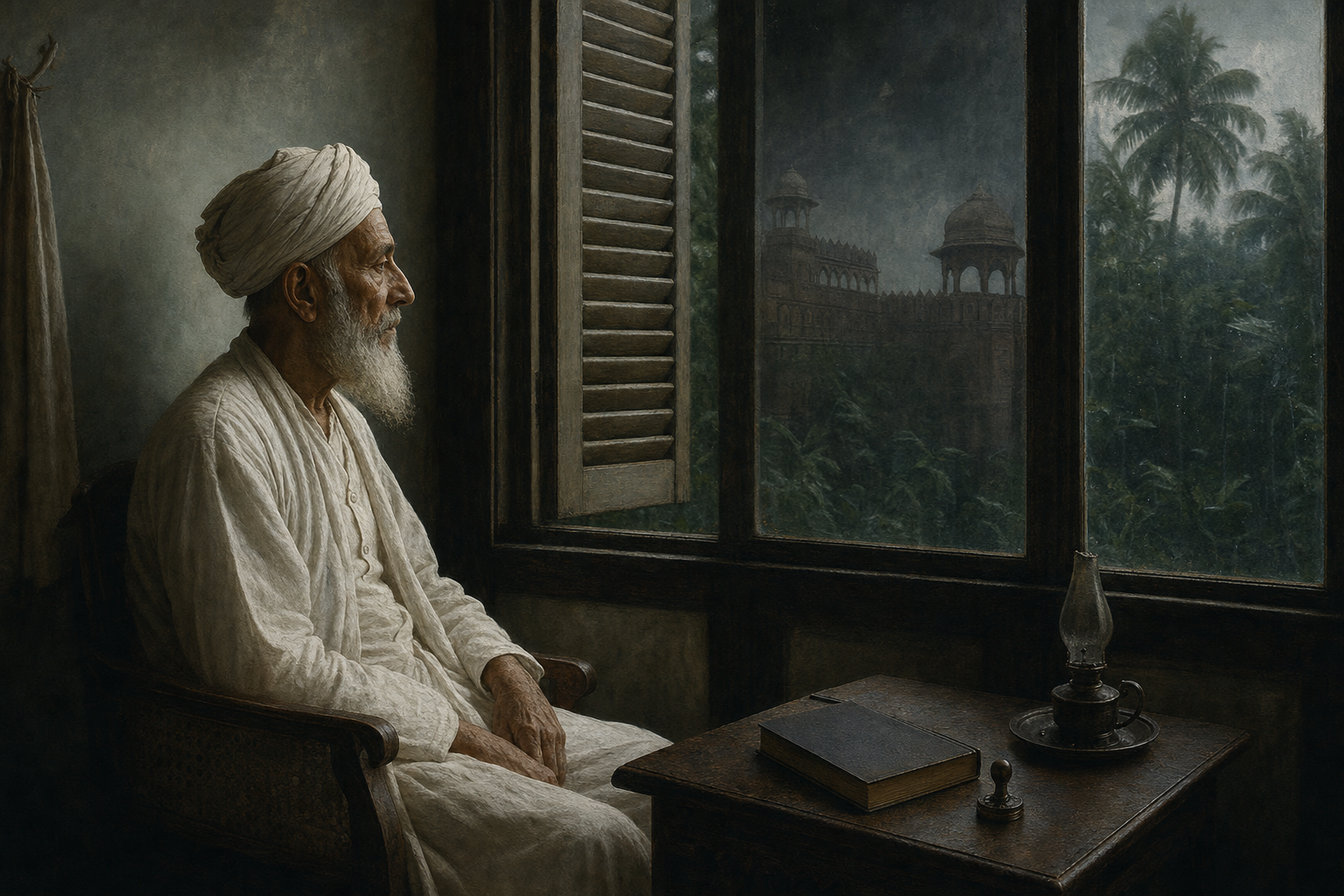
The name given to 1857 often reveals the scale of the claim being made. British imperial history preferred “mutiny,” centring military insubordination and minimizing the broader social and political revolt. V.D. Savarkar presented it as a war of independence, emphasizing anti-colonial purpose and unity. R.C. Majumdar questioned whether the uprising possessed an all-India character or sufficient central coordination to bear that description without qualification.
Acharya Jadunath Sarkar’s treatment of late Mughal decline helps place Zafar inside institutions that had weakened long before 1857. G.B. Malleson’s military histories preserve extensive campaign detail while also carrying the assumptions of an imperial viewpoint. You do not have to select one historian as a complete package. Separate chronology, institutional analysis, political interpretation, and moral judgment, then test each on its own terms.
Begin with scale. “There was substantial anti-colonial cooperation” is not the same claim as “the whole subcontinent acted under one national command.” Hindus and Muslims fought together in many theatres, and appeals to protect established faiths gave the revolt a shared political language. At the same time, some princely states and military contingents remained aligned with the British because of local interests, earlier conflicts, and calculations about survival.
Neither fact cancels the other. Cooperation does not require perfect unanimity, while local collaboration with the British does not justify assigning collective guilt to an entire community. The revolt was a mosaic of resistance, neutrality, opportunism, loyalty, fear, and regional strategy. Any account that turns this mosaic into a single communal verdict is likely serving a present argument more than explaining 1857.
Then examine labels. “Emperor” sounds like a description of power, but in Zafar’s case it often described inherited status and symbolic recognition. “Commander” should be reserved for evidence of operational obedience. “Betrayer” requires intentional disloyalty and a demonstrable effect, not merely failure. “Hero” should not erase hesitation, limited capacity, or morally difficult choices.
Finally, grade the evidence. A public farman, a trial allegation, a hostile intelligence summary, a later patriotic narrative, and a military outcome do not carry the same kind of information. Ask who produced a claim, under what pressure, for which audience, and whether independent facts corroborate it. Preserve uncertainty when the chain is incomplete.
This standard matters for a Dharmic reading of history. Civilizational confidence does not require a spotless pantheon or a convenient villain for every defeat. It requires the ability to honour resistance to colonial domination while recognizing fragmentation, institutional weakness, and the moral ambiguity created by siege. Truthful memory is stronger than a usable myth because it remains credible when challenged.
Zafar should therefore be remembered as a tragic and constrained sovereign whose name gave the uprising a political centre it otherwise lacked. That was a real contribution. It was not supreme command. His indecision and frailty can be judged without inflating them into an unsupported theory of treason, just as his suffering and poetry can be honoured without turning him into the mastermind of 1857.
The next time you meet a confident claim about Zafar, place it under the three headings: agency, intent, and effect. If it cannot survive all three, do not let a slogan settle the history for you. That discipline honours the people who resisted colonial rule more faithfully than either automatic canonisation or casual accusation.