

If you want to revive an Indian model of education, choosing an ancient name is the easy part. The harder question is what the name commits you to: a gifted teacher with freedom to shape each student, or a durable institution able to preserve knowledge across generations.
Takshashila and Nalanda give you different answers. Takshashila shows how learning can grow around the authority of the ācārya, practical apprenticeship and a cosmopolitan city. Nalanda shows how a residential scholarly community can sustain advanced study, libraries, debate and international exchange. The strongest modern application is not to copy either one literally, but to understand which educational problem each model solved.
Choose the model by the problem you need to solve
Calling Takshashila and Nalanda ancient universities can be convenient, but it can also hide their most useful difference. Takshashila flourished as early as the sixth century BCE, whereas Nalanda attained prominence from the fifth century CE. They were separated not only by centuries and geography, but also by institutional design.
Takshashila was not a single centralized campus with one administration, uniform admissions and a common degree. It was a constellation of teacher-led schools situated within the active urban world of Gandhāra. Nalanda was a purpose-built Mahāvihāra: a large residential complex organized around monasteries, teaching spaces, shrines, libraries and shared systems of support.
| Educational decision | Takshashila’s answer | Nalanda’s answer | What it means for you |
|---|---|---|---|
| Where authority sits | Primarily with the chosen ācārya | With teachers operating inside a governed scholarly institution | Decide whether your immediate need is exceptional mentorship or institutional continuity |
| How study is organized | Flexible apprenticeship shaped around teacher, student and discipline | Residential study combining foundations, specialization and communal discipline | Use flexibility for individual formation; use common structures when many learners must progress together |
| Connection to society | Embedded in a commercial, political and multilingual city | A campus connected to courts, monasteries and transregional scholarly networks | Give learners either direct contact with practice or deliberate routes from the campus into the wider world |
| How knowledge survives | Teacher lineages, texts and networks of practice | Teacher lineages reinforced by libraries, manuscript production, endowments and resident communities | Do not let an excellent course disappear when one teacher leaves; build an archive and a succession path |
| What scale makes possible | Adaptation, personal responsibility and close instruction | Advanced specialization, sustained debate and a large intellectual commons | Keep teaching relationships small even when the supporting institution becomes large |
This distinction gives you a practical diagnostic. If learners cannot find a capable mentor, more buildings will not solve the problem; begin with the Takshashila principle. If capable teachers are working in isolation and their knowledge vanishes with them, personal mentorship is not enough; you need the Nalanda principle of institutional memory.
At Takshashila, the teacher was the institution
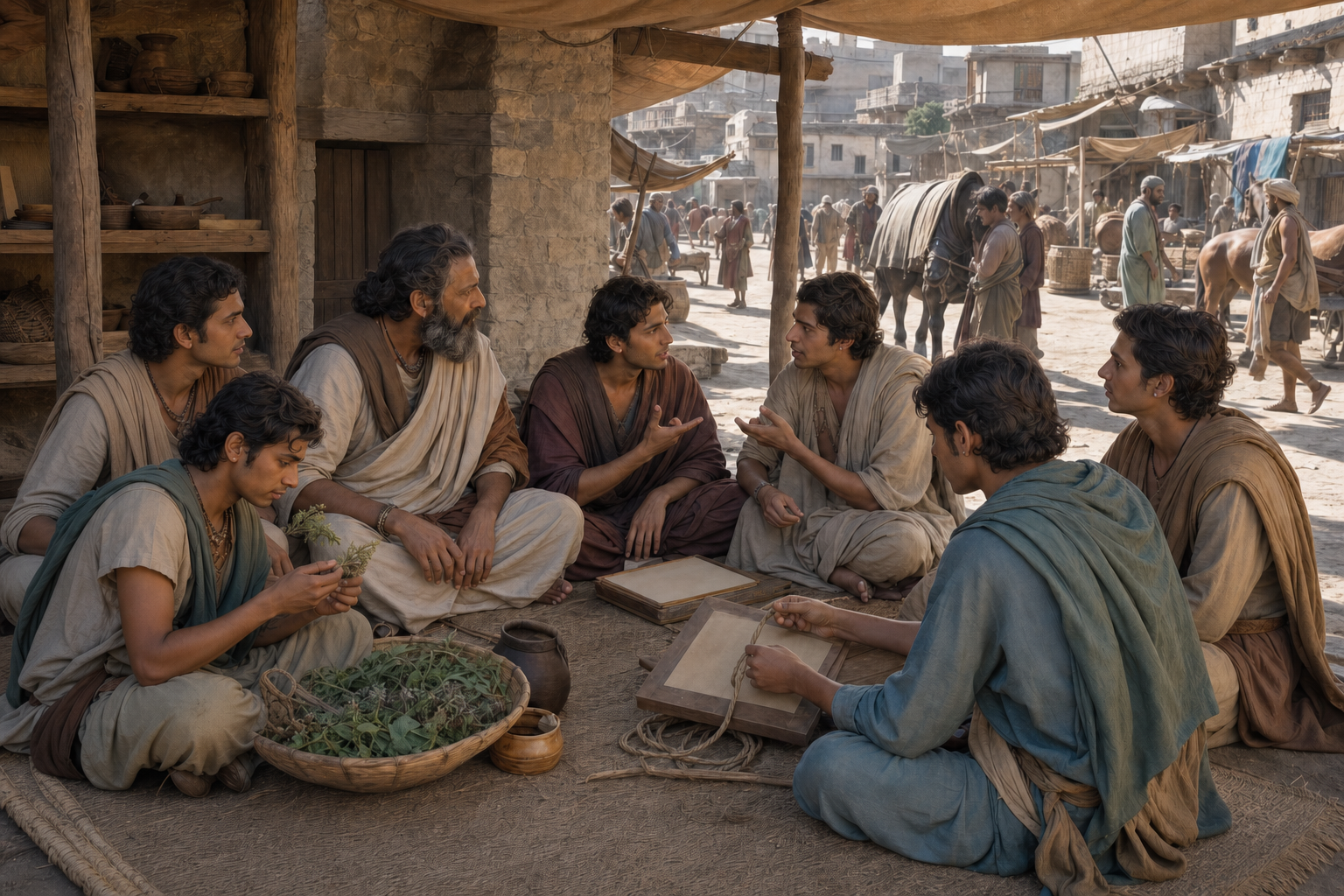
Takshashila’s physical landscape helps explain its educational form. The Bhir Mound, Sirkap and Sirsukh represent successive urban horizons, while nearby establishments such as Dharmarajika, Jaulian and Mohra Moradu show the presence of sustained Buddhist monastic activity. This was an urban and monastic learning ecology rather than one standardized academic enclosure.
A student sought an ācārya suited to the desired discipline. Curriculum, length of study and compensation could be settled within that relationship, with fees sometimes given in kind. That arrangement placed unusual weight on discernment. The student had to choose a teacher, and the teacher had to accept responsibility for more than delivering information.
The range of learning associated with Takshashila was correspondingly practical. Grammar and linguistic analysis stood beside statecraft, medicine, martial training, commerce and metrology. Sanskrit interacted with regional Prakrits such as Gandhārī, while Kharoṣṭhī and later Brāhmī belonged to its written environment. The city sat on routes linking the subcontinent with Iranian, Central Asian and Mediterranean worlds, so multilingual and cross-cultural contact was part of the setting in which knowledge was used.
This model changes how you should evaluate mentorship. Do not ask only whether a teacher possesses information. Ask whether the teacher has a method, can diagnose errors, can assign practice appropriate to the learner and can state what mastery will look like. A Takshashila-inspired programme should make four matters explicit:
- The field of responsibility: name the knowledge and conduct for which the ācārya is accountable.
- The path of practice: identify the texts, exercises, observations or real tasks through which the student will learn.
- The evidence of competence: require the student to interpret, construct, diagnose, advise or perform, depending on the discipline.
- The terms of completion: finish when the agreed capability has been demonstrated, not merely when a calendar has expired.
Takshashila also teaches caution about prestigious names. Pāṇini’s grammatical achievement belongs to the wider Gandhāran intellectual world. Buddhist narratives place the physician Jīvaka in study under a renowned teacher there, while later tradition connects Kauṭilya with its scholarly milieu. These associations do not all carry the same kind of archaeological verification. Use them as evidence of the disciplines and ideals remembered around Takshashila, not as if an ancient registrar had supplied a modern alumni list.
For a modern educator, the transferable principle is distributed excellence. A network of serious teachers can respond quickly to local needs, preserve disciplinary autonomy and connect learning to work already happening in society. Its weakness is fragility: quality varies between teachers, and knowledge can disappear when a lineage ends. That is precisely where Nalanda’s model becomes necessary.
At Nalanda, the institution protected depth across generations
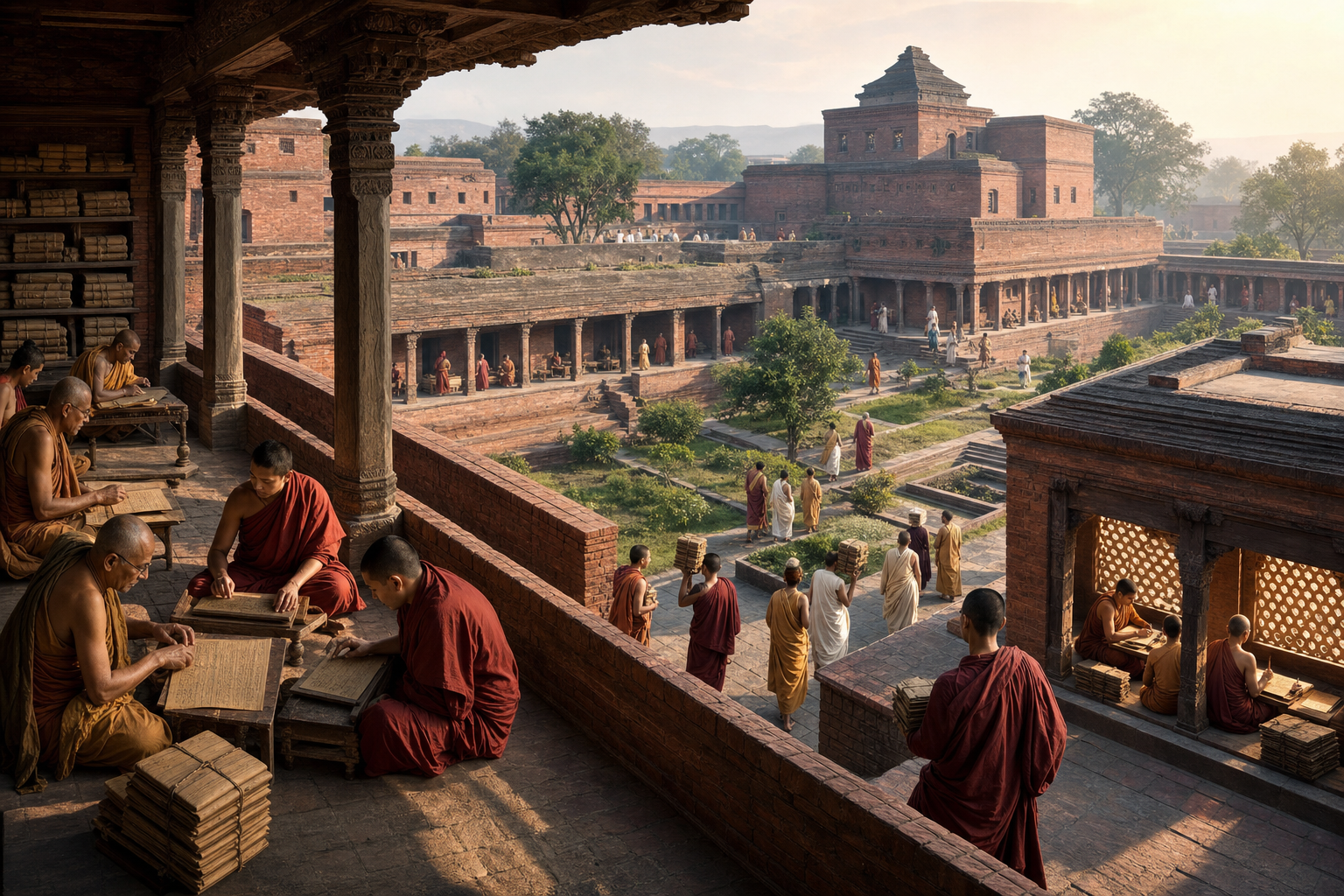
Nalanda made scholarship durable by giving it an institutional home. Its red-brick monastic quadrangles, regular cells, temples, axial routes and water systems reveal a campus deliberately organized for residence, study, worship and debate. Gupta patronage supported its emergence; Emperor Harṣa and the Pāla rulers sustained its expansion. Under the Pālas, revenues from endowed villages helped support resident monks, teachers, libraries and visitors.
That funding model matters because advanced learning requires protected time. Teachers cannot maintain difficult textual traditions, train successors, receive foreign scholars and preserve manuscripts if every activity must produce an immediate commercial return. Nalanda joined patronage to a governed community with daily scholarly discipline.
Accounts associated with Xuanzang and Yijing describe a demanding intellectual culture. Aspirants reportedly faced examination by gate scholars, or dvārapaṇḍitas, who tested readiness for advanced study. The point was not exclusivity for its own sake. A large scholarly community could function only when entrants possessed enough conceptual and ethical preparation to participate in its work.
Teaching combined pravacana, or exposition, with commentary, memorization and structured debate. Students needed to understand an authoritative teaching, follow its interpretations, retain its conceptual vocabulary and defend claims under questioning. These were mutually reinforcing practices. Memorization preserved access to the material; commentary disclosed layers of meaning; debate exposed weak reasoning.
Nalanda’s curriculum is often described through five broad sciences:
- Śabdavidyā: grammar and the disciplined use of language.
- Hetuvidyā: logic, reasoning and the grounds on which knowledge claims can be defended.
- Cikitsāvidyā: medicine and the care of embodied life.
- Śilpakarmasthānavidyā: arts, crafts and architecture.
- Adhyātmavidyā: knowledge directed toward inner cultivation.
Buddhist sūtras and śāstras across Madhyamaka, Yogācāra and Abhidharma traditions stood within this wider intellectual environment. Astronomy, mathematics, legal reasoning and poetics also enriched it. The five sciences should therefore not be reduced to five modern departments. They express a more demanding idea: an educated person needs command of language, standards of reasoning, useful knowledge, constructive skill and disciplined interior life.
If you are building an academy meant to outlast its founders, translate that idea into infrastructure. Set prerequisites for advanced study. Establish a common intellectual vocabulary. Preserve lectures, commentaries, disagreements and revisions. Give visiting scholars a defined place in the community. Train successors before senior teachers depart. Secure recurring support for work whose value appears over generations rather than at the end of a term.
Nalanda’s reach shows what such continuity can achieve. Manuscripts were copied, studied, glossed and transmitted through translation networks reaching China and Tibet. A copper-plate charter of Devapāla records support connected with Balaputradeva of Śrīvijaya, demonstrating that the institution also belonged to a Bay of Bengal knowledge network. Nalanda became a transregional scholarly commons because intellectual excellence was joined to residence, preservation, patronage and exchange.
Character, language and debate were part of competence
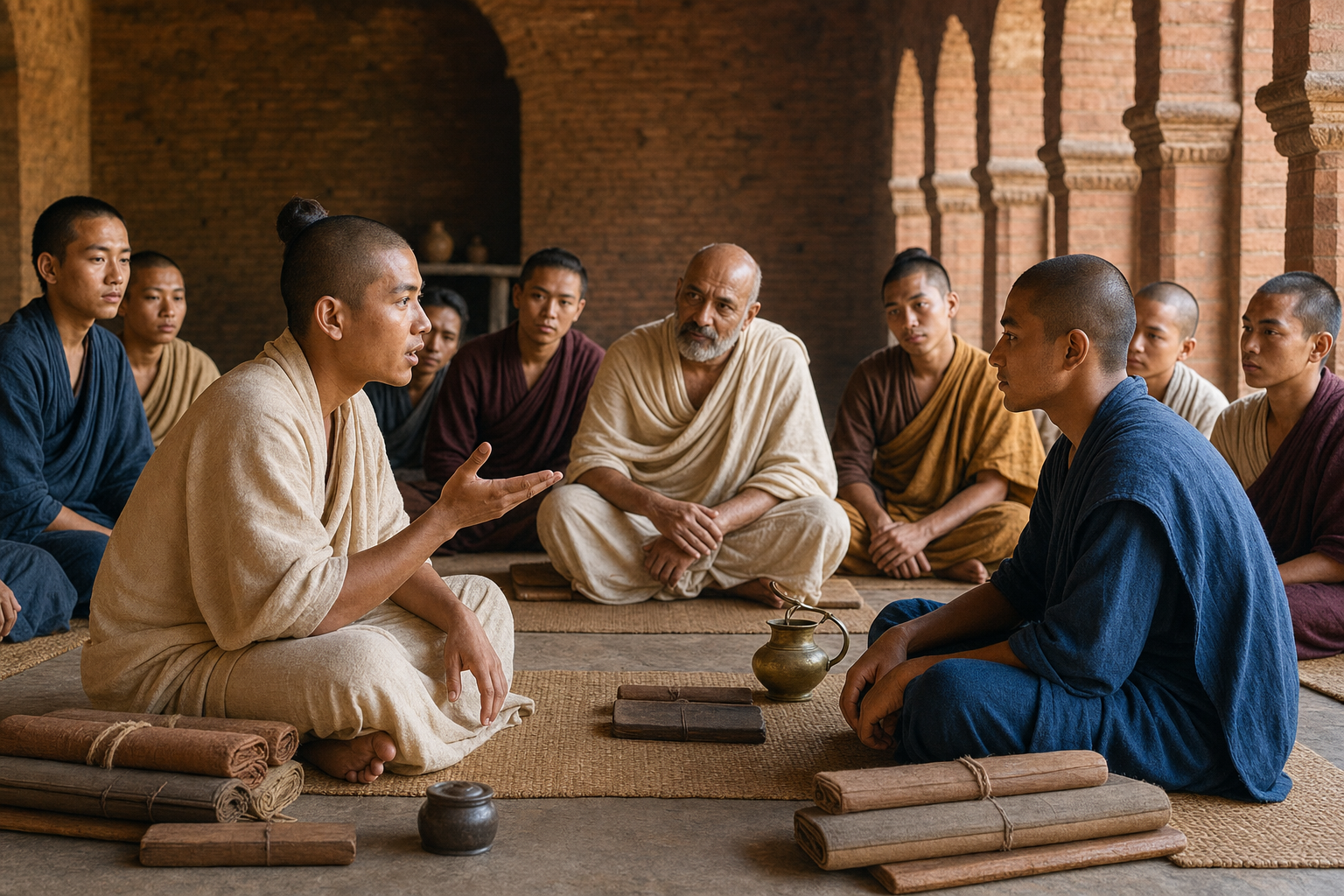
Neither model treated education as the transfer of neutral information into an otherwise unchanged person. Codes of conduct, communal duties and the ethical purpose of knowledge belonged to the educational process. Practical skill without self-command could be dangerous; spiritual aspiration without intellectual discipline could become vague or credulous.
Their pluralism also deserves precision. Vedic learning, Buddhist scholastic traditions and Jaina ethical reasoning could meet within the wider intellectual life of the subcontinent. That did not mean that doctrinal differences disappeared. It meant that disagreement could take place within shared expectations of disciplined inquiry, ethical restraint and respect for more than one path.
It would be anachronistic to place later Sikh institutions inside Takshashila or Nalanda. The more defensible connection lies in a wider dharmic conviction that learning should form character, sustain community and direct knowledge toward service. You can recognize a civilizational continuity without pretending that every tradition occupied the same historical institution.
Language was equally central. Takshashila’s environment included Sanskrit, Gandhārī and other Prakrit usage, as well as more than one script. Sanskrit was the principal language of advanced discourse at Nalanda, while other languages remained present in religious and everyday life. Cosmopolitan education did not require abandoning source languages. It required enough linguistic discipline to move ideas accurately between communities.
A present-day programme can recover that strength by choosing a common scholarly language without closing access to regional and classical languages. If a student studies Indian philosophy only through simplified summaries, the student inherits someone else’s conceptual limits. Build a staged path: accessible instruction first, technical vocabulary next, and direct engagement with source-language passages when the discipline demands it.
Debate should then function as quality control rather than spectacle. A useful modern adaptation of vāda would require each participant to:
- State the proposition in terms precise enough to be challenged.
- Define the key words before arguing over their implications.
- Present the strongest serious objection, not the weakest version of an opponent’s position.
- Answer with reasons, textual evidence or demonstrated consequences appropriate to the field.
- Identify what would require the original claim to be revised.
- Record the conclusion so the next group begins from accumulated knowledge rather than repeating the same exchange.
This protocol is a contemporary application, not a claim that every ancient debate followed those exact steps. It preserves the essential mechanism: knowledge becomes more reliable when memory, explanation, criticism and ethical restraint work together.
Build a hybrid instead of reenacting the ruins
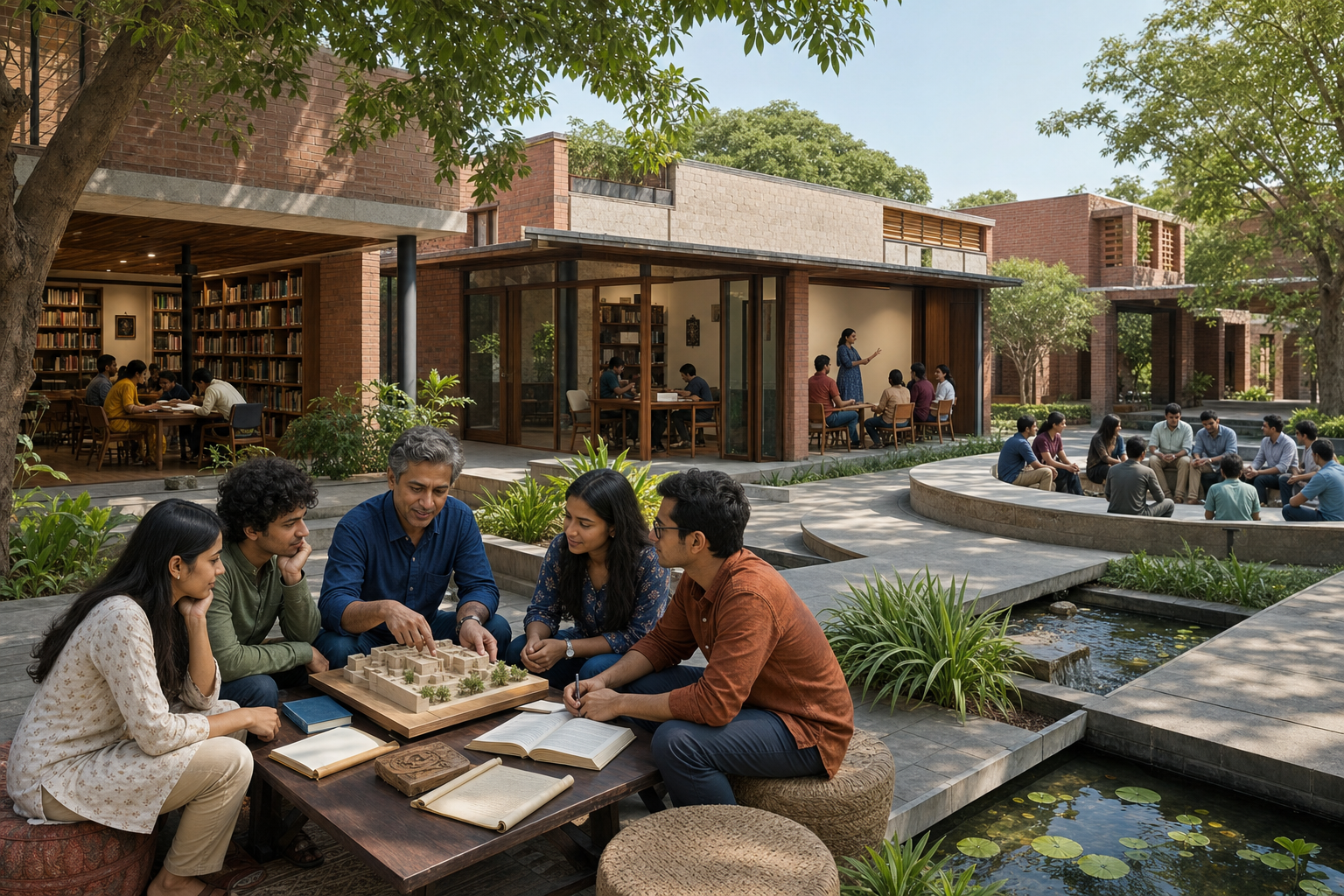
A replica of an ancient building will not recreate an ancient education. The transferable inheritance lies in relationships, standards and systems. If you are planning a school, university centre, gurukula, monastery programme or community study circle, build the model in this order:
- Name the social purpose. Decide which human or civilizational need the learning will serve. Takshashila’s applied disciplines and Nalanda’s union of scholarship with inner cultivation both resist knowledge without purpose.
- Make an ācārya accountable for formation. Every learner should have a teacher who can see the whole path, correct weaknesses and judge readiness. A collection of disconnected classes is not a lineage of education.
- Create a common foundation. Require language precision, reasoning, ethical discipline and enough breadth to prevent narrow specialization from becoming intellectual blindness.
- Move from explanation to practice. Students should use what they learn through diagnosis, composition, translation, design, public reasoning, service or another form appropriate to the discipline.
- Test understanding through serious exchange. Use commentary and debate to reveal whether students can defend, revise and apply a claim rather than merely repeat it.
- Preserve institutional memory. Maintain texts, teaching notes, recorded questions, translations and revised curricula in a system that remains usable after individual teachers leave.
- Build routes of exchange. Invite scholars from other regions and traditions, and prepare your own students to carry knowledge outward without stripping it of context.
- Fund continuity. Separate long-term scholarly work from the demand for instant return. Patronage should support teachers, learners, archives, translation and succession, not only visible construction.
The hybrid has a clear division of labour. Takshashila contributes the close teacher-student bond, curricular adaptability and contact with practical life. Nalanda contributes admissions standards, residential community, common resources, specialization, archives and continuity. One keeps the institution human; the other keeps human excellence from being lost.
Key takeaways
- Takshashila is best understood as a distributed network of ācārya-led learning rather than a centralized university in the modern sense.
- Nalanda was a governed residential Mahāvihāra designed to sustain advanced study, libraries, debate and international scholarly exchange.
- Takshashila is the stronger model when the immediate need is mentorship, flexibility and practical application.
- Nalanda is the stronger model when the need is specialization, preservation, shared standards and continuity across generations.
- Both models joined intellectual rigor to ethical formation; neither reduced education to credentials or information delivery.
- A serious modern revival should combine personal responsibility for each learner with institutional responsibility for preserving knowledge.
Before naming your next educational initiative after either centre, write down answers to four questions: Who is responsible for the learner’s formation? What must the learner demonstrate? How will the knowledge survive the founding teacher? Who will sustain work that may take generations to bear fruit? Clear answers turn civilizational remembrance into an educational model you can actually build.