
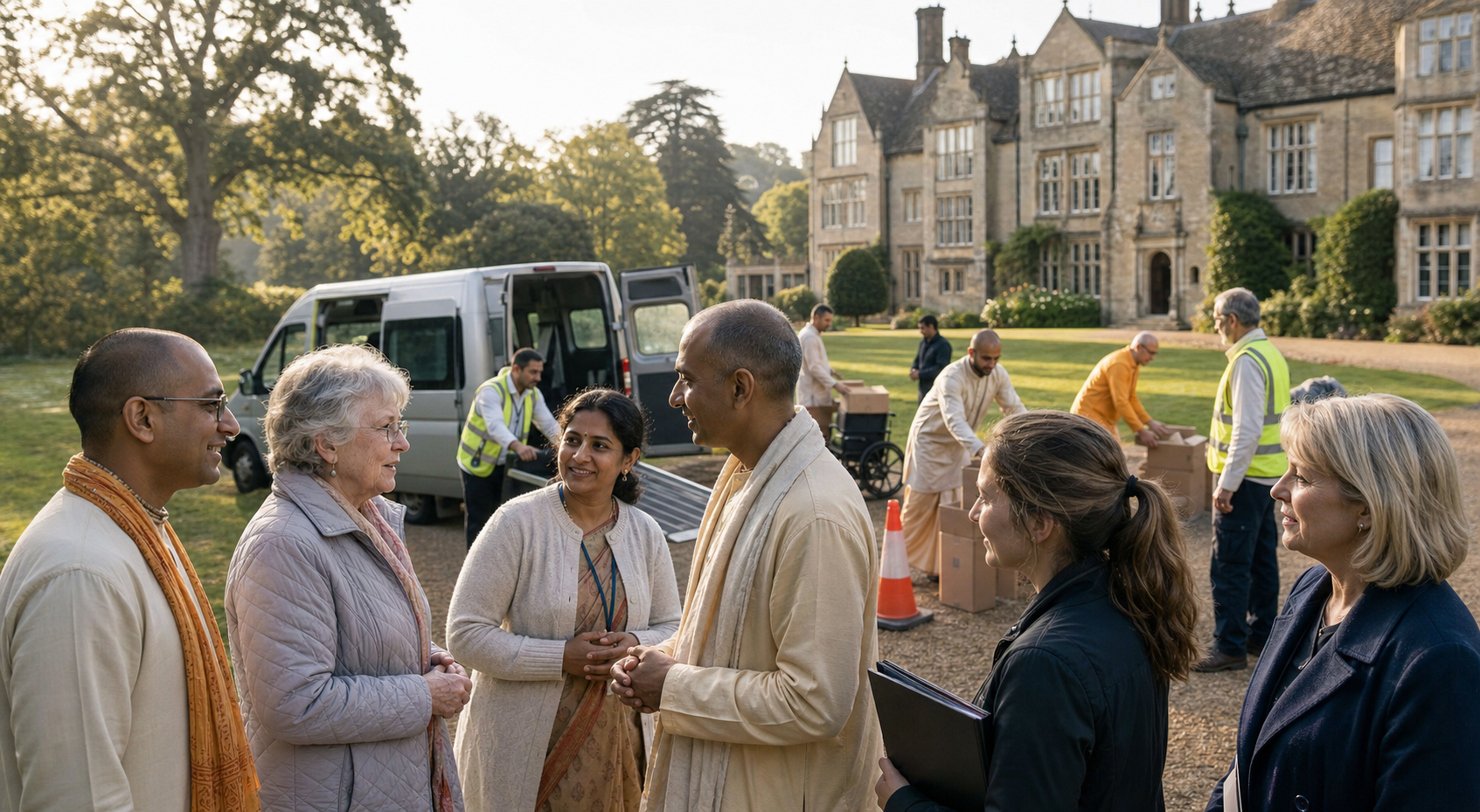
If you help lead a temple, the difficult civic question is not whether seva has value. It is whether a neighbour, charity or council can safely rely on that seva when someone is isolated, a family needs guidance, or a major festival places pressure on the surrounding area.
Bhaktivedanta Manor offers a practical answer. Its model joins a recognisable point of contact, trained volunteers, sound safeguards and public relationships without treating devotional identity as an obstacle. The aim is not to copy one institution’s structure. It is to understand the chain that turns a dharmic intention into dependable public service.
Key takeaways
- Give community care a visible front door. People need to know where to ask for help, what help is available and what happens next.
- Build safeguarding, confidentiality, referral and volunteer-support systems before inviting outside organisations to depend on the service.
- Keep the temple’s devotional character clear while making civic assistance inclusive, dignified and non-proselytising.
- Define each partnership around a specific problem, named responsibilities and a safe handoff between organisations.
- Measure response, referral, follow-up and user feedback. Activity alone does not show whether a person’s situation improved.
- Treat awards and official visits as openings for deeper work, not as substitutes for a programme with an owner, process and review point.
Civic service starts with a door someone can actually enter
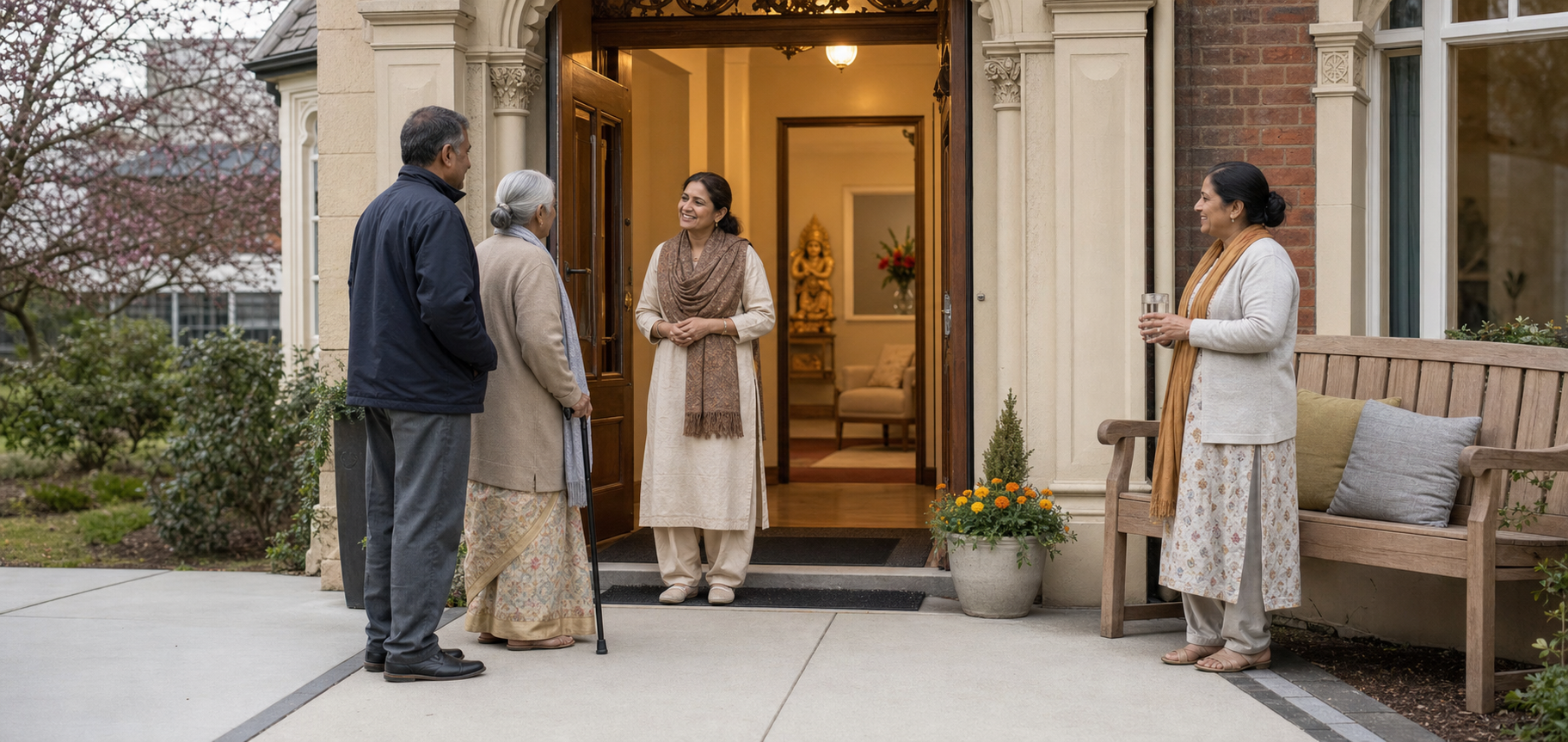
Many temples already contain a great deal of informal care. A devotee notices that an elder has stopped attending. A family seeks support around illness or bereavement. A newcomer cannot work out which local service to approach. Volunteers respond with meals, companionship, prayer, transport or advice. The compassion is real, but the route into it may depend on whom the person happens to know.
Bhaktivedanta Manor’s Devotee Care Office addresses that weakness by serving as a recognisable contact for practical and pastoral support. Its remit brings spiritual, emotional and social needs into one care pathway while allowing appropriate services to handle matters beyond a volunteer team’s competence. Hertsmere’s decision to give the office a Civic Award in the Community Care category is significant because it places this faith-rooted work within the borough’s wider understanding of community well-being.
The useful principle for your temple is simple: do not make a person navigate the whole institution before receiving an answer. Create one published contact point and one consistent pathway behind it.
- Receive the request. A named person or monitored channel acknowledges it and listens without making promises the team cannot keep.
- Clarify the need. Separate pastoral companionship from requests requiring medical, psychological, legal, financial or statutory expertise.
- Choose the safe next step. The response may be befriending, culturally sensitive support, volunteer coordination, signposting or referral.
- Complete the handoff. Giving someone a telephone number is not always enough. Where appropriate and permitted, help the person understand how to approach the relevant service.
- Follow up. A brief, agreed check-in can establish whether the connection worked or whether another route is needed.
The first response does not have to solve every problem. It must produce a safe and intelligible next step. If there is an immediate danger or a safeguarding concern, the matter should move through the designated professional or statutory route rather than remain inside an informal congregational circle. Volunteer warmth is valuable, but it is not a substitute for specialist care.
This structure also protects the spiritual character of the work. Hindu seva, Buddhist karuna, Jain dana and Sikh traditions of service do not have to be flattened into a generic civic slogan. Each tradition can explain its own moral source while meeting a neighbour with dignity. Faith-informed encouragement may be offered where it is wanted; access to practical help should not depend on accepting a belief or joining a congregation.
Goodwill becomes public trust only when the system holds

A council or charity cannot base a referral relationship on the hope that a particularly dedicated volunteer will always be available. It needs to know what the temple does, where its limits lie, who is accountable and how concerns will be handled. This is where seva acquires an organisational form.
For a UK temple, a minimum civic-ready operating pack should cover the following:
- A defined service scope: who can approach the team, what kinds of support it provides and what it explicitly does not provide.
- Safeguarding: proportionate policies, a clear reporting route and a named lead who knows when professional escalation is required.
- Confidentiality and data protection: a procedure for obtaining, storing, sharing and disposing of personal information in line with GDPR responsibilities.
- Equality and access: an inclusive approach that respects different beliefs, languages, cultures and personal circumstances.
- Risk assessment: practical checks for home visits, transport, events, work with vulnerable people and other activities carrying foreseeable risk.
- An accessible complaints route: people receiving support must be able to raise a concern without having to challenge the volunteer who is directly helping them.
- Volunteer preparation: written roles, boundaries, active-listening training, referral guidance and clarity about who supervises difficult cases.
- Reliable rotas and debriefing: continuity for service users and a way for volunteers to process demanding situations before strain becomes burnout.
- A referral directory: current contacts for statutory bodies, charities and qualified professionals rather than an improvised internet search during a crisis.
These controls are not bureaucratic decorations. They protect the person asking for help, the volunteer offering it and the temple responsible for both. They also make partnership possible: an outside body can see how a request moves through the system and where its own expertise enters.
Accountability should remain proportionate. A small care office does not need to bury volunteers under an elaborate reporting regime. It does need a few measures that answer useful questions: How quickly was a request acknowledged? Was a referral made? Did the person reach the intended service? Was a follow-up completed? What did the person say about the help received?
Short, anonymised accounts of reduced isolation, improved confidence or a successful connection to local support can explain what raw totals miss. At the same time, personal stories should never be used publicly without appropriate permission. The point of evidence is to improve care and demonstrate reliability, not to turn someone’s hardship into publicity.
A partnership should clarify boundaries, not blur identities

Bhaktivedanta Manor’s work with councils, faith networks and local charities illustrates an important distinction. Public partnership does not require a temple to secularise Krishna worship, and it does not require a public body to endorse the temple’s theology. Each side needs to understand the other’s contribution to a defined civic task.
Start with the shared problem, not a vague declaration of shared values. Loneliness, difficulty navigating local services, youth development, cultural education, food relief, festival safety and environmental stewardship can each support a concrete programme. A broad promise to “serve the community” cannot tell a partner what it may safely refer, fund, support or evaluate.
Before agreeing to joint work, put six points on one page:
- Purpose: name the problem and the intended benefit in plain language.
- Access: state who may use the service, how they reach it and whether any capacity limits apply.
- Responsibilities: specify what the temple, charity, council or faith network will each do.
- Boundaries: state what volunteers are not qualified or authorised to do.
- Handoff and escalation: identify the contact, consent process and route for urgent or specialist cases.
- Learning: agree what will be recorded, how privacy will be protected and when the arrangement will be reviewed.
A useful partnership statement might be as direct as this: the temple provides culturally informed befriending and helps residents navigate services; the specialist charity receives referrals that require professional intervention; both organisations confirm whether the handoff succeeded without sharing unnecessary personal information. That sentence is more valuable than several pages of ceremonial language because a volunteer can act on it.
Interfaith work becomes stronger under the same discipline. Dialogue has value, but joint training and joint service reveal whether institutions can cooperate under real conditions. Temples, gurdwaras, Jain organisations, Buddhist communities and non-dharmic faith groups can share safeguarding instruction, referral knowledge or a tightly defined service project while retaining their own worship, doctrine and internal life.
Official visits need similar clarity. The visit of Telangana minister Konda Surekha, whose responsibilities included religious endowments and the environment, brought two relevant governance settings into contact: Indian stewardship of large temple systems and a British diaspora temple operating within charity and civic frameworks. That contact creates possibilities for learning about records, accountability, environmental care and festival management. It should not be mistaken for a formal partnership unless a shared piece of work, responsible owner and review process follow it.
This distinction protects both credibility and dharmic dignity. A photograph records access. A partnership produces a result that the temple, public body and community can each explain.
Community care can grow into stewardship of place
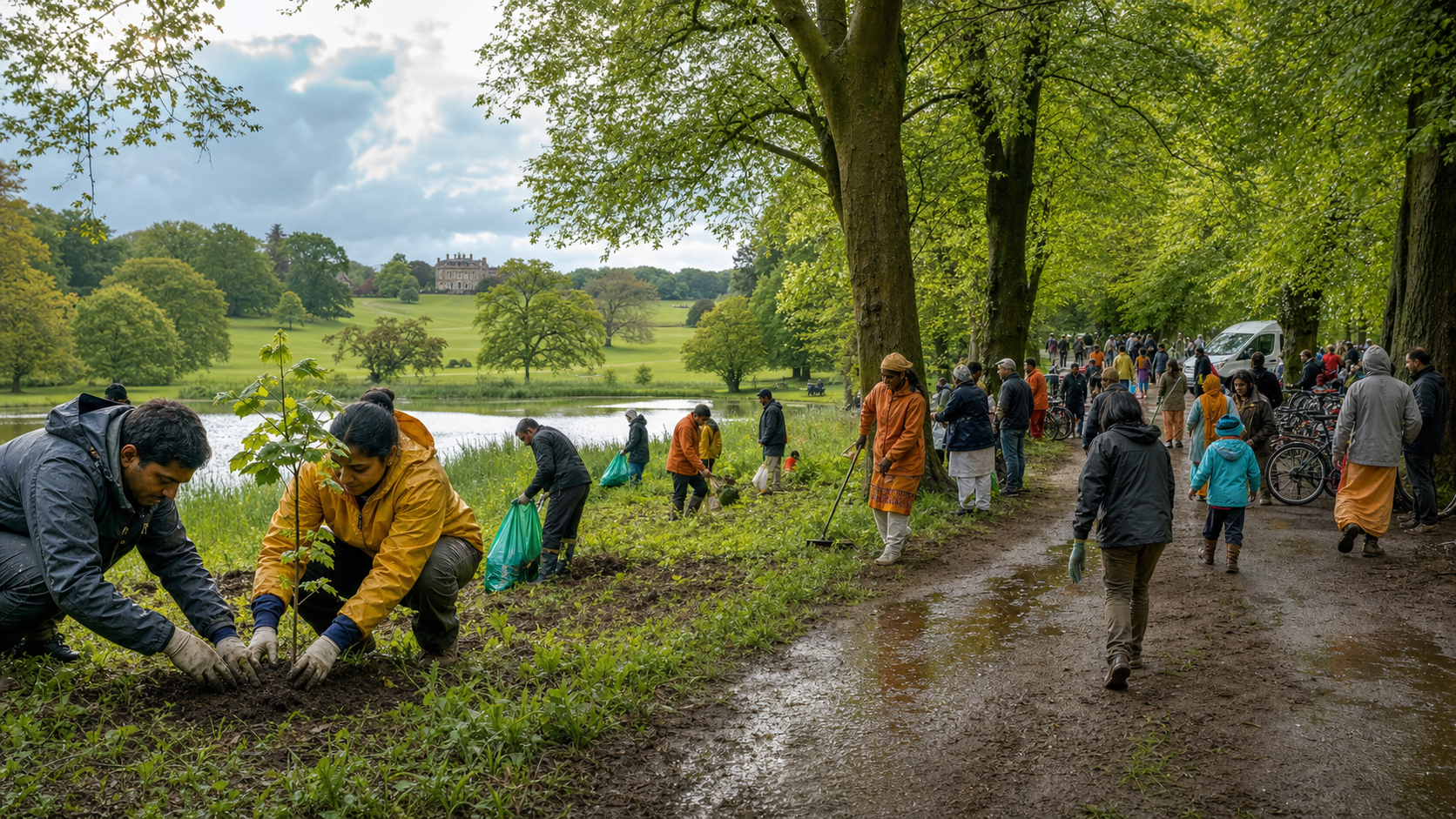
Bhaktivedanta Manor is not only a pastoral-care setting. Established in 1973 with George Harrison’s support, it is an active Gaudiya Vaishnava campus that combines worship, education, cultural heritage and service. Its major Janmashtami activity forms part of an annual reach measured in tens of thousands. At that scale, civic responsibility extends from caring for individuals to managing land, heritage, visitors, transport and neighbourhood impact.
A temple considering wider public partnerships should separate this work into manageable lanes:
- People and care: pastoral contact, befriending, culturally informed navigation, referrals and volunteer mobilisation.
- Festivals and public safety: visitor flows, queues, sanitation, accessibility, proportionate security, emergency planning and transport coordination with local authorities.
- Land and ecology: energy use, water management, biodiversity, waste from prasada and flowers, packaging, ethical procurement and conscientious animal care.
- Heritage: digital records of buildings and objects, preventive conservation, fire planning, disaster readiness and protection of living traditions such as kirtan, language learning and craft knowledge.
- Youth and education: programmes connecting devotional learning with language, music, arts, environmental activity and service-based leadership.
Each lane calls for different partners. A specialist charity may be best placed to receive a complex care referral. A council may be essential for festival access, safety and traffic planning. Environmental organisations can contribute technical knowledge that a devotional community does not hold internally. Schools and faith networks may strengthen cultural education and youth service. Public officials responsible for temples or the environment may be able to exchange governance practices across jurisdictions.
Do not launch all of these under one grand civic initiative. Choose the area where the temple already has a credible base and where an external partner fills a clearly identified gap. A care office with trained volunteers may be ready for a referral arrangement. A large festival may justify a multi-agency planning group. A temple estate may begin with an energy or water assessment before promising a comprehensive green transformation.
This narrower approach also keeps dharmic language connected to observable practice. Ahimsa is visible when procurement and waste choices reduce avoidable harm. Seva is visible when an isolated person receives a timely response. Responsible stewardship is visible when heritage records, fire plans and crowd systems protect both sacred life and the public. Values become persuasive in civic space when people can see how they govern a decision.
Put this on your next trustee or volunteer agenda
- Select one existing service that neighbours already seek from the temple.
- Name its contact point, scope, limits and accountable lead.
- Draw the path from first request to follow-up, including the route for urgent and specialist cases.
- Check safeguarding, confidentiality, complaints, volunteer training and debriefing against that path.
- Identify the single outside organisation whose expertise would close the most important gap.
- Draft the one-page partnership note before requesting a meeting.
- Review a small set of response, referral, follow-up and feedback evidence before expanding the work.
Begin with that one-page service pathway. When a neighbour can understand it, a volunteer can follow it and a public partner can rely on it, your temple is ready to move from generous activity to durable civic service.
References
- DharmaRenaissance Blog – Dharmic Harmony and Heritage: Telangana Minister Konda Surekha’s Inspiring Visit to Bhaktivedanta Manor
- DharmaRenaissance Blog – Inspiring Recognition: Bhaktivedanta Manor’s DCO Wins Hertsmere Civic Award for Community Care