

If you are trying to understand why West Bengal can change ruling parties without fully changing its political culture, the Bengali Bhadralok is a useful place to look. But the term becomes useless the moment it is reduced to a caste slur, a synonym for educated Bengalis, or a convenient explanation for every failure of the state.
The sharper question is how a historically influential social stratum learned to convert education, language, professional status, and institutional access into political authority under very different regimes. Once you see that mechanism, you can distinguish cultural achievement from elite gatekeeping, social welfare from partisan mediation, and Dharmic recovery from merely changing the slogans of those in power.
Bhadralok describes a structure of influence, not all Bengalis

Bhadralok literally means gentlefolk. Historically, it referred to a social formation whose members possessed some combination of respectable status, education, property, professional employment, and fluency in the language of administration. Brahmins, Baidyas, and Kayasthas were prominent within it, but treating the category as a fixed list of castes misses its political significance.
Its rise depended on a particular institutional arrangement. The Permanent Settlement of 1793, English education, land-revenue connections, and expanding colonial professions created routes into influence that were unavailable to much of society. Calcutta’s courts, colleges, presses, missionary schools, Fort William College, bureaucracy, journalism, and legal profession supplied the infrastructure. Macaulay’s Minute on Education in 1835 strengthened the demand for an Anglophone intermediary class.
This produced more than clerks serving an empire. The same educated public also developed Bengali prose, newspapers, literary societies, legal argument, political associations, and new forms of public debate. Bankim Chandra Chattopadhyay, Rabindranath Tagore, Swami Vivekananda, and Aurobindo Ghosh drew from Sanskritic inheritance, Bengali creativity, and global thought to express a civilizational confidence that colonial education alone cannot explain.
That double inheritance matters. One face of Bhadralok life mastered the institutions established by foreign rule. The other used modern education and print to recover, reinterpret, and defend Bharat’s civilizational resources. Brokerage and renaissance were not two neatly separated camps. They often existed within the same institutions and sometimes within the same individual.
So when you hear that the Bhadralok caused a political development, ask three questions before accepting the claim:
- Which institution is involved? A university department, newspaper, court, cultural academy, party office, civil-service network, and landed household exercise different kinds of power.
- What resource is being controlled? Look for authority over credentials, appointments, public reputation, administrative access, publication, contracts, or the language in which a policy is judged legitimate.
- Who needs an intermediary? Elite influence becomes politically consequential when ordinary people must approach the state, a party, or a public institution through someone who can translate rules into access.
A claim that does nothing more than recite surnames is weak analysis. A claim that maps institutions, incentives, recruitment, and channels of access may reveal something real. This distinction lets you criticise entrenched privilege without turning an entire intellectual culture into a hereditary accusation.
Why Marxism found a moral audience in a Dharmic landscape
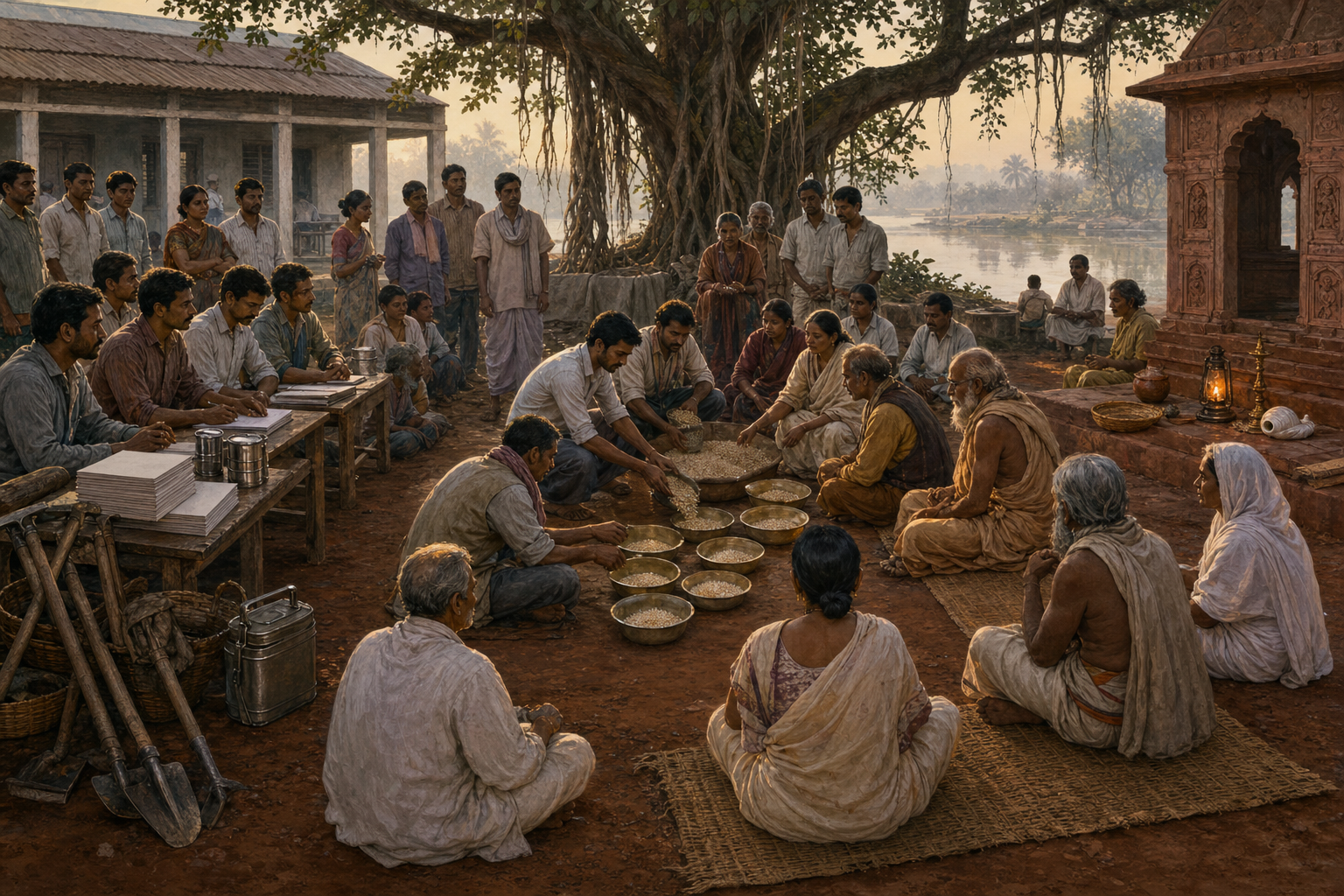
Bengal’s twentieth-century turn toward the Left is sometimes described as though a foreign doctrine suddenly displaced an otherwise undisturbed Dharmic society. That explanation is emotionally satisfying but historically thin. Political ideas become powerful when they name suffering that existing institutions have failed to address.
The Partition of Bengal in 1905 had already generated Swadeshi mobilisation and sharpened arguments about imperial authority. The Bengal Famine of 1943 combined wartime policy failures with market distortions, producing a moral shock that incremental reform could not easily absorb. Marxism offered an organised vocabulary for class, extraction, land, labour, surplus, and state responsibility. To many educated Bengalis, it appeared to explain why poverty survived beneath the language of progress.
This does not excuse admiration for Stalinist repression or Maoist violence. The human cost of those systems cannot be dissolved into anti-imperial sentiment. It does, however, explain why Leninist or Maoist resolve could function symbolically as a promise to break exploitation, even among people formed by Bengal’s older religious and literary traditions. Understanding an attraction is not the same as endorsing it.
Partition deepened the pressure. The Great Calcutta Killings of 1946, the division of Bengal in 1947, and continuing refugee arrivals from East Pakistan transformed family life, employment, housing, education, and public administration. The genocide and refugee crisis surrounding the 1971 Liberation War renewed the demands placed on civil society and the state. Security, welfare, education, minority protection, border management, and economic survival were not abstract debating points. They were intertwined consequences of repeated upheaval.
The Naxalbari uprising in 1967 represented one revolutionary expression of this discontent. Its fragmentation and the severe state response did not end the wider Leftward movement. The Left Front’s electoral rule from 1977 to 2011 then converted Left politics into a durable institutional order rather than a temporary protest.
You do not have to choose between romanticising that order and denying all of its achievements. A useful assessment keeps the benefit, mechanism, and cost in the same frame.
| Area | Material change | Question you should ask |
|---|---|---|
| Land and rural power | Operation Barga strengthened tenancy security, while panchayati raj decentralised parts of rural governance. | Did local participation remain rule-bound, or did access increasingly depend on party cadres? |
| Education | Basic education expanded, and universities retained considerable intellectual prestige. | Were appointments, curricula, and acceptable viewpoints protected from partisan or ideological gatekeeping? |
| Political stability | Party-society networks brought organisation and relative calm to parts of the countryside. | Did stability protect citizens equally, or did it make the party the routine mediator of public life? |
| Industry and employment | The state did not capture important industrialisation opportunities, while capital flight and outward migration became persistent concerns. | Did labour policy protect workers while enabling new employment, or did political control substitute for economic renewal? |
The cultural effect was as important as the electoral one. Publishing, theatre, cinema, universities, and historical writing increasingly operated within Left-of-centre assumptions. That did not make every scholar a party functionary. It meant that one political vocabulary came to define what sounded sophisticated, humane, or intellectually respectable before a particular argument had even been tested.
The disputes involving historians such as R.C. Majumdar and Acharya Jadunath Sarkar are therefore more than old academic quarrels. They point to a continuing test for any school of history: does it allow archives to unsettle its moral preferences? A civilizational interpretation can become as careless as a Marxist one if it selects evidence only to reward its own side. When you evaluate a historical claim, look for how it handles inconvenient facts, not merely whether its conclusion feels ideologically familiar.
Why the 2011 change of government did not erase elite continuity

Mamata Banerjee’s Trinamool Congress victory in 2011 was widely understood as a rejection of stagnation and the Left Front’s long rule. Yet replacing a government does not automatically replace the professionals, cultural arbiters, institutional habits, local intermediaries, or prestige networks through which government is interpreted and delivered.
This is where continuity becomes easier to see. Older landed power had already weakened after Independence through the abolition of zamindari and land reform. Bhadralok influence increasingly rested in professions, law, education, journalism, administration, media, and culture. These forms of capital can survive an election because they are embedded in qualifications, reputations, organisations, and social relationships rather than in a single party card.
The TMC era brought a different political language and welfare priorities. Kanyashree and Sabuj Sathi placed emphasis on social provision, including support connected with girls, education, and mobility. At the same time, public allegations of clientelism and local syndicate control raised questions about who mediated access to resources and contracting. These allegations should be treated as allegations where they have not been adjudicated, but the institutional question they raise is legitimate.
A welfare benefit and an unfair delivery network can exist at the same time. A programme’s social value does not prove that every local gatekeeper acts impartially. Conversely, evidence of local patronage does not show that every beneficiary received nothing of value. If you collapse those two questions, party loyalty will decide your conclusion before the facts do.
The more durable pattern is elite mediation. Under colonial government, an educated stratum translated imperial rules and local society to each other. Under Left rule, cadres and intellectual institutions helped translate ideology into administration and public legitimacy. Under the TMC, established professionals and cultural networks could adjust to a new centre of patronage while local political brokers mediated benefits, permissions, and opportunities. The names and rhetoric changed more quickly than the social utility of being an intermediary.
This should not be mistaken for a secret conspiracy. Institutional memory, literacy, legal expertise, and administrative competence are real public assets. A society needs people who can interpret complicated systems. The danger begins when interpretation turns into private control: rules become negotiable for insiders, public recognition depends on ideological conformity, and citizens cannot obtain ordinary services without partisan assistance.
You can test for that danger without relying on rumours. Choose one institution and trace four things over time: who receives appointments, which qualifications are treated as decisive, whether critics retain meaningful access, and whether formal procedures work without a political intermediary. For welfare schemes, separate eligibility rules from the local process of enrolment and delivery. For universities, distinguish scholarly disagreement from attempts to exclude a viewpoint. For cultural bodies, compare artistic merit with patterns of patronage. For public contracts, look for transparent rules and consistent enforcement rather than assuming that every politically connected participant proves the same allegation.
This method also helps explain Bengal’s much-discussed brain drain. Liberalisation in the 1990s created new opportunities across India, especially in growing professional and technology centres, while West Bengal’s domestic industrial revival lagged. Many Bengali students and professionals succeeded elsewhere. Their individual success demonstrated the strength of Bengal’s educational capital, but their departure also exposed the state’s difficulty in converting that capital into enough opportunity at home.
A Dharmic standard must judge conduct, not political branding
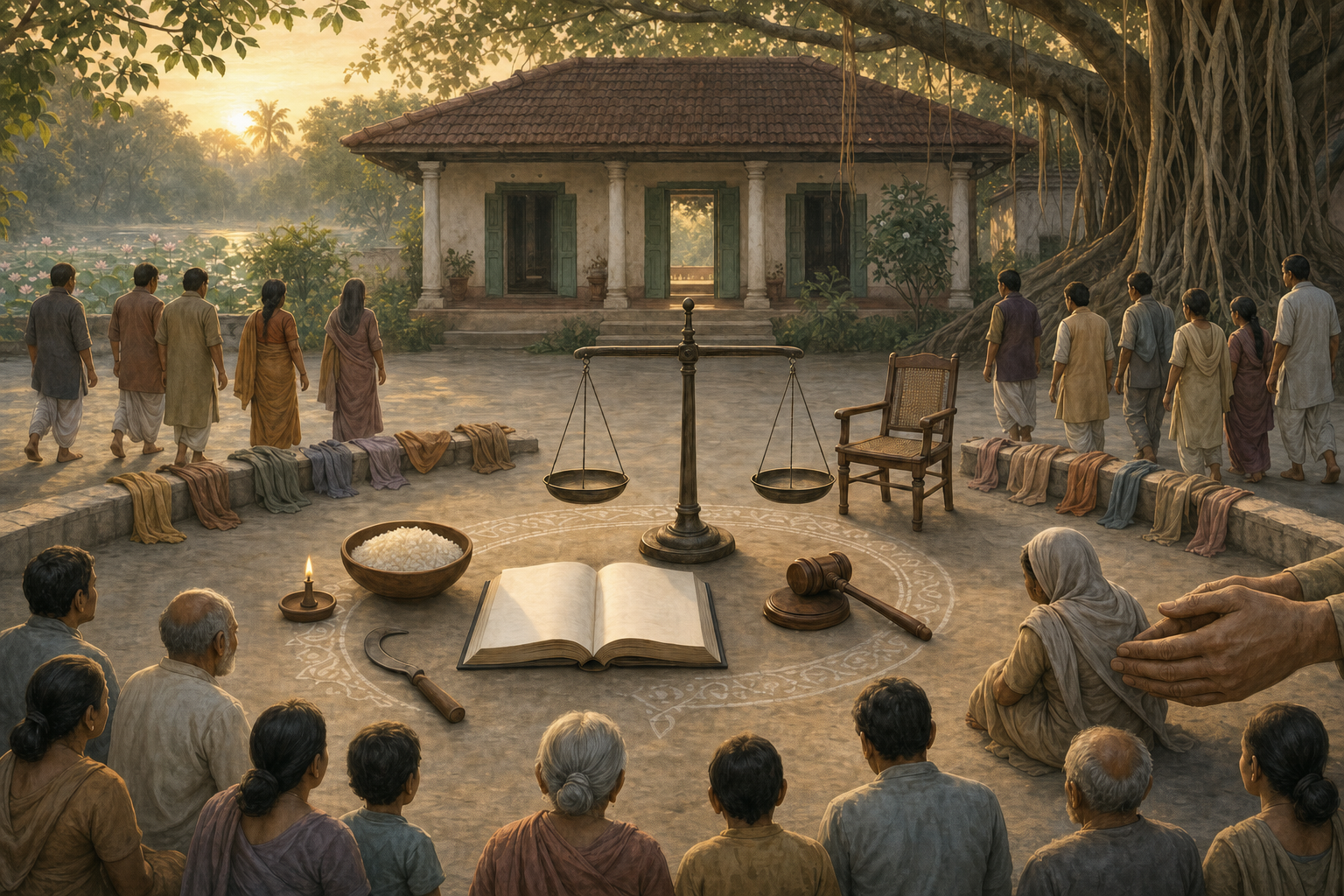
A pro-Dharma response should not simply invert the old hierarchy, replacing a Left-approved list of thinkers with a Hindu-approved list while preserving the same habits of exclusion. That would change the vocabulary of power without changing its character.
Bengal’s civilizational inheritance offers a more demanding standard. Chaitanya Mahaprabhu’s devotional current, Bankim’s cultural imagination, Sri Ramakrishna’s spiritual capaciousness, Vivekananda’s union of strength and service, Tagore’s intellectual freedom, and Aurobindo’s civilizational vision cannot be reduced to decorative icons for an election campaign. They challenge Bengalis to connect cultural self-respect with character, scholarship, social duty, and freedom of thought.
The Ramakrishna Mission’s emphasis on seva and character formation is especially relevant. It demonstrates that a Dharmic institution can serve society, respect religious plurality, and strengthen civilizational confidence without making party brokerage the basis of public work. That is a practical alternative to both cultural deracination and partisan religious display.
Use five standards when assessing any Bhadralok-led institution, political formation, or cultural campaign.
- Civilizational literacy: Does it seriously engage Bengal’s Dharmic and historical inheritance, or use a few revered names as symbols while retaining intellectual contempt for the traditions they represented?
- Institutional fairness: Can people obtain education, employment, recognition, welfare, or justice through published rules, or must they display proximity to a party or approved social network?
- Intellectual honesty: Are the crimes of colonialism, Stalinism, Maoism, communal violence, and partisan repression judged by consistent moral standards?
- Social duty: Does cultural influence produce schools, scholarship, relief, livelihoods, and service, or mainly conferences, slogans, and control over prestige?
- Economic responsibility: Does policy protect vulnerable people while creating conditions for work and enterprise, or does it distribute benefits without repairing the productive base on which future welfare depends?
These standards also prevent two common errors in Hindu political discussion. The first is to dismiss all concern for poverty, labour, minority protection, or refugee welfare as Leftist language. Bengal’s history gives those concerns a real moral basis. The second is to treat invocations of pluralism as sufficient, even when they avoid hard questions about communal violence, border management, historical memory, or equal application of law. A Dharmic outlook should be capable of compassion and clarity at the same time.
The Bhadralok legacy is therefore neither a civilizational villain nor an automatic source of enlightenment. Its education and cultural production helped Bengal speak to Bharat and the world. Its dependence on proximity to successive centres of authority also made accommodation, gatekeeping, and ideological fashion recurring temptations. The right response is not resentment of learning. It is to demand that learning answer to truth, public duty, and institutions that remain fair when political power changes hands.
Key takeaways for reading West Bengal politics
- Do not use Bhadralok as a caste insult. Use it to analyse how education, professional standing, cultural authority, and administrative access become political power.
- Do not explain Marxism as simple civilizational betrayal. Famine, exploitation, Partition, land conflict, and refugee upheaval created the moral conditions in which structural explanations gained force.
- Keep the Left’s achievements and costs in one ledger. Tenancy security, decentralisation, and education can be recognised without ignoring cadre control, capital flight, or missed industrialisation.
- Do not confuse a change of party with a change of institutions. Universities, media, law, culture, and professional networks often outlast governments and adapt to new patronage.
- Judge welfare and delivery separately. A useful programme can coexist with allegations of local gatekeeping; each question needs its own evidence.
- Apply the same Dharmic test to every party. Look for civilizational literacy, seva, intellectual freedom, economic competence, institutional fairness, and equal moral standards.
The next time a political controversy in West Bengal is blamed on the Bhadralok, do not begin with a stereotype. Pick the institution involved, identify the resource being controlled, trace the intermediary, and ask whether the same rule would survive a change of government. That will tell you far more than the loudest ideological label.