

You may be practicing faithfully and still wonder what your effort is doing. If divine grace is freely given, why undertake tapas, japa, puja, or study? If austerity can move a deity, are you cultivating devotion or trying to force a result?
Your answer will shape everything from the mantra you choose to the way you interpret a setback. A sound Vedic-Tantric approach neither waits passively for grace nor treats spiritual technique as a machine for producing favors. It joins right understanding, disciplined practice, ethical restraint, and receptivity to the Divine.
Grace can answer you without endorsing your aim

Two errors sit at opposite ends of spiritual life. One says that enough austerity obliges the deity to grant your demand. The other says that because grace cannot be purchased, disciplined practice is unnecessary. Both confuse the relationship between human effort and divine response.
Tapas concentrates your will. Bhakti directs the heart. Mantra steadies attention and joins it to sacred sound. None of these turns Ishvara into an instrument of the ego. Practice prepares, strengthens, and exposes you; grace remains the Divine’s freedom to reveal, empower, correct, redirect, or withhold.
Shaiva traditions make this distinction unusually vivid. Shiva is remembered as Ashutosha, the Lord who is readily pleased, and his response crosses the deva-asura boundary. Ravana’s severe tapas receives a divine answer. Yet regional traditions connect the resulting Linga with Gokarna or Baidyanath rather than allowing Ravana’s purpose alone to control the outcome. The details vary, but the theological point remains stable: the sincerity and force of devotion can be real even when the devotee’s intention is mixed.
That is not moral relativism. Shiva’s willingness to respond does not certify every use of the power received. Bhasmasura represents the same warning in sharper form: capacity can increase faster than wisdom. Dharma and karma continue to operate after a boon, a vision, or a siddhi. Divine generosity does not protect a practitioner from the consequences of pride, violence, or misuse.
Read the term rakshasa carefully in this setting. It is a narrative description of beings and dispositions associated with formidable power, passion, and sometimes adharma. It is neither a modern ethnic label nor a formal Agamic classification of Lingas. The Linga itself signifies a divine presence that cannot be confined to social categories such as insider and outsider, friend and enemy, or deva and asura.
Before beginning a vrata or asking for a specific result, write down three questions:
- What exactly am I asking the deity to change?
- What am I willing to let the practice change in me?
- Who could be helped or harmed if my request is fulfilled?
If you can answer the first question but not the second, your practice may be seeking leverage rather than transformation. If the desired result depends on another person’s humiliation, loss, or coercion, revise the sankalpa before intensifying the method. Ask instead for clarity, protection, rightful resolution, and the strength to act without adharma.
Let Vedic vision set the direction and Tantra embody it

You do not have to choose between a supposedly intellectual Veda and a supposedly experiential Tantra. That opposition misdescribes both. Vedic revelation supplies a vision of truth, rita, sacrifice, Atman, Brahman, and liberation. Tantric and Agamic traditions give an applied grammar through which sacred presence is invoked in sound, image, body, space, and communal worship.
The Vedic modes of shravana, manana, and nididhyasana ask you to listen, examine, and absorb. Tantra works through such disciplines as mantra, yantra, mudra, nyasa, and deity-centered worship. Shaiva, Shakta, and Vaishnava Agamas also shape much of the consecration, archana, alankara, naivedya, and festival practice found in Hindu temples. The metaphysical horizon may be Vedic or Vedantic while the visible ritual procedure is Agamic.
This complementarity appears across traditions. Advaita Vedanta articulates Brahman as nondual reality. Shakta Tantra speaks of the inseparability of Shiva and Shakti, consciousness and its power. Kashmir Shaivism joins nondual recognition to Tantric sadhana. Pancharatra orders Vaishnava worship through a theology of the One and its shaktis. These systems should not be flattened into identical doctrines, but they show why Vedic insight and Tantric practice can inhabit the same religious life.
Integration, however, is not indiscriminate mixing. A coherent practice has four layers:
- Vision: What does your tradition teach about the Divine, the self, bondage, action, and liberation?
- Form: Through which Ishta Devata, prayer, mantra, puja, meditation, or service do you embody that teaching?
- Authority: Which elements are publicly practiced, and which require diksha or instruction within a lineage?
- Ethical test: Does the practice strengthen satya, ahimsa, humility, self-command, and responsible action?
Use these layers in order. Do not begin with an attractive bija mantra, chakra diagram, or ritual fragment and only later ask what worldview and obligations belong to it. Start with the Divine as understood in your sampradaya, establish the ethical ground, and then accept methods appropriate to your adhikara.
Build a daily practice that does not outrun your authority

If you have not received initiation into a specialized practice, simplicity is a strength. You can build a serious daily rhythm without pretending to an authority you do not possess. The following sequence keeps knowledge, devotion, embodiment, and conduct connected.
- State a dharmic sankalpa. Use one plain sentence. Ask that the practice deepen truthfulness, non-harm, discernment, devotion, and the welfare of beings. If you also seek a particular result, place it inside that larger intention.
- Prepare the place and your attention. Use a clean, settled space. Sit or stand with care, set aside distraction, and approach the deity as a presence rather than as an object being operated.
- Orient the understanding. Recite a prayer or sacred passage that belongs to your inherited or learned practice, or reflect on a teaching already given to you. The aim is to remember what the practice is for before its emotional or energetic intensity begins.
- Perform one stable form of upasana. Use a divine name, stotra, public devotional form, or mantra you have legitimately received. A Shaiva practitioner may encounter the Shiva Panchakshari, Rudram, or Mahamrityunjaya mantra, but lineages can differ about eligibility and procedure. Do not assume that the public visibility of a mantra erases every lineage rule concerning its use.
- Allow silence after the recitation. Do not immediately search for a vision, omen, sensation, or prediction. Offer the fruit of the practice and notice the mind without turning each passing state into a divine message.
- Carry the sankalpa into conduct. Choose a concrete expression for that day: correct an untruth, restrain a harmful reaction, complete a neglected duty, make restitution, or perform seva without seeking recognition.
Keep the core order stable long enough to see its effect. If you change the deity focus, mantra, repetition pattern, visualization, and breathing method at the same time, you will not know what is deepening attention and what is merely generating novelty. Add complexity only when a qualified teacher gives a reason for it.
A weekly audit more honest than mystical self-scoring
Spiritual experiences can be meaningful, but they are easy to exaggerate or misread. Review your practice through observable conduct instead:
- Did truthfulness become easier when it carried a cost?
- Did anger become less likely to dictate speech and action?
- Did your ordinary duties become steadier rather than more burdensome?
- Did compassion increase without making you passive toward adharma?
- Did you become more receptive to correction?
- Did contempt for other deities, sampradayas, or Dharmic paths grow?
If the last tendency is growing while the others are weakening, additional ritual intensity is unlikely to correct the imbalance by itself. Return to ethical foundations, simplify the practice, and seek guidance. A powerful method feeding sectarian superiority is not evidence of mature realization.
Know the bright line between devotion and initiated method
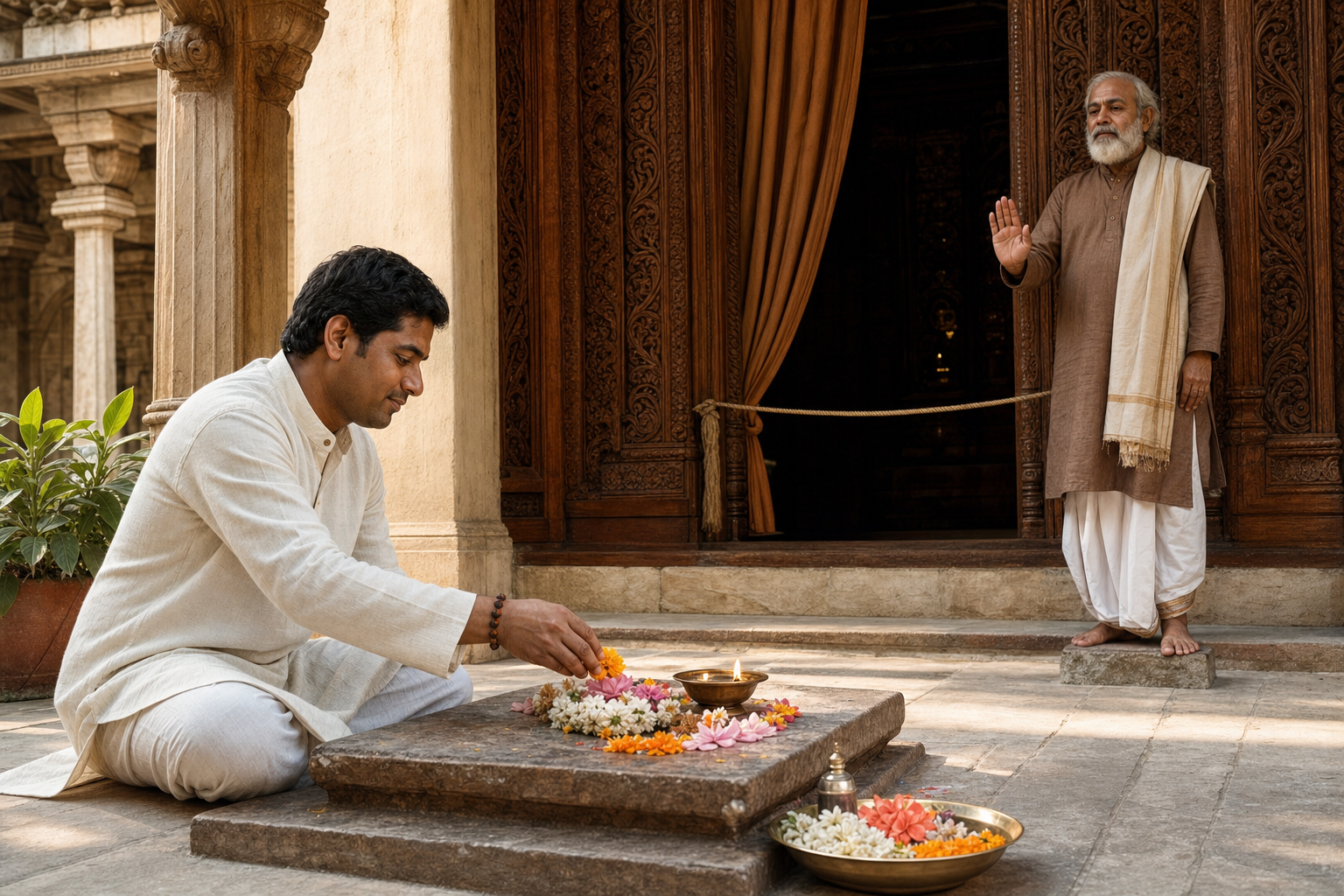
Tantra is not a synonym for everything esoteric, and diksha is not permission to indulge every impulse. Initiation creates responsibility within a guru-shishya lineage. It can carry rules about mantra pronunciation, visualization, nyasa, offerings, secrecy, daily observance, and the sequence of preparatory practices.
Pause before attempting any sequence that combines bija mantras, specialized nyasa, psychophysical mudras, chakra-oriented Kundalini work, or transgressive elements. Traditional lineages may reserve such methods for practitioners with specific preparation, or they may use symbolic substitutions. Copying an isolated instruction removes the safeguards supplied by its philosophy, ritual sequence, ethical discipline, and teacher.
Ask these questions before accepting an advanced practice:
- Which sampradaya and lineage transmit this method?
- Is it open devotional practice, or does it require diksha?
- What ethical commitments and preliminary disciplines accompany it?
- What daily obligations follow from accepting it?
- How does the teacher distinguish genuine progress from fascination with sensations, visions, or siddhis?
- Does the instruction reinforce ahimsa, satya, humility, and duty, or attempt to suspend them?
A teacher should be able to place a practice within a recognizable lineage and explain the practitioner’s obligations. Secrecy may protect an initiatory method, but it does not cancel Dharma. If secrecy is used to forbid reasonable ethical questions, excuse exploitation, or demand conduct you understand to be harmful, do not treat compliance as spiritual surrender.
Temple consecration marks another clear boundary. Formal prana-pratishtha in Shaiva Agamic settings can involve sanctification of materials, bimba-shuddhi, mantra-nyasa, vastu alignment, kumbhabhisheka, and an initiated Sivacharya with the required ritual authority. The exceptional Linga installations remembered in Puranic sacred geography do not convert extraordinary divine sanction into a do-it-yourself rule. Household worship of a symbol or murti and the formal consecration of a public temple are not interchangeable acts.
The same discernment applies when interpreting grace. A desired outcome may be grace, but so may a correction that exposes pride, a delay that prevents misuse, or a teaching that changes what you desire. Conversely, an intense sensation or apparent success is not self-authenticating. Test every interpretation against Dharma, the teaching of your lineage, and its fruit in conduct.
Key takeaways: judge intensity by its fruit
- Grace responds to sincere devotion without becoming a wage paid for austerity.
- Tapas can increase spiritual capacity, but Dharma determines whether that capacity matures into wisdom or feeds bondage.
- Vedic teaching supplies orientation; Tantric and Agamic disciplines give embodied forms of transformation and worship.
- A coherent synthesis follows sampradaya, Ishta Devata, adhikara, and ethics rather than stacking unrelated techniques.
- Use public, inherited, or properly taught practices until diksha authorizes a restricted method.
- Measure progress through truthfulness, non-harm, humility, steadiness, service, and openness to correction.
Choose one honest next step today. Clarify your sankalpa, remove one unauthorized addition from your routine, ask your teacher one precise question about adhikara, or connect your worship to a neglected act of Dharma. You do not make grace arrive by accumulating techniques. You make your life more capable of receiving grace without turning its gifts toward pride or harm.
References
- DharmaRenaissance Blog — Rakshasa Linga Explained: How Fierce Tapas Wins Shiva’s Non-Discriminating Grace
- DharmaRenaissance Blog — Beyond Rivalry: Why a True Vaidika Honors Tantra and a True Tantrika Reveres the Vedas