
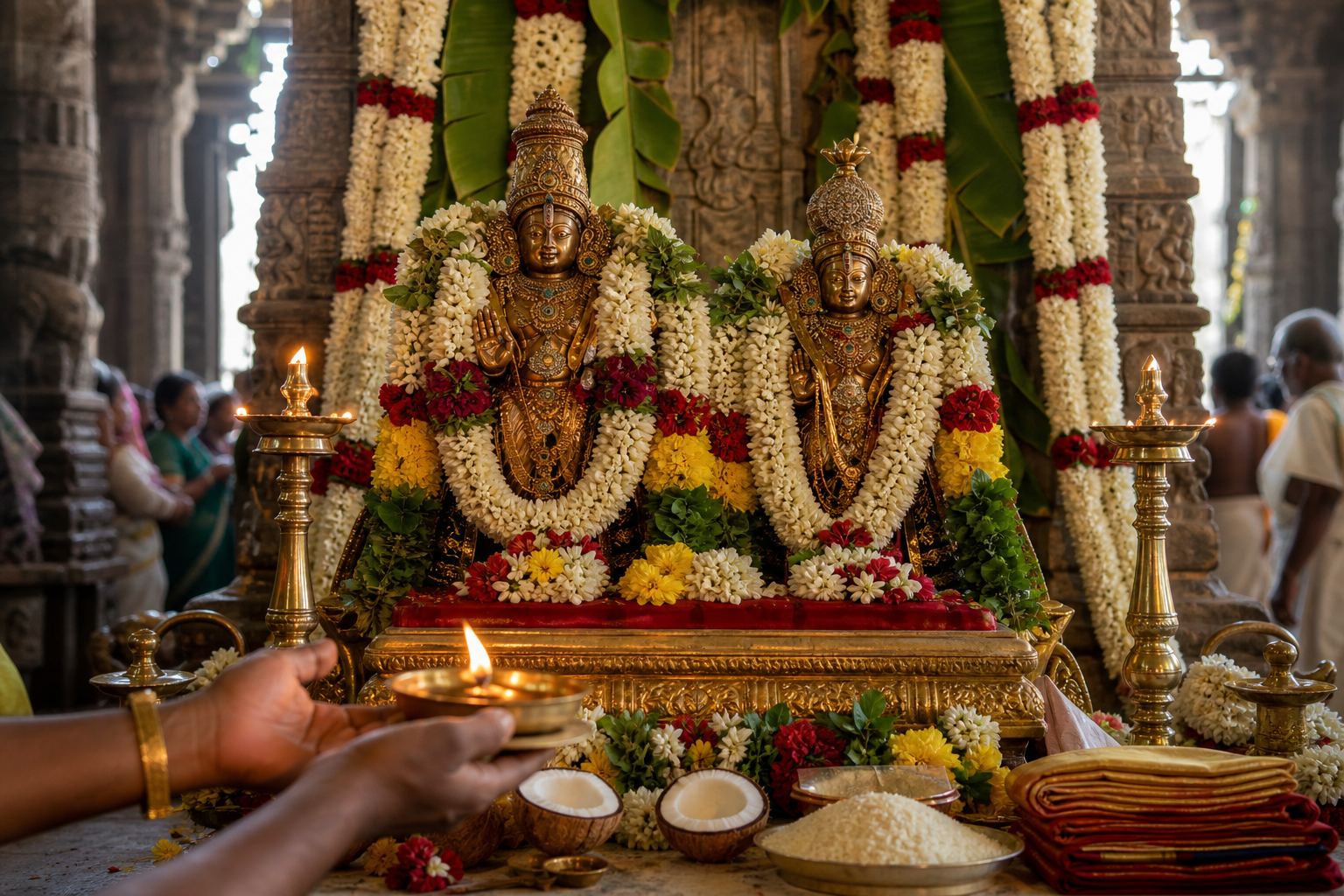
If you have watched a temple kalyanam and wondered whether you are seeing a wedding, a sacred story, or a philosophical teaching, do not force a single answer. The ceremony can operate on all three levels, but each level makes a different kind of claim.
Here is a reliable way to read it: identify the relationship being consecrated, find the vow that governs it, and watch which gesture, icon, recitation, or food keeps that vow alive. This method protects devotional meaning while leaving room for honest questions about texts, history, and regional variation.
Follow the governing vow before interpreting the wedding
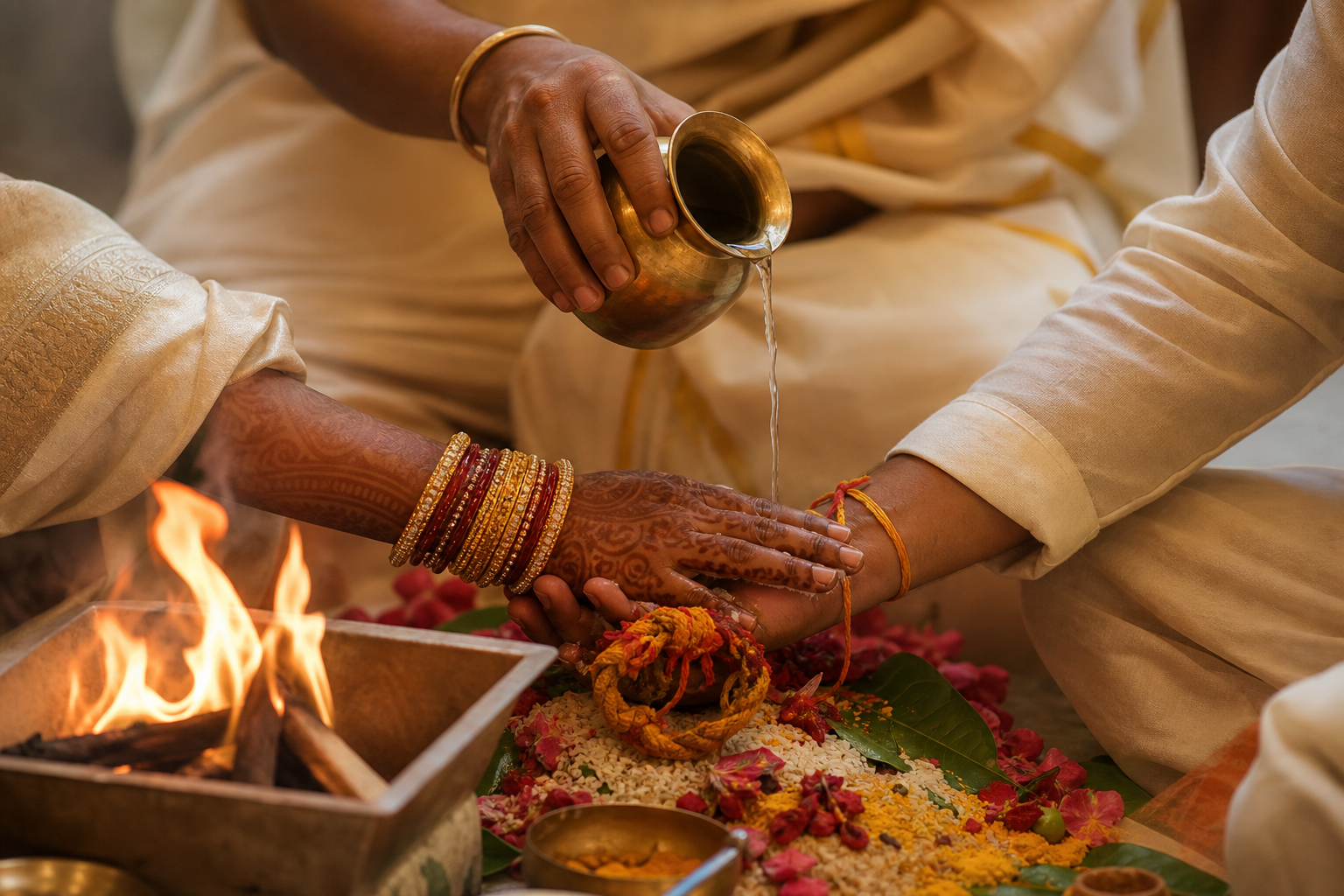
Our modern instinct is to treat every marriage as a couple’s biography. We ask whether the pair established a household, pursued conjugal life, or had children. Those questions are natural, but they can misread a divine kalyanam. A sacred marriage may instead consecrate a relationship between powers, duties, cosmic principles, or forms of grace. The decisive question is not merely who married whom. It is what the union places under dharma.
Hanumath Kalyanam makes the distinction especially important. Hanuman is revered as a nitya-brahmachari, while Suvarchala is understood as a personification of the Sun’s intense radiance. In the regional sacred narrative, Hanuman completes his Vedic education under Surya Bhagavan, and the union with Suvarchala arises as a higher form of guru-dakshina. The marriage preserves Hanuman’s brahmacharya, is not directed toward ordinary household enjoyment, and produces no offspring.
The apparent contradiction disappears once the vow becomes the interpretive center. Marriage does not cancel restraint here; it places immense power within restraint. Hanuman embodies disciplined prana and the steadiness associated with vayu. Suvarchala embodies solar tejas, or luminous potency. A yogic reading therefore sees their union as the alignment of vitality and radiance for clarity, courage, and seva. Interpretations involving pingala and sushumna belong to this yogic layer; they should not be mistaken for the only meaning accepted by every temple or devotee.
At Oppiliappan Temple, the governing vow has a different shape. Markandeya raises Bhumi Devi after finding her near a tulasi grove. When Vishnu appears as an ascetic suitor, Markandeya worries that the young bride does not know how to cook with salt. Vishnu promises to accept food without salt, and that promise becomes the continuing ritual signature of the marriage. At Thiruvinnagar, all naivedyam for Oppiliappan is prepared without salt. The wedding joins divine preservation to the Earth that bears and nourishes life, while the culinary restriction turns unconditional acceptance into a daily practice.
When you encounter a sacred marriage, begin with four questions:
- What quality, power, or responsibility does each divine figure embody?
- What promise or boundary governs their relationship?
- Which repeated ritual act makes that promise visible?
- What form of service is expected to follow from the union?
This approach also prevents a crude opposition between marriage and spiritual discipline. Buddhism recognizes both renunciate and householder paths. Jain tradition gives brahmacharya an exalted place while also recognizing responsibilities before formal renunciation. Sikh tradition locates disciplined remembrance and seva within grihastha life. These paths are not interchangeable, but they share a useful test: a life station becomes spiritually meaningful when its vows are upheld with integrity.
Separate textual history from living ritual authority
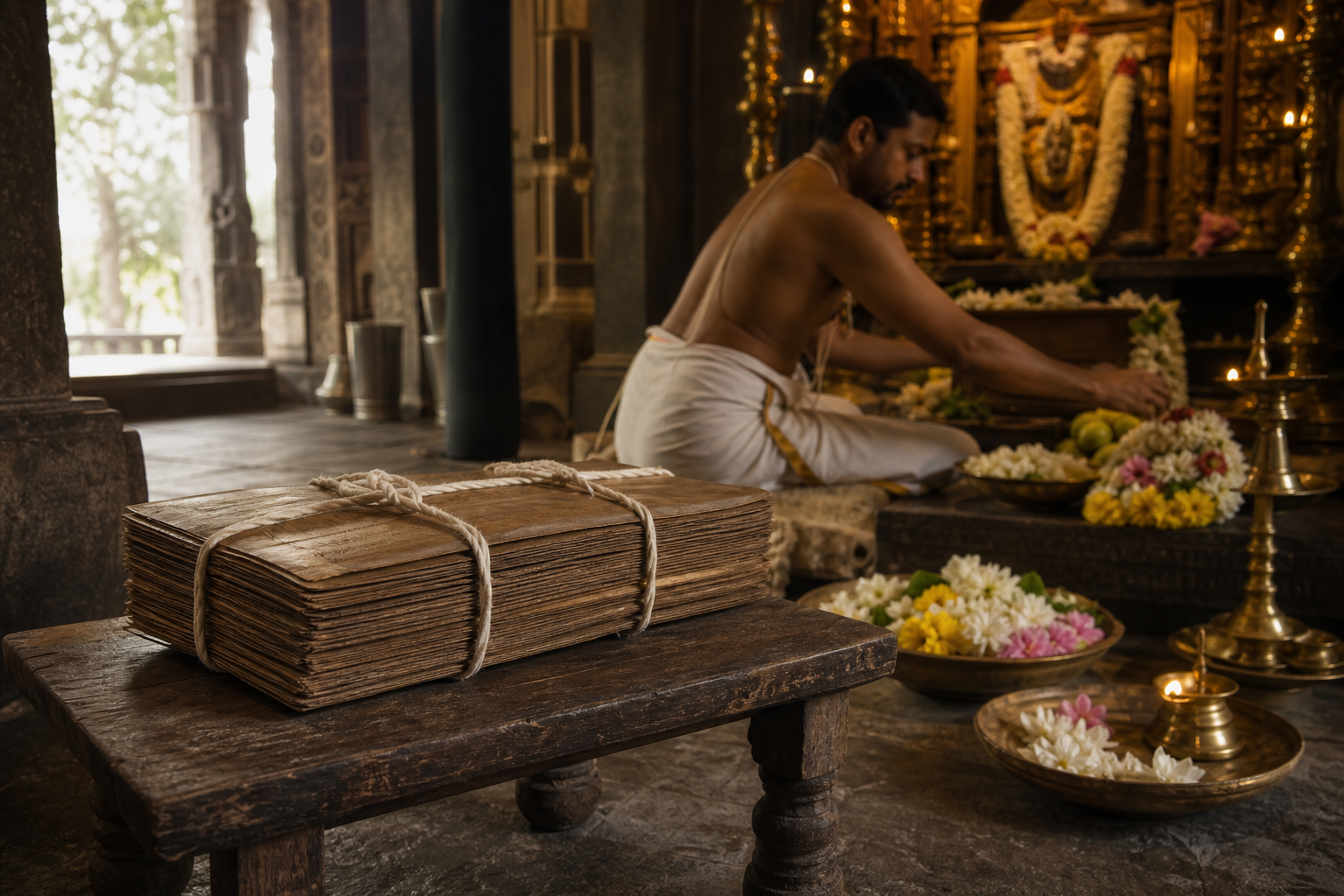
You do not have to choose between historical care and devotional respect. You do have to distinguish the claims being made. Early textual attestation, wide geographical acceptance, regional sacred memory, and living temple practice are different forms of evidence. One cannot silently substitute for another.
The Valmiki Ramayana does not narrate Hanuman’s marriage to Suvarchala, and many early Sanskrit accounts are also silent about it. The motif becomes prominent in later South Indian retellings, sthala-puranas, Harikatha traditions, temple narratives, and festival performances, particularly in Telugu and Tamil devotional settings. The accurate formulation is therefore specific: Valmiki does not record the marriage, while living regional traditions celebrate it as ritually and theologically meaningful.
Textual silence sets a boundary on a historical claim; it does not issue a veto against later sacred interpretation. Conversely, the presence of a festival does not move its complete narrative backward into an earlier text. Saying both things clearly avoids the two common errors: dismissing a living tradition merely because it developed later, and presenting a regional tradition as though every early authority narrated it identically.
Oppiliappan’s sacred geography rests on another combination of authority. Thiruvinnagar is honored among the 108 Divya Desams, receives praise in the Nalayira Divya Prabandham, and sustains its marriage narrative through temple liturgy, festival, iconography, and saltless naivedyam. That continuity establishes the shrine’s devotional identity. It does not require you to recast every element of the sthala-purana as a modern historical report.
Use three labels when you explain such a tradition to someone else:
- Textual baseline: State what an early or pan-Indian text does and does not narrate.
- Regional sacred narrative: Identify the community, temple landscape, language, or performance tradition that carries the account.
- Living liturgy: Point to the festival, vow, icon, offering, hymn, or vrata through which devotees enact its meaning.
This vocabulary is useful whether you are teaching a child, answering a skeptical relative, writing a temple caption, or trying to understand an unfamiliar festival yourself. It replaces the unhelpful demand for one flat version with a precise account of how Hindu traditions preserve multiple layers of meaning.
Read the ritual sequence as a grammar of commitment
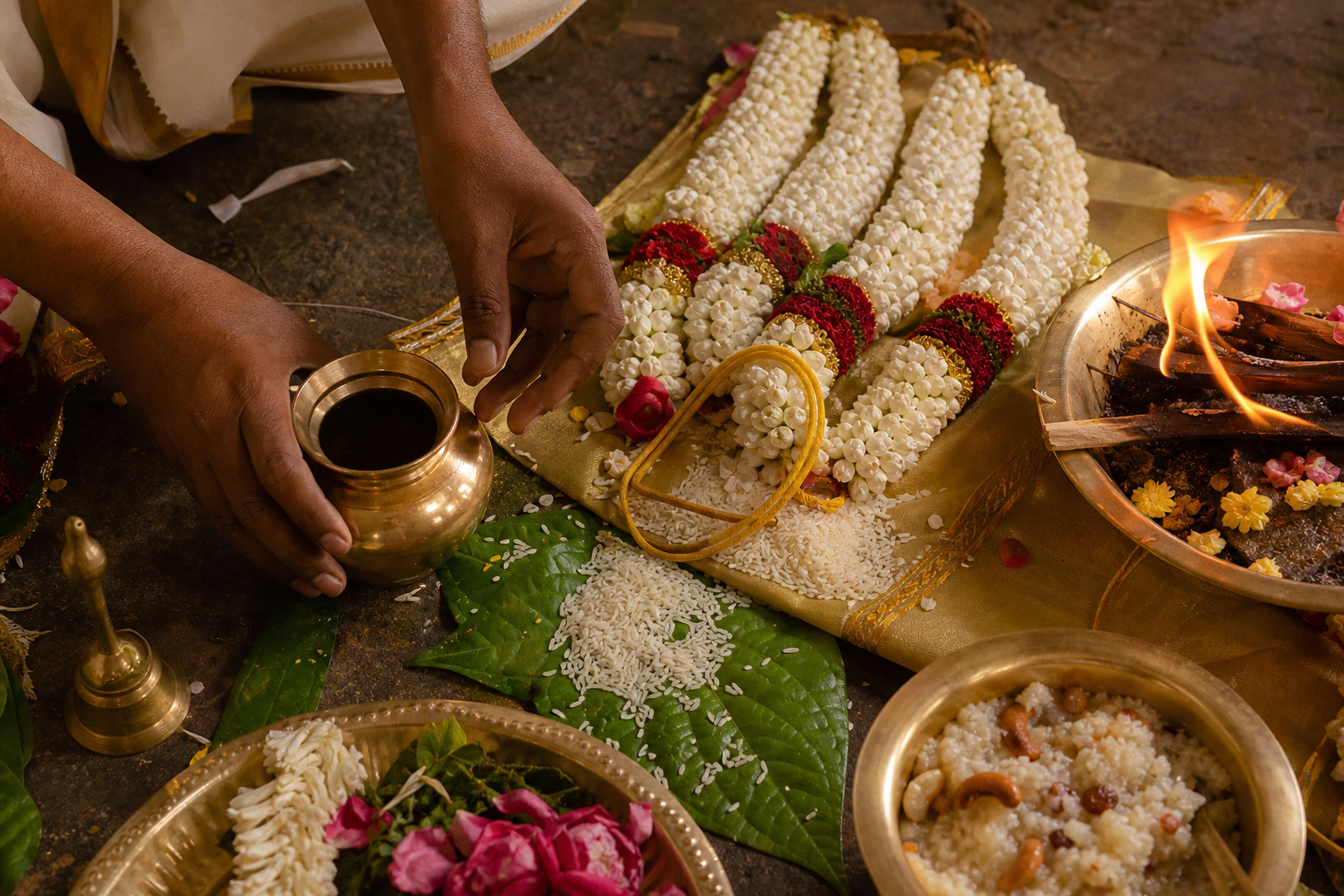
A kalyanam communicates through verbs. Seeds are sown, guests are received, responsibility is entrusted, hands are joined, a marriage token is tied, and blessings are showered. The meaning does not sit in decoration alone. It unfolds through the sequence of actions.
Hanumath Kalyanam celebrations can include the following moments, although the order and liturgical detail vary by temple:
| Ritual moment | Plain action | What to notice |
|---|---|---|
| Ankurarpana | Seeds are ritually sown to begin the observance auspiciously. | Ask what kind of flourishing is being invoked. Do not assume that growth must mean biological offspring. |
| Edurukolu | The divine parties are ceremonially received or brought into encounter. | Notice who welcomes whom and how relationships are publicly acknowledged. |
| Kanyadanam | The bride is formally entrusted within the wedding narrative. | Look for the responsibilities carried by parent, guardian, teacher, and recipient; do not isolate the gesture from its local theological setting. |
| Panigrahana | The hand is taken or joined. | Treat the gesture as visible acceptance of an obligation, not automatic proof of an ordinary conjugal biography. |
| Mangalya-dharana | The marriage token is tied. | Identify the vow being publicly sealed and the dharmic purpose it is meant to protect. |
| Talambralu | Grains are showered upon the divine pair in communal blessing. | Notice how the gathered community participates instead of remaining a passive audience. |
No table can replace the temple’s own liturgy. Some tellings of Hanumath Kalyanam place particular weight on panigrahana and mangalya-dharana because the ritual commitment, rather than entry into ordinary householdership, resolves the theological question. At Oppiliappan Temple, the enduring interpretive center is not one wedding gesture alone but the vow that continues in every saltless offering.
When a sequence is shortened, expanded, or rearranged, do not immediately conclude that something is missing. Ask which act carries the local tradition’s central promise. Ritual compression can preserve the essential theological verb even when every regional wedding custom is not performed.
Let the recurring symbol tell you how to participate
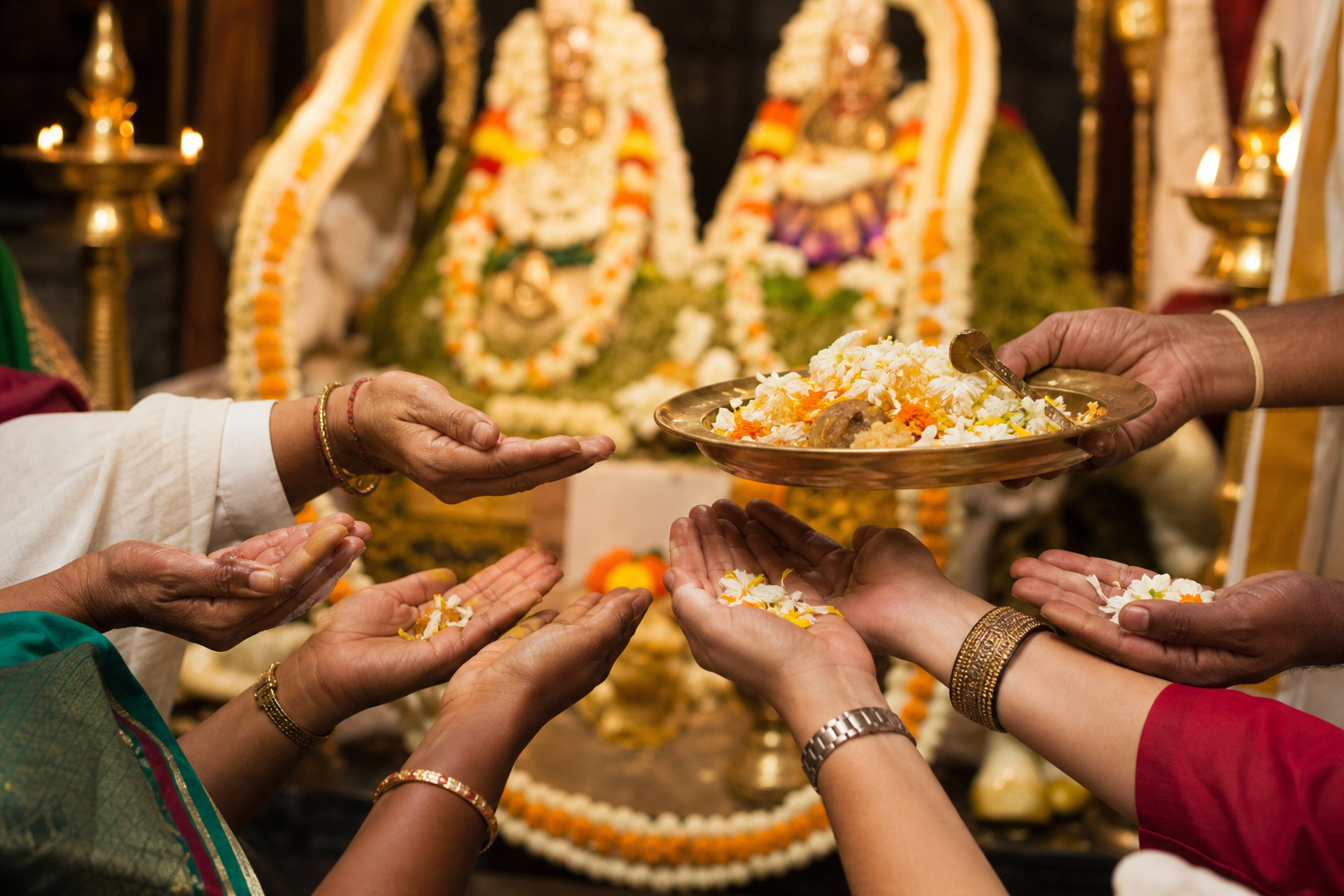
The strongest clue is often the symbol that returns after the wedding day. A recurring icon, offering, hymn, or vrata shows how a community expects the sacred relationship to enter ordinary life.
At Hanumath Kalyanam, watch how strength is restrained
Hanumath Kalyanam is observed in numerous Anjaneya temples in Andhra Pradesh and Telangana, including at the completion of Hanuman Deeksha. Liturgies can draw upon Suryopasana and Hanuman stotras, joining the solar identity of Suvarchala to Hanuman’s devotion, courage, and disciplined vitality. Suvarchala-sameta Anjaneya icons are not universal, but where they appear, Hanuman’s abhaya is complemented by Suvarchala’s quiet solar luminosity.
If you attend, listen for the movement from power to service. Solar tejas without discipline can become excess; vitality without direction can become agitation. The marriage asks you to notice whether strength has accepted a governing purpose. Carry that question into one real decision: before using authority, anger, ambition, or physical energy, name the seva it is supposed to accomplish. If no dharmic purpose can be named, restraint may be the more faithful expression of strength.
At Oppiliappan, allow the offering to remain saltless
Oppiliappan’s name carries two intertwined devotional hearings. Oppu illa appan points to the Lord who is without equal; uppu illa appan evokes the Lord who accepts food without salt. The wordplay is more than a clever explanation. It places the temple’s vow in the name devotees speak.
Receive the saltless prasadam on its own terms. Do not approach it as unfinished food that needs correction. Notice the grain, vegetable, aroma, texture, and natural sweetness that stronger seasoning can conceal. The practical lesson is not that every devotee must permanently remove salt from ordinary meals. It is that gratitude need not wait for ideal conditions, and divine hospitality does not measure the offering by luxury.
If you plan to bring an offering, do not assume that ordinary prepared food is suitable. Salted naivedyam does not fit this shrine’s vow; tulasi, flowers, and fruits belong naturally to its devotional custom, subject to the temple’s local guidance. The same principle applies elsewhere: learn the shrine’s governing promise before choosing what to offer.
The icon completes the teaching. Vishnu stands with shankha and chakra, signs of protection and order, while Bhumi Devi’s close presence places Earth within the field of divine care. Food, land, protection, and provision consequently belong to one ethical relationship. A fitting response is concrete: reduce avoidable food waste, offer a simple meal in service, or treat the ground that feeds you as sacred rather than disposable.
Use this five-step method at an unfamiliar kalyanam
- Identify the local form. Note the temple, divine pair, language, and regional lineage instead of assuming that one generic wedding explanation applies everywhere.
- Find the vow. Ask what promise, restraint, or responsibility makes this particular union necessary.
- Track one repeated sign. Follow a hand gesture, mantra, marriage token, iconographic feature, offering, or item of prasadam from the ceremony into continuing worship.
- Ask one precise question. If the language is unfamiliar, ask a priest or informed devotee which vow a specific step preserves. That question usually yields more than asking what the entire ceremony symbolizes.
- Choose one corresponding discipline. Translate the symbol into conduct: govern power before using it, receive simple food gratefully, practice seva, or make one act of care toward Bhumi.
Key takeaways
- A divine marriage may consecrate powers and responsibilities without reproducing every feature of ordinary household life.
- Hanuman’s union with Suvarchala preserves brahmacharya by placing prana and solar tejas under a vow of service.
- Oppiliappan’s marriage to Bhumi Devi remains visible in the temple’s continuing promise of saltless naivedyam.
- Textual attestation, regional sacred narrative, and living liturgy should be identified separately rather than collapsed into one claim.
- The most useful interpretive chain is relationship, vow, repeated symbol, and corresponding action.
At the next kalyanam, do not try to decode everything at once. Choose one vow and one recurring sign, then let them govern one act within the following week. Restrain energy before using it, offer food without fuss, or reduce waste as service to Bhumi. Sacred marriage symbolism becomes intelligible when the bond witnessed in the temple begins to shape your conduct.
References
- DharmaRenaissance Blog – Hanumath Kalyanam Explained: Why Hanuman Weds Suvarchala – Texts, Symbolism, Ritual Life
- DharmaRenaissance Blog – Oppiliappan Temple’s Sacred Vow: Vishnu’s Marriage to Bhumi Devi and the Saltless Offering