
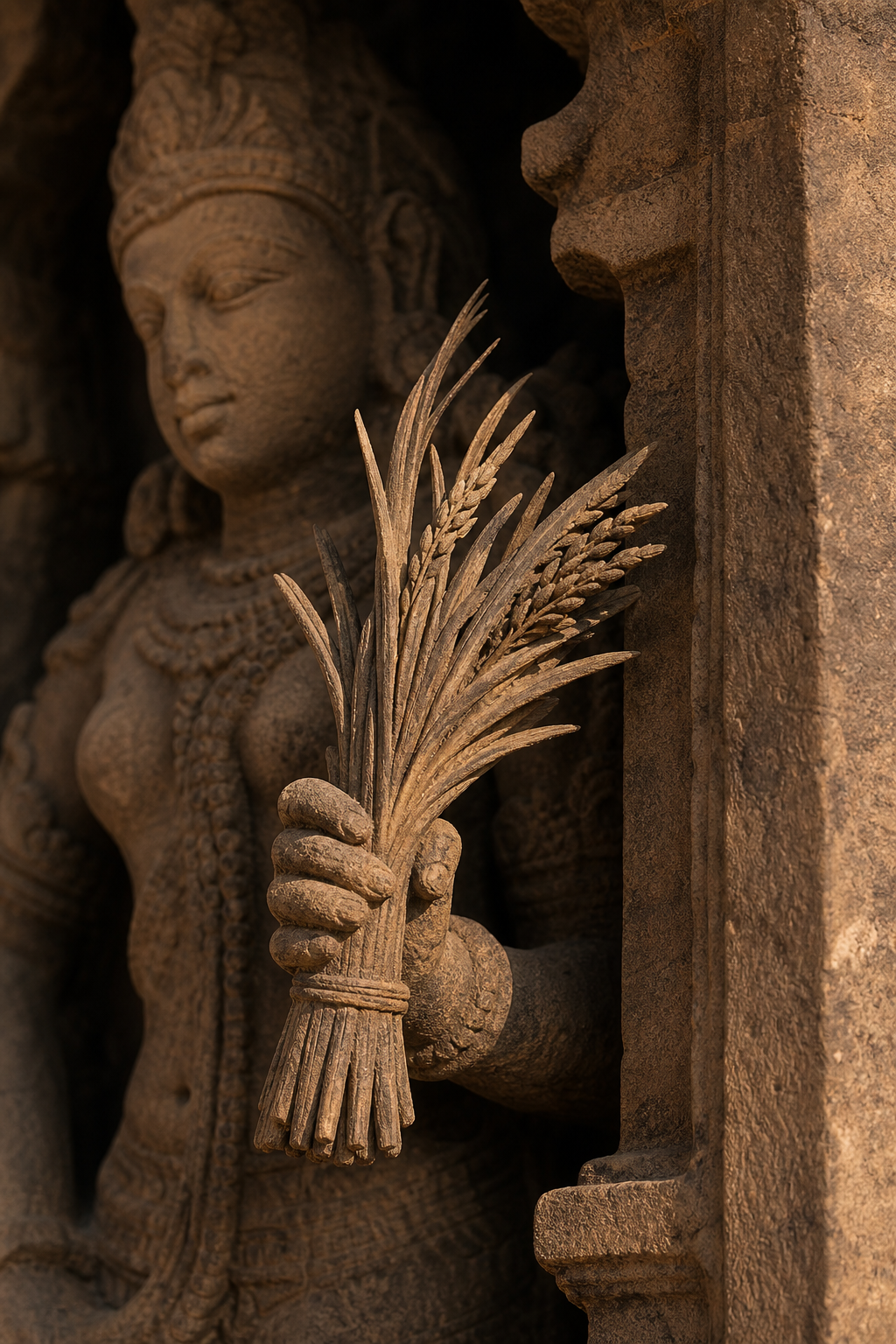
You notice a small bundle in a deity’s hand or beside a temple doorway. It resembles grass, grain, a leafy fan, or even a worn weapon. The catalogue calls it patra, but that label alone doesn’t tell you what the sculptor wanted you to see.
You can read the motif more confidently by following the form before reaching for symbolism. Look for the strands, the binding, the placement, and the surrounding deity. Those clues reveal whether you are seeing a harvested sheaf and, if so, whether it is emphasizing ritual purity, nourishment, prosperity, resilience, or the ethical use of abundance.
First identify the object, not the idea
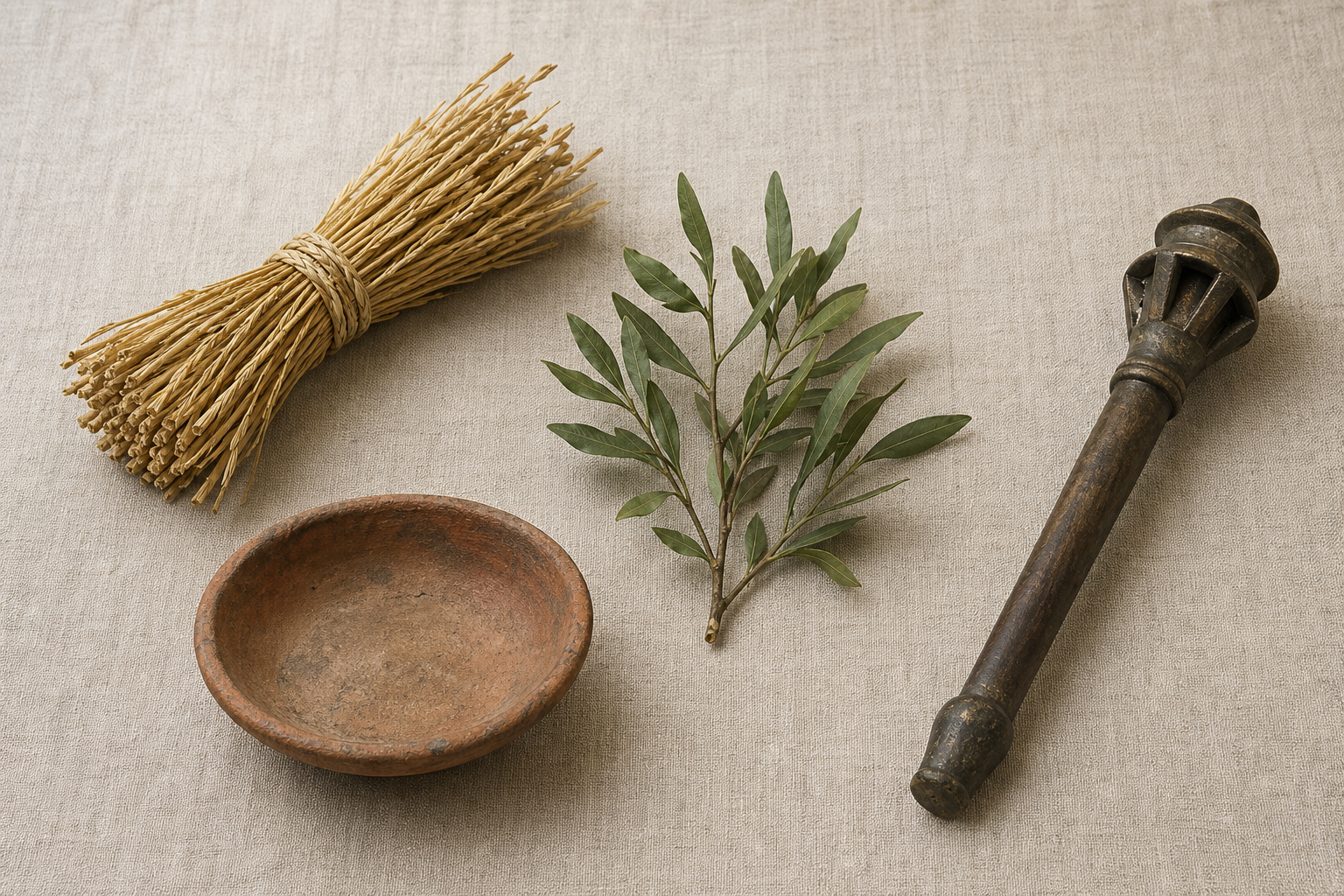
The patra discussed here is a compact bundle of leaves, grass, or grain stalks. Its most dependable feature is not leafiness but binding: several organic elements have been gathered and visibly cinched. The upper ends usually taper or flare, while the lower portion remains narrow enough to grasp, carry, or place as an offering.
Begin with the binding band. On a clear carving, it crosses the stalks near the grip or midpoint. On weathered stone, the individual grooves may disappear while the band survives as a shallow transverse ridge. A ridge by itself is not conclusive; confirm that slender, roughly parallel forms continue above and below it. In bronze, small differences in thickness may make the bundle look less regular and more vegetal.
Next, inspect the tips. Paddy can be represented by nodules or bead-like grains along a stem. Grass is usually sleeker and more linear. A leafy bundle may broaden into several pointed blades. These distinctions are clues, not botanical guarantees. A sculptor working at small scale may compress all three into a similar silhouette, so the surrounding composition still matters.
Watch the vowel when you consult labels. Patra can denote a leaf, while pātra denotes a vessel. Hindu art often places vegetal abundance beside a vessel or shows foliage rising from a kalāśa, making the two words easy to confuse. Patra-puṭa, a term associated with a packet or wrapping of leaves, is another related usage; it should not automatically be treated as the formal name of every sculpted sheaf.
| Possible motif | Visual test | Decisive difference |
|---|---|---|
| Patra sheaf | Parallel or slightly irregular stalks gathered into a narrow bundle | A visible cinch or bound waist separates the gathered body from the flaring tips |
| Lotus bouquet | Stems converge in the hand or at the base | Recognizable flowers, buds, or seed heads terminate the stems |
| Floral scroll | Leaves repeat along a decorative band | The growth continues as a curling vine rather than a harvested, tied bundle |
| Martial attribute | Several projecting lines may resemble stalks after erosion | The geometry is rigid and deliberately symmetrical, without organic variation |
| Pūrṇa-ghaṭa or kalāśa | Foliage rises from a compact central form | A vessel body is present; the leaves are sprouting or arranged, not visibly harvested and tied |
This comparison prevents a common interpretive mistake: deciding that an object represents prosperity because the figure is Lakṣmī, then working backward until every worn line looks like grain. Identify the structure first. Let the deity and setting confirm or refine that identification rather than manufacture it.
The sheaf joins nourishment to disciplined abundance
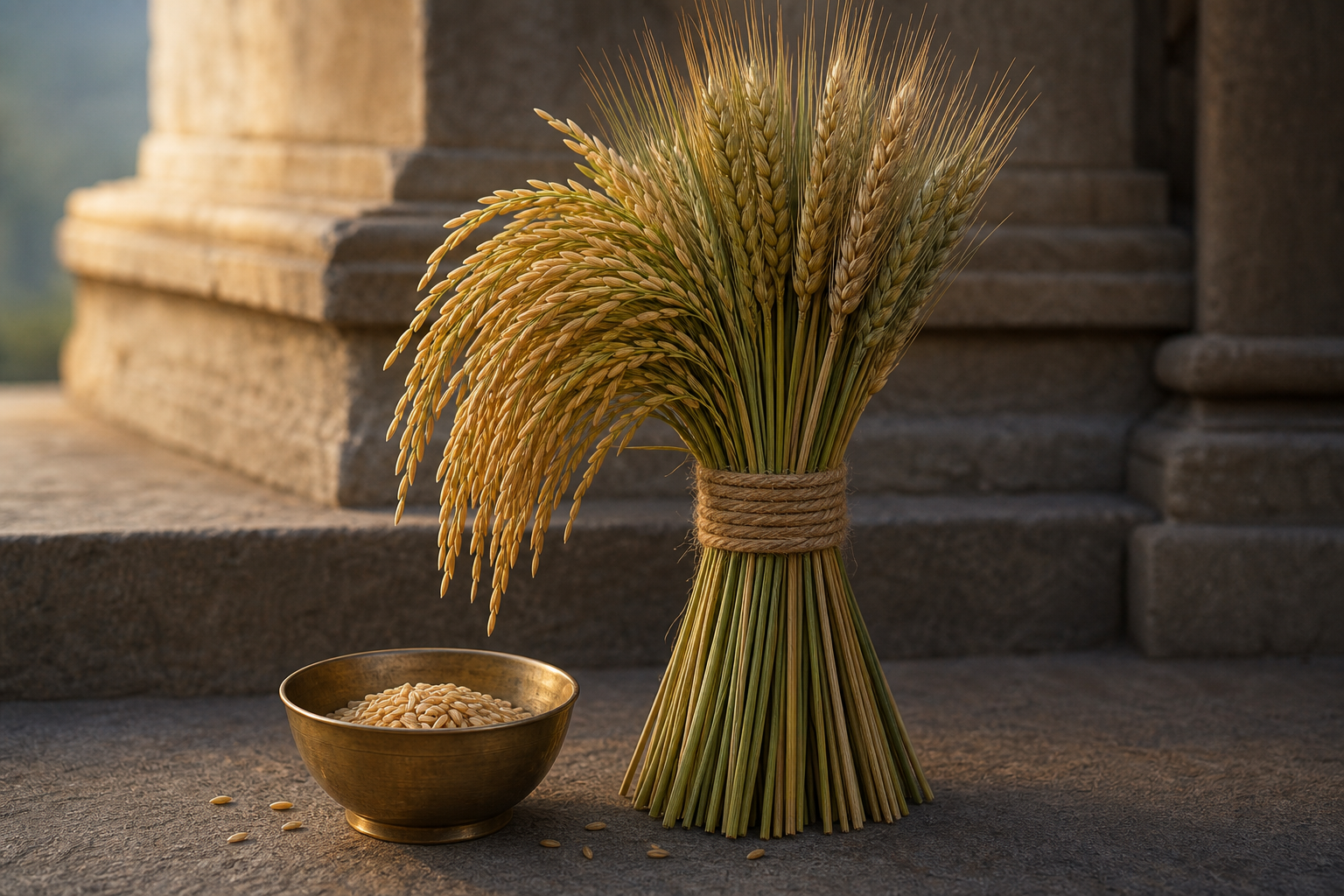
Once the form is secure, read it at three connected levels: material, ritual, and ethical. Materially, the bundle contains something grown from the earth and capable of sustaining life. Ritually, it has been gathered, ordered, and made ready for consecrated use. Ethically, its abundance is controlled rather than displayed without limit.
The Bhagavad Gītā places a leaf alongside a flower, fruit, and water as an offering accepted when given with bhakti. The point is not the market value of the gift. A simple vegetal offering becomes spiritually weighty through intention. A sculpted sheaf belongs to this larger grammar: what the earth provides can be returned in gratitude rather than treated merely as possession.
That offering grammar helps explain why the patra is read as a sāttvika sign. Sattva carries associations of clarity, balance, and luminosity. Fresh leaves, ritual grass, and edible grain embody life-supporting plenty without the aggression of a weapon or the ostentation of treasure. The sheaf therefore points less to riches in the abstract than to prosperity made pure by right intention and restraint.
The cord is crucial to this meaning. Loose growth has been selected and bound for a purpose. The form says that abundance must be gathered responsibly before it can nourish a household, sustain a community, or become an offering. In this sense, the patra visualizes stewardship: receive the yield, order it, use it well, and return a portion through worship.
You may also read the many stalks held together as an image of loka-saṅgraha, the holding together of the world. That is a philosophical interpretation, not a mechanical label that must apply to every sheaf. It is strongest when the composition itself stresses gathering, offering, communal prosperity, or a threshold shared by many worshippers.
This layered reading keeps two errors apart. Reducing the motif to “fertility” misses its ritual discipline. Treating it as a purely mystical emblem erases the agrarian labor behind it. The patra works because the sacred and the practical remain joined: food is cultivated, harvested, bound, shared, and offered.
Placement tells you which meaning is active

A patra in a hand does not communicate exactly what a patra beside a doorway communicates. After identifying the bundle, widen your view. Note who holds it, how the hand presents it, what appears beneath it, and whether the composition belongs to an image, pedestal, threshold, or decorative border.
With Lakṣmī, especially in an agrarian or Dhānya-Lakṣmī setting, grain foregrounds prosperity as food, continuity, and auspicious yield. It is not simply a generic sign of money. If granular stalks, a kalāśa, elephants, or other forms of vegetal plenitude accompany her, the composition is building a complete environment of śrī: radiant well-being grounded in sustenance.
With Bhūdevī, a sheaf directs attention toward the earth as giver and bearer. With Annapūrṇā, it enters a theological world in which food answers hunger and the fear of deprivation. With Gaṇeśa, slender grass-like forms may evoke durvā, the regenerating grass offered to him. In each case, the same basic shape acquires emphasis from the deity’s established relationship to earth, food, fortune, or ritual vegetation.
A bundle placed on a pedestal is more likely to function as an offering or as part of an auspicious ensemble. Look for a nearby vessel, fruit, flowers, or worshipper. A sheaf incorporated into a frieze may extend prosperity across the whole architectural surface, especially when it alternates with vines, parrots, or kalāśas.
At a threshold, the meaning becomes communal and transitional. Living doorways may be dressed with mango-leaf toranas; a carved vegetal bundle makes a related blessing durable in stone. The location asks the entrant to cross from ordinary activity into ordered sacred space. In that setting, auspicious welcome and moral restraint belong together.
Do not isolate the object by cropping too closely. A useful record includes both the bundle’s surface and its compositional relationship to the figure. If photography is permitted, capture the hand or pedestal around it as well as the detail. Without that context, a sheaf can be miscatalogued as a fan, plume, bouquet, or damaged weapon.
Plant, region, material, and tradition sharpen the reading
Plant identity matters when the carving preserves it. Paddy connects the image directly to harvest, nourishment, and agrarian fortune. Kuśa, also called darbha, belongs to the ordering of Vedic ritual space: it is used for such functions as seating, marking boundaries, and sanctifying rites. Durvā brings a different emphasis through its association with Gaṇeśa and its capacity for vigorous regeneration.
Yet you should resist naming a grass species from a few worn lines. Botanical specificity is strongest when form, deity, placement, and ritual context agree. A sleek sheaf near Gaṇeśa may support a durvā reading; a similarly carved bundle in a ritual enclosure may suggest kuśa. When those contextual supports are absent, “bound grass sheaf” is the more responsible description.
Regional style changes the motif’s visual accent. Chola and post-Chola bronzes can give the sheaf a flowing profile that continues the rhythm of the arm and drapery. Western Deccan stonework may render paddy as denser, bead-like growth within a broader kalāśa ensemble. Eastern Indian reliefs can give grain and vegetal abundance greater architectural weight, particularly around thresholds.
Eastern ritual culture also provides a useful interpretive frame. Paddy is central to Lakṣmī-centered seasonal and household observances in Bengal and Odisha, including Manabasa Gurubara in Odisha. Navapatrikā gathers multiple plants into a bound, deity-directed presence. These practices do not prove the identity of every carved bundle, but they explain why artisans and worshippers could recognize bundled vegetation as a bearer of auspicious presence rather than as background decoration.
Material condition can conceal the answer. On sandstone, examine the surface under light arriving from the side; raking light can reveal shallow stalk grooves and a surviving binding ridge that frontal illumination flattens. On bronze, changes in patina around the cord and stalks may show how protruding areas were handled during ritual use or procession. Patina is evidence of surface history, however, not proof of plant identity.
Related Dharmic traditions broaden the civilizational setting without making all their symbols interchangeable. In Buddhist memory, the gift of kuśa grass before the Bodhisattva’s awakening makes grass both seat and sanctuary. Jain imagery frequently uses the foliage-filled pūrṇa-ghaṭa as a non-violent sign of fullness and ethical prosperity. Sikh observance of Vaiśākhī honors the agrarian year, harvest, and the dignity of labor even though Sikh theology does not turn the sheaf into the same deity-held icon.
These are resonances, not permission to collapse distinct traditions into a single code. The Buddhist grass seat, Jain full vessel, Sikh harvest celebration, and Hindu patra can express a shared respect for life-sustaining yield while retaining different ritual functions and theological meanings. Use the comparison to recognize a civilizational intuition; use the immediate image to determine the actual iconography.
A field method for your next encounter
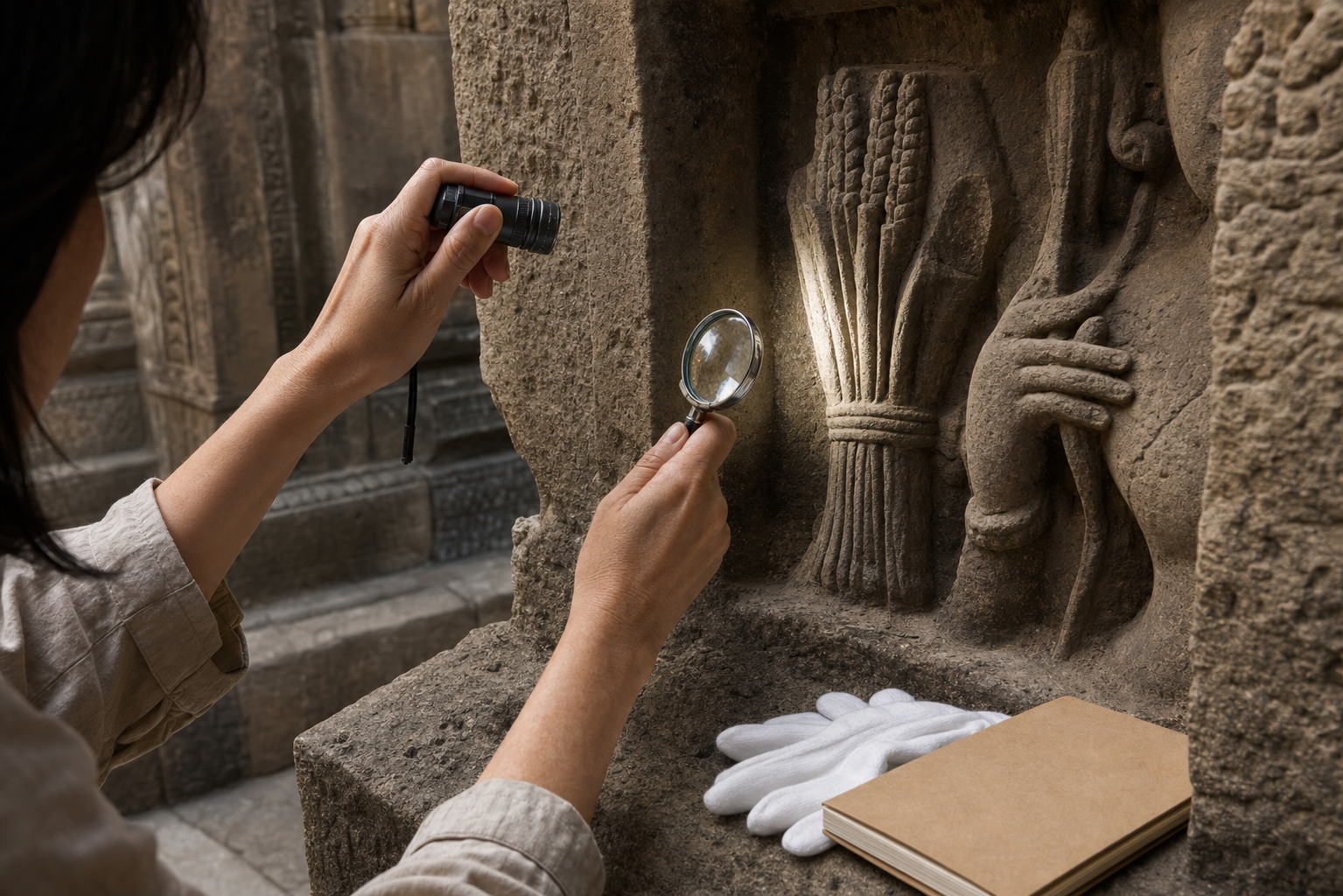
Whether you are visiting a temple, studying a museum image, or checking an online catalogue, keep observation and interpretation in that order. The following questions form a compact test.
Key takeaways
- Find the binding. Look for parallel organic strands crossed by a band or narrowing into a cinched waist. If the bind is absent, keep the identification provisional.
- Classify what was gathered. Beaded or nodal stems suggest paddy; smooth tapered strands suggest grass; broad pointed elements suggest leaves. Do not claim a species unless the context supports it.
- Read the placement. A held attribute emphasizes the deity’s relationship to sustenance or ritual vegetation; a pedestal bundle behaves like an offering; a threshold sheaf conveys auspicious passage and communal plenty.
- Test the look-alikes. Search for lotus flowers, a continuous vine, rigid weapon geometry, or a vessel body before settling on patra.
- Interpret in layers. Begin with the earthly gift, move to ritual offering, and only then consider sattva, stewardship, or loka-saṅgraha. State only as much as the visible evidence warrants.
When you make a note, separate what you see from what you infer. “Tapering parallel strands, bound at the midpoint, held beside a grain-associated goddess” is an observation. “Probable patra sheaf signifying auspicious nourishment” is the interpretation it supports. That small discipline prevents a familiar symbol from becoming a guess repeated as fact.
At your next temple or gallery visit, pause at the smallest vegetal attribute instead of passing it as ornament. Trace the stalks, locate the cord, and restore the object to its deity and architectural setting. The modest bundle may then become legible as its makers intended: earth’s yield gathered with care, sanctified through offering, and enjoyed without forgetting restraint.