
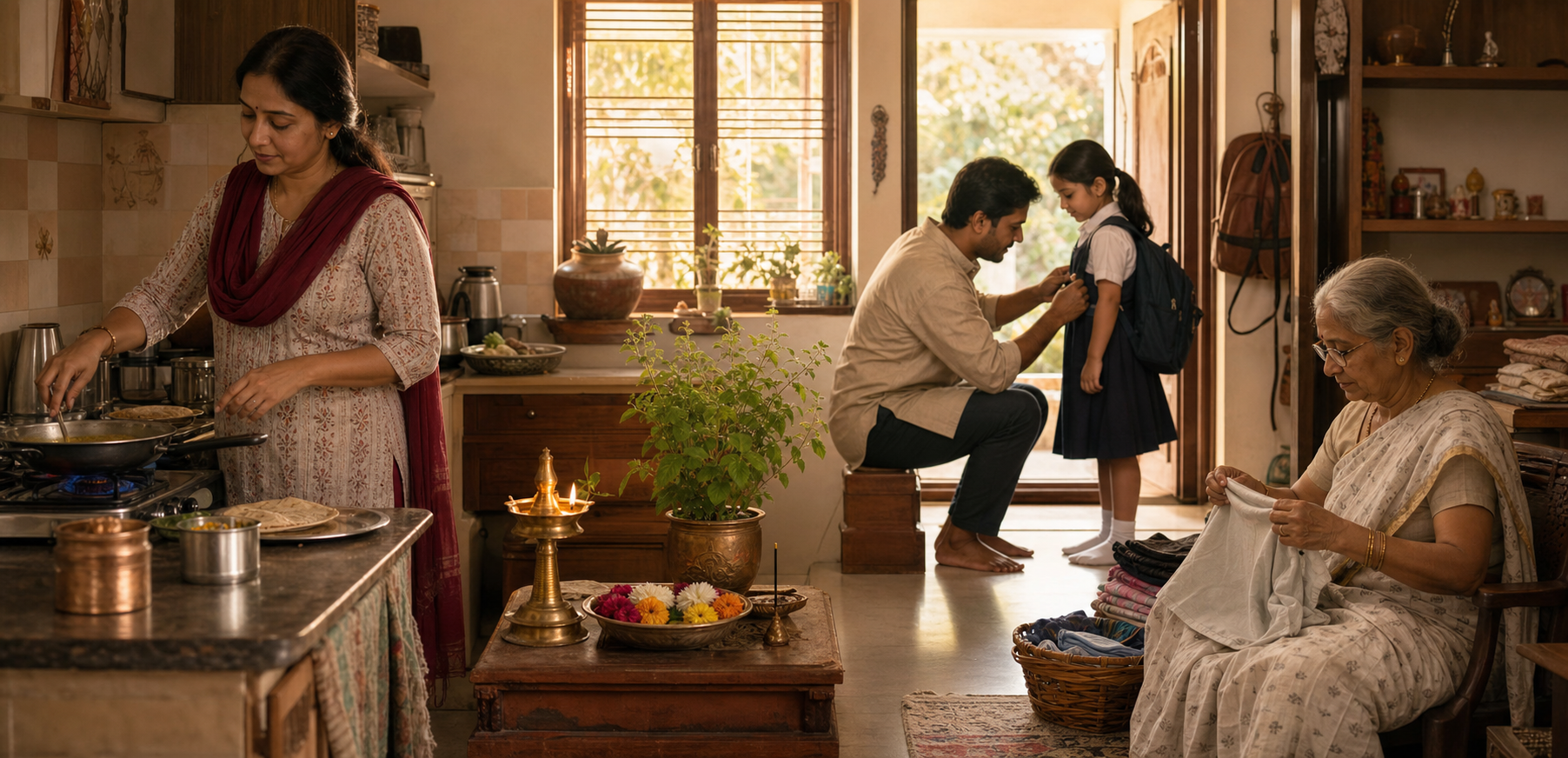
If you love your family but fear that marriage, parenting, earning, or caring for elders has pushed liberation out of reach, you don’t have to choose between abandoning your responsibilities and abandoning moksha. Hindu family life can become a serious spiritual path. But living in a household is not automatically sadhana; it becomes sadhana when duty is joined to ethical clarity, devotion, disciplined attention, and non-attachment.
The decisive question is not whether an action looks worldly. It is whether the action strengthens craving, control, and egoic ownership or weakens them. Cooking a meal can reinforce resentment, purchase praise, or express seva. Earning money can feed greed or sustain a truthful and generous life. The outward act may remain the same while its spiritual direction changes completely.
The household is a field of practice, not an automatic virtue
The traditional ashrama framework places grihastha between disciplined learning and the later deepening of renunciation: brahmacharya, grihastha, vanaprastha, and sannyasa. This sequence reveals an important principle. Spiritual maturity can be cultivated through relationship and responsibility before it is expressed through withdrawal.
Grihastha is central because householders sustain children, elders, guests, teachers, temples, communities, and those devoted to contemplation. Yet social usefulness alone is not moksha. A householder can remain deeply bound by possessiveness, reputation, anger, and fear. A renunciate can carry those same attachments into solitude. External circumstances matter, but inner bondage is not measured by your address, clothing, or marital status.
This is why inner renunciation, or antah-sannyasa, belongs inside family life. You begin relinquishing the demand that people obey your script, that good work guarantee the result you want, and that your role make you indispensable. You continue to care, provide, protect, teach, and repair. What you surrender is the claim of ownership over people and outcomes.
That distinction also prevents a dangerous misuse of duty. Svadharma does not mean treating every family expectation as sacred. A demand does not become dharma merely because it comes from a spouse, parent, elder, or community. Deceit, cruelty, humiliation, coercion, and exploitation cannot be purified by calling them tradition. Patience is not permission for abuse, and non-attachment is not indifference to safety. Where a home is violent or coercive, protecting the person at risk is the immediate responsibility; spiritual language must never be used to demand silent endurance.
Real duty must be examined through dharma. Ask what your role genuinely requires, what your capacity permits, whether the action is truthful and non-harming, and whether you are serving another person or merely preserving your image. This turns obedience into discernment and sacrifice into conscious seva.
Turn ordinary duties into Karma Yoga

The Bhagavad Gita does not make freedom dependent on inactivity. In 3.20, Krishna points to King Janaka as one who attained perfection through rightly performed action. In 3.35, the emphasis on svadharma warns you against borrowing an impressive spiritual identity while neglecting the responsibility actually in front of you.
Karma Yoga changes action through two linked disciplines. Before acting, practise Ishvara-arpana: offer the action to the Divine. After the result arrives, practise prasada-buddhi: receive what has come as material for learning, gratitude, correction, and further duty. Offering does not excuse careless work, and acceptance does not prohibit changing a bad situation. You act as skilfully as you can without making inner peace conditional on controlling the outcome.
Use this sequence when a household duty becomes emotionally charged:
- Name the actual duty. Separate what must be done from what your pride wants to prove. In an argument, the duty may be to tell the truth and listen fairly, not to win.
- Find the attachment. Notice the particular result you are demanding: appreciation, obedience, certainty, status, comfort, or vindication.
- Choose the dharmic action. Check it against truthfulness, ahimsa, fairness, and the welfare of everyone affected. Do not use a good intention to excuse harmful means.
- Offer the work. Perform it attentively rather than using spirituality as permission for passivity or mediocrity.
- Receive the result without collapse or vanity. Correct errors, make amends, and try again, but refuse to turn success into self-glorification or failure into a verdict on your worth.
This discipline works because it meets raga and dvesha – compulsive attraction and aversion – at the point where they become action. Repeated offering loosens the thought that everything depends upon you. Repeated acceptance weakens the demand that reality conform to preference. As reactivity falls and sattva increases, attention becomes steadier. Depending on your sampradaya, the culmination may be articulated through Self-knowledge, devotion, or another account of liberation; Hindu traditions do not reduce moksha to a single formula. The household discipline remains recognisable: less egoic possession, greater clarity, and deeper orientation toward the Divine.
Apply it to the places where family life most often exposes attachment:
- Partnership: Say what is true without using truth as a weapon. Listen for information, not merely for an opening to reply. If you caused harm, repair it without adding a defence disguised as an apology.
- Parenting: Protect and teach a child without treating the child as an extension of your ambition. Guidance is a duty; ownership of another person’s future is attachment.
- Elder care: Serve with tenderness while making promises you can actually keep. Agreeing to an impossible burden and then living in resentment is neither honest nor sustainable.
- Livelihood: Refuse unethical gain even when accepting it would benefit the household materially. Money acquired by violating dharma cannot be made spiritually clean by spending a portion on ritual.
- Success: Let achievement increase usefulness and generosity rather than entitlement. Offer the result before the ego converts it into a claim of superiority.
The four purusharthas help you keep the whole life aligned. Dharma governs artha and kama, while moksha provides the ultimate horizon. Artha is not condemned; it becomes stewardship. Kama is not automatically an enemy; enjoyment can remain grateful, proportionate, and non-exploitative. Moksha is not an extra task squeezed between work and sleep. It is the direction that prevents wealth and pleasure from becoming masters.
Build a household rhythm that survives busy days

A sustainable grihastha practice must fit the life you actually have. An elaborate routine that repeatedly collapses will train discouragement. A modest rhythm kept through demanding seasons is more useful than an ideal schedule maintained only when nothing interrupts it.
Anchor the day before digital input and other people’s demands take possession of your attention. Use a personally appropriate combination of mantra japa, pranayama, meditation, puja, and a short passage from the Bhagavad Gita or an Upanishad. The purpose is not to complete a spiritual checklist. It is to remember who acts, for whom the action is offered, and what kind of person you intend to be when pressure arrives.
During work or caregiving, use ordinary transitions as reminders. Before a difficult call, pause for a conscious breath. Before spending, ask whether the purchase serves a real need, a wholesome enjoyment, generosity, or restless comparison. Before entering the home, release the urge to make your family absorb the emotional residue of the day. These small thresholds carry morning practice into conduct.
At the close of the day, review conduct rather than chasing an experience. Where did attraction or aversion make the decision? Which action was genuinely offered? Is an apology, repayment, boundary, or unfinished duty waiting for you? Then make the repair concrete. Reflection purifies only when it changes the next action.
Shared practice can be equally simple. A recurring family satsanga might include a verse, a bhajan, silent prayer, reflection on a moral choice, or planning an act of seva. Do not turn it into a compulsory performance. If relatives do not share your practice, keep your discipline without sarcasm, pressure, or spiritual ranking. Conduct is more persuasive than enforcement.
The Pancha Mahayajnas provide a practical audit of household life. They keep spirituality from shrinking into private self-improvement:
- Brahma-yajna: Honour knowledge. Study, preserve, discuss, and pass on wisdom rather than consuming sacred teaching as entertainment.
- Deva-yajna: Cultivate reverence and gratitude through puja, prayer, or another practice suited to your tradition.
- Pitri-yajna: Remember ancestors and fulfil appropriate responsibilities toward elders. Preserve family memory without pretending that every inherited habit is dharmic.
- Bhuta-yajna: Care for other beings and the natural world. Reduce needless waste, treat animals without cruelty, and make household consumption answerable to ahimsa.
- Atithi-yajna: Practise hospitality and generosity. Make room for the guest, the stranger, and the person who cannot repay you.
You do not need to stage five elaborate ceremonies before the framework becomes meaningful. Look for the neglected relationship. A home full of private devotion but indifferent to guests needs atithi-yajna. A family generous in public but careless toward an exhausted elder needs pitri-yajna. A household rich in ritual but wasteful in consumption needs bhuta-yajna. Let the imbalance determine the next practice.
Household sadhana must also respect the spiritual agency of every adult. Do not design a family routine in which one person studies and worships while another quietly carries all the domestic labour. Gargi and Maitreyi represent philosophical inquiry, while Arundhati and Anasuya represent steadfast dharma; Shakti theology makes it impossible to treat women’s spiritual lives as merely supportive of men’s. Caregiving can be profound yoga, but that truth must not be used to romanticise unequal exhaustion. Share labour, protect time for one another’s practice, and recognise wisdom wherever it appears.
Judge progress by character under pressure

A peaceful meditation, emotional kirtan, or powerful ritual may be meaningful, but none gives you a reliable exemption from examining conduct. Family life supplies a harder test because the people closest to you encounter the habits that public spirituality can conceal.
Useful signs of maturation include less reactivity, greater compassion, deeper contentment, and steadier attention. Translate those qualities into questions you can answer honestly:
- Do you recover from anger sooner, or do you keep punishing the household after the argument has ended?
- Can you apologise without immediately explaining why the other person was also wrong?
- Has generosity become quieter, or do you maintain an inner ledger of recognition and repayment?
- Does ethical resolve survive when dishonesty would bring a real advantage?
- Can you give full attention to a family member without treating every interruption as an offence?
- Does your contentment depend less completely on praise, comfort, and control?
Compare your present conduct with your earlier conduct, not with a saint’s life or somebody’s curated spiritual image. The question is whether yamas and niyamas are becoming more visible when circumstances are inconvenient. Sattva is not a costume of perpetual softness. It includes clear perception, disciplined energy, truthful boundaries, and the ability to act without hatred.
Notice the warning signs as well. Practice is drifting when ritual observance grows while honesty declines; when your family becomes afraid of questioning you; when you demand sacrifice from others in the name of your detachment; when seva secretly purchases control; or when every disappointment is blamed on another person’s lack of spirituality. These patterns do not prove that family life blocks liberation. They show that ahamkara has learned religious vocabulary.
Formal sannyasa should not be treated as an escape hatch from fatigue, conflict, debt, or unfulfilled ambition. The renunciate ideal presupposes discernment, dispassion, fearlessness, steadiness, and a weakening of egoic doership. A reactive wish to flee responsibility is not the same as mature renunciation. If that vocation becomes serious, examine it within your sampradaya and with qualified guidance, especially where other people depend upon you.
Nor must every householder imitate sannyasa outwardly. Janaka’s significance is precisely that action and realization are not mutually exclusive. Yajnavalkya, Tyagaraja, and Tukaram likewise prevent us from reducing spiritual attainment to one social form. Their lives should not become decorative inspiration; they should sharpen the practical question: can you perform a demanding role without allowing the role to possess your identity?
Questions householders often need answered
Must you eventually leave your family to attain moksha?
No single outward life pattern can be imposed on every Hindu practitioner. Formal sannyasa is a distinct and demanding vocation, not a universal certificate of seriousness. What no path can avoid is renunciation of egoic possession, compulsive craving, aversion, and false identification. That inner work can begin amid marriage, employment, parenting, elder care, and community service.
What if your family does not support spiritual practice?
Protect a modest personal discipline and stop trying to make other adults perform it. Keep commitments, speak with restraint, share work fairly, and let practice make you easier to trust. If relatives object because your routine abandons responsibilities or transfers extra labour to them, treat the objection as information. If they simply prefer another form of worship or no shared practice, do not turn difference into a contest of purity.
Is enjoying money, food, affection, or comfort opposed to liberation?
Enjoyment governed by dharma is part of the integrated purushartha framework. The test is not whether pleasure occurred, but whether it required harm, deceit, exploitation, excess, or loss of freedom. Enjoy what is wholesome with gratitude. Notice when enjoyment becomes entitlement, concealment, or a condition you believe you cannot live without.
What should you do when there is almost no time for practice?
Keep the smallest complete rhythm: remember the Divine before action, perform the immediate duty with full attention, and release the result afterward. Add japa, meditation, study, puja, or kirtan as circumstances permit, but do not wait for an ideal schedule before practising Karma Yoga. A crowded day contains many opportunities to notice attachment because every interruption reveals what you thought you owned.
Choose one recurring household duty that currently produces resentment. At its next occurrence, name the attachment, check the action against dharma, offer the work, and receive the outcome without keeping an emotional account. That is not a lesser path practised while you wait for spiritual life to begin. Properly understood, it is where spiritual life is already asking for your full attention.