

If you’re trying to bring Hindu, Buddhist, Jain, and Sikh communities into a common renewal effort, the first trap is to ask everyone to agree on what dharma ultimately means. That turns cooperation into an identity negotiation, and the people most rooted in their traditions may become the least comfortable in the room.
A better aim is shared discipline and public service with theological boundaries intact. You want unity that can be seen in how people speak, decide, serve, restrain power, and repair conflict—not a blended creed that nobody can honestly take home.
Start with a covenant, not a common creed
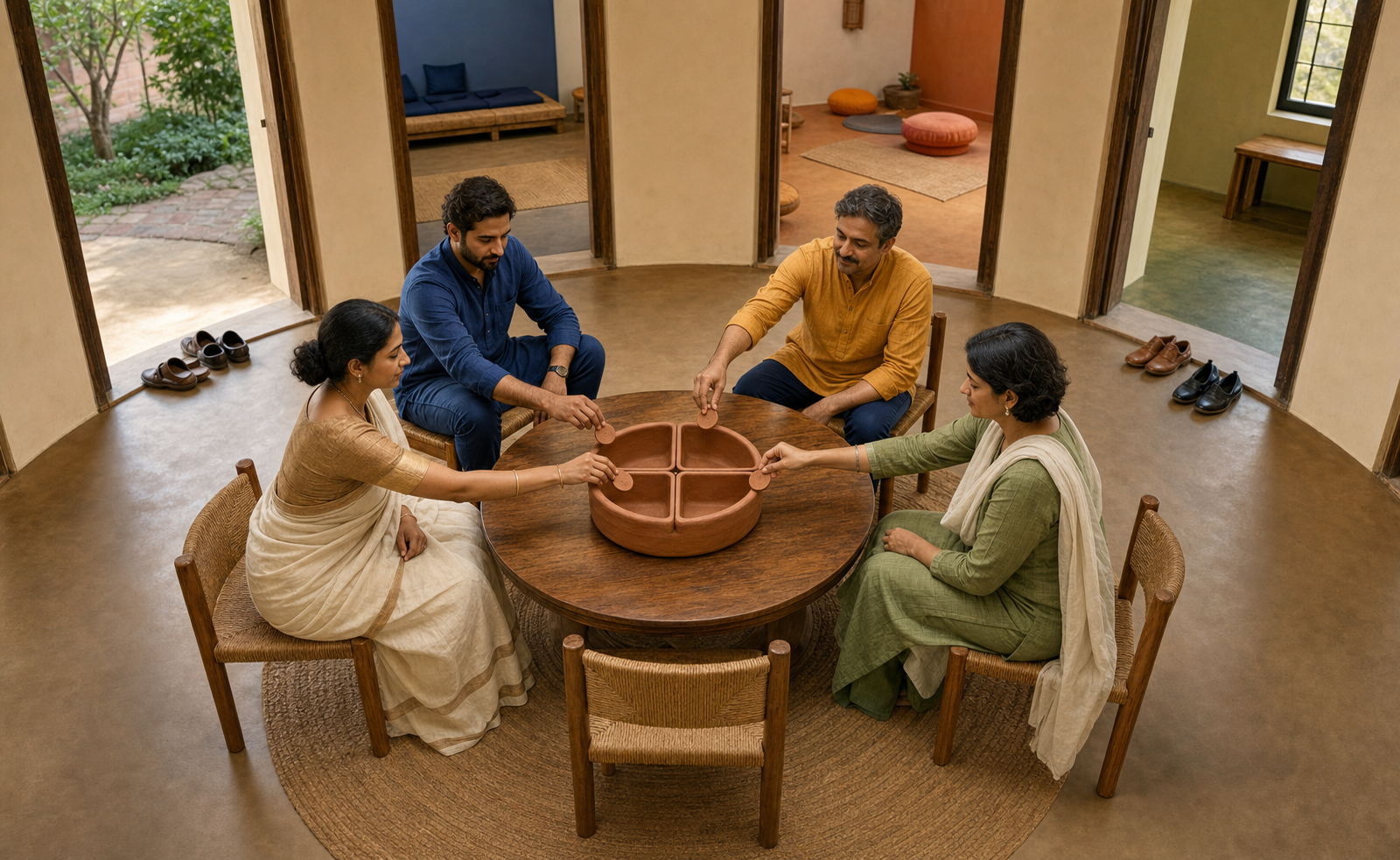
The four traditions offer overlapping disciplines of truthfulness, non-harm, generosity, contemplation, restraint, remembrance, and service. That overlap is substantial enough for common action. It does not make their accounts of liberation, the self, ultimate reality, scripture, authority, or ritual interchangeable.
Build constitutional unity rather than theological uniformity. Constitutional unity means agreeing on the conduct required to work together: freedom of conscience, honest representation, non-coercion, fair decision-making, and accountability. Each community then remains free to explain the deeper ground of that conduct in its own language.
| Tradition | Contribution to shared work | Boundary to protect |
|---|---|---|
| Hindu traditions | Dharma, yama-niyama, karma-yoga, devotion, and Upanishadic inquiry | Do not compress diverse Hindu sampradayas into a single doctrine or required form of worship |
| Buddhist traditions | The Noble Eightfold Path and the brahmaviharas of loving-kindness, compassion, sympathetic joy, and equanimity | Do not translate Buddhism into a theistic framework it does not claim |
| Jain traditions | Ahimsa, aparigraha, and anekantavada as disciplines of non-harm, restraint, and perspectival humility | Do not reduce Jain dharma to a generic preference for peace |
| Sikh tradition | Naam Japna, Kirat Karni, Vand Chhakna, and Sarbat da Bhala: remembrance, honest work, sharing, and the welfare of all | Do not present Sikhi as a branch or diluted form of another lineage |
Use the final column as a boundary check. If a proposed slogan, ceremony, lesson, or public statement crosses one of those lines, revise it before asking anyone to endorse it. No participant should have to choose between coalition membership and truthful representation of their own tradition.
A workable covenant should cover these commitments:
- Self-representation: each community defines its own beliefs, terms, symbols, and practices.
- Freedom of conscience: shared service carries no obligation to join a prayer, accept a doctrine, or receive religious instruction.
- Conduct before consensus: participants may disagree, but they may not use collective blame, humiliation, threats, or deliberate misrepresentation.
- Fair participation: hosting, facilitation, visibility, and decision-making do not remain with the largest or wealthiest institution by default.
- Repair: complaints have a known route, decisions are recorded, and public errors are corrected publicly.
Keep the covenant short enough to use at an actual meeting. A grand declaration that cannot settle a dispute over a speaker, a logo, a prayer, or a budget is not governance; it is decoration.
Key takeaways
- Place unity in ethical conduct, civic purpose, and service; preserve difference in doctrine and ritual.
- Approve a written covenant before holding a public interfaith event.
- Let every tradition contribute a real discipline, not merely a representative face or ceremonial greeting.
- Judge renewal by harm reduced, trust earned, commitments kept, and public goods created.
Turn shared values into repeatable meeting habits
Values become civilizational only when they survive ordinary friction. Ahiṃsa is tested when a rumor spreads. Satya is tested when correcting an ally is embarrassing. Anekantavada is tested when another community’s account feels incomplete. Seva is tested when the work is repetitive and nobody receives public credit.
Translate the shared vocabulary into rules that can be observed:
- Ahiṃsa in speech: criticize a claim, action, or decision rather than assigning motives to an entire community. Stop dehumanizing language even when it comes from your own side.
- Satya with viveka: require factual claims used in joint decisions to be traceable. When a claim proves false, send the correction through the same channel that carried the error.
- Anekantavada in disagreement: before rebutting another participant, restate that person’s position accurately enough that the person recognizes it. Perspectival humility does not require surrendering judgment; it requires understanding before judgment.
- Dhyana or simran without ritual coercion: open with voluntary silence or a host-appropriate practice. Do not invent a hybrid ritual merely to make the gathering look unified.
- Seva with responsibility: end every gathering with a named steward, a visible task, and an agreed reporting point. Good intentions without ownership disappear between meetings.
This method does not claim that yama-niyama, the Eightfold Path, Jain vows, and Sikh rehat are equivalent. It recognizes that distinct disciplines can support a common ethical direction while retaining their sources, meanings, and modes of practice.
Contemplative practice may support attention, emotional regulation, resilience, and prosocial conduct, but such findings require careful interpretation. Do not turn associations in contemplative science into a medical promise, a proof of metaphysics, or a claim that meditation replaces professional care. In a dharmic coalition, contemplation should deepen responsibility, not furnish scientific-sounding publicity.
Education should follow the same pattern. A curriculum can place the Upanishads, Dhammapada, Ācārāṅga Sūtra, and Guru Granth Sahib beside ethics exercises, service learning, media-literacy work, and conflict-resolution practice. The practical question is not merely, What does this text say? Ask what its discipline requires when someone forwards an inflammatory message, wastes food at a festival, hides a financial conflict, exploits a worker, or refuses to hear a neighbor’s grievance.
Make service the public proof of unity

Interfaith dialogue often fails because conversation is treated as the finished product. Dialogue is valuable, but trust grows more reliably when people carry responsibility together. Temple, vihāra, derāsar, and gurdwara networks already hold combinations of kitchens, gathering spaces, volunteers, donors, local knowledge, and public trust. Coordinating those capacities can expand food security, ecological stewardship, disaster response, and other forms of local resilience.
Choose the first shared project by applying a strict filter:
- The need is experienced across community boundaries and can be described without ideological language.
- The participating institutions already possess enough capacity to begin; the project does not depend on an imagined future bureaucracy.
- No volunteer has to violate a dietary, ritual, or conscience boundary to participate.
- No beneficiary must attend worship, receive religious instruction, or endorse a religious claim to obtain help.
- The intended result is visible enough to evaluate, and one institution is clearly responsible for each operational commitment.
An interfaith langar-annadāna kitchen is a strong model when local food insecurity is the real need. Preserve both names and explain their respective traditions; do not rename them into a vague universal meal. The unity lies in feeding people with dignity, sharing work fairly, preventing waste, and refusing proselytization—not in pretending the practices have identical histories.
Other suitable projects include watershed care, sacred-grove conservation, neighborhood environmental stewardship, zero-waste festival operations, and coordinated disaster preparation. The ethics of ahimsa and aparigraha make reduced harm and restrained consumption part of renewal, while Sarbat da Bhala and lokasaṅgraha direct that renewal toward collective welfare.
Move from intention to delivery in this order:
- Map existing assets. Record available kitchens, halls, vehicles, volunteer skills, supply relationships, land, communication channels, and safeguarding procedures.
- Name one bounded public need. Avoid launching under a slogan as broad as civilizational renewal. Name the food, water, waste, habitat, or preparedness problem the coalition will address.
- Assign work by capacity rather than prestige. The most prominent religious figure need not supervise logistics, finance, food safety, volunteer conduct, or data collection.
- Publish service conditions. State who may receive help, what volunteers may and may not do, how donations are handled, and where concerns can be reported.
- Review conduct as well as output. Ask whether people were served fairly, whether any tradition was misrepresented, whether waste or harm shifted elsewhere, and whether commitments were completed.
- Repeat only what earned trust. Repair weak governance before expanding the banner, budget, or geographic reach.
Do not begin with a grand summit if the participating institutions have never completed a modest task together. Ceremonial unity is easy to stage. Operational unity appears when volunteers arrive, accounts remain clear, disagreements are repaired, and beneficiaries retain their dignity.
Measure renewal and guard it against capture

If a coalition records only attendance, photographs, and social-media reach, it will eventually optimize for spectacle. A Dharma Maturity Index can organize evaluation around inner cultivation, compassion in action, ecological responsibility, harmony, and integrity. These domains should guide honest questions, not manufacture a league table of supposedly superior communities.
| Domain | What to record | What not to claim |
|---|---|---|
| Inner cultivation | Regular, voluntary participation in sādhana, simran, or dhyana connected to the work | Do not rank private holiness or infer spiritual attainment from attendance |
| Compassion in action | Service effort, reach, accessibility, unmet need, and follow-through | Do not treat publicity or donation totals as proof that suffering was reduced |
| Ecological responsibility | Waste prevented, resources conserved, pollution addressed, and habitats restored or protected | Do not shift damage outside the measured event or neighborhood |
| Harmony | Joint work completed, disputes addressed, recurrence of conflicts, and participation across institutions | Do not equate silence with harmony; people may be afraid to raise concerns |
| Integrity | Commitments completed, decisions and finances disclosed, complaints answered, and conflicts of interest handled | Do not let spiritual stature substitute for administrative accountability |
Set a baseline before the work begins, then report the same indicators after each cycle. Publish limitations beside achievements. If the coalition cannot establish what changed, say so. Measurement should protect the mission from self-deception, not dress uncertain results in impressive language.
Safeguards for the predictable failure modes
- Against dilution: retain the names and meanings of tradition-specific practices. Shared work does not require a blended theology.
- Against majority capture: rotate hosting and facilitation, disclose finances, record decisions, and prevent population size from becoming automatic moral authority.
- Against coercion: make contemplative and ritual participation voluntary, and never condition public service on religious participation.
- Against personality cults: place authority in transparent institutions, establish independent ethical review, and ensure that roles can pass to another qualified person.
- Against relativism: use anekantavada to examine partial viewpoints, not to declare every factual or moral claim equally sound. Pluralism still requires evidence, discernment, and boundaries.
- Against biological hierarchy: if anyone uses the language of a new humanity, define it as a change in conduct, consciousness, and institutions—never genetics. Civilizational transformation must reject eugenics and affirm equal dignity.
- Against digital manipulation: adopt a digital-dharma rule for privacy, verification, corrections, bias, and inflammatory content. Do not reward material merely because it mobilizes your own side.
A covenant without enforcement trains participants to ignore it. When a representative repeatedly violates agreed boundaries, pause that representative’s role, document the reason, and provide a clear route for repair. Protecting pluralism sometimes requires saying no to the person who invokes unity while undermining the conditions that make unity possible.
Use a launch sequence that can grow without losing its soul

You do not need a civilizational council before you can begin. You need a genuine local need, credible institutions, protected boundaries, and people willing to be accountable for ordinary work.
- Define the public problem. Write it in language that a beneficiary would recognize, without using dharmic renewal as a substitute for a concrete objective.
- Meet institutions separately. Ask each temple, vihāra, derāsar, or gurdwara what it can contribute, what it cannot endorse, and who has authority to make commitments.
- Draft the covenant from those answers. Resolve foreseeable disputes over prayer, symbols, food, funds, publicity, data, and volunteer behavior before the public launch.
- Select a project that uses existing capacity. Beginning from functioning kitchens, volunteer networks, land, or neighborhood relationships is more reliable than building a new organization around an abstract aspiration.
- Pair reflection with action. Let participants connect the service to their own discipline, while keeping shared rituals voluntary and tradition-specific.
- Record results and failures. Use the maturity domains to show what changed, what remained uncertain, and which commitments were missed.
- Choose whether to deepen, correct, or stop. Scale is not automatically success. A smaller coalition with trust and integrity is stronger than a large platform held together by avoidance.
Think in horizons. During the opening 0–3 years, concentrate on pilots in service, education, contemplation, and neighborhood dialogue; in 3–7 years, connect successful programs with ecological and ethical-technology standards; over 7–21 years, link mature networks through shared learning, evaluation, resilience, and peacebuilding. Do not jump to the final horizon because a launch event drew a crowd.
The language of a Golden Age within Kali-yuga becomes credible when it names cumulative work rather than a timetable of inevitable triumph. Inner cultivation must alter speech and conduct. Service must become dependable infrastructure. Institutions must remain plural, transparent, and resistant to capture.
Your next move is deliberately small: identify a need your neighbors already recognize, contact the nearest willing dharmic institutions, and ask for a working session around that need—not a conference about unity. If the group can protect difference while completing useful work, renewal has already begun.