

The installation of a Sushruta statue in Edinburgh provides an entry point into a larger question: what makes his legacy more than a celebrated episode in the history of rhinoplasty? The available DharmaRenaissance Blog account portrays an Indian surgical tradition encompassing classification, anatomical study, instruments, operative training, wound care, and professional ethics.
That heritage is best understood on three connected levels: the layered text attributed to Sushruta, the practical system described within it, and the later circulation and recognition of its ideas. Keeping those levels distinct preserves both the importance of the tradition and the uncertainties surrounding its chronology.
A layered text behind a durable reputation
The DharmaRenaissance report says tradition places Sushruta around 600 BCE and credits him with compiling the Sushruta Samhita. It also acknowledges scholarly debate over the work’s date and textual layers, noting that some material has been associated with later redactors such as Nagarjuna. The historical claim, therefore, is not that every surviving passage can be assigned confidently to one author and moment. It is that the medical corpus bearing Sushruta’s name became a seminal framework for surgical thought and practice.
According to the report, the compendium’s major sections, or Sthanas, bring anatomy, pathology, therapeutics, toxicology, and operative care into a common structure. It says the Uttara-tantra broadens that scope to fields including ophthalmology, otolaryngology, dentistry, and paediatrics. This breadth matters because it places surgery inside a larger clinical system rather than presenting operations as isolated feats.
What made the tradition recognizably surgical
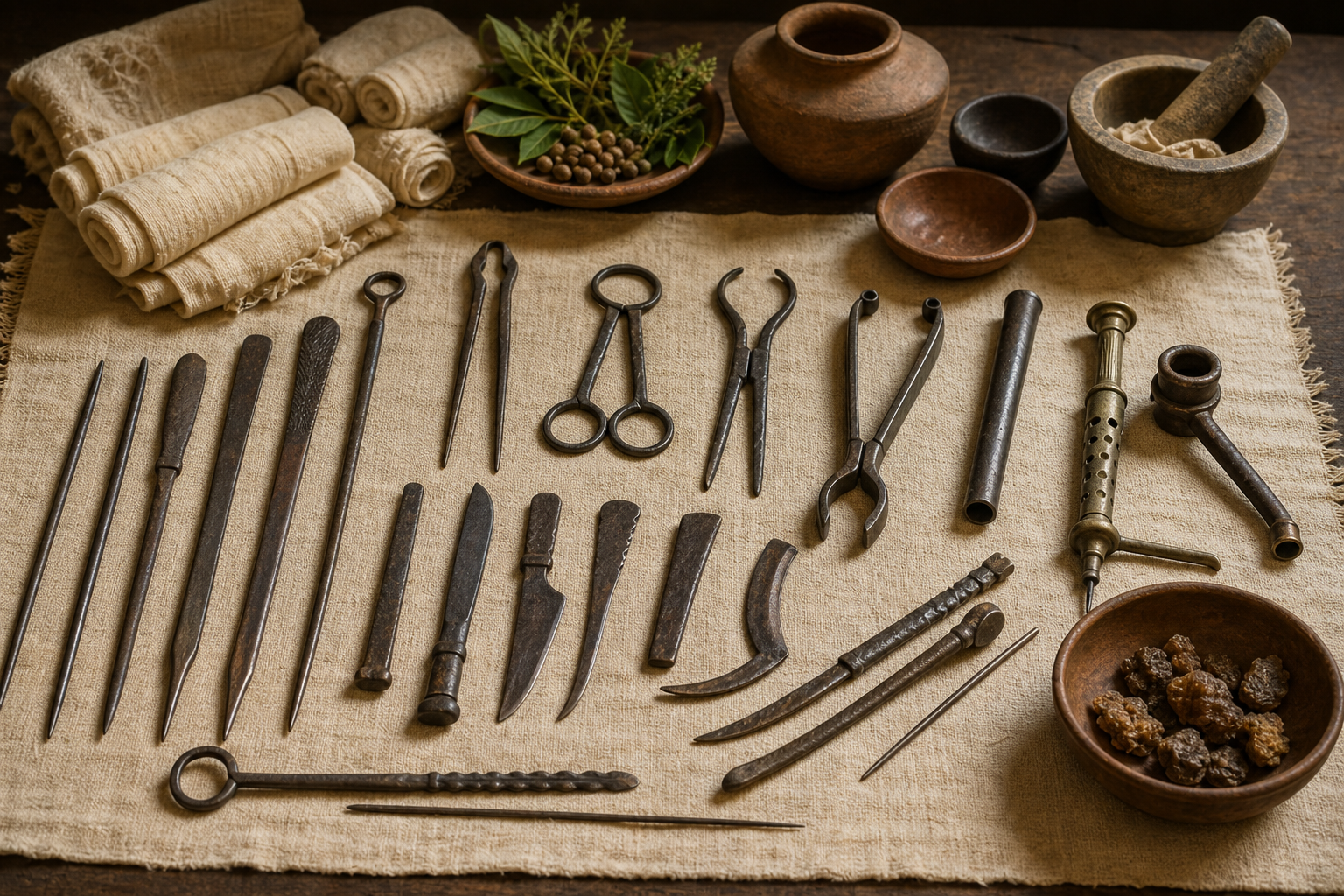
The report identifies eight categories of surgical action in the text: excision, incision, scarification, puncturing, probing, extraction, drainage, and suturing. It also reports a catalogue commonly described as containing approximately 125 instruments, including scalpels, forceps, needles, and probes, with some forms modeled on shapes observed in nature. Fourteen bandaging styles are traditionally enumerated in the same account.
Those numbers are less revealing by themselves than the relationships among the elements. A classification system tells the practitioner what kind of intervention is being attempted; specialized instruments make those interventions possible; and instructions on ligatures, haemostasis, suturing, dressings, and follow-up address what happens around the decisive operative act. The source consequently depicts a surgical ecosystem extending from preparation to rehabilitation.
Key takeaways
- Sushruta’s importance rests on an integrated surgical framework, not only on one reconstructive procedure.
- The chronology and authorship of the surviving text remain layered questions, even while its historical influence is emphasized.
- Training, cleanliness, bleeding control, wound management, and ethics appear as interdependent parts of competent care.
- Modern recognition is most useful when it encourages critical study rather than treating ancient and contemporary medicine as interchangeable.
Training joined technical skill to ethical discipline
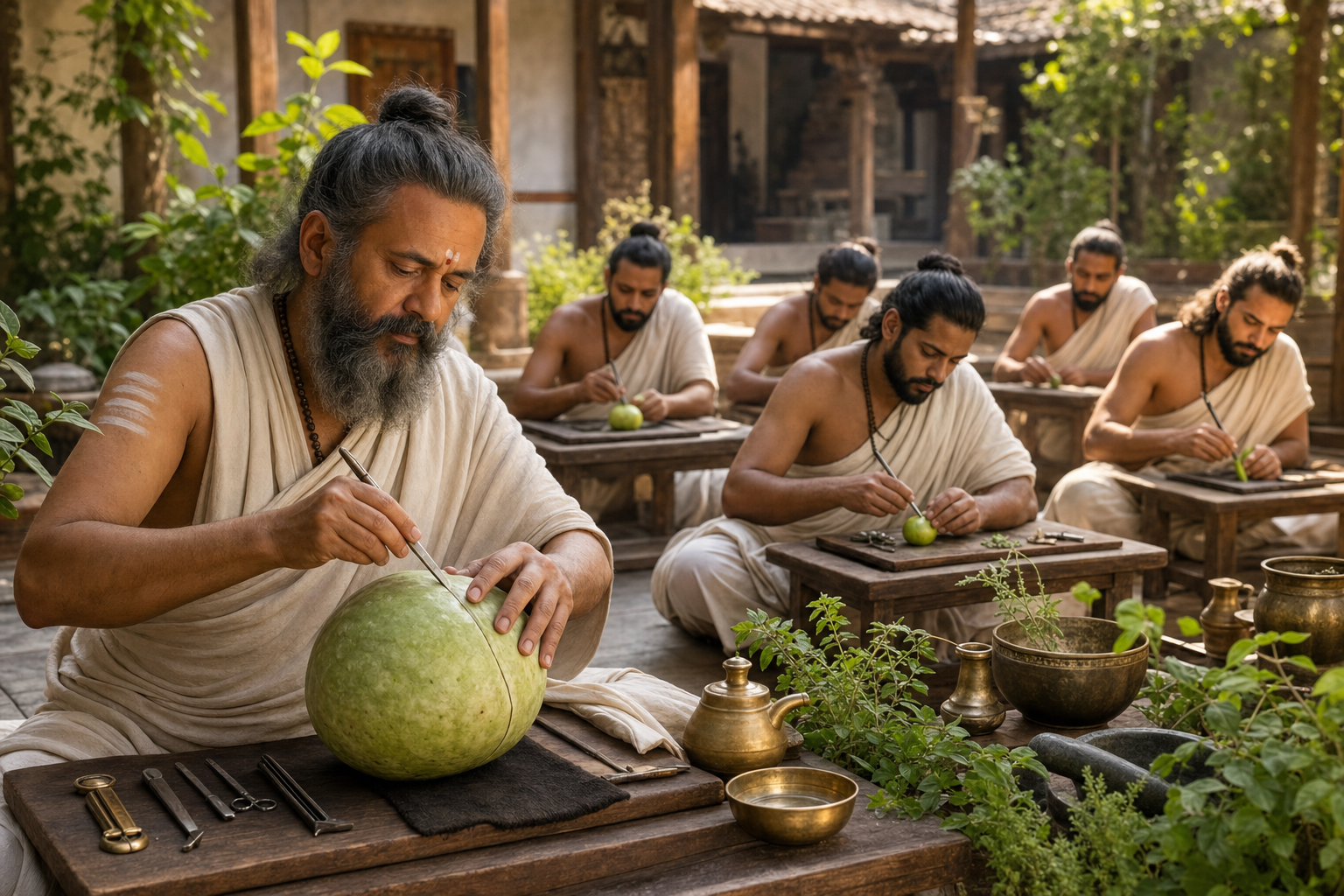
One of the report’s most consequential themes is the education of the surgeon. It says the Sushruta Samhita advocates cadaveric dissection for direct anatomical observation and prescribes preliminary practice on fruits, vegetables, and animal tissues. In modern terminology, this resembles the educational logic of simulation: manual competence should be developed before an inexperienced practitioner operates on a patient. The comparison concerns a principle of training, not an assertion that ancient exercises were equivalent to present-day clinical education.
The same account links dexterity to character. It describes ethical precepts emphasizing compassion, honesty, self-discipline, cleanliness, and responsibility toward the patient. It also reports attention to cleansing the operative field and instruments, dressings, fumigation, diet, staged wound care, and rehabilitation. These recommendations were expressed through an Ayurvedic medical framework, but their practical purposes can still be recognized: limiting contamination, controlling bleeding, protecting tissue, and supporting recovery.
This combination complicates the popular image of early surgery as daring technique alone. In the tradition presented by the source, the surgeon is expected to observe anatomy, rehearse procedures, select instruments, manage the wound, and accept moral obligations. Technical confidence without disciplined preparation is not treated as mastery.
Rhinoplasty as emblem, not the whole inheritance
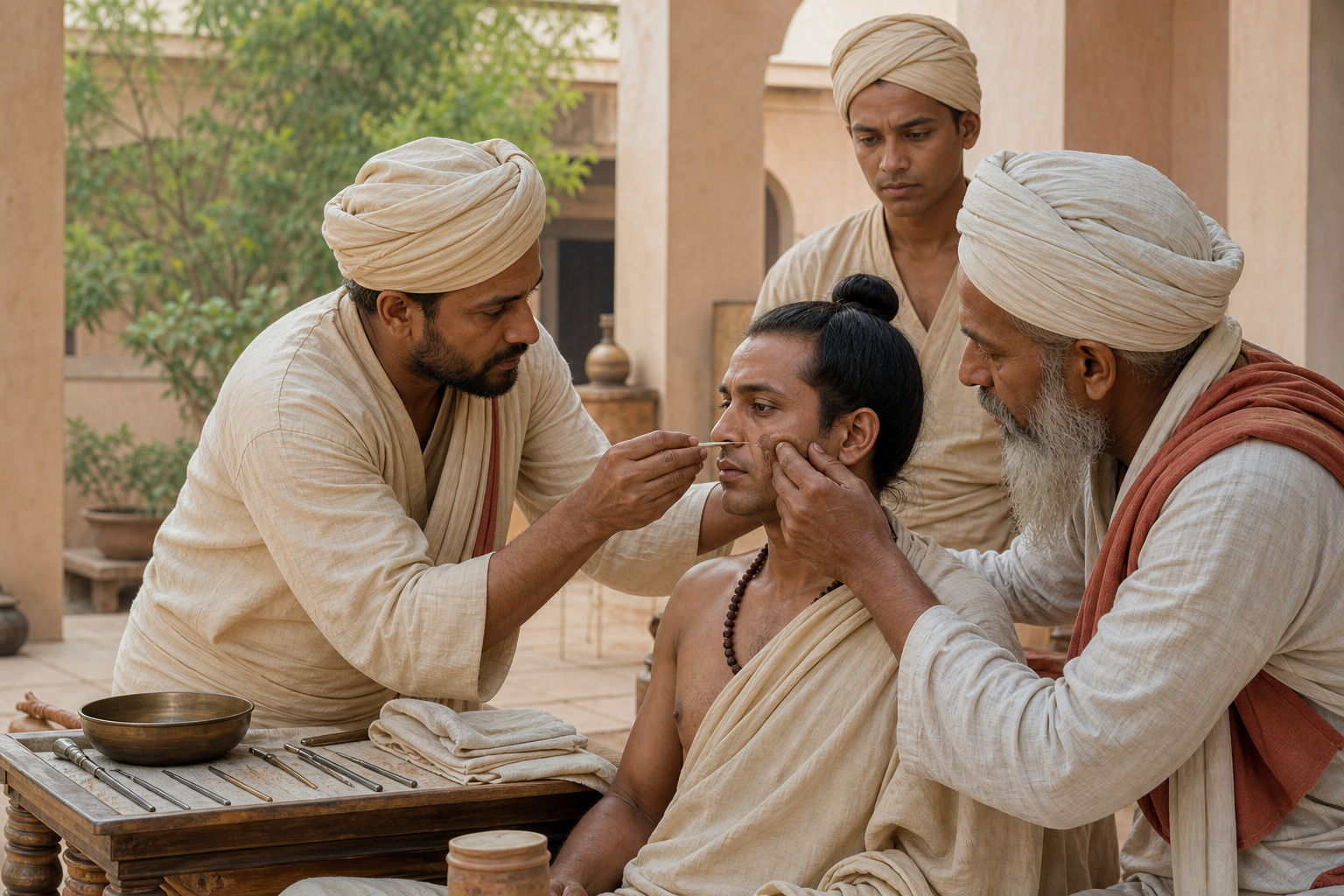
Nasal reconstruction remains the best-known element of Sushruta’s reputation. The report describes nasasandhana techniques using pedicled skin flaps, often taken from the forehead, to restore nasal form and function. It further states that reports from the Indian subcontinent in the late eighteenth century attracted European attention and influenced later pioneers of plastic surgery. In the source’s account, this transmission connects the ancient description with the procedure subsequently known as the Indian method of rhinoplasty.
Yet focusing only on the nose narrows the tradition. The same report attributes to the compendium approaches to traumatic wounds, fracture reduction and immobilization, anal fistulae, dental extraction, skin grafting, and cataract couching, as well as the use of wine and plant-based preparations for analgesia or sedation. It also emphasizes haemostasis and staged aftercare. These examples show why Sushruta is presented as a system-builder rather than merely the originator of a famous flap.
Historical significance should not be confused with current clinical endorsement. A procedure such as cataract couching belongs to the history of attempts to restore sight, while contemporary treatment is governed by modern evidence, technology, and safety standards. Ancient descriptions are most responsibly valued as evidence of observation, experimentation, and organized medical teaching in their own setting.
The Edinburgh statue and a polycentric history
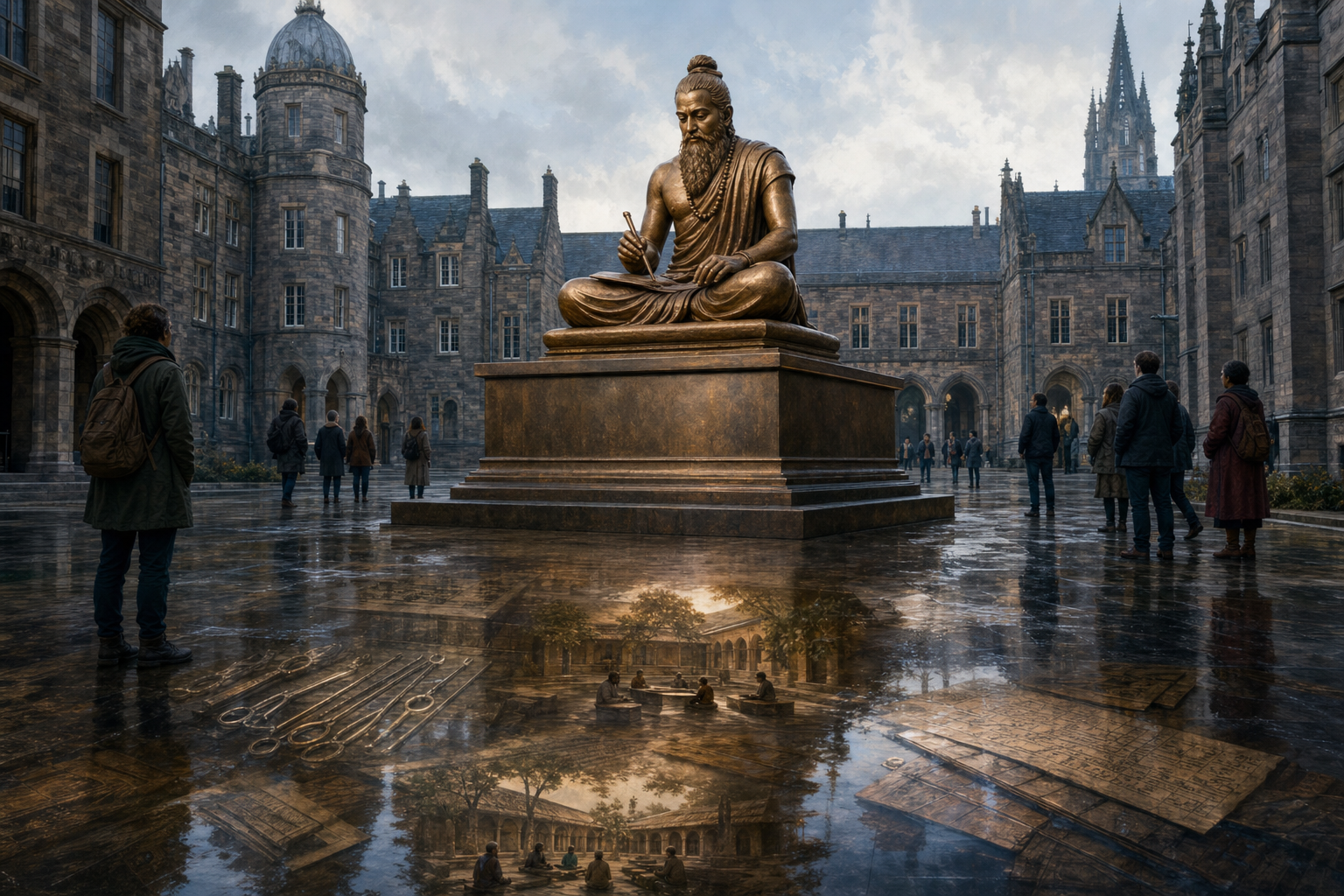
The source reports that a bronze statue of Sushruta was installed at the Royal College of Surgeons of Edinburgh. It interprets the setting as especially meaningful because Edinburgh’s surgical school is associated with influential traditions of operative training and standard-setting. Placing Sushruta there makes an institutional argument: the history of surgery was formed through more than one intellectual center.
The account extends that argument beyond a simple India-Europe exchange. It says medical learning preserved in the Indian subcontinent served communities across Hindu, Buddhist, Jain, and later Sikh settings. It also reports that Persian and Arabic translations and commentaries carried relevant knowledge into wider Afro-Eurasian medical discussion. These pathways present transmission as a long process involving texts, teachers, practitioners, patients, and successive acts of interpretation.
This perspective avoids two distortions: excluding India from global medical history and claiming that modern surgery emerged fully formed in antiquity. Sushruta’s durable importance lies between those extremes. The corpus associated with him documents an ambitious effort to classify operations, teach anatomy and manual skill, regulate conduct, and manage patients before and after intervention.
The statue’s most constructive legacy will depend on the scholarship it stimulates. Continued work across philology, medical history, surgical education, and cross-cultural transmission can clarify how the text changed over time, how its techniques were practiced, and how later readers adapted them. Recognition then becomes an invitation to inquiry rather than the final word on the past.