Pandit Madan Mohan Malaviya’s nation-building can be understood as a chain of conversion: personal credibility generated public trust; trust made cooperation and fundraising possible; and those resources were directed into institutions, political agreements, and economic capability. In the supplied account, leadership was therefore not merely a matter of holding office or delivering speeches. It was the disciplined translation of character into collective capacity.
The account draws upon Sir M. Visvesvaraya’s Some Personal Reminiscences and follows Malaviya across education, politics, and economics. Read across those domains, a consistent method emerges: retain a clear civilizational purpose, consult widely on execution, work with people of differing views, and accept personal costs when public duty requires them.
Moral authority as a practical form of capital
The source presents Malaviya’s simplicity of life, lack of interest in personal gain, cultural learning, and consistency of purpose as more than private virtues. These qualities gave credibility to his public appeals. His moral authority could consequently produce tangible effects: donors contributed, political opponents entered discussions, and audiences remained receptive to arguments joining cultural continuity with material development.
Visvesvaraya’s portrait, as relayed by the article, places unusual weight on Malaviya’s ability to communicate across intellectual and social settings. His speeches reportedly drew upon Sanskrit learning, English history and literature, contemporary economics, finance, and knowledge of conditions on the ground. He could address large audiences without notes, while his Hindi oratory carried particular force among orthodox audiences in North India. The significance was not eloquence alone. Malaviya could frame technical, political, and cultural questions within a shared moral vocabulary.
The article interprets this combination as dharmic leadership: conviction restrained by responsibility, and cultural rootedness directed toward public service. Whether considered in religious or secular terms, the underlying leadership mechanism is recognizable. Reputation reduced the distance between an ambitious proposal and the willingness of others to support it.
BHU made education an instrument of national capacity
The clearest institutional expression of Malaviya’s method was the Benares Hindu University. According to the source, the university was conceived neither as a conventional colonial institution nor as the private monument of a single benefactor. It depended upon public confidence in Malaviya and upon a design that connected civilizational learning with the practical requirements of national development.
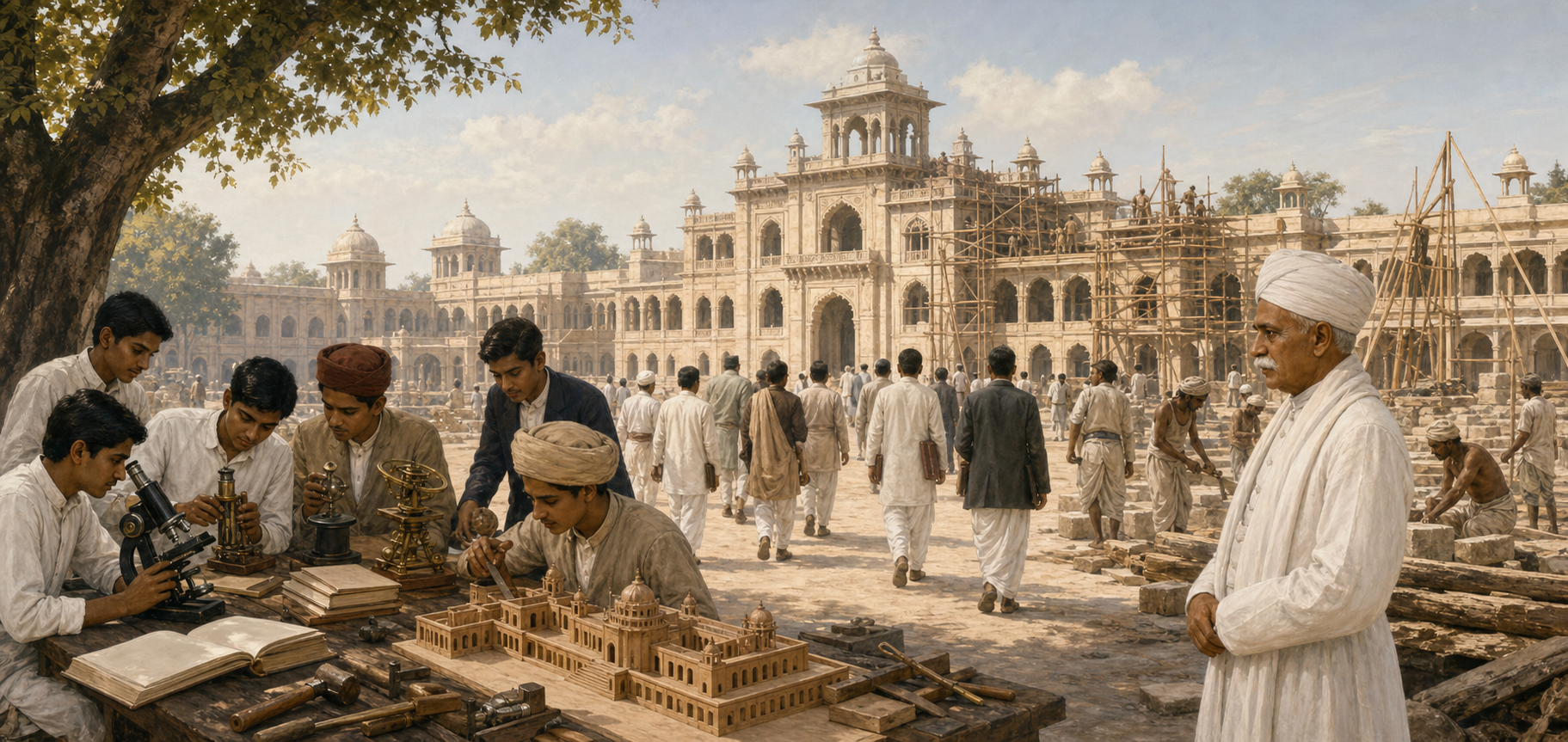
That design refused a simple choice between inherited knowledge and modern expertise. Hindu religion, philosophy, and Sanskrit learning were to coexist with science, engineering, agriculture, and business. Varanasi was selected because its long association with learning gave the project cultural continuity, while professional disciplines were expected to help India enlarge its productive capabilities. The choice of the Maharaja of Mysore as the first Chancellor further signaled, in the source’s presentation, that BHU was intended as a culturally grounded but pan-Indian institution.
Malaviya reportedly consulted engineers, architects, educationists, and industrial leaders on the campus, academic organization, and sustainability. Consultation did not mean surrendering the central concept: classical studies and applied disciplines were to strengthen one another. This distinction is important for understanding his leadership. He was flexible about means while remaining firm about institutional purpose.
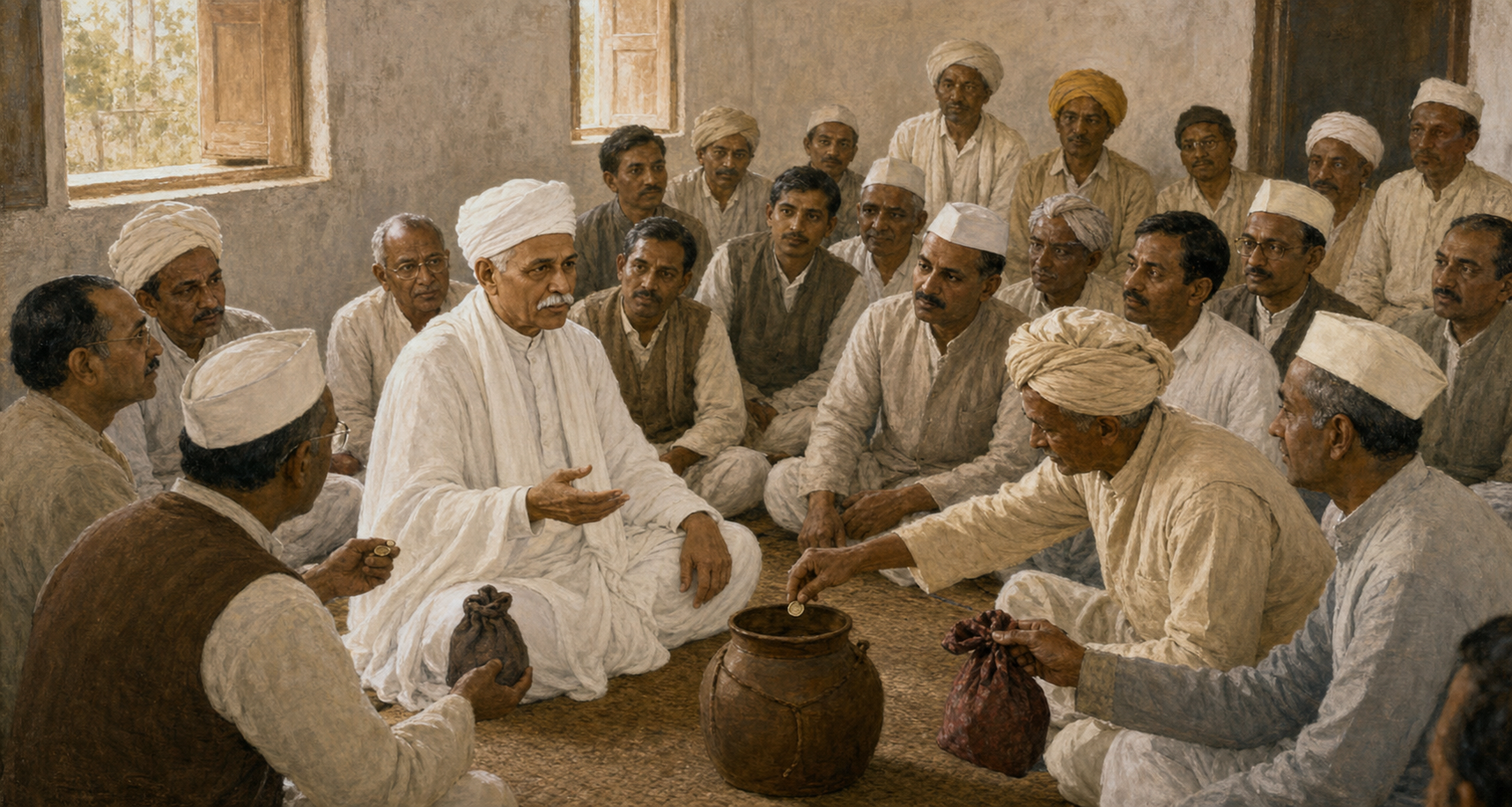
Fundraising then tested whether the vision could command material support. The article reports that Malaviya addressed assemblies in major cities and appealed to merchants and zamindars through patriotism and the duty of philanthropy. At a Calcutta meeting in January 1912, delivered in Hindi, support reportedly arrived through both substantial pledges and money offered at the gathering. The episode illustrates how his ethical credibility and communicative skill were converted into institutional resources.
The source dates the enabling Benares Hindu University Act to 1915 and the beginning of operations to 1916. By January 1923, it describes an established complex supporting arts and sciences, Sanskrit classics, and engineering, with an agriculture college in preparation and students arriving from across India. The sequence matters: Malaviya’s nation-building was designed to outlast a campaign by producing trained people, accumulated knowledge, and an enduring educational community.
Coalition-building joined constitutional method with sacrifice
Malaviya’s political conduct followed a parallel logic. At the Indian National Congress session in Allahabad in December 1910, the source describes him guiding deliberations with confidence while combining firm positions with constitutional propriety. From his early Congress involvement beginning in 1886 through his later service in the Imperial Legislative Council and Indian Legislative Assembly from 1910, he is presented as pursuing change mainly through constitutional agitation.
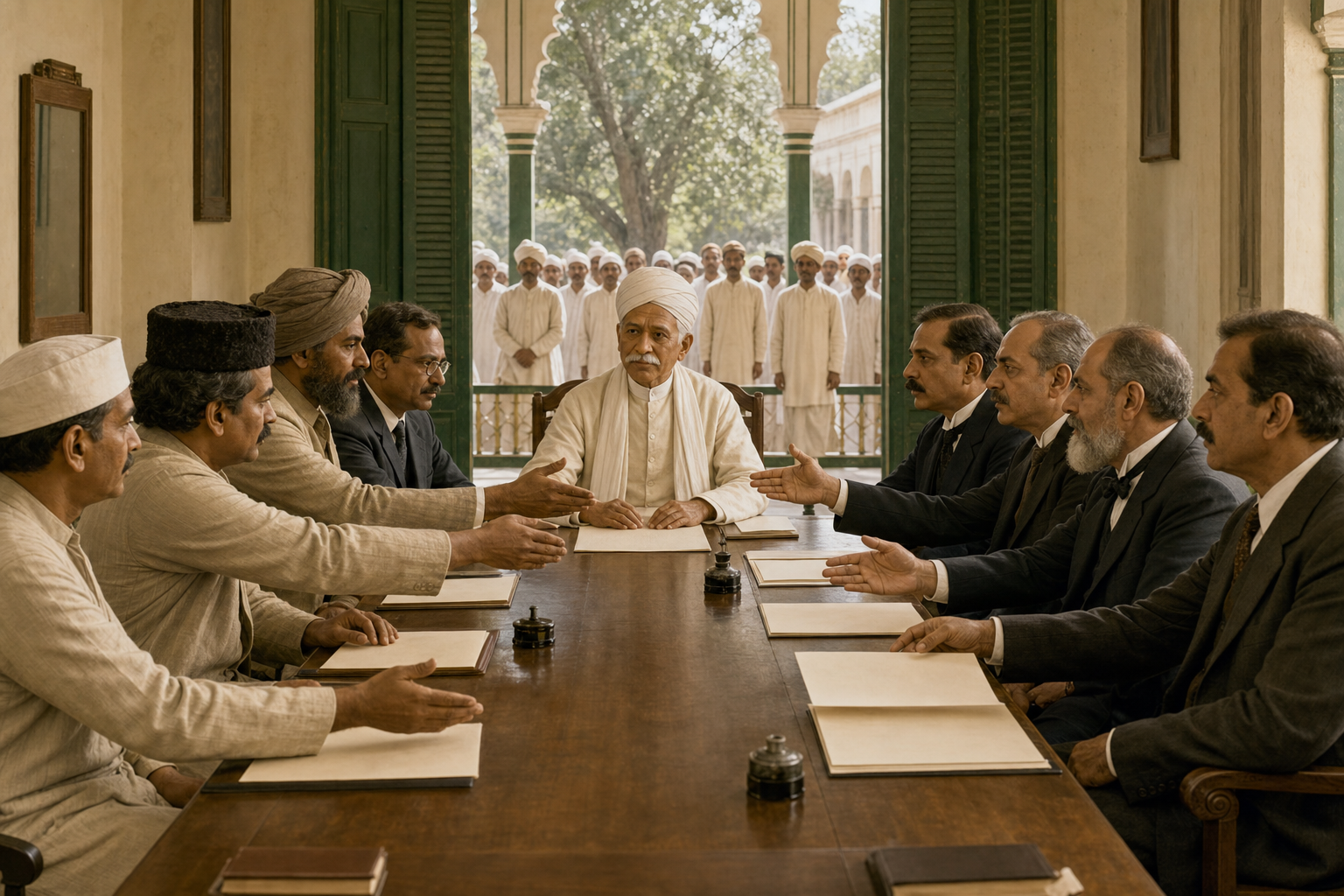
Constitutionalism, in this account, was not passivity. In December 1921, Malaviya led a cross-party deputation to the Viceroy in Calcutta with Annie Besant and other leaders. The group reportedly sought measures to reduce social unrest, criticized the limited character of the reforms associated with the Government of India Act of 1919, and pressed for an immediate political advance that could enable constructive work.
On January 10, 1922, he helped convene an All-Parties Conference in Bombay. The source names M. A. Jinnah and M. R. Jayakar among leaders of differing positions brought into a committee for practical follow-up. This episode reveals an important distinction: Malaviya sought agreement sufficient for action, not ideological uniformity. Coalition-building was a means of releasing national capacity that factional division would otherwise immobilize.
His reliance on negotiation also had limits. The article reports that in 1931, amid civil resistance and the imprisonment of national leaders, Malaviya joined the working committee of a proscribed Congress and accepted incarceration. Visvesvaraya emphasized the severity of prison life for an orthodox Hindu such as Malaviya. Within the source’s interpretation, the decision represented ethical sacrifice: constitutional restraint remained a governing preference, but it did not excuse withdrawal when conscience demanded a greater personal cost.
Economic policy connected learning with productive strength
The educational and political strands of Malaviya’s work converged in his economic thinking. The source highlights his contribution to the Industrial Commission of 1916-18, where his note reportedly emphasized indigenous capability, balanced development, and a working relationship between technical education and enterprise. BHU’s professional disciplines can therefore be read as components of an economic strategy rather than additions to a primarily cultural university.
This wider conception of capacity also informed his support for compulsory primary education. Higher institutions could prepare specialists, but broader education was necessary to enlarge human capability throughout society. The account additionally attributes to him support for community organizations, cooperative uplift, and basic military training for civic preparedness. It frames the last of these as disciplined responsibility for protecting homes and communities, not as aggression.
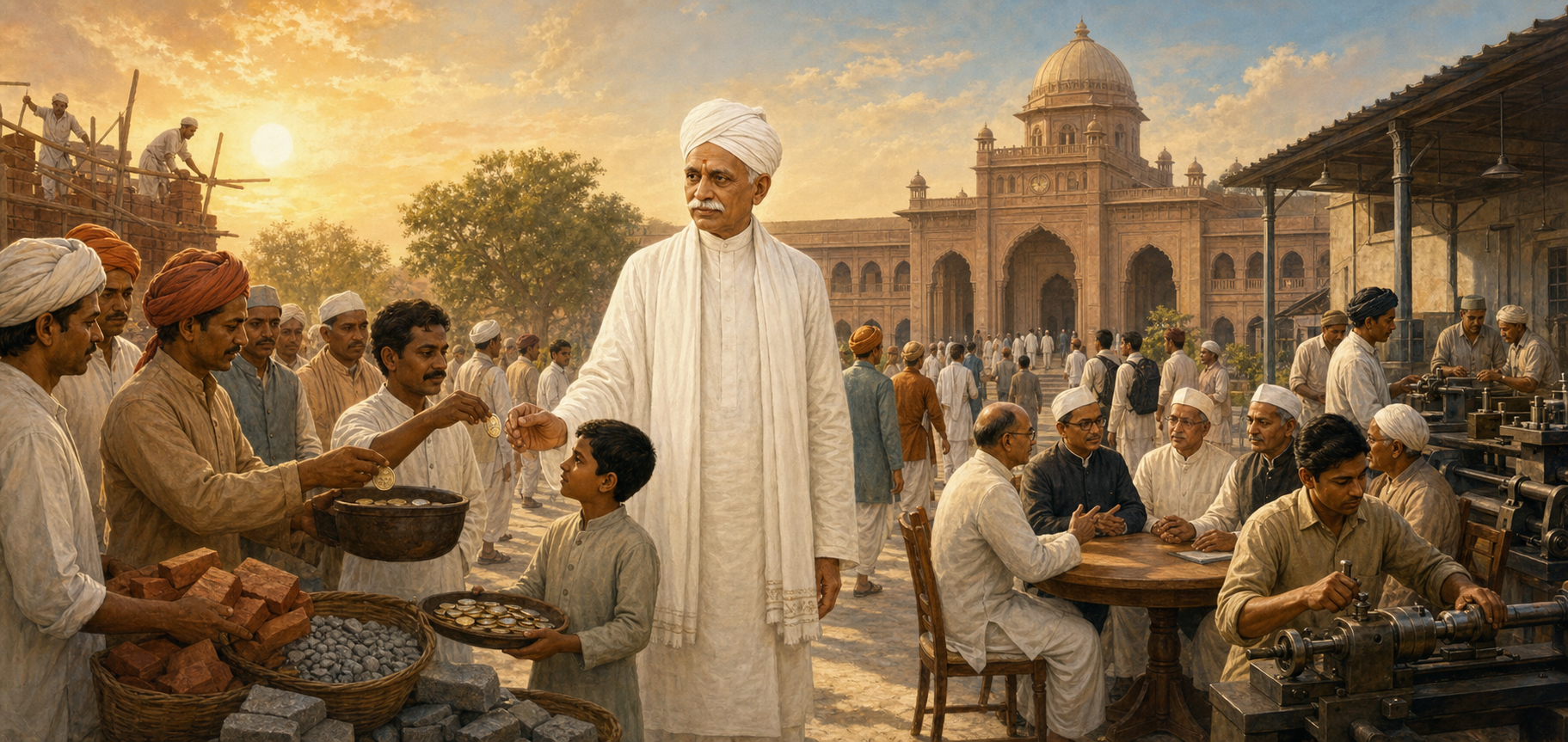
Malaviya’s approach thus joined social, intellectual, and economic infrastructure. Cultural confidence supplied orientation; general education widened participation; technical study developed expertise; and enterprise created a route from knowledge to production. Nation-building, on this reading, was not confined to political sovereignty. It required a society capable of educating, organizing, financing, and protecting itself.
What this record reveals, and where caution is needed
The available source is an admiring interpretation of Visvesvaraya’s personal reminiscences, not an independent multi-source biography. Its value lies in showing how one eminent engineer-administrator understood Malaviya’s character and public method. Its limitations should also remain visible: the reported episodes are not tested here against competing recollections, institutional archives, or assessments of policy outcomes.
The source itself nevertheless identifies a tension that complicates any purely celebratory account. Political prominence sometimes strengthened Malaviya’s ability to support BHU, but official displeasure could also threaten grants. During his imprisonment, the article reports, rumors suggested that university staff might be reduced to half-pay. Citizen-led institutions operating under colonial authority therefore needed more than a compelling founder. Diverse funding, endowments, and community solidarity were safeguards against political shocks.
Key takeaways
- Malaviya’s credibility functioned as institutional capital, helping turn public confidence into donations, cooperation, and sustained organization.
- BHU embodied integration rather than imitation: civilizational learning established purpose, while modern disciplines built practical national capability.
- His coalition method sought workable agreement among differing leaders without requiring them to erase their political differences.
- Durable nation-building depended on structures beyond personal leadership, including trained people, diversified finance, and institutions able to survive political pressure.
For future institution-builders, the open question is how to reproduce this chain of trust, competence, and resilience without making an organization dependent upon one exceptional personality. Malaviya’s example points toward leadership that measures success by the capacity it leaves behind.