

Three reports approach Hindu unity at different scales: the reintegration of an individual, coordination among organisations, and the preparation of households and young people. One reflects on the reported return of Netaji Palkar under Chhatrapati Shivaji Maharaj; another describes a Gorakhpur gathering of more than 160 Hindu organisations; and a third reports that over 325 young people attended training camps in Varanasi and Ghazipur. These particulars come from the respective source articles and have not been independently verified here.
Read together, the reports offer a useful framework for community resilience. Belonging must remain voluntary, unity must produce institutions of service, and preparedness must be disciplined by law, non-aggression, safeguarding, and public accountability.
Three scales of unity: person, institution, and household
At the personal scale, the ghar wapsi article presents reintegration as a form of identity repair. Its central example is the Shivaji-Palkar narrative, in which a person separated from his natal faith is said to have been welcomed back through Shuddhikaran. The article treats this not simply as a ritual event but as a relationship between conscience and communal acceptance: the individual chooses, and the community removes barriers to return.
At the institutional scale, the Gorakhpur article reports that representatives of more than 160 organisations discussed unity across sampradayas and regions, temple-based service, legal safeguards, and community safety. Its most constructive formulation is unity without uniformity. Cooperation can occur through shared programmes and standards while distinct schools, practices, and authorities retain their integrity.
At the household scale, the account of the Shaurya Training Camps describes physical conditioning, attention exercises, contemplative practice, teamwork, and elementary self-protection. The reported "Har Ghar Yoddha" model imagines each home as a small centre of healthy routine, situational awareness, ethical discipline, and service rather than as an isolated private unit.
The three scales depend on one another. A community that speaks of belonging but cannot welcome a sincere return leaves its principles incomplete. A coalition without durable local services risks remaining rhetorical. Training without ethical and institutional supervision can lose its civic purpose. Unity becomes credible when personal dignity, organisational capacity, and household preparedness reinforce one another.
Reconversion requires consent, historical care, and acceptance
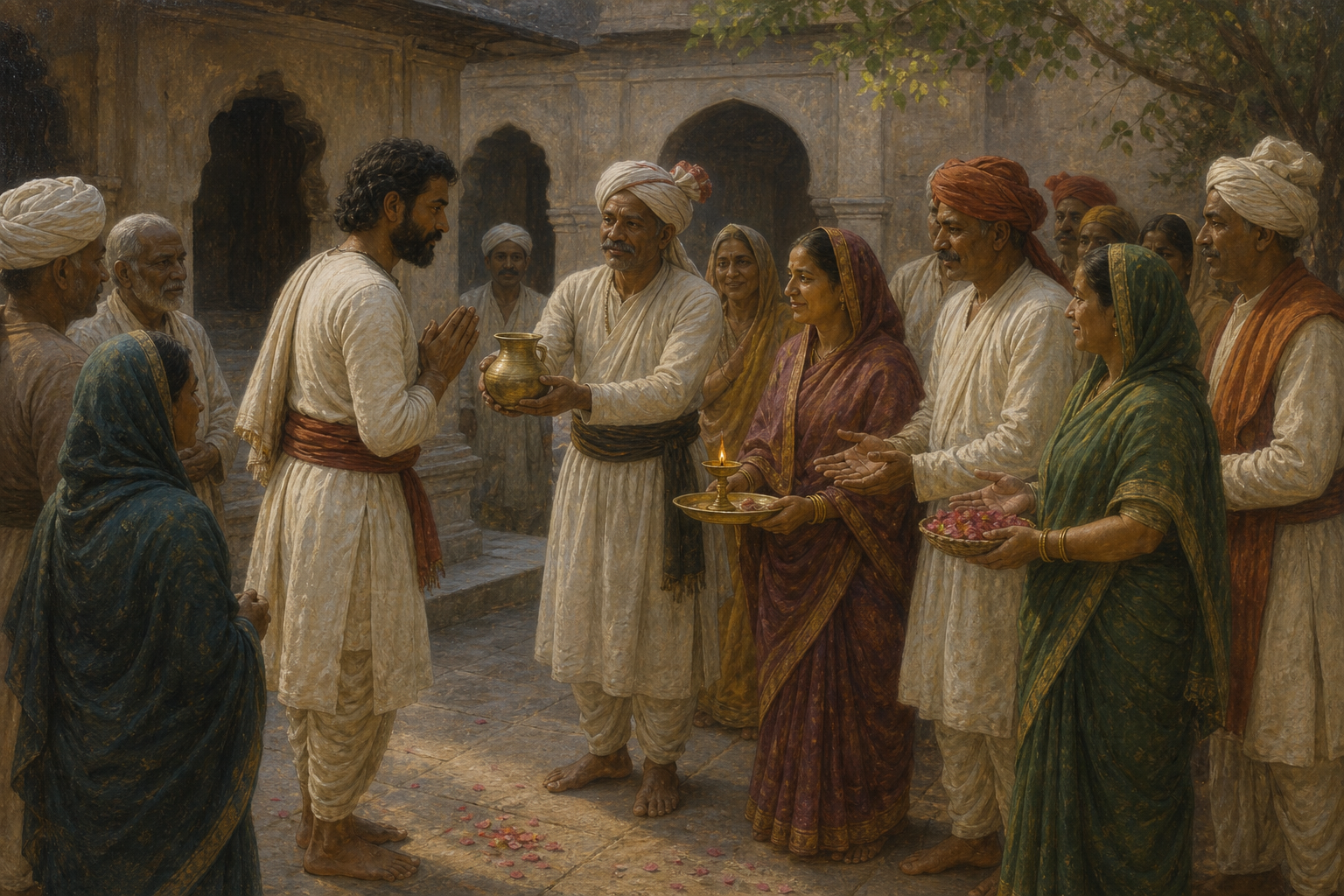
The first report links a proposed observance of 19 June as "National Ghar Wapsi Diwas" to what it describes as the 350th anniversary of Netaji Palkar’s return. It also acknowledges that chronicles differ on details of his captivity and reintegration. That qualification matters: the commemorative meaning of an episode should not be used to conceal uncertainty in its documentary record. Responsible public memory can honour an inherited narrative while distinguishing broad agreement from contested particulars.
The article situates Shuddhikaran alongside Hindu ideas of prayaschitta and communal readmission. It also draws comparisons with Sikh Amrit Sanchar, Jain pratikraman and prayaschitta, and Buddhist refuge or renewed lay vows. These practices are not interchangeable, but the comparison identifies a shared ethical pattern: voluntary recommitment, disciplined conduct, and renewed participation in a religious community.
Consent is therefore the decisive boundary. The ghar wapsi article invokes Article 25’s protection of freedom of conscience and notes that coercion, fraud, or undue inducement falls outside legitimate religious choice. The Gorakhpur report likewise cites the constitutional distinction between propagation and conversion through prohibited means. These sources frame the law as a safeguard in both directions: it protects a voluntary return while also protecting a person from pressure to return.
A responsible reintegration process would consequently require informed consent, confidential counselling, an opportunity to withdraw, screening for pressure or material inducement, and compliance with applicable local procedures. The community’s conduct after a ceremony is equally important. If a returning person encounters suspicion, humiliation, or permanent second-class status, the restorative purpose has not been fulfilled.
Unity becomes durable through service institutions
The Gorakhpur gathering reportedly discussed allegations described by participants with the contested labels "love jihad" and "corporate jihad." The source itself offers a more workable policy vocabulary: examine specific conduct such as deception, coercion, trafficking, intimidation, or undue influence without presuming guilt from the religions of the people involved. This shift from identity labels to provable behaviour is essential if community advocacy is to protect victims without stigmatising consensual relationships or lawful religious activity.
The same report proposes narrow legal definitions, due-process safeguards, privacy protection, victim support, independent oversight, and transparent reporting. Whether pursued through legislation or community protocols, these principles provide an accountability test. Complaints, verified incidents, prosecutions, and outcomes should not be collapsed into a single statistic, and assistance should not depend on whether a case advances a preferred narrative.
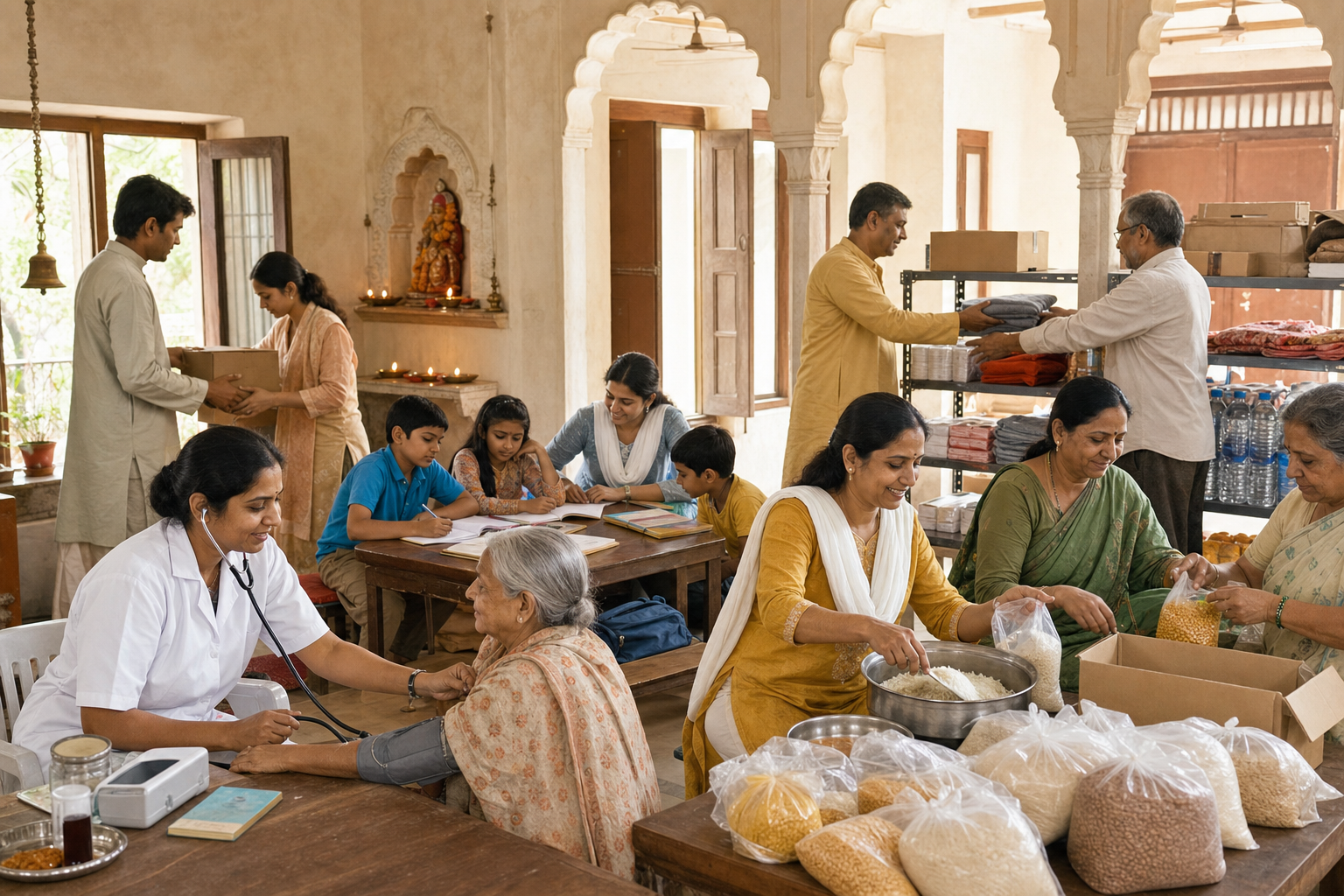
Temples can give this framework a practical local base. The Gorakhpur article identifies youth mentorship, skills programmes, women’s safety workshops, counselling, scholarships, health initiatives, and relief work as possible forms of temple-linked outreach. The training-camp article adds the possibility of continuing practice circles, alumni networks, and seva projects. Together, these ideas reposition the temple from an occasional venue into a dependable civic institution while preserving its religious character.
Cooperation across Hindu sampradayas, and where appropriate with Buddhist, Jain, and Sikh communities, need not erase doctrinal differences. Joint service calendars, shared safety standards, referral networks, and coordinated relief can express common values while each tradition governs its own rituals and teachings. This federated model offers a more durable unity than symbolic declarations alone.
Preparedness must remain preventive, lawful, and measurable
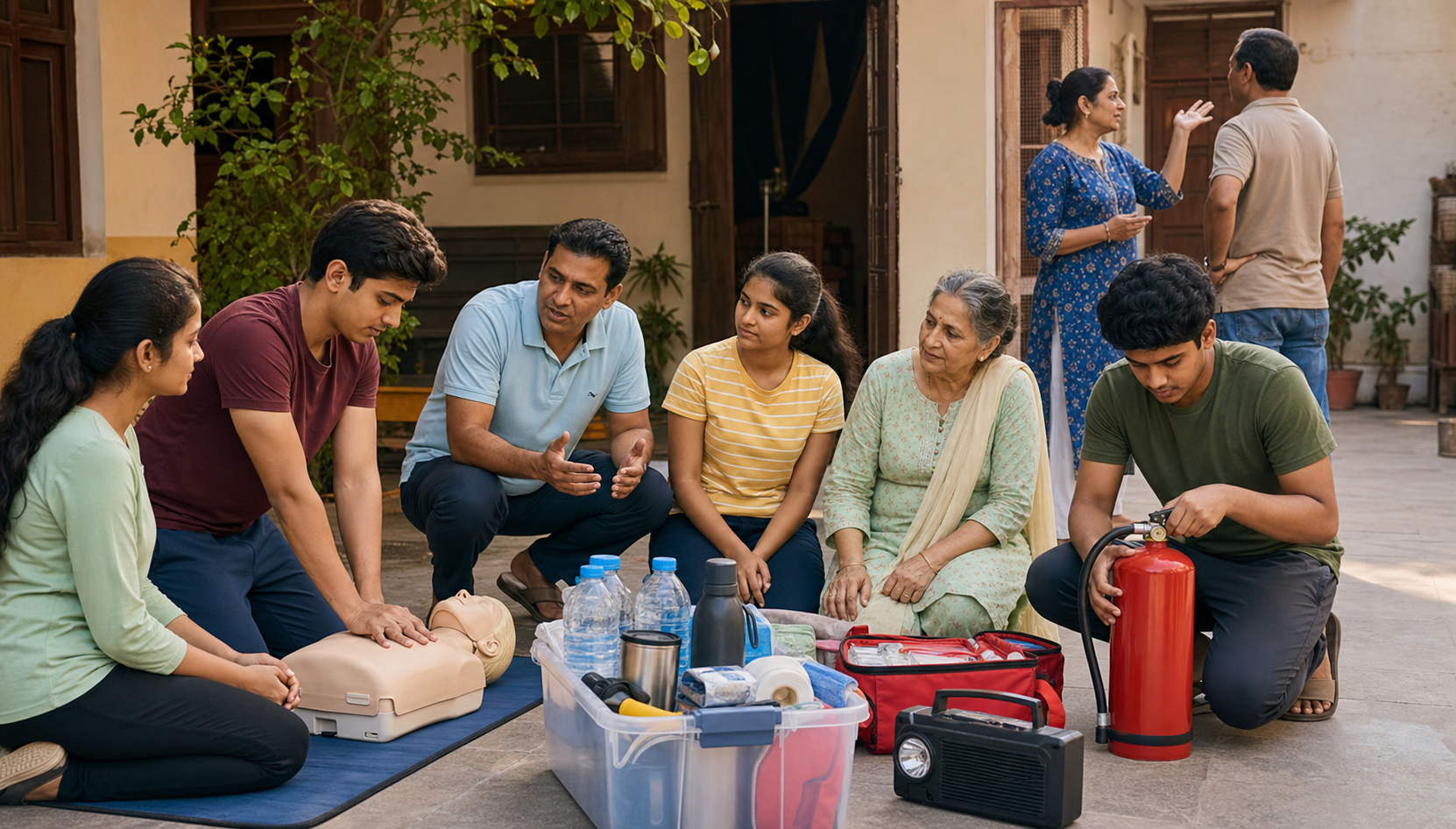
The Varanasi and Ghazipur article reports participation by more than 325 young men and women in camps organised around physical, mental, and spiritual development. Its described methods include progressive fitness drills, breath awareness, attention exercises, group problem-solving, reflection, and escape-oriented self-protection. De-escalation, boundary-setting, safe distance, voice assertion, and bystander safety are presented as foundations rather than aggressive confrontation.
The Gorakhpur report broadens preparedness beyond self-defence to first aid, disaster response, cyber-safety, legal literacy, and police liaison. This is an important synthesis: a prepared household is not defined mainly by its ability to fight. It is one that can recognise risk, remain composed, assist an injured person, respond to an emergency, protect personal information, document an incident, and contact the appropriate public authority.
Safeguarding determines whether such programmes deserve trust. The camp article describes age-appropriate progression, gender-sensitive facilitation, codes of conduct, hydration, first-aid readiness, and mentor supervision. Those protections should be treated as programme requirements, accompanied by instructor vetting, confidential reporting channels, clear limits on physical contact, and explicit rejection of vigilantism. Training creates no policing or punitive authority.
The source reports encouraging participant impressions, including greater confidence and attentional steadiness, but these observations are not equivalent to an independent impact evaluation. The article itself suggests tracking attendance, fitness indicators, self-reported stress, and service hours with privacy and consent. Future assessments should also distinguish participation, skill retention, safe real-world application, and unintended harms. Evidence can improve a programme only when unfavourable findings are recorded as seriously as positive ones.
Key takeaways
- Ghar wapsi is ethically defensible only as a voluntary exercise of conscience followed by genuine social acceptance.
- Hindu unity is strongest as cooperation among distinct sampradayas, not the forced standardisation of belief or practice.
- Temple networks can translate solidarity into visible service through mentorship, counselling, safety education, relief, and other accountable programmes.
- Community preparedness should prioritise awareness, de-escalation, first aid, emergency response, legal literacy, and service rather than confrontation.
- Clear rules, measurable outcomes, privacy protections, grievance procedures, and independent scrutiny protect both participants and the legitimacy of the wider mission.
Future initiatives will be judged less by the scale of their slogans than by the quality of their consent procedures, the usefulness of their services, the safety of their training, and their willingness to publish credible results. Building on those standards would allow historical memory and contemporary organisation to strengthen community life without sacrificing individual dignity or constitutional restraint.
References
- DharmaRenaissance Blog – June 19 as ‘National Ghar Wapsi Diwas’: Honouring Shivaji-Palkar and Renewing Dharmic Unity
- DharmaRenaissance Blog – Gorakhpur’s Hindu Rashtra Adhiveshan: 160+ Groups Unite for Dharmic Unity and Legal Safeguards
- DharmaRenaissance Blog – Shaurya Training Camps empower 325+ youth in Varanasi & Ghazipur under ‘Har Ghar Yoddha’