
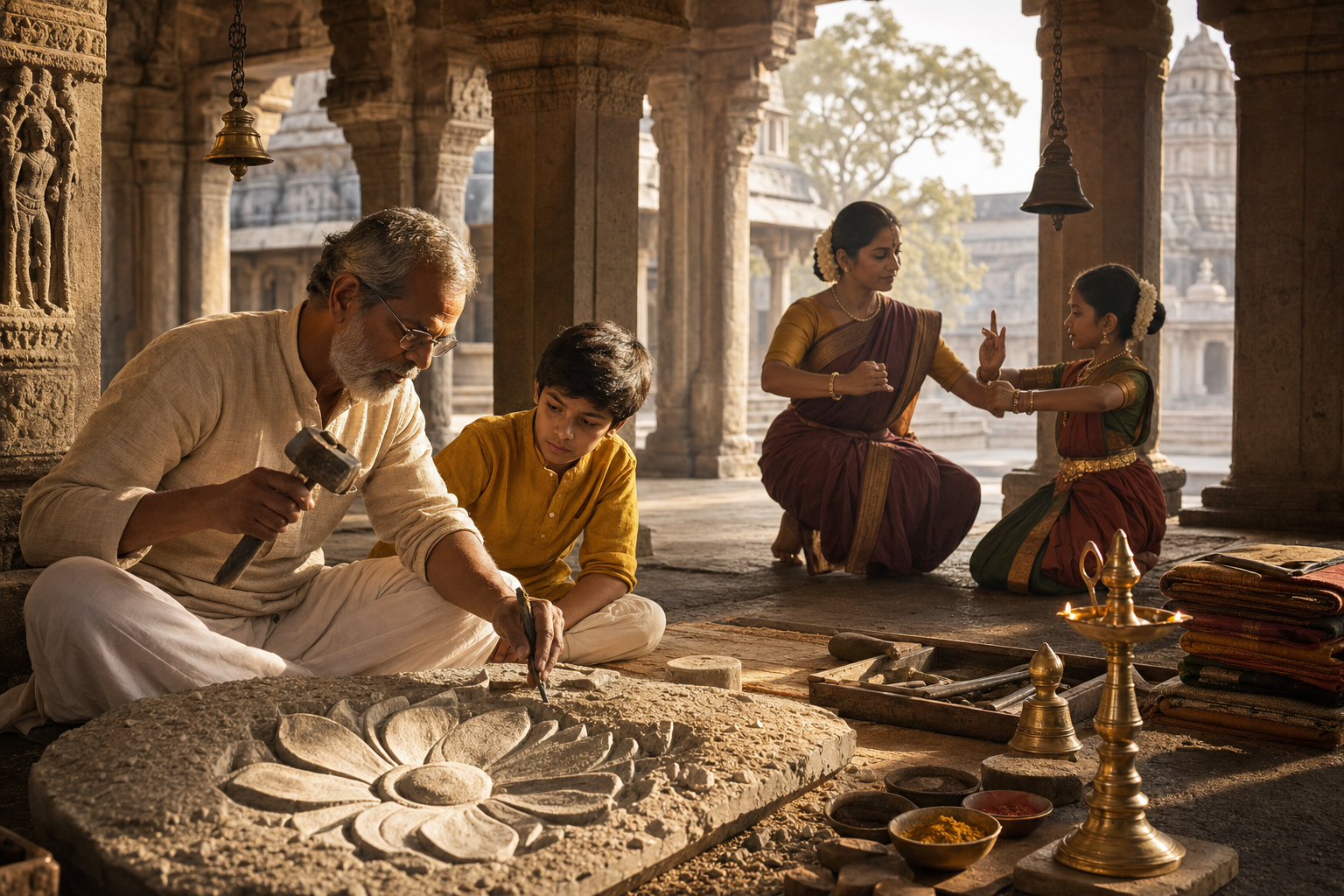
Sacred art preserves more than the appearance of a tradition. A sculpted hand, a dancer’s gesture, a temple image, or a ritual form can carry theology, memory, discipline, and ways of interpreting the world.
The two source articles illuminate this process at different scales. One closely examines Ardha Chandra Mudra as a visual and performative sign; the other considers why Dharmic knowledge, languages, practices, institutions, and arts require preservation. Read together, they show that cultural continuity depends on conserving both sacred forms and the living grammar that makes those forms intelligible.
Sacred art is an archive meant to be practised
The article on Dharmic cultural preservation argues that preservation should not freeze society in an earlier period or demand uncritical acceptance of every inherited practice. Its purpose is to protect the principles, texts, languages, arts, rituals, values, and institutions through which a civilisation can renew itself without surrendering its identity.
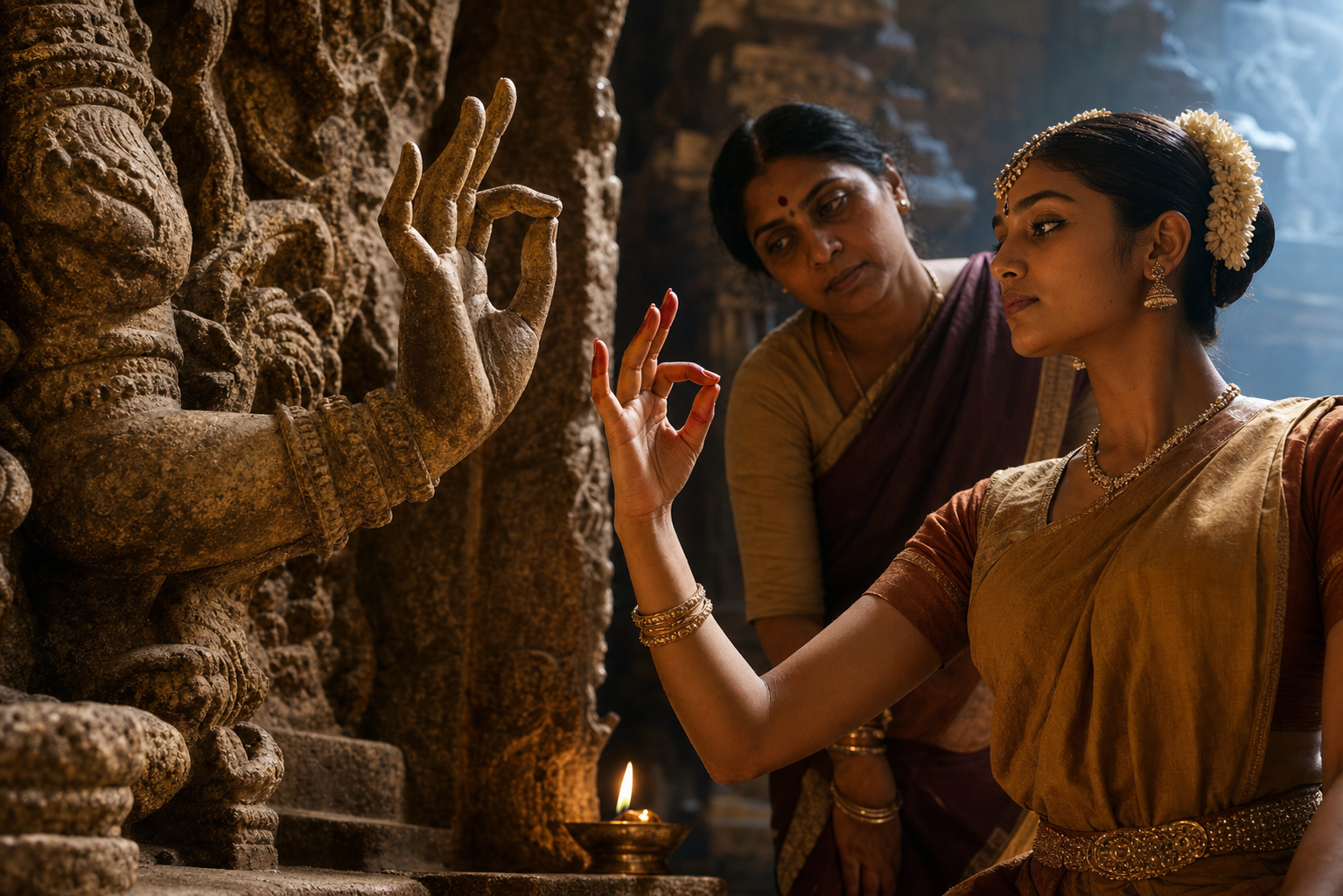
Sacred art belongs at the centre of that work because it joins several kinds of inheritance. A temple sculpture is a material object, but its posture and attributes may also communicate philosophy, ritual purpose, aesthetic discipline, narrative memory, and knowledge of bodily expression. The article on Ardha Chandra Mudra describes the hand in Hindu sculpture as a vehicle of communication rather than a merely anatomical detail. Through mudra, a figure can suggest blessing, protection, devotion, instruction, invitation, or a theological state without using written language.
This makes sacred art a participatory archive rather than a storehouse of inert objects. Its meanings are activated through worship, storytelling, movement, recitation, study, and attentive viewing. The broader preservation essay similarly presents ritual as embodied philosophy: inherited ideas enter ordinary life through repeated actions before they are formulated as abstract theory. Sculpture and ritual therefore perform related cultural work. Both give durable form to ideas that might otherwise become remote from daily experience.
Material survival remains indispensable, but it is not sufficient. If an image endures while knowledge of its gestures, narrative setting, terminology, and ritual relationships disappears, the visible form survives with part of its cultural memory missing.
The half-moon hand reveals how much one form can carry
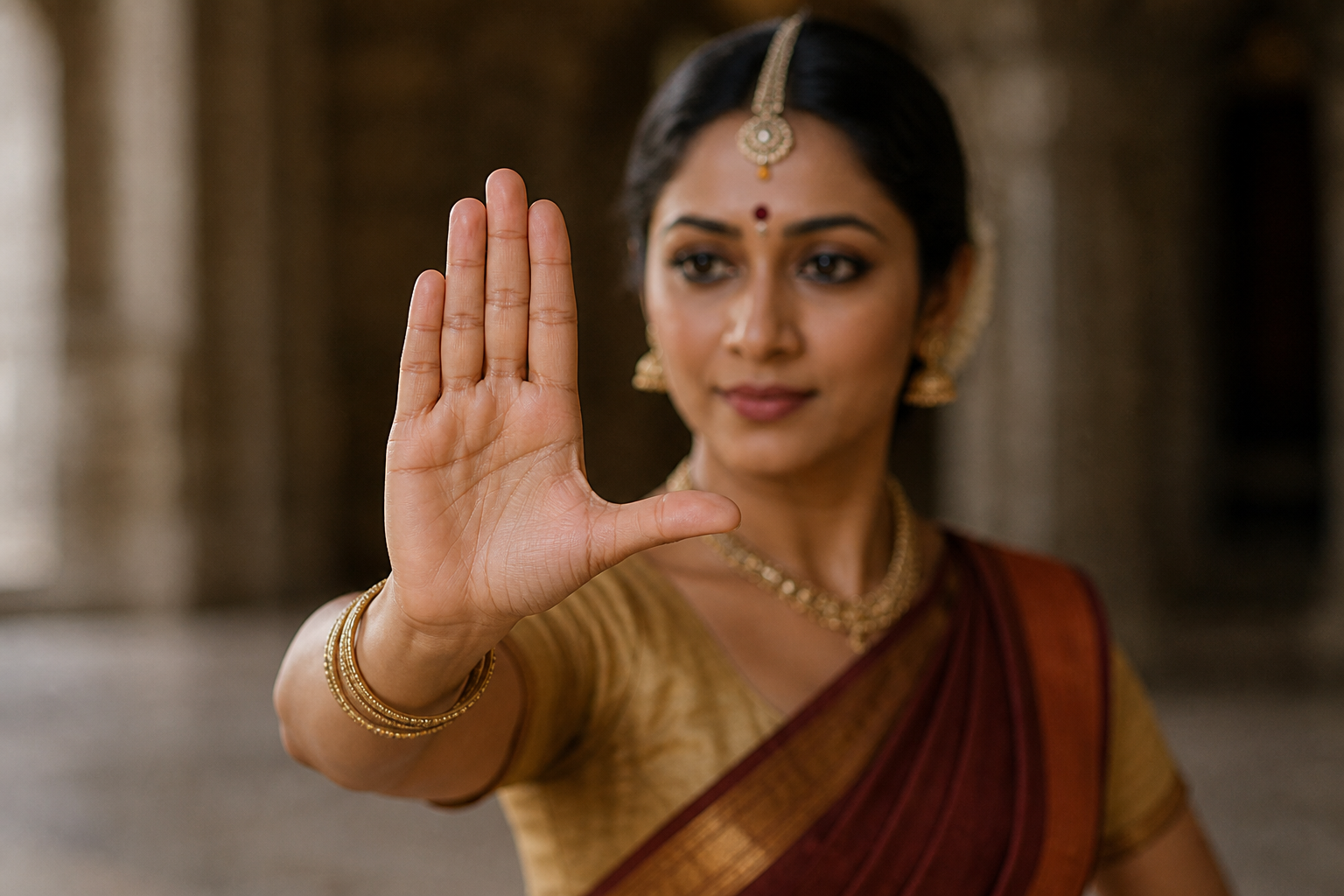
Ardha Chandra Mudra provides a focused example of this layered transmission. The source article explains that ardha means half and chandra means moon. It describes a hand form in which the fingers are generally extended together while the thumb opens outward, producing the impression of a crescent. It also cautions that the sculptural form can vary with region, period, artistic school, and iconographic setting.
The gesture carries meaning through association rather than through a single fixed definition. According to the mudra article, lunar symbolism in the Indic imagination encompasses rhythm, cyclical time, coolness, nourishment, renewal, fertility, the mind, and the changing patterns of nature. The crescent differs symbolically from the full moon: it can imply transition, measured light, restraint, or emergence rather than completion.
The article places these associations in a wider Shaiva field through Shiva as Chandrashekhara, bearer of the crescent in the matted locks. In that setting, the crescent is connected with mastery over time, the cooling of ascetic fire, and the integration of stillness with movement. This does not mean that every crescent-like hand has one Shaiva meaning. It shows instead how an individual form can participate in a network of stories, attributes, philosophical concepts, and devotional associations.
The same gesture also connects sculpture with performance. The source identifies Ardhachandra as a single-hand gesture within the codified vocabulary of classical dance and discusses its use in expressive communication, including Bharatanatyam and other traditions. A carved figure may therefore preserve the memory of movement: the stone records a bodily position, while a performance lineage preserves how such a position participates in rhythm, narrative, and emotion.
This relationship demonstrates why sacred art can transmit culture across media. A symbolic idea may appear as a sculpted hand, a dancer’s hasta, a divine attribute, a ritual action, or a term taught by a teacher. No single medium carries the whole inheritance. Their connections create resilience because meaning can be encountered through sight, movement, sound, language, and communal practice.
Preservation must protect objects, contexts, and interpretation
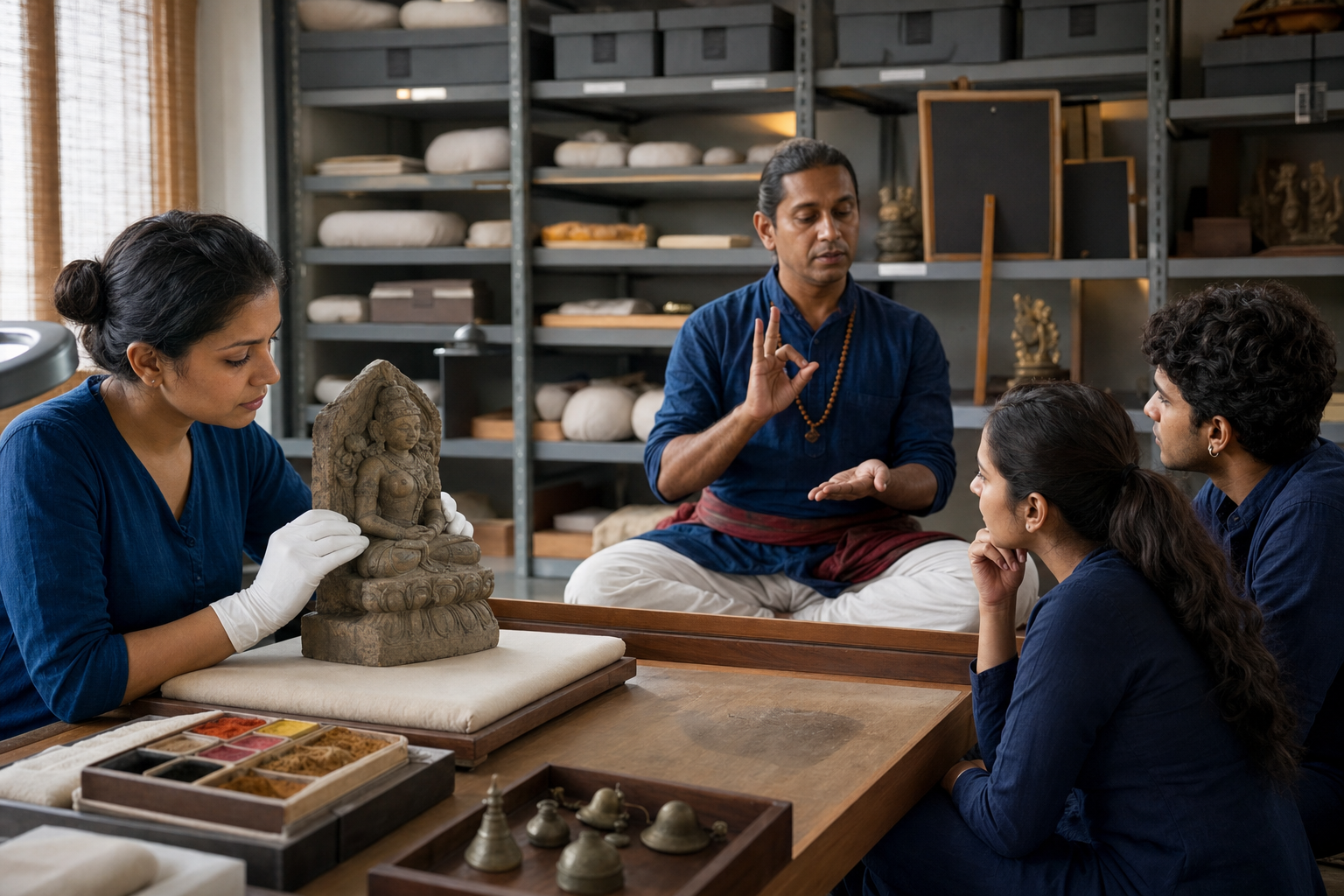
The mudra article warns that weathering, breakage, repainting, ritual use, and restoration can make a damaged hand difficult to identify. It calls for close attention to the thumb, fingers, palm, wrist, and the relationship of the arm to the torso. That caution has wider significance for cultural preservation: responsible interpretation distinguishes what can be observed from what is inferred.
Context is equally important. The meaning of a hand depends on the figure’s posture, expression, attributes, surrounding figures, narrative scene, architectural position, and religious setting. A gesture found in a Shaiva shrine cannot automatically be read in precisely the same way when it appears in a Vaishnava, Shakta, narrative, devotional, or dance-related composition. Sacred iconography is a grammar whose signs acquire force through relationships, not a codebook in which every form has only one translation.
Language forms another layer of that grammar. The cultural-preservation article stresses that inherited terms often contain shades of meaning that cannot be compressed into a single English equivalent. Translation remains valuable, especially for widening access, but it should accompany rather than erase terms such as dharma, bhakti, jnana, seva, ahimsa, moksha, and mudra. In the case of sacred art, retaining original vocabulary helps keep visual forms connected to the intellectual and devotional worlds that shaped them.
Practice completes the chain. Dance instruction can preserve how a hand is formed and used; ritual can preserve how an image is approached; storytelling can retain its narrative associations; and scholarship can compare form, placement, and textual vocabulary. Temples, monasteries, educational settings, cultural associations, teachers, performers, craftspeople, devotees, and families may contribute different kinds of knowledge. Preservation is strongest when these forms of expertise remain in conversation rather than being treated as interchangeable.
Continuity requires fidelity without simplification
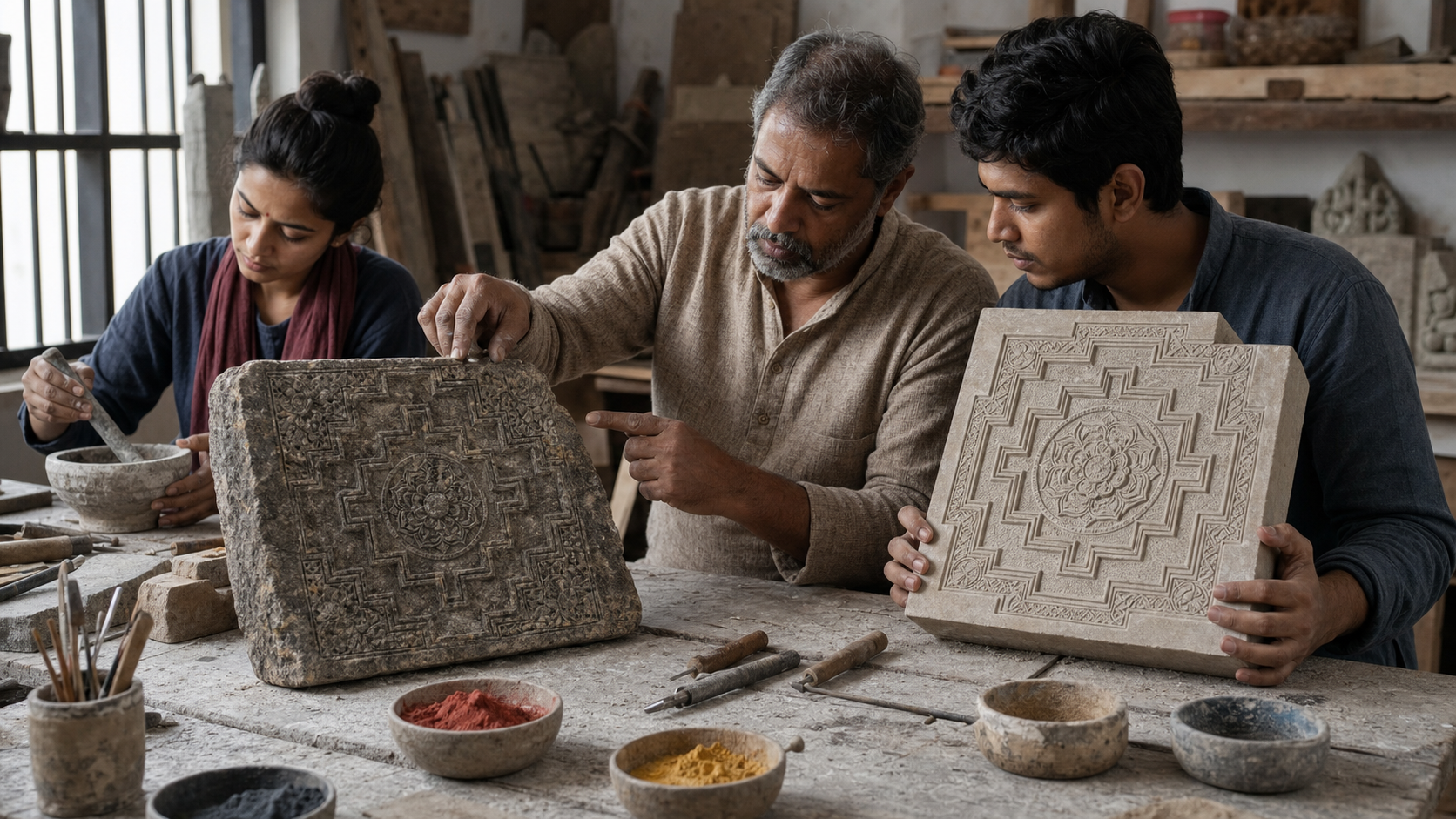
The two sources point away from two opposing errors. One is to reduce sacred art to attractive decoration, detached from ritual, philosophy, and disciplined convention. The other is to impose a rigid explanation that ignores variation, damage, historical context, or the plurality of Dharmic traditions.
A sound preservation ethic would begin by recording a work’s observable features and physical condition. It would then document its architectural, narrative, ritual, linguistic, and performative relationships. Interpretations could be presented with appropriate degrees of confidence, especially where a hand or attribute is incomplete. Such an approach protects the object while also protecting viewers from confident but unsupported claims.
It would also preserve plurality. The cultural-preservation essay situates Hindu, Buddhist, Jain, and Sikh traditions within a shared civilisational conversation while insisting that their distinct histories and frameworks should be honoured. Even within Hindu art, Shaiva, Vaishnava, Shakta, Smarta, philosophical, regional, and performative contexts cannot be collapsed into a single uniform system. Unity in preservation should mean cooperation across differences, not the removal of those differences.
Education is consequently as important as conservation. Viewers can be taught to notice the direction of a palm, the alignment of fingers, the figure’s gaze, nearby attributes, and the placement of the image. They can also learn to compare sculpture with dance and ritual without assuming that every resemblance proves an identical meaning. This interpretive literacy turns encounters with sacred art into disciplined inquiry rather than passive admiration.
Key takeaways
- Sacred art preserves Dharmic knowledge by joining material form with theology, narrative, ritual, language, and bodily practice.
- Ardha Chandra Mudra shows how one visual form can connect lunar symbolism, Shaiva associations, classical dance, and the sculptural suggestion of movement.
- Conserving an image without preserving its vocabulary and interpretive context leaves cultural memory incomplete.
- Careful preservation separates visible evidence from uncertain identification, particularly when a sculpture is damaged or altered.
- Dharmic continuity is strengthened by protecting regional, sectarian, philosophical, and artistic plurality rather than forcing uniform explanations.
The future of sacred art depends on keeping form and understanding together. When conservation, living practice, linguistic knowledge, community memory, and careful scholarship reinforce one another, ancient images can remain active sources of cultural education rather than becoming silent remnants of a disconnected past.
References
- DharmaRenaissance Blog — Ardha Chandra Mudra in Hindu Sculpture: Powerful Meaning of the Sacred Half-Moon Gesture
- DharmaRenaissance Blog — Why Preserving Dharmic Culture Is Essential for Knowledge, Identity, and Unity