
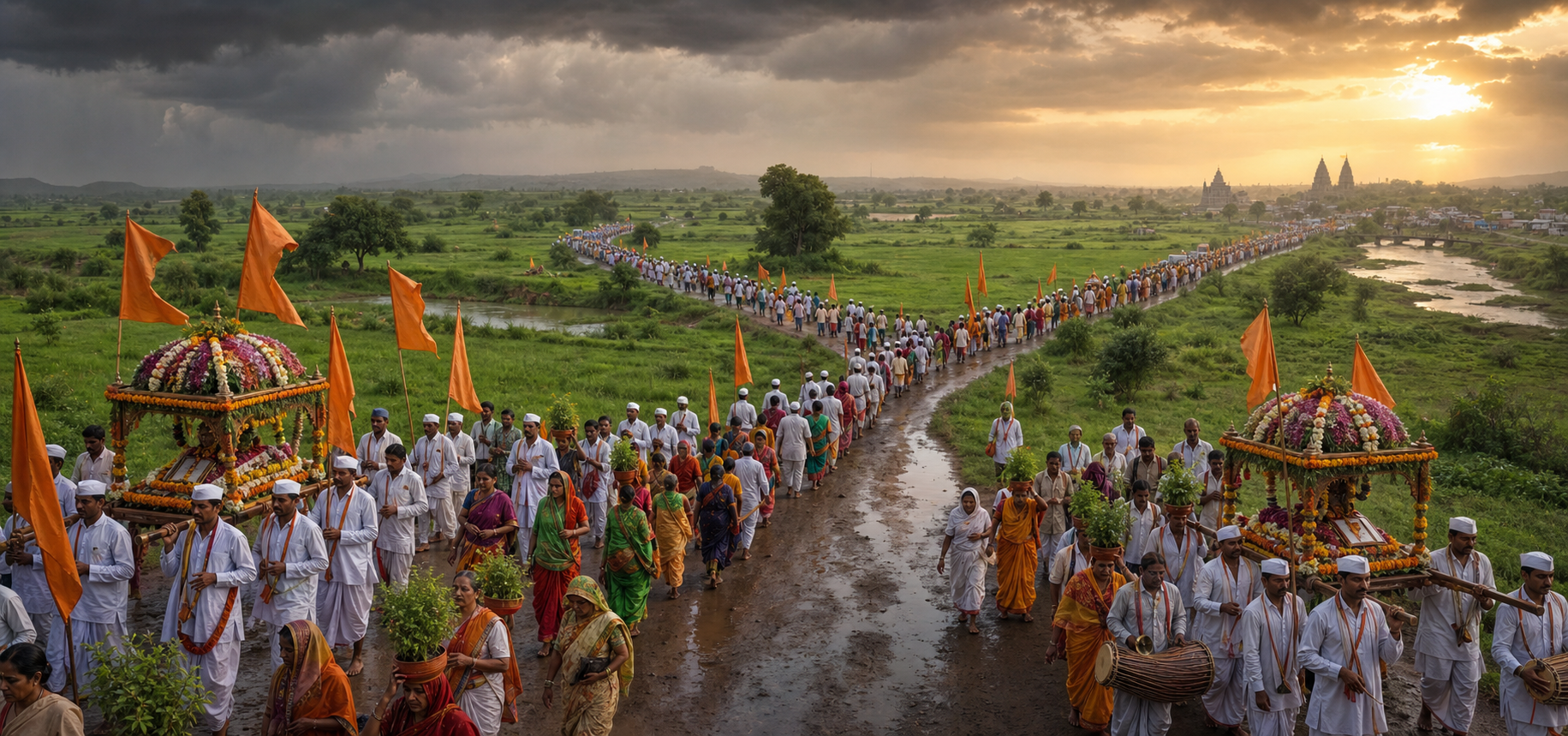
Two saint-centered processions offer a useful way to understand the Varkari pilgrimage season in 2026. The account of Sant Muktabai’s palkhi follows a devotional line from Muktainagar, while the account of Sant Eknath Maharaj’s palkhi begins with Paithan. Both orient the journey toward Pandharpur and Ashadhi Ekadashi.
Read together, the accounts explain more than two routes. They show how the Wari joins distinct saintly legacies through paduka worship, disciplined group travel, devotional music and public service. They also reveal an important limit for prospective pilgrims: a reported festival date is not the same as a confirmed procession timetable.
Different starting points converge on Pandharpur
The two reports present the Wari as a network rather than a single procession. Each palkhi carries the sacred sandals of a particular saint from a landscape associated with that saint, but both journeys culminate in devotion to Vithoba at Pandharpur. This allows local religious memory to remain distinctive while participating in a shared Varkari horizon.
| Procession | Reported point of origin | Saintly legacy emphasized by the source | Shared orientation |
|---|---|---|---|
| Sant Muktabai Palkhi | Muktainagar | Muktabai as a saint-poet, the younger sister of Sant Dnyaneshwar, and a voice of spiritual maturity and inclusive devotion | Pandharpur for Ashadhi Ekadashi |
| Sant Eknath Maharaj Palkhi | Paithan | Eknath as a saint, philosopher and poet who helped make sacred teaching accessible through Marathi works | Pandharpur for Ashadhi Ekadashi |
The Muktabai account connects Muktainagar with northern Maharashtra’s participation in the wider Wari. The Eknath account connects Paithan, Eknath’s samadhi setting on the Godavari, with the devotional culture of Pandharpur. These are therefore not interchangeable departures. Each procession carries a regional history and a particular way of remembering spiritual authority.
Key takeaways
- The supplied reports describe two distinct saint-centered pilgrimages within the wider Ashadhi Wari, not a complete calendar of every 2026 palkhi.
- Both articles report Ashadhi Ekadashi on July 25, 2026, but neither supplies a final, officially confirmed halt-by-halt schedule.
- The common structure includes sacred padukas, organized dindis, collective singing, walking discipline and service to fellow pilgrims.
- Muktabai’s procession foregrounds a woman saint’s philosophical authority, while Eknath’s highlights the relationship between learning, Marathi literature and accessible devotion.
The palkhi is a moving institution, not just a vehicle
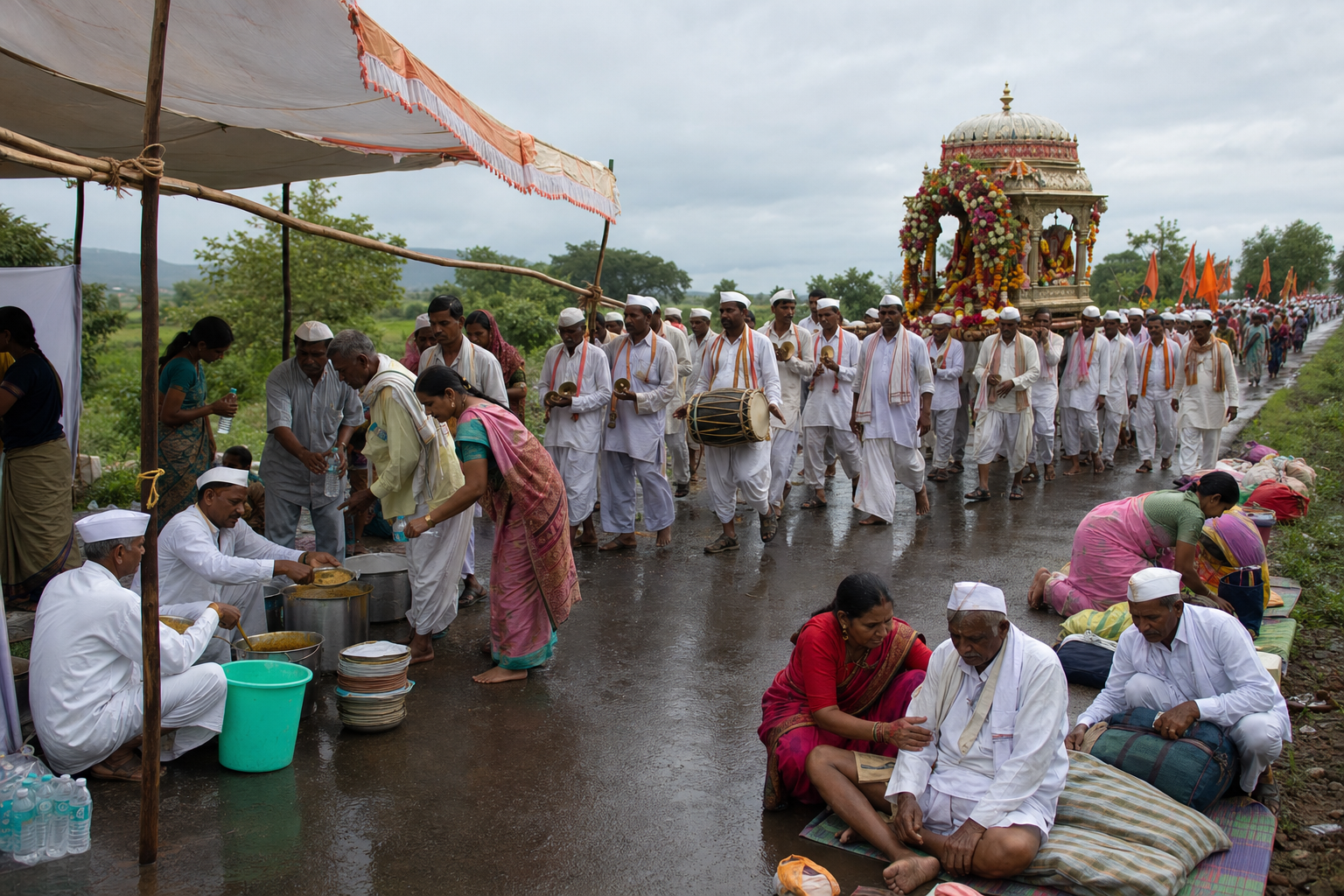
Both sources explain the palkhi through the presence of the saint’s padukas. In their devotional interpretation, the sandals represent guidance, surrender and the continuing presence of the saint. Carrying them through villages, fields and public roads brings sacred memory out of a fixed shrine and into ordinary social space.
The dindi gives that movement an organized human form. The reports describe dindis as disciplined pilgrim groups that coordinate walking order, devotional singing, food, rest and mutual assistance. Tal, mridang, flags, chanting and abhangs create a recognizable collective rhythm, but the music also has an inward purpose: repeated remembrance helps align bodily effort, attention and devotion.
This structure explains how the Wari can be both intimate and large in scale. A pilgrim belongs to a manageable group, while that group participates in a much wider convergence. Hospitality along the way extends the same pattern beyond registered walkers. Villages, volunteers and devotional associations can turn water, meals, resting space and assistance into forms of seva.
The sources also acknowledge the civic framework supporting the sacred journey. The Eknath article names local administrations, police, health workers, sanitation teams, temple bodies and volunteers as contributors to the procession’s continuity. The Muktabai article similarly directs readers to religious institutions and district authorities for final arrangements. Their combined picture is clear: devotion supplies the purpose, while coordination makes collective participation possible.
What the sources establish about the 2026 season
Both companion articles report July 25, 2026, as the date of Ashadhi Ekadashi, also identified in the sources as Devshayani or Shayani Ekadashi. Agreement between two articles from the same publication is useful, but it should not be treated as independent official confirmation. The Eknath report places the broader Wari season in July and refers contextually to the better-known Dehu and Alandi palkhis; the supplied material does not provide enough verified detail to construct a comprehensive 2026 calendar from those references.
More importantly, neither article presents a final departure time, daily route plan or complete list of halts for the Muktabai and Eknath processions. Both advise participants to confirm details closer to travel through the relevant sansthan, local authorities and official Wari coordination channels. Traffic changes, medical arrangements, access instructions and local timing should likewise be treated as unsettled until those bodies publish or confirm them.
The practical advice is therefore best read as preparation guidance rather than an official directive. The Eknath account anticipates July heat, humidity and monsoon rain, recommending attention to hydration, suitable clothing, footwear, identification and basic medicines. It also suggests that families walking with children or older people consider shorter segments when the complete journey is not physically appropriate. Individual fasting practice, it adds, should be balanced with health and medical need.
Two saintly legacies broaden the meaning of participation
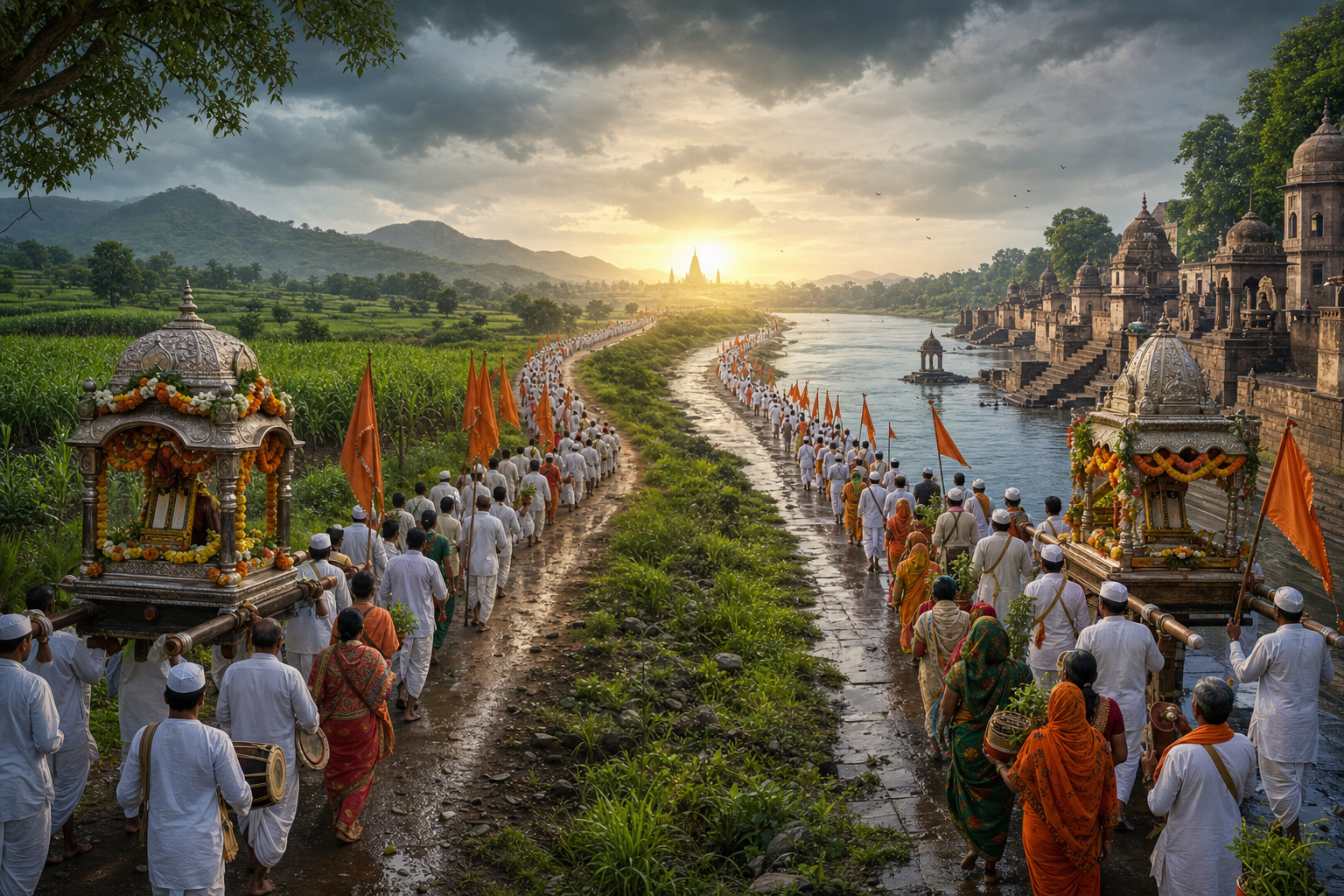
The Muktabai article interprets the procession through the saint’s wisdom, compassion and spiritual steadiness. It gives particular weight to her position as a woman saint and argues that her remembered authority cannot be reduced to her relationship with Sant Dnyaneshwar. In that account, walking with Muktabai’s padukas also preserves a philosophical voice associated with humility, inner clarity and an inclusive understanding of devotion.
The Eknath article places a different emphasis on transmission. It describes Sant Eknath as a sixteenth-century thinker and poet whose Eknathi Bhagavata and Bhavarth Ramayan helped bring sacred ideas into Marathi literary and household life. His palkhi consequently represents not only remembrance of a saint but also the movement of religious learning beyond narrowly scholarly settings.
Together, these portraits resist a flattened idea of the Wari. Muktabai’s memory highlights insight that transcends age, gender and institutional status; Eknath’s highlights the connection between learning, ethical conduct and accessibility. Their processions meet at the level of practice: singing, walking, waiting, serving and accepting inconvenience alongside others.
Both articles extend that practice into a social ethic. They describe the Wari as a setting in which farmers, workers, householders, scholars, elders and younger devotees can share one devotional rhythm. Equality in this context is not presented as an abstract slogan. It is rehearsed through common discipline, shared space and responsibility for fellow travelers, even though the sources do not claim that pilgrimage eliminates every social difference.
Joining the Wari with informed expectations
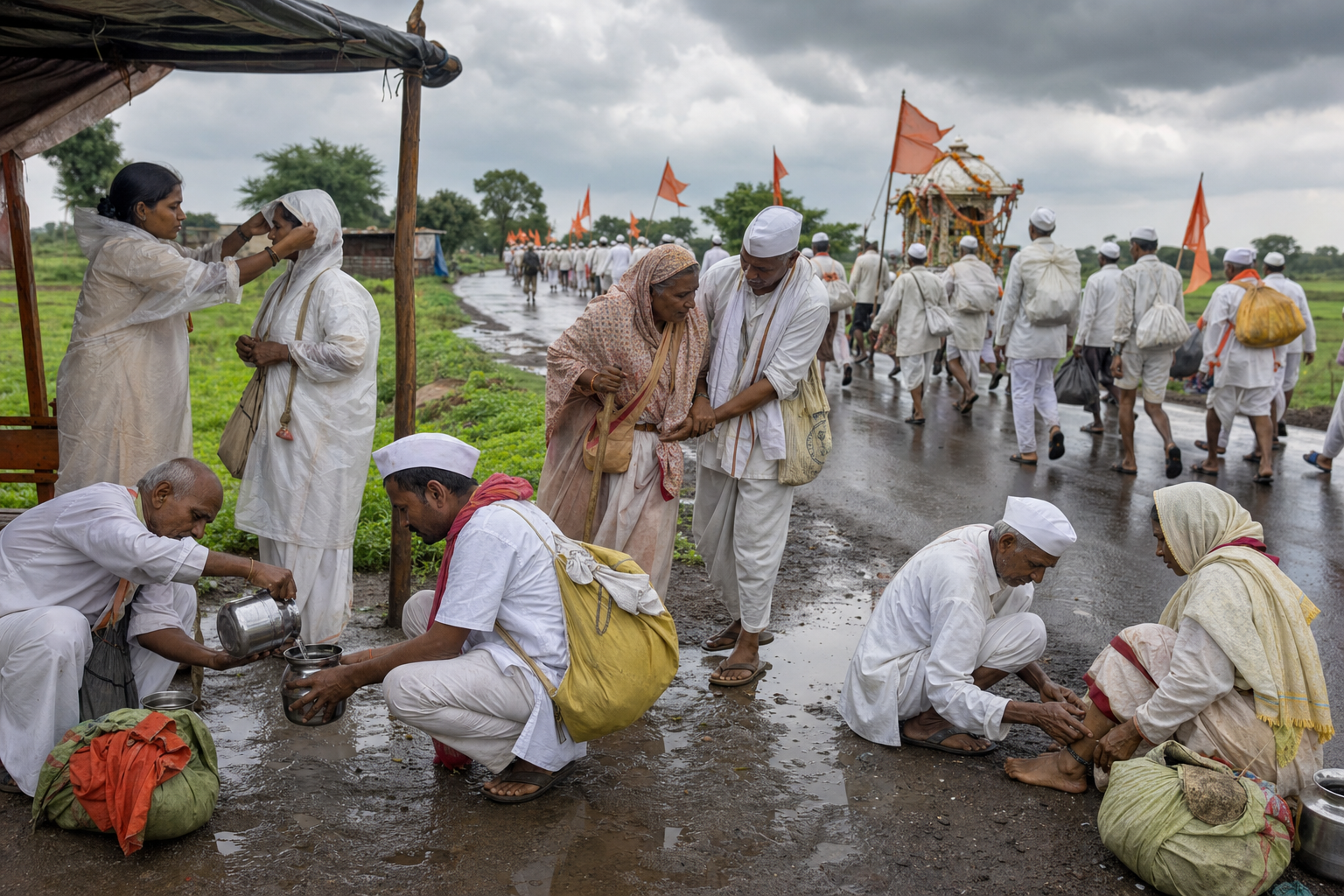
A prospective participant can use these accounts to choose a saintly and regional connection, understand the function of a dindi, and prepare for the physical demands of a monsoon-season walk. The articles cannot yet be used as final travel documents. Joining responsibly requires a current schedule from the relevant organizers, attention to administrative instructions and a realistic assessment of health and walking capacity.
The same distinction matters for observers and readers. The palkhi should not be viewed merely as colorful spectacle or mass movement. Within the sources’ Varkari framework, abhangs function as carried teaching, padukas as sacred presence, dindi order as devotional discipline and hospitality as worship expressed through service.
As the 2026 arrangements are finalized, the most useful next step is to follow official route and safety notices while retaining this larger perspective: each local procession contributes a different saintly voice to the shared journey toward Pandharpur.
References
- DharmaRenaissance Blog — Sant Muktabai Palkhi Sohala 2026: Powerful Wari Guide to Faith and Unity
- DharmaRenaissance Blog — Sant Eknath Maharaj Palkhi 2026: Powerful Wari Guide from Paithan to Pandharpur