
Living Hindu tradition is easily misunderstood when a temple is viewed only as architecture or a ritual rule is detached from the world that gives it meaning. One source examines Lingaraj Temple as a continuously worshipped sacred complex; the other surveys observances that connect menstruation, fertility, the earth, and divine feminine power.
Read together, the sources reveal a shared religious grammar. Sacred life is sustained by relationships among place, body, season, community, and disciplined action. Sometimes those relationships are expressed through movement toward a sanctum; at other times, through a deliberate pause that protects a period of transformation.
When place and cycle become sacred
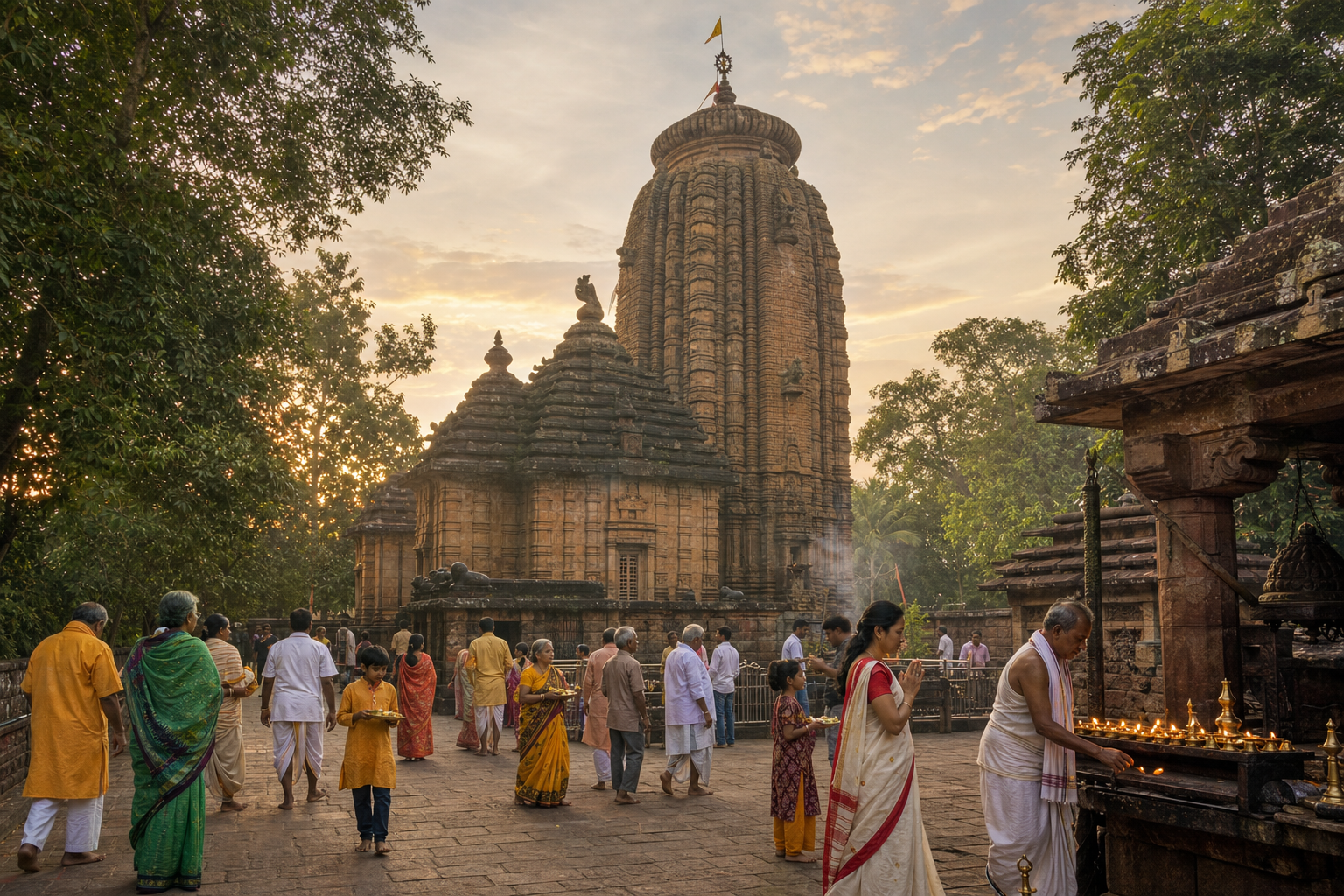
The account of Lingaraj Temple presents sacredness as inseparable from geography. Bhubaneswar’s traditional identity as Ekamra Kshetra connects the shrine with the memory of a mango grove and the belief that Shiva manifested beneath a sacred mango tree. The article describes the presiding Shivalinga as Swayambhu: a self-manifested, naturally present stone resting on a Sakti, rather than an ordinary sculpted image.
This understanding of place extends beyond the sanctum. According to the Lingaraj article, the present temple is generally dated to the late eleventh century, although worship at the site or elements of an earlier complex may reach back to the sixth or seventh century. It reports an approximately 180-foot tower, a walled courtyard containing around 150 smaller shrines, and an axial sequence of four principal structures: the vimana, jagamohana, natamandira, and bhoga-mandapa. The arrangement carries worshippers from more public spaces toward the concentrated presence of the sanctum.
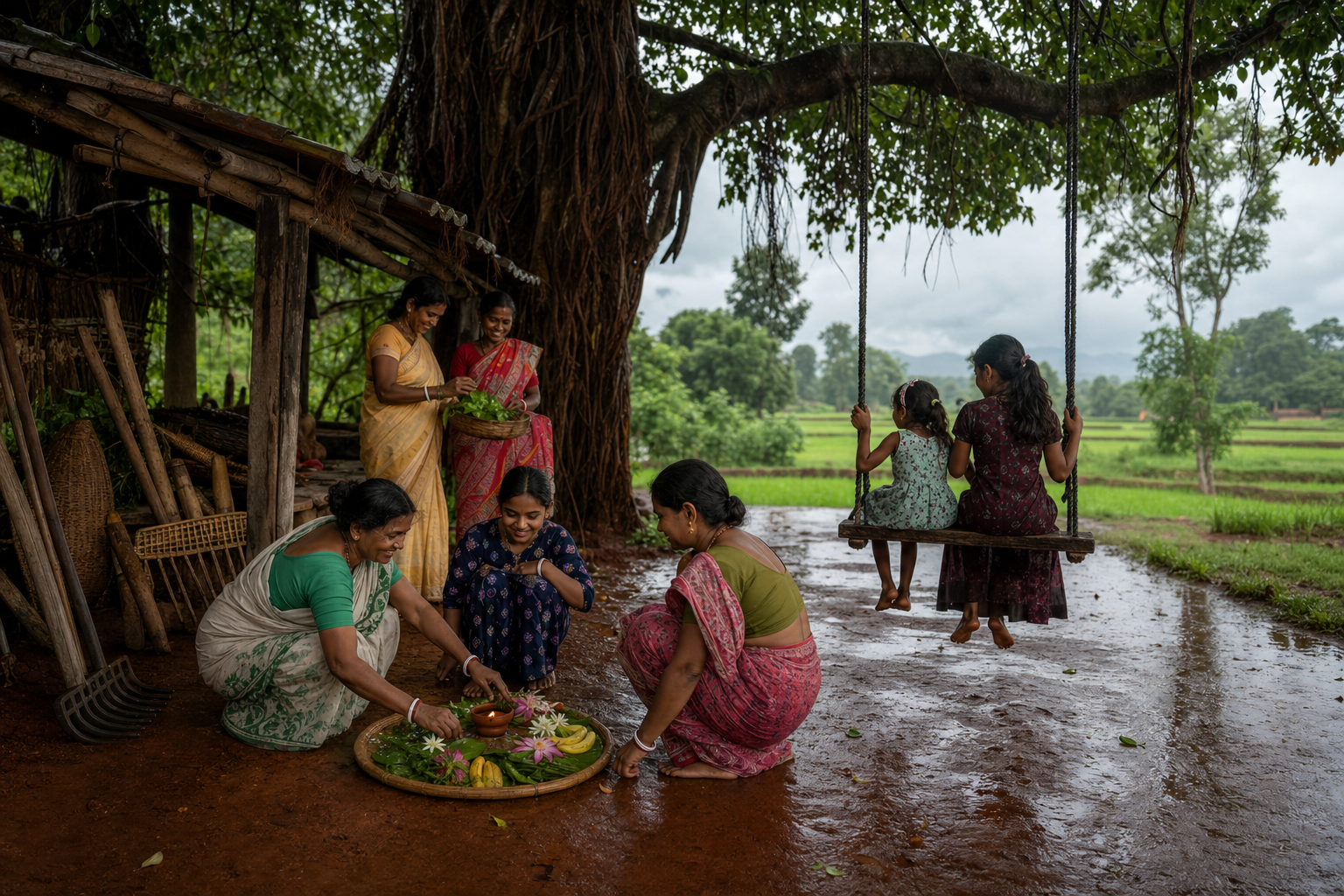
The survey of menstrual traditions describes another way of consecrating experience: sacred time. At Kamakhya Temple, Ambubachi marks the understood menstruation of Devi Kamakhya. The temple closes for three days, ordinary worship pauses, and the reopening on the fourth day becomes an occasion of celebration. At Odisha’s Raja Parba, the menstrual cycle of Bhu-Devi is associated with the monsoon and a suspension of agricultural work. Chengannur’s Thripputhu gives the temple Devi a period of seclusion and a ceremonial bath, while the Tulu observance of Keddasa gives Mother Earth a period of rest.
The comparison is instructive. Lingaraj’s architecture orders movement through space, while these observances order restraint and renewal through time. In both cases, sacredness emerges through an enacted relationship rather than through an object or belief considered in isolation.
Ritual life alternates between approach and pause
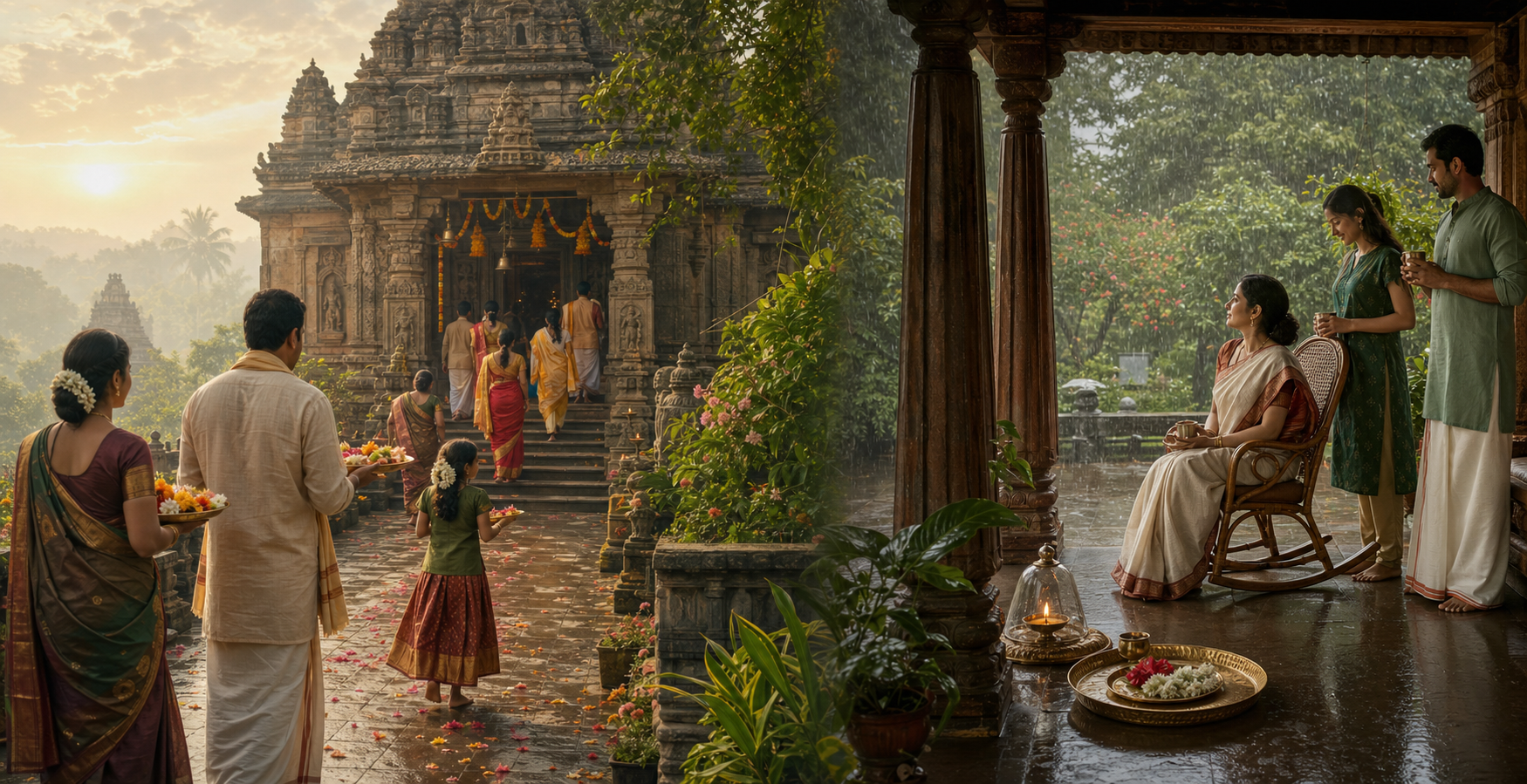
The Lingaraj complex, as described by its source article, accommodates several forms of participation. The jagamohana provides an assembly space, the natamandira reflects the historical place of music, dance, and festival performance, and the bhoga-mandapa is associated with offerings. Together with the sanctum and subsidiary shrines, these spaces show that temple worship includes gathering, artistic expression, food offerings, and inward movement toward the deity.
The menstrual observances emphasize a complementary discipline: knowing when not to proceed. Ambubachi suspends ordinary access to Kamakhya’s sanctum. The source reports that devotees subsequently receive red cloth and sacred water associated with the period of seclusion as prasad. Raja Parba temporarily halts work upon the earth before Vasumati Snana ceremonially marks Mother Earth’s bathing. During Keddasa, the account says that tilling, cutting trees, digging wells, and other forms of disturbing the soil are avoided.
These practices complicate any automatic equation between ritual separation and rejection. The source on menstrual traditions argues that separation can signify intensity, vulnerability, transition, protection, or rest. A closed sanctum may itself carry ritual meaning; a prohibition on ploughing may express reverence for the land rather than hostility toward it.
That interpretation should not be romanticized. The same source acknowledges that some menstrual customs have caused discomfort, exclusion, or stigma, particularly when symbolic discipline hardened into social judgement. Context therefore matters: the formal meaning of a practice, the explanations offered by its custodians, and the experiences of the people subject to it may not always coincide. A responsible reading must consider all three.
Continuity does not require uniformity
Lingaraj Temple illustrates plurality within a single sacred institution. Although Shiva is worshipped there as Lingaraj, the source emphasizes the temple’s Harihara character, in which Shaiva and Vaishnava devotional currents meet. It describes growing Vaishnava influence in Odisha under the Ganga dynasty as an additional layer rather than a replacement of the shrine’s Shaiva foundation. The resulting tradition preserves distinction while expressing a wider unity.
The second source finds a comparable pattern across regions, but it does not claim that every observance has one origin or identical theology. Kamakhya’s Ambubachi belongs to a major Shakta and Tantric centre in Assam. Raja Parba is a public and seasonal celebration in Odisha. Thripputhu operates through Kerala temple procedures, while Keddasa belongs to the agrarian ritual life of Tulu-speaking communities in coastal Karnataka. The article also reports regionally varied ceremonies that acknowledge menarche through blessings, clothing, food, and family participation.
The common thread is therefore not a standardized ceremony. It is a recurring capacity to place embodiment, fertility, transition, and renewal within a sacred framework. Local communities give that framework different myths, ritual authorities, foods, songs, spaces, and forms of participation.
This distinction guards against two errors. Treating all Hindu practice as a single unchanging system erases regional and sectarian particularity. Treating every local variation as wholly disconnected obscures the shared concepts that allow traditions to recognize relationships among Shakti, Bhumi, fertility, restraint, and regeneration. Living continuity occupies the space between those extremes.
Sacred ecology is preserved through social memory
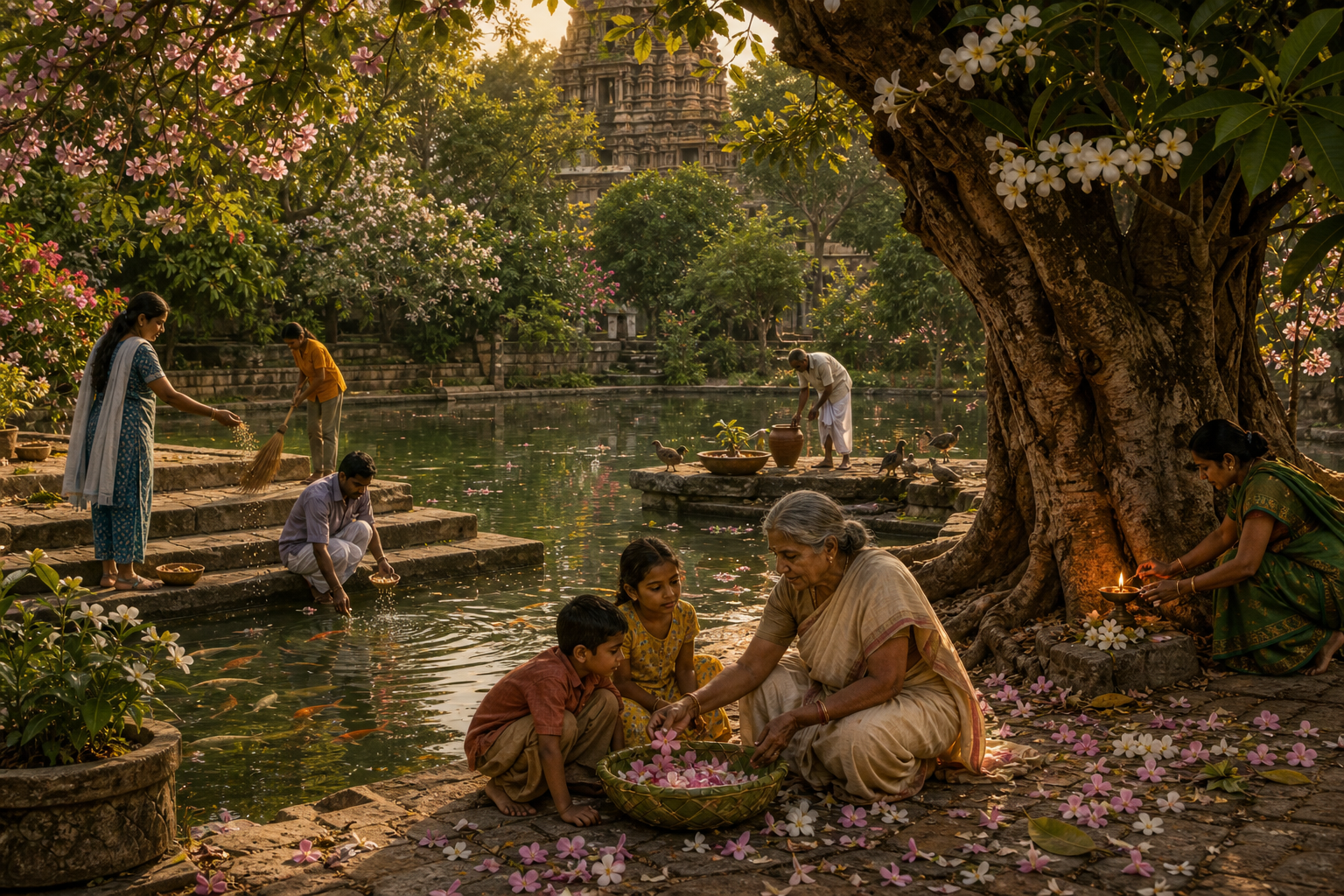
Both sources connect religious practice with the material world. The Lingaraj article situates the temple within memories of grove, water, city, procession, and worship. The menstrual-traditions survey connects the body of the Devi with the body of the earth: Ambubachi is linked with restraint from ploughing in parts of the Brahmaputra valley, Raja Parba joins the monsoon with the rest of Bhu-Devi, and Keddasa suspends activities that break or disturb the soil.
This is an ecological imagination expressed through ritual analogy, not a technical environmental programme. Land is addressed as a living presence to which people owe periods of restraint. The analogy between earth and body turns non-interference into a positive religious act: refraining from work can become as meaningful as making an offering.
Social memory gives such ideas durability. The Raja Parba account points to swings, songs, seasonal food, new clothing, and family gatherings as ways the festival becomes emotionally visible. At Lingaraj, architectural spaces and recurring worship preserve memory in stone and practice. The temple article also reports inscriptions recording royal patronage, including gifts of gold coins in 1172 CE, offerings of betel leaves, and grants connected with nearby village communities. Such details show how sacred continuity can be supported by artistic, economic, and civic relationships as well as devotional conviction.
Architecture and festival can thus function as complementary forms of cultural memory. A temple gives recurring practice a durable spatial centre; a seasonal observance renews meaning through repetition in households, fields, and community life. Neither works by preservation alone. Each depends on people continuing to interpret, perform, and transmit what the inherited forms signify.
Key takeaways
- Living sacred traditions are sustained through repeated relationships among deity, place, body, season, and community.
- Temple approach and ritual pause are complementary disciplines: one organizes movement toward sacred presence, while the other marks rest, intensity, or transition.
- Shared concepts do not erase local difference. Harihara worship at Lingaraj and regionally distinct menstrual observances both demonstrate continuity without complete uniformity.
- Ritual boundaries require contextual interpretation because a practice can carry a sacred meaning while still being experienced as burdensome when converted into social stigma.
- Sacred ecology appears as reciprocal restraint, especially where the earth is treated as a living mother rather than merely as a resource.
Reading living traditions with greater care
A useful interpretation begins by asking what a practice means within its own ritual setting, who carries it forward, how participants experience it, and how it has changed over time. Archaeological description alone cannot explain a worshipped temple, just as a rule stated without its seasonal and theological setting cannot explain a festival.
The two source articles also indicate why neither celebration nor criticism is sufficient by itself. Sacred traditions can preserve sophisticated ideas about plurality, embodiment, and restraint while remaining open to questions about exclusion and lived experience. Their vitality lies partly in this continuing work of interpretation.
Future documentation can deepen that understanding by keeping ritual specialists, devotees, women, families, craftspeople, and local communities within the same field of view. Living tradition will be understood most clearly where inherited meaning and present experience are allowed to speak to one another.
References
- DharmaRenaissance Blog – Lingaraj Temple Bhubaneswar: Powerful History, Sacred Architecture, and Living Faith
- DharmaRenaissance Blog – Sacred Cycles of Shakti: How Bharat Honors Menstruation With Reverence