
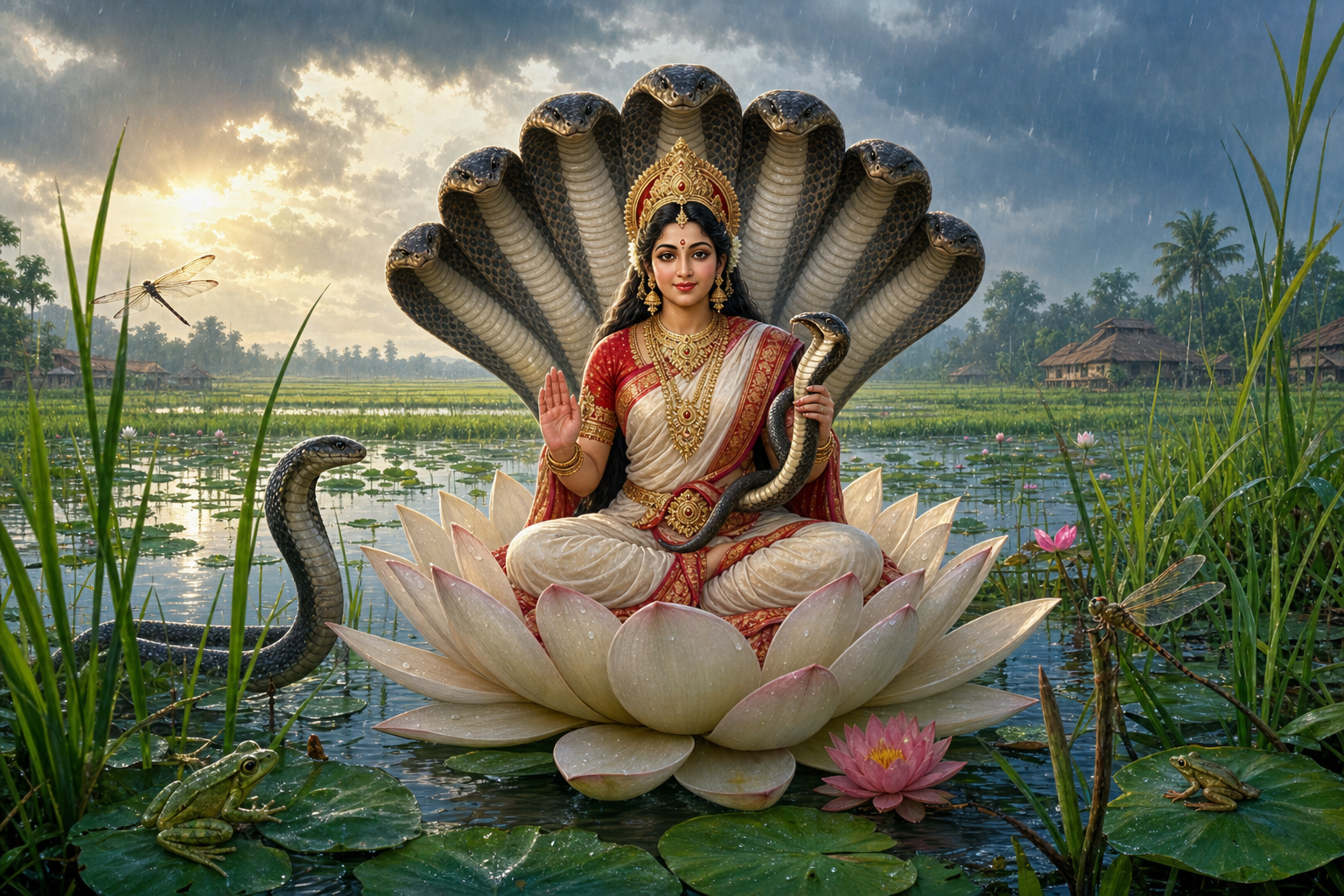
Goddess Manasa stands where several human concerns meet: fear of snakebite, dependence on fertile landscapes, hope for family continuity, and reverence for powers that cannot be fully controlled. The DharmaRenaissance account presents her worship not simply as an attempt to avert danger, but as a religious language for living within a world shared with dangerous and necessary forms of life.
Viewed together, Manasa’s names, narratives, images, and seasonal observances reveal a consistent movement from fear toward relationship. They also show how a goddess rooted in eastern Indian devotional culture can be understood as a maternal form of Shakti, a guardian of households, and a figure of moral restraint.
Key takeaways
- Manasa worship joins practical vulnerability to snakebite with a broader ethic of respect for the natural world.
- The title Jagadgauri interprets Manasa as an auspicious, radiant power whose significance extends beyond a narrowly regional identity.
- Her differing sacred genealogies show how communities connected a local goddess with wider Hindu narrative traditions.
- The stories of Astika and Behula place serpent worship within two moral settings: restraint in the face of collective vengeance and perseverance in the face of personal grief.
- Her serpent canopy, lotus, protective role, and associations with fertility unite danger, renewal, sovereignty, and maternal care.
Why the feared serpent becomes a sacred relationship
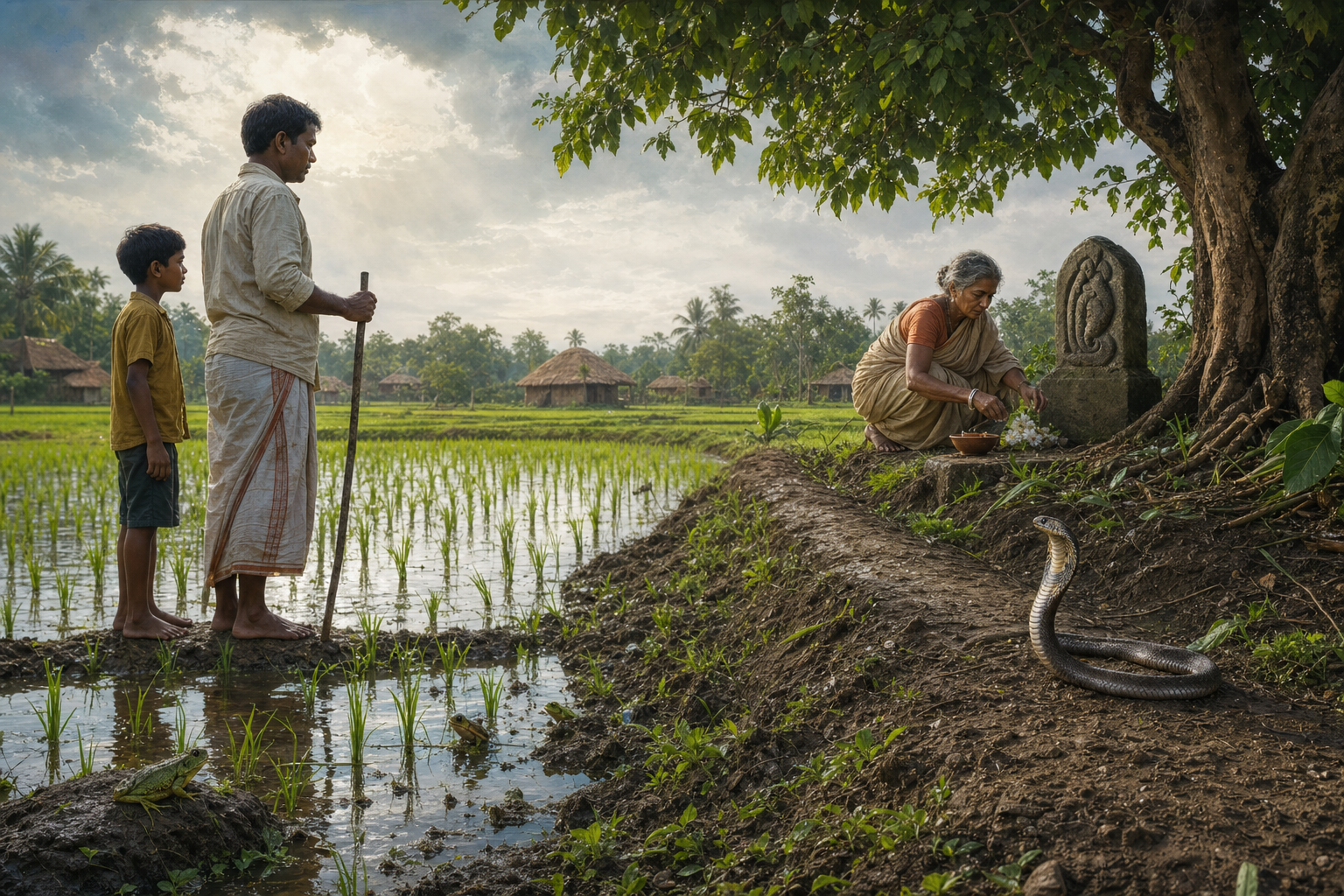
The DharmaRenaissance source situates Manasa’s devotion especially in Bengal, Assam, Odisha, Bihar, Jharkhand, parts of Bangladesh, and other eastern regions shaped by agrarian and riverine life. It describes fields, ponds, granaries, village paths, and monsoon-soaked courtyards as places where encounters with snakes could become part of ordinary experience. Protection from snakebite and the healing of poison therefore belong to the immediate setting of her worship.
That setting helps explain why the serpent is neither treated as harmless nor reduced to an embodiment of evil. It remains dangerous, yet it also belongs to the ecological order on which human communities depend. Ritual offers a way to acknowledge both truths without erasing either one. Fear is given a disciplined form, while the nonhuman world is approached with humility rather than an assumption of complete mastery.
This is the deeper logic behind Manasa’s protective character. The goddess does not make danger unreal; she makes a relationship with danger imaginable. Serpent worship consequently becomes less a celebration of threat than an admission of vulnerability and interdependence. The source’s association of Manasa with fertility, children, household welfare, and agricultural prosperity widens that relationship further: the deity who guards against death also protects the continuity of life.
Jagadgauri and the passage from locality to universality

The source interprets Jagadgauri through jagat, the world or moving universe, and Gauri, a name associated with radiance, auspiciousness, purity, and the Divine Mother. Applied to Manasa, the title can be understood as the radiant or auspicious Gauri of the universe. This interpretation does not discard her regional identity. Instead, it treats the local encounter with snakes, poison, rain, fertility, and healing as an entry into a larger theology of Shakti.
Her sacred genealogies perform a similar work. According to the DharmaRenaissance account, some narratives describe Manasa as the mind-born daughter of Shiva, while other traditions associate her with the sage Kashyapa and connect her to the serpent lineage through the Naga king Vasuki. She is also remembered as the wife of the sage Jaratkaru and the mother of Astika. These accounts need not be forced into a single modern-style biography. Their variation records the different ways communities placed Manasa within a wider sacred history.
Jagadgauri therefore names a theological expansion rather than a rejection of folk devotion. Manasa remains close to fields, households, illness, and seasonal danger, yet those concerns become expressions of a universal maternal power. Her radiance lies in revealing order within what initially appears threatening: poison and healing, fear and reverence, mortality and renewal are held together rather than divided into separate worlds.
Astika and Behula offer two scales of moral restoration

Two narratives highlighted by the source clarify Manasa’s ethical importance. In the Mahabharata tradition as summarized there, King Janamejaya begins a great serpent sacrifice after his father Parikshit dies from a bite by Takshaka. When the rite threatens the destruction of the serpent race, Astika intervenes and stops it through wisdom and restraint. Because Astika belongs to the lineage associated with Manasa, the goddess becomes connected with the restoration of dharma when vengeance has exceeded justice.
The Manasamangal cycle approaches restoration through the household rather than the royal arena. The source describes the conflict between Manasa and Chand Saudagar, a wealthy merchant and devotee of Shiva who resists worshipping her. After Chand’s son Lakhindar dies from a serpent bite on his wedding night, Behula undertakes a difficult journey shaped by grief, fidelity, endurance, and the hope of restoring life. Her perseverance eventually contributes to both restoration and recognition of the goddess’s power.
Read side by side, Astika and Behula answer different forms of excess. Astika checks public vengeance before it destroys an entire order of beings; Behula refuses to let private grief end in helplessness. One story is concerned with restraint, the other with steadfast action. Together they prevent Manasa worship from being reduced to fear of punishment. Her narrative world also asks how balance can be recovered after anger, refusal, loss, or death has ruptured it.
Images and observances turn theology into lived memory
The source reports that Manasa may be shown seated on a lotus, accompanied by serpents, or sheltered beneath a serpent canopy. She can also appear with a child, a pot, a lotus, or other auspicious emblems. The canopy communicates authority over the Naga realm and poison, while also functioning as shelter. The lotus associates purity with difficult conditions. In one visual field, danger becomes protection and mastery becomes maternal care.
Serpents add another layer through their association with renewal and cyclical vitality, symbolized by the shedding of skin. When this imagery is placed beside Manasa’s links to fertility and family welfare, protection means more than surviving an immediate threat. It includes regeneration, continuity, and the capacity of life to proceed through recurring periods of danger and change.
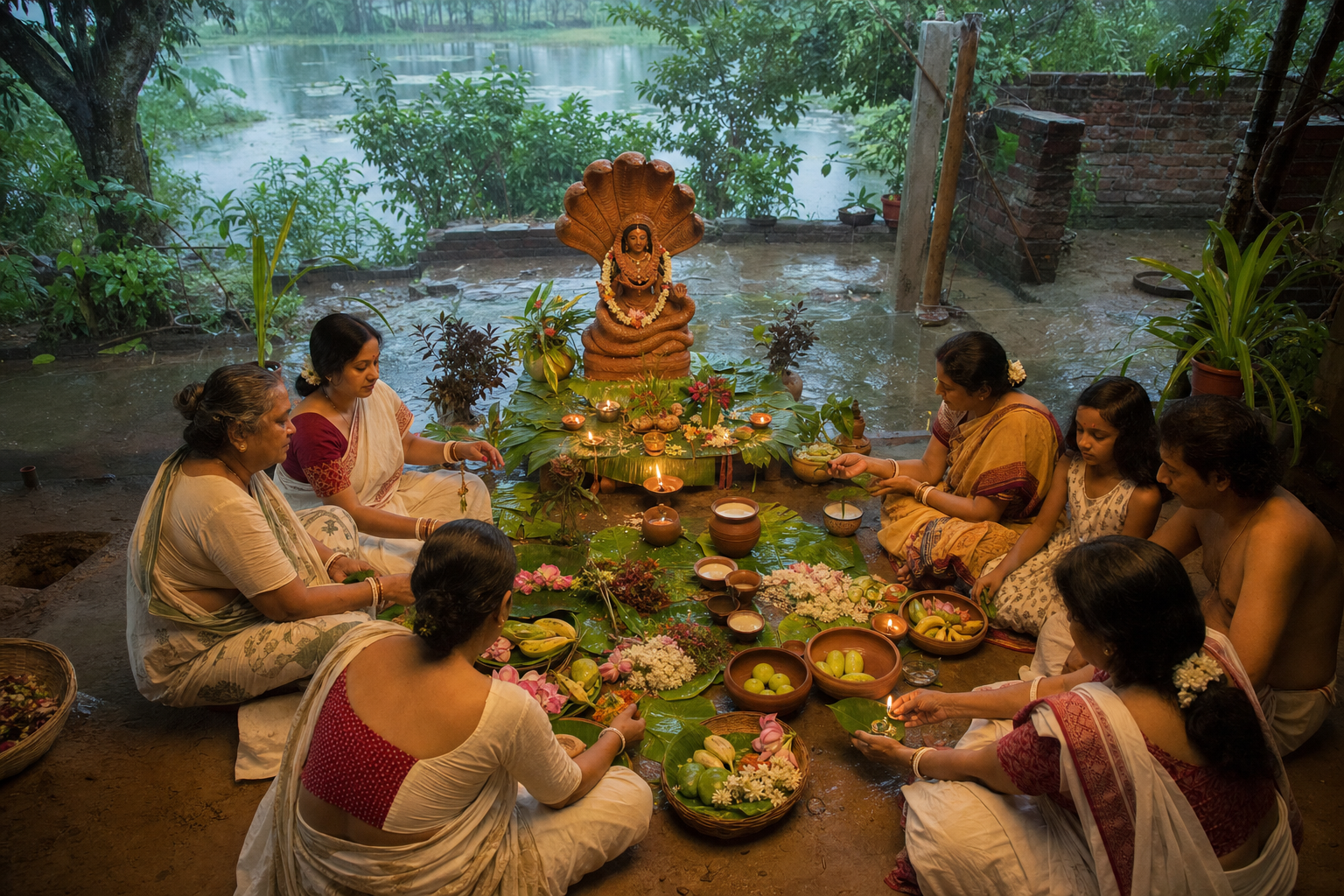
The DharmaRenaissance account also connects Manasa’s worship with the monsoon, when snakes become more visible and agricultural activity intensifies. Seasonal offerings, images, songs, and vows bring ecological conditions into ritual time. Literature, iconography, and observance thus reinforce one another: stories give suffering a moral shape, images make the goddess’s paradoxes visible, and worship places those meanings within the changing year.
As landscapes and patterns of life change, Manasa’s tradition can continue to invite reflection on coexistence rather than domination. Its enduring question is how human beings might respond to dangerous forms of life with practical caution, moral restraint, and recognition that vulnerability does not cancel sacred relationship.