
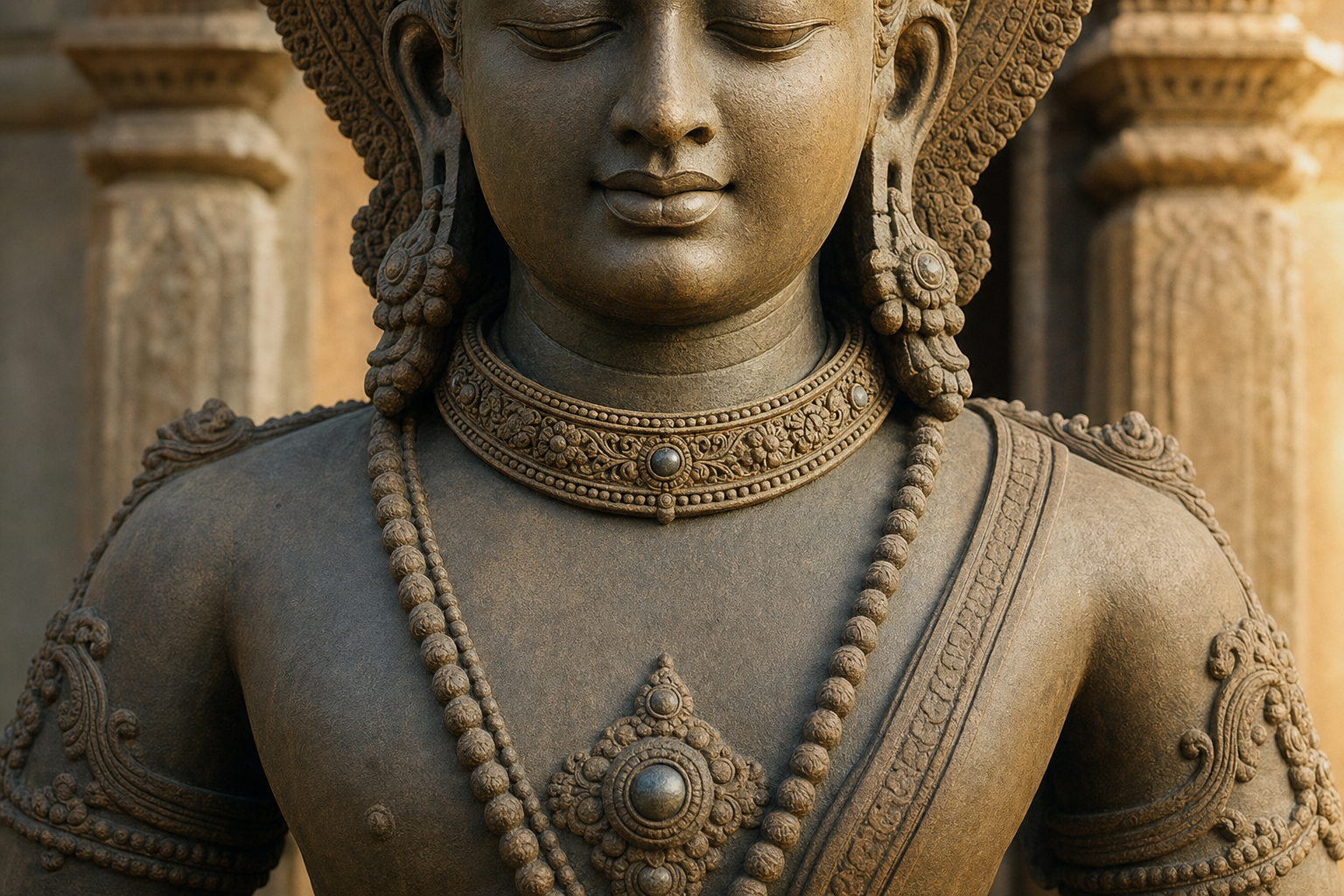
Graiveyaka in Hindu sculpture is one of those small details that quietly changes the way a sacred image is read. At first glance, the eye may move toward the face, the mudra, the weapon, the crown, or the halo of a deity. Yet the close-fitting ornament at the base of the throat often carries its own visual and theological weight. The graiveyaka is not merely decorative jewelry. It marks the griva, the neck or throat region, and helps frame the sacred body as a disciplined, luminous, and ritually complete form.
The term graiveyaka is derived from the Sanskrit griva, meaning the neck or throat. In the language of Hindu art and iconography, this matters because ornaments are rarely placed randomly. Classical sculpture treats the divine body as an ordered field, where the head, throat, chest, waist, arms, hands, and feet each carry specific symbolic emphasis. The graiveyaka belongs to the throat zone, and its close position distinguishes it from longer necklaces such as the ekavali, dama, and hara, which fall over the chest and participate in a different visual grammar.
In practical terms, the graiveyaka may be understood as a collar, choker, or tight neck ornament. It sits high and close, often at the base of the throat, rather than dropping freely across the torso. This distinction is important for identifying Hindu sculptures because sacred figures frequently wear multiple ornaments at once. A deity may have a graiveyaka at the throat, a longer hara across the chest, armlets on the upper arms, bracelets at the wrists, anklets at the feet, and a crown above the head. Each layer reinforces hierarchy, beauty, and divine presence.
The graiveyaka is especially meaningful because the throat is a charged region in Hindu thought. It is associated with voice, mantra, breath, authority, and the passage between the head and the heart. A throat ornament therefore does more than beautify the image. It visually emphasizes the point where speech becomes sacred utterance and where the inner life of the deity is expressed outward through blessing, command, song, teaching, or cosmic sound. In this sense, the graiveyaka can be read as a sculptural sign of controlled power.
For students of Hindu iconography, the ornament also gives a useful lesson in how Indian temple sculpture should be studied. The most obvious symbols are not always the only meaningful ones. Shiva may be recognized by the trishula, matted locks, crescent moon, third eye, or serpent. Vishnu may be recognized by the shankha, chakra, gada, padma, kirita, and calm royal bearing. Devi may be recognized by her weapons, lion, lotus, or gesture of protection. Yet the ornaments around the throat, chest, and limbs help complete the identity, mood, and rank of the sacred form.
The graiveyaka also belongs to the larger history of Indian jewelry and sacred adornment. In ordinary human life, jewelry communicates status, prosperity, lineage, celebration, protection, and aesthetic refinement. In sacred art, these meanings are elevated. The ornaments of a murti are not only signs of wealth. They indicate auspiciousness, divine embodiment, royal sovereignty, and ritual fitness. The image is not presented as a bare anatomical body, but as a consecrated body made worthy of darshan through proportion, posture, ornament, and symbolic completeness.
This is why the graiveyaka appears naturally in discussions of Hindu Sculptures, Temple Architecture, Hindu Art and Culture, and Iconography. It belongs at the intersection of art history, Sanskrit terminology, ritual aesthetics, and theology. A sculptor carving a deity did not simply add jewelry as an afterthought. The body of the deity followed inherited rules of measurement, gesture, ornament, and sacred identity. The graiveyaka formed part of that precise visual system, even when regional styles altered its shape, thickness, decoration, or material appearance.
In many sculptures, the graiveyaka may appear as a simple band. In others, it may be beaded, tiered, gem-like, floral, rope-like, or made of repeated geometric units. Some examples resemble a smooth collar pressed gently against the throat, while others show a more elaborate arrangement with pendant-like elements. The exact form depends on period, region, sectarian context, available stone, metalworking conventions, and the skill of the artist. A Chola bronze, a Pallava relief, a Hoysala carving, and a North Indian stone image may treat the throat ornament differently while preserving the same basic placement.
South Indian temple sculpture often makes this visual richness especially clear. In Chola, Vijayanagara, Hoysala, Pallava, and later temple traditions, deities are covered with carefully rendered ornaments that echo both textual prescriptions and living temple practice. The graiveyaka in such contexts may harmonize with the broader decorative rhythm of the body. It can visually connect the face to the chest, soften the transition from chin to torso, and frame the upper body in a way that enhances the serenity, majesty, or dynamic energy of the image.
In images of Vishnu, the graiveyaka participates in a royal and cosmic vocabulary. Vishnu is often shown as the preserver, protector, and sovereign presence who sustains order. His ornaments, including neck ornaments, long garlands, chest jewels, and crown, affirm his status as the divine king. The graiveyaka at the throat, placed above the chest and below the face, helps articulate a body that is both humanly approachable and cosmically superior. It is part of the visual language through which the deity becomes both intimate and transcendent.
In images of Shiva, the meaning may shift according to form. Shiva can appear as an ascetic, teacher, dancer, lord of beings, householder, fierce protector, or cosmic principle. His throat is already theologically significant in the memory of Nilakantha, the blue-throated one who holds poison for the welfare of the worlds. A throat ornament in Shiva sculpture therefore invites careful attention. It may coexist with serpents, rudraksha-like forms, matted locks, or other ascetic signs, creating a layered tension between renunciation and ornamented divinity.
In images of Devi, the graiveyaka often supports the theology of shakti as radiance, sovereignty, beauty, and protective power. Goddesses are frequently adorned with rich jewelry because adornment is not treated as superficial luxury. It is a sign of auspicious fullness, creative abundance, and divine splendor. Whether the form is Lakshmi, Saraswati, Durga, Parvati, Lalita, or a regional goddess, the ornamented throat helps establish the deity as a living center of grace, knowledge, strength, or maternal presence.
The graiveyaka also helps viewers distinguish the visual levels of sacred adornment. A short throat collar is not the same as a long hara. A hara may hang across the chest and draw attention to the torso, the heart region, or a central jewel. An ekavali may appear as a single-strand necklace. A dama may suggest a garlanded or chain-like ornament. The graiveyaka remains close to the neck. Its importance lies precisely in that closeness, which makes it part of the expressive frame of the face and voice.
This technical distinction is useful when reading broken or weathered sculptures. In many temple sites and museum collections, hands, attributes, crowns, and faces may be damaged. Ornaments can then become important evidence. A surviving graiveyaka may help identify the posture, rank, or type of image, especially when studied alongside other features such as the sacred thread, waist belt, armlets, anklets, chest marks, pedestal, attendant figures, and remaining iconographic attributes. Small details can preserve information that larger elements have lost.
The throat ornament also contributes to the emotional experience of darshan. Sacred sculpture is not only read intellectually; it is encountered. A devotee or visitor standing before a murti often experiences the image through a gradual movement of attention: the eyes, the face, the hands, the chest, the feet, and the surrounding aura of ornament. The graiveyaka subtly holds attention near the face. It makes the throat region luminous and composed, suggesting a body that is not ordinary flesh but a sanctified and ritually awakened presence.
There is a broader philosophical reason why ornament matters in Hindu art. Classical Indian aesthetics does not sharply divide beauty from truth or decoration from meaning. Alankara, ornamentation, can intensify recognition. It can reveal rank, rasa, auspiciousness, and inner quality. A deity without ornament may communicate ascetic power, while a fully ornamented deity may communicate abundance and sovereignty. The graiveyaka belongs to this aesthetic world, where beauty is a disciplined language and not a random embellishment.
The same principle appears across Dharmic traditions. Hindu, Buddhist, Jain, and Sikh visual cultures differ in theology, practice, and historical development, yet they share a deep respect for disciplined form, sacred memory, and symbolic embodiment. Bodhisattva images in Buddhist art, Jina images with attendant symbolism in Jain art, and sacred objects in Sikh tradition all remind viewers that form can support devotion and understanding. The graiveyaka, while specifically discussed here in Hindu sculpture, belongs to a wider Indic sensitivity toward meaningful adornment.
This point is important for unity among Dharmic traditions. The study of ornaments should not become a narrow sectarian exercise. It should open a wider appreciation for how sacred communities use form, restraint, proportion, and beauty to point toward higher values. Hindu temples, Buddhist caves, Jain tirtha sites, and Sikh sacred spaces all preserve forms of visual discipline that help human beings remember dharma, humility, courage, compassion, and liberation. The graiveyaka is one small doorway into that larger civilizational conversation.
From an art historical perspective, the graiveyaka also reminds researchers to avoid flattening Indian sculpture into generalized ornament. Terms matter. When every necklace is simply called a necklace, the precision of the sculptural tradition disappears. Sanskrit and regional vocabularies preserve distinctions that correspond to placement, function, and visual effect. A graiveyaka, a hara, a keyura, a kundala, a mekhala, and a nupura each occupy different zones of the body. Together, they form a map of sacred embodiment.
The neck is especially important in this map because it mediates between the thinking head and the feeling heart. In yogic and symbolic language, the throat is associated with expression, purification, sound, and truthfulness. While not every sculpture should be forced into a later yogic chakra interpretation, the broader association between throat, voice, and sacred utterance is ancient and intuitive. The graiveyaka gains depth from this association. It visually crowns the place from which mantra, command, song, and teaching emerge.
The ornament can also be studied materially. In stone sculpture, the graiveyaka must be carved from the same block as the body, requiring the sculptor to suggest softness, weight, and preciousness through hard material. In bronze, especially in South Indian icons, the ornament may be cast as part of the body and then further detailed. In living temple practice, metal ornaments, flowers, cloth, and jewels may be added to the murti during worship. The sculpted graiveyaka and the ritual ornament then enter into a dynamic relationship.
This relationship between permanent sculpture and changing ritual adornment is one of the most beautiful features of Hindu temple culture. A stone or bronze image may already contain a carved graiveyaka, yet during festivals it may receive additional necklaces, garlands, silk, flowers, and jewels. The fixed iconographic form and the living ritual form do not compete. They enrich one another. The sculpted ornament preserves the grammar of the image, while the ritual ornament renews the relationship between deity and community.
The graiveyaka may also reveal social history. Royal patrons, temple donors, guilds, sculptors, and ritual specialists all contributed to the visual culture of sacred icons. Ornaments seen on gods and goddesses often echo elite jewelry traditions, while also transforming them into symbols of divine perfection. Kings wore collars and necklaces as marks of sovereignty; deities wore them as signs of cosmic sovereignty. Sacred art therefore reflects both earthly culture and its idealized transformation within dharma.
At the same time, the graiveyaka should not be reduced to royal display. Hindu iconography repeatedly turns material beauty into spiritual suggestion. Gold, gems, pearls, and carved ornament point toward brilliance, purity, auspiciousness, and fullness. Even when the image is carved in plain stone, the ornament tells the eye to imagine radiance. It teaches the viewer that divine beauty is not dependent on material wealth alone; it is communicated through proportion, order, devotion, and symbolic clarity.
For the modern viewer, the graiveyaka offers a practical method of looking more carefully. When visiting a temple, museum, cave shrine, or heritage site, one may begin by observing the face and hands, but then pause at the throat. Is there a tight collar? Is it plain or jeweled? Does it sit alone, or is it layered with longer necklaces? Does it frame a calm face, a fierce expression, a dancing posture, or a royal stance? Such questions transform viewing into study and study into reverence.
This careful looking also protects cultural heritage. Many sculptures are misidentified or poorly described because their details are not observed with patience. When viewers learn the vocabulary of Hindu Sculptures, they become better guardians of temples, museums, inscriptions, and local traditions. A word like graiveyaka may seem specialized, but it trains the eye to respect the intelligence of the tradition. It shows that ancient sculptors worked within a sophisticated system where even a narrow band at the throat could matter.
There is also a linguistic caution. The word graiveyaka appears in more than one Indic context. In Jain cosmology, Graiveyaka can refer to a class of heavenly realms. In the present discussion, however, the concern is the ornament connected with griva, the neck. This difference is not a contradiction but a reminder that Sanskrit terms often carry layered meanings across philosophical, ritual, cosmological, and artistic traditions. Context determines interpretation, and careful scholarship keeps these meanings distinct.
In temple sculpture, context is always decisive. A graiveyaka on a standing Vishnu image does not function in exactly the same way as a throat ornament on Nataraja, Durga, Surya, Ganesha, or a royal donor figure. The ornament may signal divinity, kingship, auspiciousness, youth, grace, wealth, or ritual completion depending on the surrounding attributes. The viewer must therefore read it as part of the full iconographic field, not as an isolated decorative object.
The graiveyaka can also help explain why Hindu sculpture often appears visually dense. To an untrained eye, the abundance of ornaments may seem excessive. To a trained eye, the abundance is ordered. The crown belongs to one zone, the earrings to another, the throat collar to another, the chest ornaments to another, the waist belt to another, and the anklets to another. This structure creates rhythm. The sacred body becomes a vertical composition of meaning from head to foot.
That vertical composition is central to the spiritual experience of Indian art. The eye rises and descends across the image, moving between transcendence and embodiment. The crown lifts attention upward; the face invites relationship; the graiveyaka stabilizes the throat; the chest ornaments draw attention toward vitality and compassion; the waist marks balance; the feet invite surrender. The ornament at the throat is therefore a point of visual pause, a stillness between the majesty of the head and the abundance of the torso.
In this way, the graiveyaka embodies a principle larger than itself: sacred detail is never trivial. Hindu art asks the viewer to slow down. It rewards attention. The more carefully one looks, the more the sculpture opens. What first appears as jewelry becomes theology, aesthetics, social memory, ritual practice, and philosophical suggestion. This is one reason Hindu temple art continues to speak across centuries, even when the original patrons, sculptors, and local dynasties are no longer present.
The ornament also has a subtle human resonance. People still understand the emotional force of something worn close to the throat: a family necklace, a protective thread, a wedding ornament, a mala, a pendant received from a teacher, or a simple chain worn in memory of someone loved. The graiveyaka operates on a sacred scale, yet it touches a familiar human intuition. What is worn near the throat feels intimate, protective, and identity-bearing. The sculpture uses that intuition and raises it toward the divine.
For kings and sacred icons, the graiveyaka also carried the visual implication of authority. A ruler’s collar may frame the seat of command; a deity’s collar frames the source of cosmic speech. In a civilization where mantra, vow, blessing, and royal command all carried deep consequence, the throat could not be visually neglected. The ornament at the throat dignifies the power of utterance. It suggests that speech, when aligned with dharma, is not ordinary sound but an ordering force.
The graiveyaka should therefore be studied as both an object and a concept. As an object, it is a close-fitting neck ornament visible in sculpture and ritual adornment. As a concept, it marks the sanctified throat, the disciplined body, the elegance of sacred proportion, and the dignity of divine presence. It is small compared with a crown or a weapon, but its position gives it unusual interpretive strength. It stands at the threshold between inner consciousness and outward expression.
In the larger study of Hindu Art and Culture, such details correct a common modern misunderstanding. Indian sculpture is sometimes treated as symbolic only at the level of major attributes: the lotus, discus, conch, trident, drum, serpent, lion, or vahana. The graiveyaka shows that meaning also lives in scale, placement, texture, and bodily articulation. Iconography is not only about what a deity holds. It is also about how the deity is formed, adorned, balanced, and made available to sacred seeing.
A mature appreciation of the graiveyaka therefore deepens respect for sculptors themselves. These artists were not anonymous decorators working without theory. They inherited technical canons, workshop practices, ritual expectations, and regional aesthetics. Their art required knowledge of anatomy, geometry, ornament, mythology, theology, and material behavior. The throat ornament, carved with care into stone or cast into bronze, testifies to that integrated knowledge system. It is a small signature of a vast artistic discipline.
The graiveyaka remains relevant today because it teaches a way of seeing that modern life often forgets. It asks for patience, exactness, and reverence toward detail. It shows that sacred heritage cannot be understood only through broad labels such as temple, idol, or ornament. Each form has a name, location, purpose, and history. When those names are remembered, the sculpture becomes less distant. It becomes a living text in stone, metal, ritual, and memory.
In conclusion, the graiveyaka is the sacred collar of the divine throat, a close-fitting ornament derived from the Sanskrit griva and placed with deliberate iconographic care. It is distinct from longer necklaces such as ekavali, dama, and hara. Its significance lies in its placement, its relation to voice and authority, its role in sacred adornment, and its contribution to the complete visual grammar of Hindu sculpture. To notice it is to enter more deeply into the intelligence of Indian sacred art.
Inspired by this post on Hindu Blog.
