

Anasara presents an unusual sacred sequence: Bhagavan Jagannath, Balabhadra, and Subhadra undergo a ceremonial bath, become unavailable for public darshan, receive restricted care, and return before Ratha Yatra. Read as a whole, the observance connects temple ritual with ideas about bodily limits, seasonal change, convalescence, devotion, and renewal.
The value of this connection lies neither in reducing worship to medicine nor in treating ritual symbolism as clinical proof. Anasara is more illuminating as a cultural grammar of healing, one in which rest has dignity, caregiving becomes seva, and recovery unfolds before renewed public activity.
From ceremonial bathing to protected recovery

The DharmaRenaissance source describes Anasara as the period of seclusion that follows Snana Purnima at Puri Srimandir. According to its account, the three deities are bathed with 108 pots of sanctified water and are subsequently understood to suffer from fever. They are withdrawn to the Anasara Ghara, attended by designated servitors, and revealed again in renewed form before Ratha Yatra.
This progression gives the observance its distinctive meaning. The ceremonial bath is followed not by uninterrupted display but by withdrawal. Vulnerability leads to care; care requires time; and renewed movement comes only after recovery. The sequence challenges the assumption that sacred importance must mean constant visibility or activity.
The illness narrative also brings the divine form into an intimate relationship with ordinary experience. Jagannath is approached not only as a sovereign Lord but as a beloved family member who can be tended during a period of weakness. Illness is therefore not represented as disgrace or failure. It becomes an occasion for responsibility, tenderness, and disciplined service.
How Ayurveda helps interpret the ritual
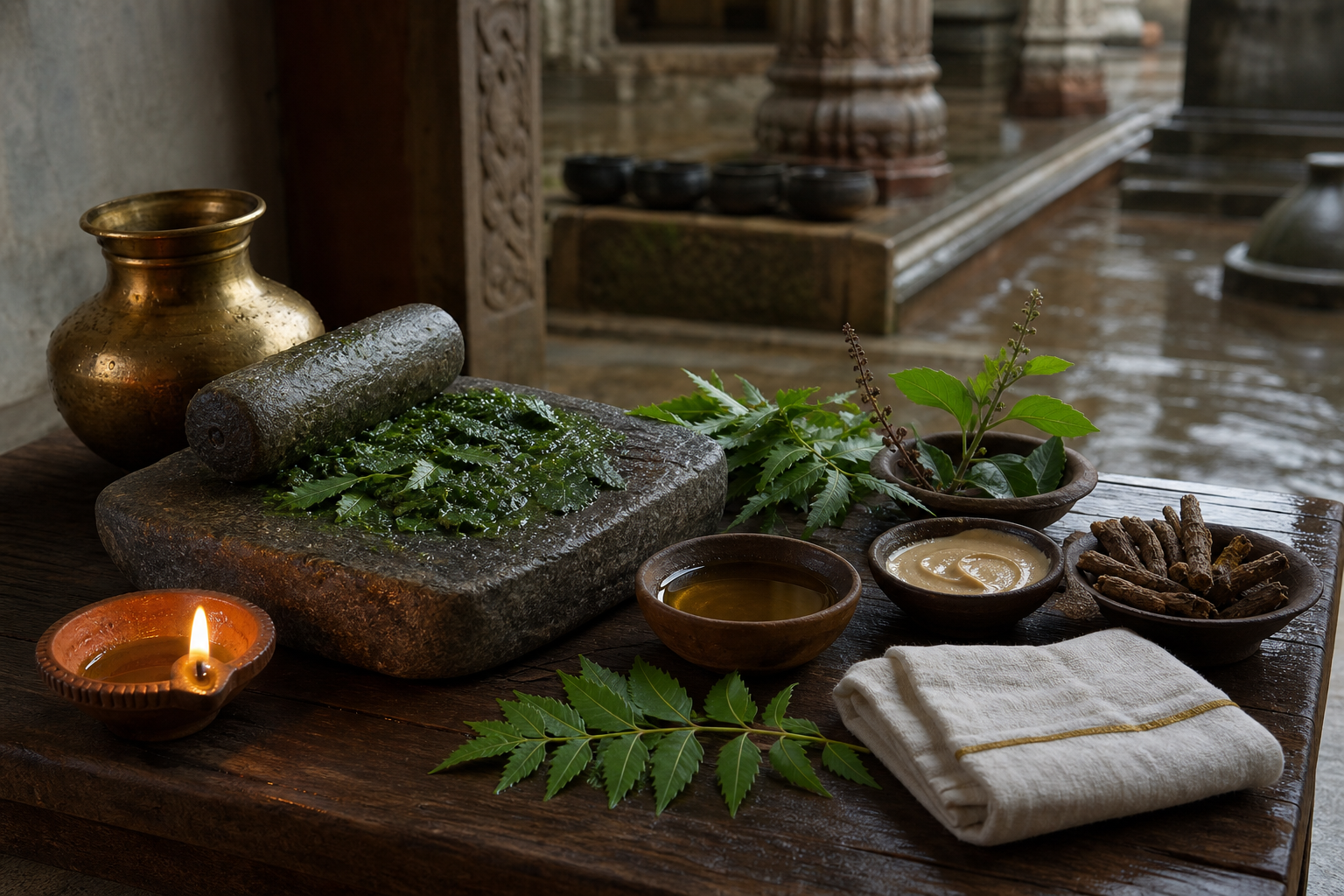
The source interprets Anasara through several Ayurvedic themes: seasonal transition, weakened digestion during fever, controlled nourishment, oil-based care, rest, and gradual restoration. It particularly invokes ritu sandhi, the junction between seasons, because Snana Purnima occurs near changing heat, humidity, and monsoon conditions. In this reading, the body is responsive to climate and must adjust rather than continue as though its surroundings were irrelevant.
Agni, the Ayurvedic concept associated with digestion and metabolism, provides another interpretive bridge. The source explains that fever is understood as a wider disturbance involving strength and digestive capacity, not merely as an elevated temperature. A lighter and regulated intake during illness consequently represents restraint at a time when ordinary demands may exceed the body’s capacity.
The reported use of Phuluri Tela, described by the source as a scented herbal oil connected with the temple’s healing observances, makes the medical symbolism especially visible. The article also refers more generally to medicated oil and restorative preparations. Along with seclusion and altered food and routine, these elements create a coherent ritual picture: exposure is followed by protection, treatment, observation, and a measured return.
This interpretation should be kept within appropriate bounds. Anasara can preserve and communicate traditional ideas about care without functioning as a clinical prescription. Its practices do not establish that any particular preparation treats modern cases of fever, and its sacred narrative should not replace diagnosis or necessary medical attention. Its contribution is ethical and cultural: it teaches that timing, diet, environment, and rest deserve attention during recovery.
Healing extends beyond the physical body

The source identifies three interwoven dimensions of Anasara: physical healing through rest and regulated care; emotional healing through tenderness, absence, and reunion; and spiritual healing through a deity who accepts human-like vulnerability. None of these dimensions stands alone. The physical condition shapes the ritual schedule, the schedule alters the devotee’s experience, and that experience deepens the meaning of service.
The Daitapati servitors embody this synthesis. The source portrays their role during Anasara as one of intimate, kin-like attendance rather than distant ceremonial formality. Care for the vulnerable becomes worship in action. This lends social meaning to convalescence: the person who is ill is not merely removed from productive life, while the caregiver is not performing an incidental task. Both occupy a morally significant relationship.
For devotees, the lack of public darshan introduces another kind of discipline. Visible absence can intensify remembrance and longing, shifting attention from immediate sight toward inward devotion. The eventual reappearance of Jagannath is therefore more than the resumption of a suspended schedule. It resolves a period in which the community has waited while the deities were ritually protected.
Ratha Yatra then gives recovery a public and kinetic form. As interpreted by the source, seclusion prepares for movement: restored strength precedes the journey. The festival sequence thus refuses both permanent withdrawal and premature return. Pause and activity belong to the same rhythm.
Key takeaways
- Anasara treats convalescence as a meaningful phase rather than an interruption that must be concealed or hurried.
- Ayurvedic ideas clarify the ritual’s attention to season, digestion, suitable nourishment, oil-based care, rest, and gradual restoration.
- The Daitapati servitors’ intimate attendance presents caregiving as sacred service and illness as a condition worthy of compassion.
- The movement from public bathing to seclusion and then Ratha Yatra links exposure, recovery, renewed visibility, and restored action.
- The ritual offers a cultural model of care, not a substitute for clinical assessment or evidence-based treatment.
Reading Anasara responsibly in the present
Anasara speaks most directly to a culture that often expects activity to resume as soon as symptoms begin to ease. Its ritual logic grants recovery its own duration. Rest is not framed as idleness, and a gradual return is not treated as insufficient resolve. Seasonal awareness likewise encourages adaptation to changing conditions rather than the expectation that food, exertion, and routine must remain constant throughout the year.
Its deepest practical insight may concern relationships. Healing involves the person who withdraws, those who provide care, and the community that learns to wait. The observance makes all three roles visible while placing physical, emotional, and spiritual renewal within one public tradition.
Future study can sharpen this understanding by comparing temple accounts, servitor knowledge, ritual history, and classical Ayurvedic discussions while preserving the distinction between symbolic interpretation and medical evidence. Such work would allow Anasara to remain a living tradition rather than either a romanticized remedy or an emptied spectacle.