
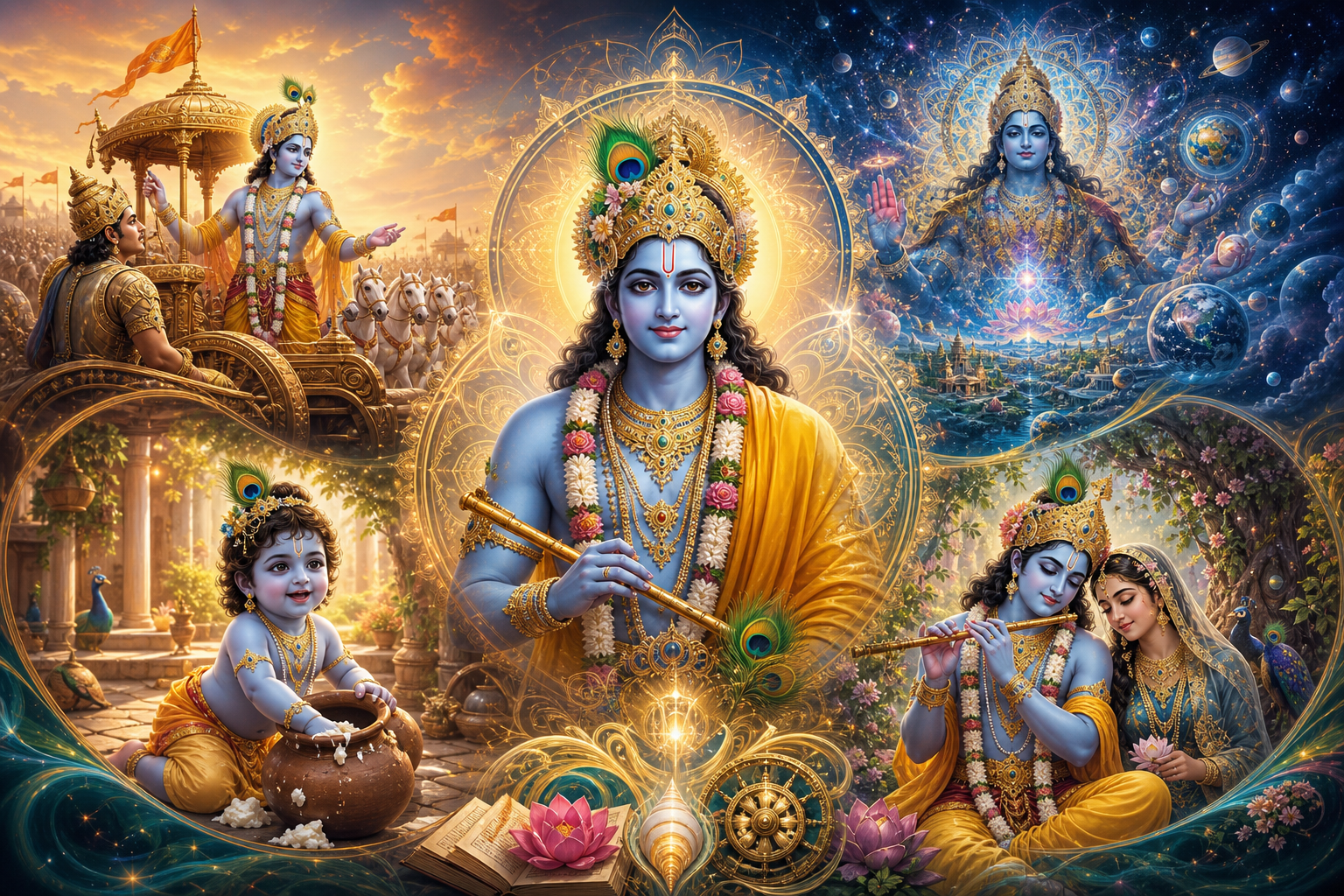
Krishna as the Complete Vision of the Divine
Krishna occupies a singular place in Hindu philosophy because he cannot be reduced to one mood, one social role, one ethical category, or one devotional image. He is remembered as the butter-stealing child of Gokula, the irresistible flute-player of Vrindavan, the intimate companion of Radha and the gopis, the strategist of the Mahabharata, the charioteer of Arjuna, the speaker of the Bhagavad Gita, and the supreme reality who reveals the virat-purusha, the cosmic form that contains all worlds. This fullness is the reason Krishna remains one of the most powerful and emotionally complete representations of God in Sanatana Dharma.
Theologically, Krishna is not merely a divine hero who performs extraordinary actions. In Vaishnava traditions, he is Bhagavan, the personal face of the Infinite, the source from whom beauty, wisdom, strength, compassion, playfulness, sovereignty, and transcendence flow together. This is why any serious study of Krishna must move beyond a narrow moral or psychological reading. His personality is not a contradiction; it is an integration. He is masculine without harshness, romantic without sentimentality, feminine in grace without losing sovereignty, childlike without ignorance, and warrior-like without cruelty.
A God Unlike Any Other
In the landscape of world religions, Krishna presents an unusually comprehensive vision of divinity. Many religious traditions emphasize God as lawgiver, judge, creator, savior, or distant absolute. Hinduism, especially through the Krishna tradition, also allows God to be playful, intimate, charming, vulnerable in appearance, and emotionally available to the devotee. Krishna can be loved as a child, served as a king, approached as a friend, revered as a teacher, contemplated as Brahman, and surrendered to as the supreme Lord.
This multidimensionality explains why Krishna bhakti has endured across regions, languages, arts, and philosophical schools. The same Krishna who dances in the Raas is also the Krishna who destroys tyrants. The same Krishna who steals butter is also the Krishna who speaks about karma, dharma, jnana, bhakti, and moksha. The same Krishna who smiles in Vrindavan also stands at Kurukshetra, urging Arjuna to rise above paralysis and act according to dharma. These are not separate deities stitched together by mythology; they are facets of a single complete being.
The Child Krishna: Innocence, Delight, and Vatsalya Rasa
The childhood narratives of Krishna in the Bhagavata Purana are among the most tender in sacred literature. As a child in Gokula, Krishna steals butter, teases the gopis, crawls through courtyards, and allows Mother Yashoda to bind him with a rope. These stories are not merely charming village folklore. They reveal a profound theological insight: the Infinite willingly becomes approachable. The supreme consciousness that contains the universe allows itself to be held, fed, scolded, and loved by human beings.
This is the essence of Vatsalya Rasa in Hinduism, the devotional mood in which the devotee loves God as a parent loves a child. Such a relationship reverses ordinary religious hierarchy. Instead of the devotee only fearing, obeying, or petitioning God, the devotee becomes emotionally responsible for the divine child. This creates a form of bhakti that is intimate, embodied, and deeply human. For many devotees, the image of Bala Krishna does not remain an abstract doctrine; it becomes a way of softening the heart, healing emotional distance, and discovering sacredness in care, feeding, song, and daily affection.
The episode in which Yashoda sees the universe in Krishna’s mouth is especially significant. It resolves a major theological paradox: the child is truly a child, yet he is also the cosmic Lord. The scene does not erase the mother-child relationship; it deepens it. Yashoda’s love continues even after the glimpse of cosmic reality. In this, the Krishna tradition teaches that love is not inferior to metaphysics. Love can become a valid mode of knowing the Absolute.
The Romantic Krishna: Divine Love Beyond Possession
Krishna’s romantic dimension, especially in relation to Radha and the gopis of Vrindavan, has often been misunderstood when read through purely literal or modern social categories. In bhakti theology, the love of Radha and Krishna is not ordinary sensuality elevated by poetry. It is a symbolic and devotional language for the soul’s longing for the Divine. Radha represents the highest intensity of bhakti, the soul that seeks no reward, status, doctrine, or heaven, but only union with Krishna.
The Raas is therefore not merely a dance; it is a metaphysical image. Krishna stands at the center and yet appears personally beside each devotee. This communicates a subtle spiritual truth: the Divine is not diminished by being completely present to each soul. In ordinary human life, intimacy is limited by time, attention, and possession. In Krishna, divine love becomes inexhaustible. Each devotee can feel personally addressed without denying the devotion of another.
This has important implications for religious pluralism within Dharmic traditions. Krishna bhakti does not need to erase other paths to establish its own validity. Hinduism has long recognized multiple forms of worship, multiple temperaments, and multiple approaches to truth. The same civilizational spirit allows Shaiva, Vaishnava, Shakta, Smarta, Buddhist, Jain, and Sikh traditions to share a broad ethical and spiritual landscape even while maintaining distinct teachings. Krishna’s love is expansive rather than exclusionary; it invites the heart into depth without demanding contempt for other sincere paths.
The Feminine Grace of Krishna
Krishna’s beauty is often described in language that transcends rigid gender categories. His flute, peacock feather, gentle smile, graceful posture, and delicate aesthetic presence reveal a divine femininity that coexists with heroic strength. In Indian art and devotional poetry, Krishna’s form is soft, enchanting, and fluid, yet his will is unshakable. This combination challenges simplistic ideas of masculinity and divinity.
Krishna shows that strength need not be emotionally barren. Power need not appear as aggression. Sovereignty need not deny tenderness. His personality includes madhurya, sweetness, and aisvarya, majesty. In some moments, sweetness predominates: the flute in Vrindavan, the affection of Yashoda, the love of Radha. In other moments, majesty becomes visible: the defeat of Kamsa, the protection of dharma, the revelation of the cosmic form. The complete being holds both without apology.
This is especially relevant in modern discussions of identity, emotional health, and social life. Krishna’s image refuses the fragmentation of the human personality. A person can be disciplined and tender, intellectually sharp and emotionally open, courageous and artistic, devotional and practical. Krishna becomes a model not because humans can imitate his divinity, but because his wholeness exposes the poverty of one-dimensional ideals.
The Warrior Krishna: Dharma, Strategy, and Moral Clarity
Krishna’s role in the Mahabharata is often more difficult for modern readers than his childhood or romantic episodes. At Kurukshetra, he is not a sentimental pacifist. He is a strategist, diplomat, charioteer, counselor, and guide in a civilizational crisis. Yet he is also not a lover of violence. Before the war, Krishna attempts peace. He goes as an emissary to the Kaurava court and seeks a settlement. War becomes unavoidable only when adharma refuses restraint and justice is denied.
This distinction is central to Kshatra Dharma. The Mahabharata does not glorify violence for its own sake; it recognizes the tragic necessity of force when all ethical alternatives have failed. Krishna’s teaching to Arjuna is not a command to hate the enemy. It is a call to perform one’s duty without selfish attachment, cowardice, ego, or moral confusion. In the Bhagavad Gita, Krishna does not tell Arjuna to become cruel. He tells him to become clear.
Arjuna’s crisis is deeply human. He sees teachers, relatives, friends, and elders standing on the opposing side. His body trembles, his bow slips, and his mind recoils from action. Many people experience a smaller version of this paralysis when duty conflicts with comfort, when justice requires personal cost, or when emotional attachment clouds moral judgment. Krishna’s response is not cold detachment but disciplined wisdom. He teaches that action rooted in dharma, performed without selfish craving, can become yoga.
The Bhagavad Gita: A Technical Map of Human Action
The Bhagavad Gita is one of the most technically sophisticated spiritual texts in world literature because it does not offer a single path for every person. It integrates Karma Yoga, Jnana Yoga, Bhakti Yoga, meditation, self-discipline, devotion, metaphysics, and social duty. Krishna diagnoses the human problem at multiple levels: confusion of identity, attachment to outcomes, domination by the gunas, fear of loss, egoistic action, and ignorance of the eternal self.
Krishna teaches that the atman is not destroyed when the body is destroyed. He explains that the wise do not grieve in the same way for the changing body, because the self is deeper than physical appearance and temporary circumstance. Yet this teaching does not produce indifference to life. Instead, it gives the foundation for responsible action. When identity is no longer trapped in ego and fear, action can become steadier, more ethical, and less reactive.
The Gita’s doctrine of karma is equally precise. Krishna does not advise withdrawal from all action. He warns that no embodied being can remain truly actionless. The choice is not between action and inaction, but between unconscious action driven by desire and conscious action aligned with dharma. This is why the Gita remains relevant to political life, family duty, professional ethics, leadership, education, and personal discipline. It converts spirituality from escape into responsibility.
Bhakti, in the Gita, is not anti-intellectual emotion. It is the disciplined offering of mind, action, love, and identity to the Divine. Krishna asks for the heart, but he also demands clarity, courage, and discrimination. In this sense, Krishna consciousness is not merely ritual remembrance; it is a restructuring of perception. The devotee learns to see work, relationships, conflict, suffering, and success through the lens of the sacred.
The Cosmic Krishna: Virat-Purusha and the Face of the Infinite
The revelation of Krishna’s universal form in the Bhagavad Gita is among the most powerful theological moments in Hindu scriptures. Arjuna sees all beings, gods, warriors, worlds, time, creation, destruction, and destiny contained within Krishna. The charming charioteer is revealed as the cosmic ground of existence. This moment prevents Krishna from being confined to pastoral sweetness or heroic biography. He is not only the beloved of Vrindavan; he is the reality in whom the universe arises, moves, and dissolves.
The universal form also has a sobering dimension. Krishna is not only beauty but also time. He is not only comfort but also the power before which all empires, bodies, ambitions, and certainties pass away. This is a mature theology. It refuses to turn God into a projection of human preference. The same Divine who enchants the heart also confronts the ego with impermanence, consequence, and truth.
In devotional life, this produces balance. If Krishna were only cosmic power, the devotee might feel distance. If Krishna were only intimate sweetness, the devotee might forget transcendence. Hinduism holds both. The flute-player and the universal form belong together. The child in Yashoda’s lap and the Lord of time are one. This is why Krishna can be approached by philosophers, artists, warriors, saints, householders, renunciates, and ordinary devotees with equal seriousness.
Krishna and the Unity of Dharmic Traditions
Krishna’s teachings also support a wider Dharmic ethic of unity without uniformity. Hinduism, Buddhism, Jainism, and Sikhism differ in metaphysics, ritual practice, historical development, and scriptural authority, yet they share civilizational concerns with dharma, self-discipline, compassion, liberation from ego, ethical conduct, and the transformation of consciousness. A respectful study of Krishna should deepen this shared inheritance rather than become a cause of sectarian pride.
The Gita’s emphasis on svadharma, inner discipline, and liberation from selfish attachment resonates with larger Dharmic concerns. Jainism’s insistence on self-restraint, Buddhism’s analysis of craving and suffering, Sikhism’s devotion, seva, and remembrance of the Divine Name, and Hinduism’s many yogic and devotional paths can be appreciated as distinct yet related efforts to purify human life. Krishna’s completeness makes space for this breadth because he does not represent a narrow ideology. He represents the overflowing abundance of the sacred.
This does not require flattening real differences among traditions. Academic honesty demands that distinctions be preserved. However, difference need not produce hostility. The Dharmic vision at its best allows rigorous debate, local tradition, spiritual experimentation, and mutual reverence. Krishna’s own teaching in the Gita recognizes that people approach the Divine according to temperament, understanding, and stage of growth. Such a principle can strengthen cultural confidence while preserving humility.
Why Krishna Still Matters
Krishna remains relevant because modern life often divides qualities that he unites. Public culture may separate intellect from devotion, love from discipline, beauty from truth, spirituality from action, and power from compassion. Krishna refuses these divisions. He teaches that the highest life is not withdrawal into one emotional register but integration under dharma. The human being must learn to think clearly, love deeply, act courageously, and surrender ego before the Divine.
In personal life, Krishna’s image offers emotional depth. The child Krishna restores tenderness. The romantic Krishna dignifies longing and beauty. The friend Krishna offers companionship. The teacher Krishna gives philosophical clarity. The warrior Krishna gives courage. The cosmic Krishna gives perspective. Together, these forms address the whole human being, not only the intellect or the ritual self.
In social life, Krishna’s teaching asks communities to resist both passivity and fanaticism. Dharma requires compassion, but it also requires the defense of justice. It encourages pluralism, but not moral confusion. It honors love, but not possessiveness. It recognizes action, but not egoistic ambition. Such a framework remains valuable for families, institutions, educators, leaders, and spiritual communities attempting to live with integrity in a turbulent world.
Conclusion: The Complete Being
Krishna is best understood as the complete being because he reveals the Divine in its fullest range: child, lover, friend, guide, warrior, philosopher, king, and cosmic reality. His life and teachings show that God is not limited to abstraction, command, or distant majesty. The Divine can laugh, dance, counsel, protect, challenge, and reveal the deepest truth of existence. This is why Krishna remains central to Hindu spirituality and continues to speak across centuries.
To contemplate Krishna is to encounter a vision of wholeness. He does not ask humanity to choose between strength and tenderness, knowledge and devotion, beauty and responsibility, or freedom and duty. He gathers them into a single luminous center. In Krishna, Hinduism presents a God who is not partial, fragmented, or emotionally distant, but complete. This is Krishna, and this is one of the most profound visions of God offered by Sanatana Dharma.
Inspired by this post on Hindu Blog.
