
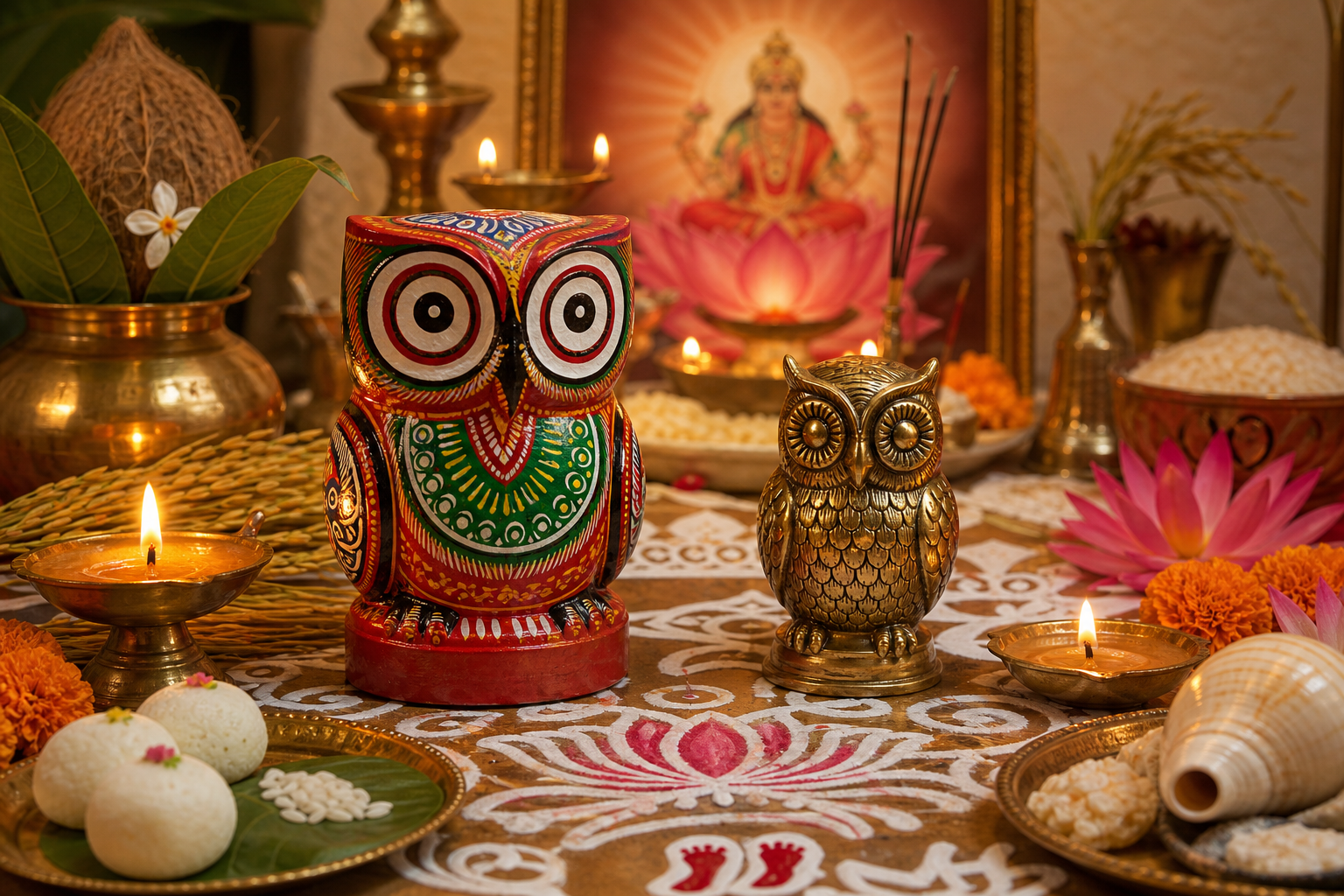
In Bengal, the owl associated with Goddess Lakshmi occupies a distinctive place in domestic worship, folk art, ritual memory, and devotional symbolism. The figure may appear as a painted wooden owl, a small metal image, a terracotta form, or an element within a larger Lakshmi image, yet its function remains deeply connected to the goddess of prosperity, abundance, auspiciousness, and household well-being. This tradition is often described simply as the worship of Lakshmi’s owl, but a more accurate understanding is that the owl is honored as the vahana, or divine vehicle, of Goddess Lakshmi. It is not usually worshipped as an independent deity; it is revered because it carries, accompanies, and symbolically expresses the presence of Sri Lakshmi within Bengali Hindu devotional culture.
The Sanskrit term commonly associated with the owl is Uluka, and in Hindu iconography the vahana is never a decorative afterthought. A deity’s vehicle communicates a theological idea through visual language. Just as Garuda expresses the sovereign and protective power of Lord Vishnu, Nandi expresses disciplined devotion to Lord Shiva, and the lion expresses the fearless shakti of Goddess Durga, the owl of Lakshmi communicates meanings that are more subtle, even paradoxical. It suggests night vision, alertness, silence, the ability to move through darkness, and the need for discernment when wealth enters human life.
In Bengali homes, this symbolism becomes especially vivid during Lakshmi Puja, particularly the Kojagari Lakshmi Puja observed on the full moon night after Durga Puja. The word Kojagari is traditionally linked with the question “Who is awake?” and the night vigil associated with Lakshmi worship gives the owl a natural ritual resonance. The owl is a nocturnal bird; it sees, moves, and remains watchful when others sleep. In that sense, Lakshmi’s owl becomes a visual reminder that prosperity requires vigilance, ethical alertness, and conscious stewardship rather than passive desire for wealth.
The Bengali imagination has never treated Lakshmi merely as a distant cosmic principle. She is also Lakshmi of the household, the courtyard, the granary, the rice field, the lamp, the ledger, the kitchen, and the rhythm of family life. Her worship is therefore intimate. The sound of conch shells, the alpana drawn with rice paste, the small footprints of the goddess entering the home, the offerings of paddy, rice, sweets, fruits, and flowers, and the presence of the owl together form a ritual grammar of abundance. In this grammar, the wooden or metal owl serves as a compact but powerful sign of the goddess’s arrival.
The use of wooden owls in Bengal also reflects the region’s strong craft traditions. Painted wooden birds, ritual toys, and folk images have long circulated through village markets, pilgrimage fairs, seasonal festivals, and household shrines. A wooden Lakshmi owl is often brightly painted, with large circular eyes, stylized feathers, a frontal posture, and a simplified body. These features are not accidental. The oversized eyes emphasize perception and wakefulness. The frontal posture gives the image a direct ritual presence. The bright color palette connects the object to the festive visual world of Bengal, where sacred art often moves easily between temple, home, courtyard, and craft market.
Metal owls used in Lakshmi worship carry a different devotional quality. Brass, bronze, copper, or mixed-metal ritual objects are valued for durability, purity, and repeated use. A metal owl may be placed near a Lakshmi image, kept on a household altar, or included among other auspicious ritual items. Metal, unlike painted wood, is less fragile and more permanent; it suggests continuity across generations. In many households, the inherited metal object acquires emotional depth because it has witnessed years of Lakshmi Puja, family prayers, harvest anxieties, financial hopes, weddings, births, and annual renewals of faith.
The material distinction between wood and metal is therefore important. Wood points toward folk creativity, seasonal devotion, village artistry, and the warmth of handmade ritual objects. Metal points toward permanence, temple-like sanctity, and inherited ritual authority. Both, however, serve the same broader purpose: they make Lakshmi’s vahana visible and accessible. They allow the devotee to contemplate not only the goddess, but also the ethical and symbolic conditions under which prosperity should be received.
In Hindu symbolism, wealth is never treated as a purely economic category. Lakshmi is associated with dhana, or material wealth, but also with dhanya, grain; saubhagya, good fortune; shri, radiance and auspiciousness; and samriddhi, flourishing. In Bengal, where rice agriculture has shaped domestic and ritual culture for centuries, Lakshmi’s connection with grain is particularly strong. The owl’s ecological role deepens this association. Owls help control rodents, and rodents threaten stored grain. Even when not stated in formal theology, this agricultural observation strengthens the symbolic suitability of the owl as the companion of a goddess connected with food security, household abundance, and agrarian prosperity.
This ecological dimension is one of the most meaningful ways to interpret the Lakshmi owl today. Traditional symbolism often carries practical wisdom beneath devotional language. A community that honors the owl as Lakshmi’s vehicle is also preserving a cultural memory of the bird’s usefulness in protecting crops and grain stores. Such reverence can support a more compassionate and dharmic relationship with the natural world. The owl is not merely a mysterious nocturnal creature; it is part of the balance that sustains village life, agriculture, and the household economy.
At the same time, the owl’s symbolic meaning is not one-dimensional. In some interpretive traditions, the owl represents blindness or foolishness when wealth is pursued without wisdom. This appears at first to contradict the positive meaning of Lakshmi’s vahana, but Hindu iconography often works through layered meanings rather than simple oppositions. The same symbol may warn and bless at the same time. The owl sees in darkness, but it is also associated with night; it may represent hidden insight, yet it may also caution against moral darkness. In relation to Lakshmi, this complexity becomes especially appropriate. Wealth can nourish life when guided by dharma, but it can also produce arrogance, greed, and spiritual carelessness when separated from wisdom.
For this reason, the Lakshmi owl should not be reduced to superstition or decorative folklore. It is a compact ethical teaching. It reminds the household that prosperity must be guarded by restraint, gratitude, generosity, and clarity. The owl sitting beside Lakshmi silently asks whether wealth is being used for family welfare, education, charity, ritual duty, community responsibility, and righteous living. In that sense, the image belongs not only to the world of worship but also to the world of moral reflection.
Bengal’s Lakshmi Puja traditions often emphasize domestic order and purity. Homes are cleaned, offerings are arranged carefully, lamps are lit, and the goddess is invited with reverence. The alpana designs made from rice paste frequently include lotus motifs, paddy symbols, vessels, and the goddess’s footprints. These are not random ornaments. They create a sacred pathway for abundance to enter the home. When the owl is added to this visual field, it completes the theological picture: Lakshmi arrives not as uncontrolled wealth, but as auspicious prosperity accompanied by awareness.
The lotus and the owl together offer a striking contrast. The lotus, one of Lakshmi’s most familiar symbols, rises unstained from muddy water and represents beauty, purity, and spiritual unfolding. The owl moves through darkness and represents watchfulness, secrecy, and nocturnal perception. Together they express a mature understanding of prosperity. Wealth must be pure like the lotus, yet practical life also demands the owl’s alertness in the shadows of uncertainty, temptation, loss, and misjudgment.
The Bengali phrase Lakshmi’r pencha, meaning Lakshmi’s owl, carries this cultural intimacy. The owl becomes recognizable not merely as a bird but as a member of the goddess’s symbolic household. In many Bengali visual traditions, Lakshmi is depicted seated or standing on a lotus, holding lotuses, blessing devotees, and accompanied by the owl below or beside her. The owl’s placement is significant. It is near the earth, close to the field, the grain, and the household domain. Lakshmi’s radiance descends into practical life through the world that the owl watches.
From an iconographic perspective, the owl’s simplified form in folk art may seem less refined than classical temple sculpture, but that simplicity is part of its power. Folk images work through recognizability and emotional immediacy. A child seeing the large-eyed wooden owl during Lakshmi Puja learns that sacred meaning can live in small objects. A family placing the owl beside the goddess participates in a ritual continuity that does not require elaborate philosophical training. The object teaches through repetition, sight, touch, memory, and annual practice.
This is one reason wooden and metal owls remain culturally important even in modern urban homes. Contemporary families may live in apartments rather than ancestral houses; rice may come from shops rather than family fields; ritual time may be compressed by professional schedules. Yet the Lakshmi owl still evokes a larger inheritance. It brings the atmosphere of Bengal’s courtyards, autumn nights, full-moon worship, family gatherings, and quiet devotional discipline into modern spaces. The object becomes a bridge between inherited culture and contemporary life.
The tradition also demonstrates the broader Hindu principle that the divine is approached through many forms, materials, and levels of meaning. A metal owl, a wooden owl, a painted image, a clay figure, a mantra, a lamp, a grain offering, and an alpana can all become vehicles of sacred remembrance when placed within a dharmic ritual context. This inclusive approach is important for maintaining unity among dharmic traditions. Hinduism, Buddhism, Jainism, and Sikhism all preserve, in different ways, the value of disciplined attention, ethical living, reverence for life, and the transformation of ordinary action into a path of inner refinement.
The Lakshmi owl is therefore not only a regional symbol; it is also a case study in how dharmic traditions encode philosophical ideas into accessible forms. A household object becomes theology. A craft item becomes memory. A bird becomes an ethical metaphor. A ritual accessory becomes a lesson in how prosperity should be understood. This layered approach is characteristic of Hindu culture, where the sacred is often transmitted through image, sound, gesture, season, food, craft, and family practice rather than through doctrine alone.
There is also an important distinction between reverence and literalism. To honor the owl as Lakshmi’s vahana does not mean that every owl is turned into an object of ritual possession or that the bird is treated as a commodity. The more dharmic interpretation is one of respect. The living owl belongs in its habitat and should be protected from harm, trade, and exploitation. The ritual owl made of wood or metal allows devotees to express reverence symbolically without disturbing wildlife. This distinction is especially relevant today, when conservation ethics must accompany traditional worship practices.
In this respect, wooden and metal Lakshmi owls are preferable ritual substitutes because they preserve symbolism without encouraging harm to living birds. The dharmic spirit of worship requires ahimsa, ecological responsibility, and awareness of the interdependence of life. A sacred symbol loses its meaning if it becomes an excuse for cruelty or illegal wildlife practices. A properly understood Lakshmi Puja honors the goddess of abundance by protecting the very ecological order through which abundance becomes possible.
The ritual placement of the owl can vary by household and region. In some homes, it is positioned near the image of Lakshmi; in others, it appears as part of the goddess’s printed or sculpted iconography. Some families keep a small owl figure on the altar throughout the year, while others bring it out especially during Lakshmi Puja. The object may be washed, wiped, decorated, or placed near lamps and offerings. The exact procedure may differ, but the underlying sentiment remains consistent: the vahana is honored because it belongs to the goddess’s sacred presence.
Offerings during Lakshmi Puja in Bengal often include rice, paddy, fruits, sweets, coconut, betel leaves, flowers, incense, lamps, and water. The goddess is invited into a clean and orderly space, and the household expresses gratitude for sustenance already received while praying for continued stability. The owl’s symbolism fits naturally into this ritual environment. It reminds devotees that prosperity is not merely acquired; it must be preserved, watched over, and aligned with dharma.
In many Bengali households, Lakshmi is also associated with discipline in daily conduct. Wastefulness, disorder, laziness, and disrespect for food are traditionally discouraged because they are believed to drive away Lakshmi. These ideas may be expressed through folk sayings rather than formal scripture, but they reveal a sophisticated domestic ethic. Wealth is not isolated from behavior. The household that seeks Lakshmi must cultivate cleanliness, responsibility, gratitude, and care. The owl’s watchful presence reinforces this ethic in visual form.
The owl’s large eyes also carry psychological significance. Ritual images often work by directing attention. A devotee looking at the owl is drawn into the theme of seeing clearly. In a world where wealth can create anxiety, comparison, pride, and insecurity, the Lakshmi owl invites a steadier gaze. It suggests that true prosperity includes the ability to see one’s duties, limits, blessings, and responsibilities. Without such vision, wealth may multiply possessions while reducing peace.
This interpretation is especially relevant in the present age, where prosperity is often measured through consumption and display. The Lakshmi owl offers a different model. It does not shout; it watches. It does not glitter like gold; it waits in silence. Its sacred message is not extravagance but awareness. Within the framework of Hindu symbols, this quietness matters. It points toward an inner economy of restraint, patience, and discernment.
Bengal’s devotional culture has always been rich in such symbolic compression. Durga Puja, Kali Puja, Saraswati Puja, Manasa worship, and Lakshmi Puja all combine Sanskritic theology with regional art, seasonal rhythms, and domestic memory. The Lakshmi owl belongs to this same cultural world. It is shaped by pan-Indian Hindu iconography, but it carries a distinctly Bengali emotional tone. Its presence in folk craft and household worship shows how regional traditions enrich the larger Hindu civilization without breaking from it.
The comparison between Bengal and other regions also helps clarify the tradition. Across India, Lakshmi is widely worshipped during Diwali, Varalakshmi Vratam, Kojagari Purnima, Friday observances, and other auspicious occasions. In Bengal, however, Kojagari Lakshmi Puja has a particularly strong domestic character, and the owl is visually memorable within that setting. This does not make Bengal separate from broader Hindu practice; rather, it shows how Hindu traditions adapt to local ecology, language, craft, and household patterns while preserving shared theological foundations.
The wooden or metal owl also belongs to the study of material religion. Material religion examines how objects, textures, colors, metals, images, and domestic spaces shape religious experience. A small owl figure may appear simple, but it organizes memory and devotion. It tells the family where to look, what to remember, and how to connect the abstract concept of prosperity with a visible form. The object becomes a devotional technology, a means by which sacred meaning is stored and transmitted.
In this sense, the Lakshmi owl is also a cultural archive. It preserves knowledge about Bengal’s agrarian past, folk artistry, household ritual, feminine sacred power, and the moral imagination surrounding wealth. The object may be small enough to fit in the palm, but its meanings extend across ecology, economy, theology, and family life. To study it carefully is to see how Hindu culture often places large ideas inside modest forms.
The presence of Goddess Lakshmi herself must remain central in this discussion. She is not merely a goddess of money. She is the radiance of auspicious life. Her association with Lord Vishnu places prosperity within the larger order of preservation, balance, and cosmic harmony. When Lakshmi is separated from dharma, wealth becomes unstable. When Lakshmi is honored with Vishnu’s sustaining principle, prosperity becomes part of a righteous and orderly life. The owl, as her vahana, belongs to this larger moral universe.
Some devotional interpretations explain that the owl warns against the darkness of greed, while Lakshmi offers the possibility of luminous abundance. This reading is especially valuable because it avoids sentimental simplification. Hindu symbols often teach through tension. The devotee is not asked merely to desire Lakshmi’s blessings; the devotee is also asked to become worthy of receiving and preserving them. The owl’s presence beside the goddess therefore becomes a spiritual discipline: see clearly, remain awake, and do not let prosperity turn into delusion.
The craftsmanship of wooden Lakshmi owls also deserves careful attention. Their stylization often reflects local aesthetic choices rather than anatomical realism. Folk art does not aim to copy the bird exactly. It distills the bird into a sacred sign. The round eyes, patterned wings, balanced posture, and bright colors create an image that is immediately legible in ritual space. The artisan’s work transforms natural observation into symbolic form, and the devotee’s worship transforms that form into sacred presence.
Metal images, by contrast, often emphasize solidity and ritual purity. Brass and bronze are common in Hindu household worship because they can be cleaned, anointed, and used repeatedly. A metal owl can sit near lamps, bells, conch shells, and other puja items without losing its dignity. Its weight gives it a grounded quality. It does not feel temporary; it feels installed within the household’s sacred order.
Both forms also demonstrate how sacred art can support local economies. Artisans who produce ritual objects contribute to the continuity of cultural traditions. When families choose handmade wooden or metal Lakshmi owls, they help sustain craft knowledge, regional aesthetics, and devotional livelihoods. This economic dimension is itself appropriate to Lakshmi worship, provided it is guided by fairness, respect for artisans, and avoidance of exploitative commercialization.
The question of authenticity should be approached with balance. A simple factory-made object may still serve devotional purposes if used with sincerity, but handmade objects carry cultural depth that mass-produced items often lack. The ideal approach is not rigid judgment but informed appreciation. Devotees may choose according to means, availability, and family tradition, while recognizing that the object’s purpose is to support remembrance of Lakshmi and her dharmic meaning.
It is also important to avoid treating the Lakshmi owl as an exotic curiosity. For Bengali devotees, it belongs to a living ritual world. Its meaning is not invented for tourism or decorative consumption. It is tied to prayer, household discipline, inherited memory, and the sacred feminine. Academic study should therefore treat the object with interpretive seriousness and cultural sensitivity.
The sacred feminine dimension is central. Lakshmi represents nourishment, beauty, good fortune, order, and generosity. In Bengal, where goddess traditions are especially prominent, Lakshmi is often understood alongside Durga, Kali, Saraswati, and other forms of Devi. Each form reveals a different dimension of shakti. Lakshmi’s owl therefore belongs to a broader devotional landscape in which feminine divinity is not abstract but embodied through images, festivals, songs, domestic rituals, and seasonal rhythms.
Within this broader landscape, Lakshmi’s form is gentle but not superficial. Prosperity may appear gentle, but it requires discipline. Household abundance can be lost through carelessness, injustice, addiction, arrogance, and social neglect. The owl’s watchfulness therefore gives Lakshmi worship an element of seriousness. It asks the household to remain awake not only during Kojagari night but throughout the ethical life of the family.
This makes the tradition deeply relevant for modern readers. Financial life today involves salaries, debt, investments, education expenses, healthcare costs, business risks, and social pressures. The ancient symbol of Lakshmi’s owl still speaks to these realities. It encourages prudent management, ethical earning, mindful spending, protection of resources, and generosity toward those in need. These are not modern additions to the tradition; they are contemporary expressions of the same dharmic concern that prosperity must serve life rather than dominate it.
The owl also invites reflection on silence. Many sacred traditions value silence because it allows perception to deepen. The owl’s quiet movement through the night suggests a form of knowledge that does not depend on noise or display. In a culture increasingly shaped by constant visibility, the Lakshmi owl reminds devotees that some forms of wealth are quiet: peace in the home, trust among family members, food offered with gratitude, knowledge passed to children, and the ability to sleep without fear.
For many Bengali families, the emotional force of Lakshmi Puja lies in these quiet details. The festival may not always have the public grandeur of Durga Puja, but it carries a different intimacy. It is the household turning inward after the public celebration. It is the family asking for steadiness. It is the lamp glowing beside rice, flowers, and the goddess’s image. The owl in that setting becomes almost like a silent guardian of the threshold between aspiration and responsibility.
The tradition should also be understood as part of Hinduism’s wider respect for animals as sacred associates. The vahanas of deities are not random mounts; they create a symbolic relationship between human devotion, divine power, and the animal world. This pattern encourages reverence for life and teaches that animals can carry sacred meaning without ceasing to be part of nature. Such a worldview supports ecological humility and counters the idea that human life stands apart from the rest of creation.
In dharmic terms, the Lakshmi owl teaches interdependence. The household depends on grain, grain depends on soil and water, fields depend on ecological balance, and stored food depends on protection from pests. The owl belongs to that chain of protection. By symbolically associating the bird with Lakshmi, Bengali tradition gives spiritual dignity to ecological function. This is an elegant example of how religious symbolism can preserve environmental wisdom.
The tradition also offers a useful corrective to shallow readings of prosperity worship. Lakshmi Puja is sometimes misunderstood as a request for money alone. In reality, the ritual structure is broader. It involves gratitude, purification, order, beauty, nourishment, ethical hope, and continuity of family life. The owl strengthens this broader reading by suggesting that wealth must be watched, understood, and protected from misuse.
When wooden or metal owls are used in worship, the devotee participates in a layered act of remembrance. The object recalls Lakshmi’s iconography, Bengal’s craft traditions, the ecology of grain protection, the full-moon atmosphere of Kojagari Lakshmi Puja, and the moral demand for wise prosperity. The act may be simple, but its cultural density is considerable.
Such traditions deserve preservation not because they are old, but because they continue to teach. A living tradition remains meaningful when it can speak to changing circumstances without losing its core. The Lakshmi owl can speak to rural agriculture and urban finance, to inherited worship and modern conservation, to household devotion and academic study. Its durability comes from this ability to hold many meanings together.
The most balanced interpretation is therefore neither literalistic nor dismissive. The wooden or metal owl used in Goddess Lakshmi worship in Bengal is a sacred symbol, a regional art form, a ritual accessory, an ethical reminder, and an ecological sign. It belongs to the devotional world of Lakshmi while also illuminating broader themes in Hindu symbolism: prosperity with discernment, abundance with humility, beauty with responsibility, and faith with awareness.
In the end, Bengal’s Lakshmi owl remains powerful because it is small but not trivial. It sits quietly beside the goddess and gathers within itself the anxieties and hopes of household life. It reminds the devotee that Lakshmi’s blessings are not only to be invited but also to be honored properly. Prosperity must be awake. Wealth must be ethical. Abundance must be shared. The eyes of Uluka, wide open in the ritual space, continue to teach that true fortune belongs to those who can see clearly in both light and darkness.
Inspired by this post on Hindu Blog.
