
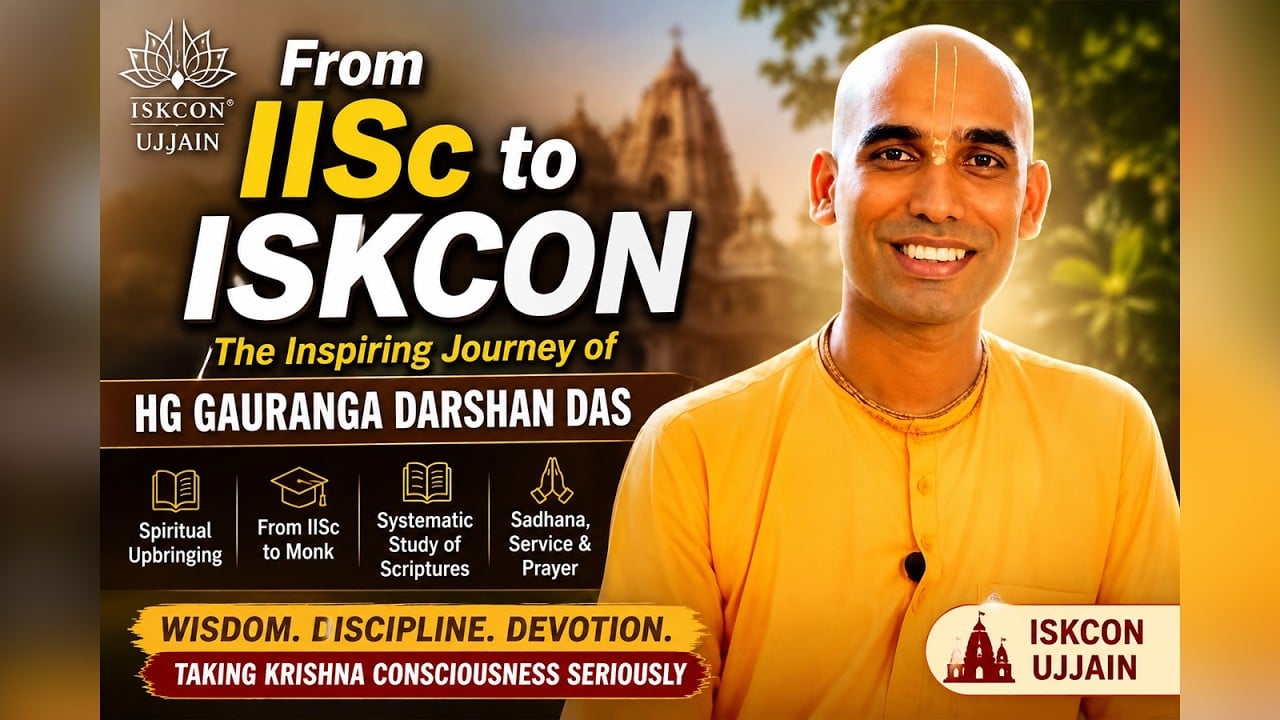
The journey of HG Gauranga Darshan Das, presented in the Wisdom Podcast by ISKCON Ujjain, offers a thoughtful case study in the meeting point between modern scientific education and traditional spiritual discipline. The title itself, moving from IISc to ISKCON, signals a transition that is not merely institutional but deeply existential: from the disciplined world of research, analysis, and intellectual precision to the equally disciplined world of bhakti, seva, scripture, and inner transformation.
Such a journey is often misunderstood when framed as a rejection of science or modern education. A more accurate reading is that it represents a widening of inquiry. The scientific temperament asks how reality functions; the dharmic temperament asks why life must be lived responsibly within that reality. In the life of a serious practitioner, these questions do not necessarily compete. They can become complementary paths of disciplined investigation.
IISc, the Indian Institute of Science, carries a symbolic weight in India’s intellectual imagination. It stands for rigour, method, experimentation, and excellence in higher learning. ISKCON, the International Society for Krishna Consciousness, founded in 1966 by A. C. Bhaktivedanta Swami Prabhupada, represents a global devotional movement rooted in Gaudiya Vaishnavism, bhakti yoga, the Bhagavad Gita, Srimad Bhagavatam, kirtan, japa, and the practice of devotional service. The movement from one space to the other, therefore, invites careful reflection on the relationship between knowledge and wisdom.
The podcast’s central value lies in showing that spiritual life is not an escape from intelligence. Within the Hindu tradition, especially within Vedanta and bhakti traditions, intelligence is not dismissed; it is refined. The mind is trained, the senses are disciplined, and the heart is educated through humility, remembrance, service, and scriptural contemplation. HG Gauranga Darshan Das’s journey becomes significant because it speaks to a recurring modern dilemma: how can a person trained in analytical thought also cultivate devotion, surrender, and inner clarity?
Gaudiya Vaishnavism, the theological stream within which ISKCON is situated, places Krishna bhakti at the centre of spiritual practice. Its philosophical framework is often associated with the principle of acintya-bhedabheda, the simultaneous oneness and difference between the individual soul and the Supreme. This idea is intellectually subtle and spiritually profound. It does not reduce spiritual life to emotion alone, nor does it reduce reality to abstraction alone. It allows devotion, reason, metaphysics, and lived practice to operate together.
The significance of a science-educated devotee entering a life of Krishna consciousness becomes clearer in this context. Technical education trains the mind to observe patterns, test assumptions, and avoid vague conclusions. Spiritual training, when practiced seriously, asks for a similar discipline at the level of character. It asks whether desire is being examined honestly, whether the ego is being corrected, whether speech is truthful, whether one’s work benefits others, and whether knowledge is being converted into service.
This is where the concept of seva becomes central. In many dharmic traditions, including Hinduism, Buddhism, Jainism, and Sikhism, service is not treated as a secondary virtue. It is a method of purification and social responsibility. In the Vaishnava context, seva is offered to Bhagavan, to guru, to devotees, and to society. In Sikh tradition, seva and sangat form the basis of community practice. In Jainism, compassion and restraint shape ethical conduct. In Buddhism, compassion and mindfulness guide the path out of suffering. These traditions differ in doctrine, but they converge in their insistence that inner life must become visible through conduct.
The podcast, therefore, is not only a biographical conversation. It becomes an entry point into a broader civilisational question: what should educated life produce? If education produces only career achievement without self-mastery, it remains incomplete. If spirituality produces sentiment without discipline, it also remains incomplete. A mature dharmic approach seeks integration. It values knowledge, but it asks knowledge to serve dharma. It values devotion, but it asks devotion to become steady, ethical, and compassionate.
The Bhagavad Gita offers a powerful framework for this integration. Arjuna’s crisis is not anti-intellectual; it is moral, emotional, and philosophical. Krishna does not ask Arjuna to abandon reason. He teaches him to see action, duty, selfhood, and surrender with greater clarity. This is why the Gita continues to speak to students, professionals, researchers, householders, monks, and leaders. It does not present spirituality as passivity. It presents spiritual wisdom as the foundation for rightly directed action.
HG Gauranga Darshan Das’s association with the world of ISKCON also brings attention to the guru-shishya tradition. In modern settings, the word “guru” is often flattened into the idea of a motivational speaker or public personality. In the dharmic sense, the guru is a transmitter of disciplined knowledge, a guide who connects the student to scripture, practice, tradition, and self-correction. The shishya is not a passive admirer but a sincere learner. This relationship demands responsibility on both sides: integrity from the guide and humility from the student.
A striking feature of such spiritual journeys is the gradual redefinition of success. In academic and professional environments, success is often measured by rank, placement, publication, income, recognition, or institutional affiliation. These measures have practical value, but they cannot fully answer the human hunger for meaning. Bhakti traditions ask a more difficult question: has the heart become softer, steadier, and more truthful? Has knowledge reduced pride or increased it? Has achievement deepened gratitude or strengthened entitlement?
This question is especially relevant for young Indians and the Indian diaspora, many of whom inherit both intense educational ambition and a deep but sometimes fragmented relationship with Hindu spirituality. The story of a scholar-practitioner moving toward ISKCON helps restore confidence that dharmic life is not intellectually inferior to modernity. It can engage modernity, examine it, learn from it, and still remain rooted in ancient wisdom.
ISKCON’s public identity is often associated with kirtan, temple worship, prasadam, festivals, and the chanting of the Hare Krishna maha-mantra. Yet beneath these visible practices lies a sophisticated theological and educational structure. The Bhagavad Gita and Srimad Bhagavatam are studied not as decorative scriptures but as guides to ontology, ethics, psychology, devotion, and social responsibility. For a person trained in technical study, this structured scriptural culture can offer a disciplined field of inquiry rather than a vague emotional refuge.
The practice of japa illustrates this discipline well. Repetition of the divine name may appear simple from the outside, but in actual practice it involves attention, posture, breath, memory, and intention. It exposes restlessness. It reveals the speed of the mind. It trains the practitioner to return, again and again, to a sacred centre. In a world shaped by distraction, this kind of practice has both spiritual and psychological significance.
Kirtan, too, has a layered role. It is devotional music, but it is also communal theology. It brings individuals into shared remembrance. It softens isolation. It allows devotion to be embodied through voice, rhythm, and participation. In this sense, the Hare Krishna movement’s emphasis on sankirtan is not merely performative. It reflects the Gaudiya Vaishnava understanding that divine remembrance becomes powerful when shared collectively and practiced with sincerity.
The emotional force of the IISc-to-ISKCON journey lies in the courage required to re-evaluate one’s life direction. Such decisions are rarely simplistic. They involve family expectations, social perception, career possibilities, inner conflict, and the difficulty of explaining a spiritual calling in a language that others can understand. Academic excellence may open many doors, but it does not automatically settle the deeper questions of identity and purpose. A turn toward bhakti can therefore be seen as a serious existential decision, not an impulsive rejection of worldly life.
This is also where a balanced academic tone matters. Spiritual biographies should not be romanticized to the point that ordinary duties appear inferior. Hindu dharma has always honoured multiple ashramas, temperaments, and legitimate paths. The householder, the scholar, the renunciate, the artist, the farmer, the administrator, and the monk may all serve dharma when their lives are aligned with truth, restraint, responsibility, and service. The value of HG Gauranga Darshan Das’s journey is not that every educated person must imitate it. Its value is that it expands the imagination of what an educated life can become.
For the broader unity of dharmic traditions, this point is essential. Hinduism, Buddhism, Jainism, and Sikhism have preserved diverse disciplines for transforming the human being: devotion, meditation, ethical restraint, scriptural study, service, renunciation, community discipline, and remembrance of the sacred. Their differences should be studied honestly, but their shared civilisational concern is unmistakable: the human being must be educated beyond appetite, ego, and fear. The podcast’s theme fits into this larger dharmic conversation.
The modern world often separates intelligence from reverence. It teaches analysis but not always gratitude; productivity but not always self-restraint; communication but not always truthfulness. Dharmic spirituality challenges this fragmentation. It asks that the intellect become luminous, not arrogant. It asks that devotion become practical, not sentimental. It asks that tradition become living wisdom, not mere identity. In this regard, the story of a technically trained seeker entering a devotional discipline has enduring relevance.
HG Gauranga Darshan Das’s journey, as introduced through this Wisdom Podcast, should therefore be read as a narrative of integration: education integrated with humility, knowledge integrated with devotion, personal aspiration integrated with seva, and intellectual inquiry integrated with spiritual practice. It reminds readers that Sanatana Dharma has never been hostile to knowledge. Its concern has always been whether knowledge leads to liberation, compassion, and right action.
The enduring lesson is simple but demanding: the highest education is not the accumulation of information but the transformation of consciousness. A life shaped by bhakti yoga does not discard learning; it offers learning at the feet of a higher purpose. In that offering, scholarship becomes service, discipline becomes devotion, and the search for success matures into the search for truth.
Inspired by this post on Dandavats.
