
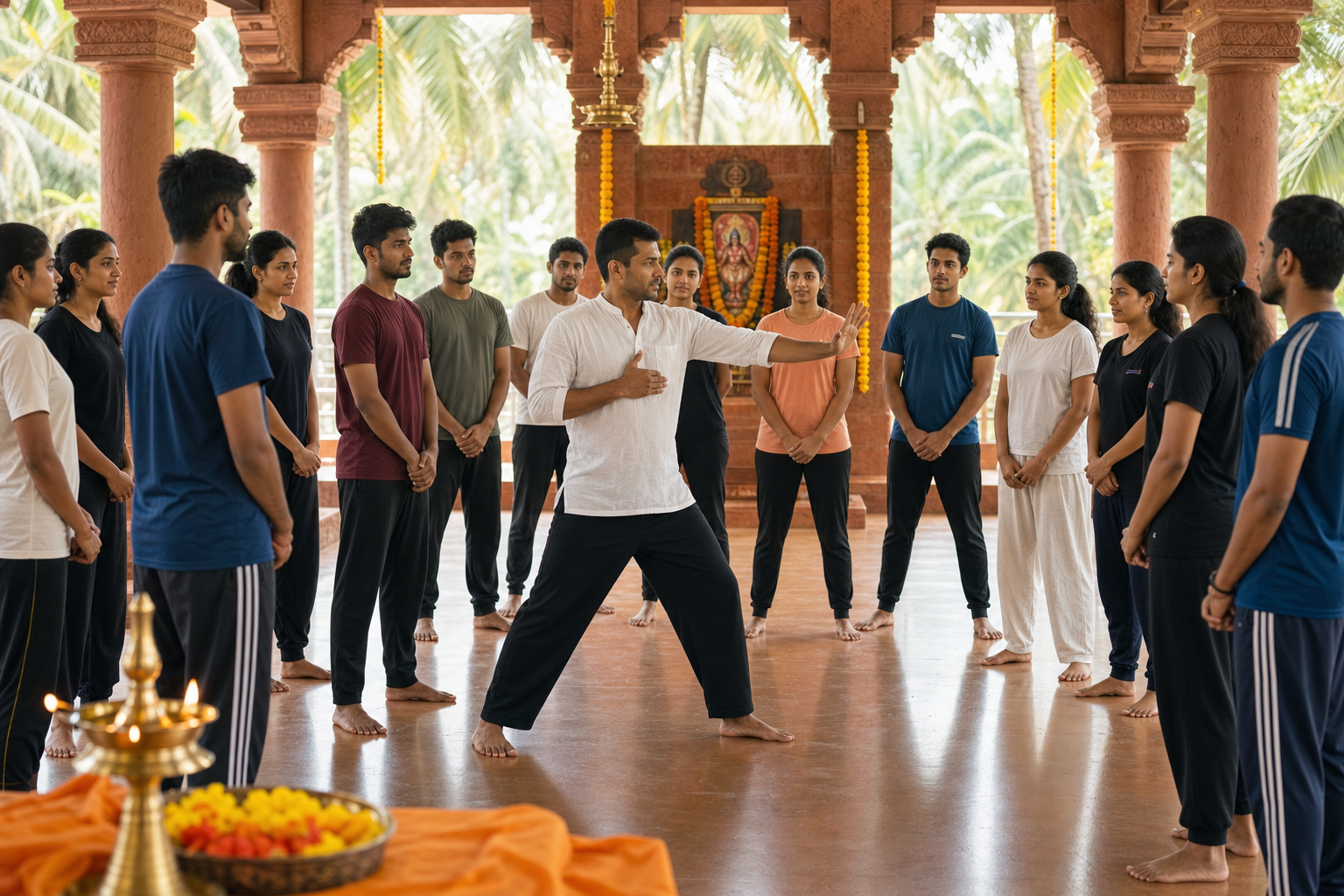
The seven-day ‘Har Ghar Yoddha’ self-protection camp organised by Hindu Janajagriti Samiti at Shri Amriteshwar Mandap in Amona, Goa, concluded successfully with the participation of 16 young men and women. The available report is brief, yet the event carries wider significance because it reflects a growing social emphasis on preparedness, discipline, confidence, and community responsibility among youth.
In its immediate form, the camp may be understood as a focused community training initiative. It brought together a small group of participants in a structured setting for seven days, allowing young people to engage with the idea of self-protection not merely as a physical skill, but as a broader discipline connected with alertness, composure, and responsibility toward family and society.
The phrase ‘Har Ghar Yoddha’ carries a strong cultural meaning. Literally suggesting the presence of a warrior in every home, it points to the idea that courage and readiness are not limited to armies, formal institutions, or public authorities. In a civilisational context shaped by Dharma, the concept of the yoddha is closely associated with self-restraint, protection of the vulnerable, and the responsible use of strength.
Such training becomes especially relevant in contemporary society, where personal safety, situational awareness, and psychological resilience are increasingly important for both young men and young women. A self-protection camp can help participants understand that safety begins before confrontation: in observation, posture, presence of mind, communication, boundary-setting, and the ability to respond calmly under pressure.
The location of the camp at Shri Amriteshwar Mandap in Amona also gives the event a community-centred character. Mandaps and local religious-cultural spaces in India have historically served not only as ritual venues, but also as gathering places for learning, dialogue, service, and social organisation. In that sense, the use of such a space for youth empowerment reflects continuity with an older pattern of community-based education.
The participation of 16 young men and women is significant because smaller groups often allow for closer instruction, more attentive correction, and deeper interpersonal engagement. In practical training environments, scale is not the only measure of impact. A smaller cohort can create a disciplined learning atmosphere where participants are able to ask questions, practise repeatedly, and internalise lessons more effectively.
Self-protection should not be reduced to physical techniques alone. A comprehensive understanding includes mental clarity, ethical conduct, physical fitness, emotional regulation, and awareness of legal and social boundaries. The most meaningful form of self-protection is not aggression, but preparedness guided by restraint and moral purpose.
Within Dharmic traditions, strength is often framed through responsibility rather than domination. Hindu, Buddhist, Jain, and Sikh traditions all preserve teachings that value courage, discipline, compassion, self-control, and service. Although their methods and philosophical vocabularies differ, these traditions share a deep concern for ethical action and the protection of life, dignity, and social harmony.
For Hindu society in particular, the idea of Kshatra has long represented the protective dimension of Dharma. Kshatra does not simply mean martial ability; it includes the willingness to stand for justice, preserve social order, and defend the innocent without losing inner balance. When taught responsibly, this idea can help young people cultivate confidence without encouraging hostility.
The broader value of a programme like ‘Har Ghar Yoddha’ lies in its ability to connect personal development with social responsibility. A young participant who learns discipline, awareness, and courage is better prepared not only for personal safety, but also for constructive citizenship. Communities benefit when their youth become more confident, respectful, organised, and service-minded.
In many Indian households, concerns around safety are experienced quietly and emotionally. Parents worry about children travelling alone, students face unpredictable public environments, and young women often carry the additional burden of evaluating risk in daily movement. A self-protection camp can respond to these anxieties by replacing fear with training, confusion with clarity, and helplessness with measured preparedness.
At the same time, academic and civic analysis requires a balanced understanding. Community self-protection initiatives are most effective when they remain rooted in lawful conduct, non-provocation, respect for all citizens, and cooperation with legitimate institutions. The purpose of such training should be the strengthening of society, not the creation of suspicion or division.
The Goa camp therefore deserves attention as a local example of youth empowerment through cultural organisation. Its importance does not rest only on the number of participants, but on the model it represents: a community identifying a practical need, bringing young people together, and using a disciplined setting to cultivate confidence and responsibility.
Goa’s social landscape is shaped by layered histories, local traditions, temple communities, coastal life, and diverse cultural interactions. In such an environment, programmes that strengthen community confidence while preserving mutual respect can contribute positively to civic life. The emphasis must remain on dignity, preparedness, and harmony across society.
The inclusion of both young men and women is particularly important. Safety training becomes more socially meaningful when it avoids narrow assumptions about who needs strength or who carries responsibility. Women’s participation challenges passivity, while men’s participation can be shaped toward restraint, service, and protective responsibility rather than impulsive displays of power.
From a technical perspective, effective self-protection education usually involves several layers: awareness of surroundings, assessment of risk, verbal de-escalation, confident body language, emergency response habits, basic physical conditioning, and knowledge of when to seek help. The available report does not specify the curriculum of this camp, so these elements should be understood as general components of responsible self-protection training rather than confirmed details of the programme.
The ethical foundation of such training is crucial. A person trained in self-protection must also be trained in judgment. Strength without discrimination can become reckless, while fear without training can become paralysis. The Dharmic ideal places both under the discipline of viveka, or discernment, so that action remains proportionate, lawful, and morally grounded.
The camp also highlights the continuing role of voluntary organisations in India’s social life. Beyond formal schooling, many young people develop character through local institutions, cultural groups, spiritual spaces, service initiatives, and disciplined camps. These informal learning spaces often shape confidence, identity, and community bonds in ways that conventional classrooms may not fully address.
For participants, the lasting value of the camp will likely depend on continued practice. Seven days can introduce habits, but long-term transformation requires repetition, reflection, and integration into daily life. The best outcome of such a programme is not merely the memory of a camp, but the formation of steadier conduct in ordinary situations.
The successful conclusion of the ‘Har Ghar Yoddha’ camp in Amona should therefore be read as more than a local event note. It points toward a wider conversation about youth empowerment, Hindu community organisation, Dharmic values, women’s confidence, civic responsibility, and the need for disciplined preparedness in modern India.
When framed with maturity, self-protection is not a message of fear. It is a message of responsibility. It teaches that every home can cultivate courage, every young person can develop awareness, and every community can become stronger when discipline is joined with compassion and Dharma is expressed through service.
Inspired by this post on Hindu Jagruti Samiti.
