
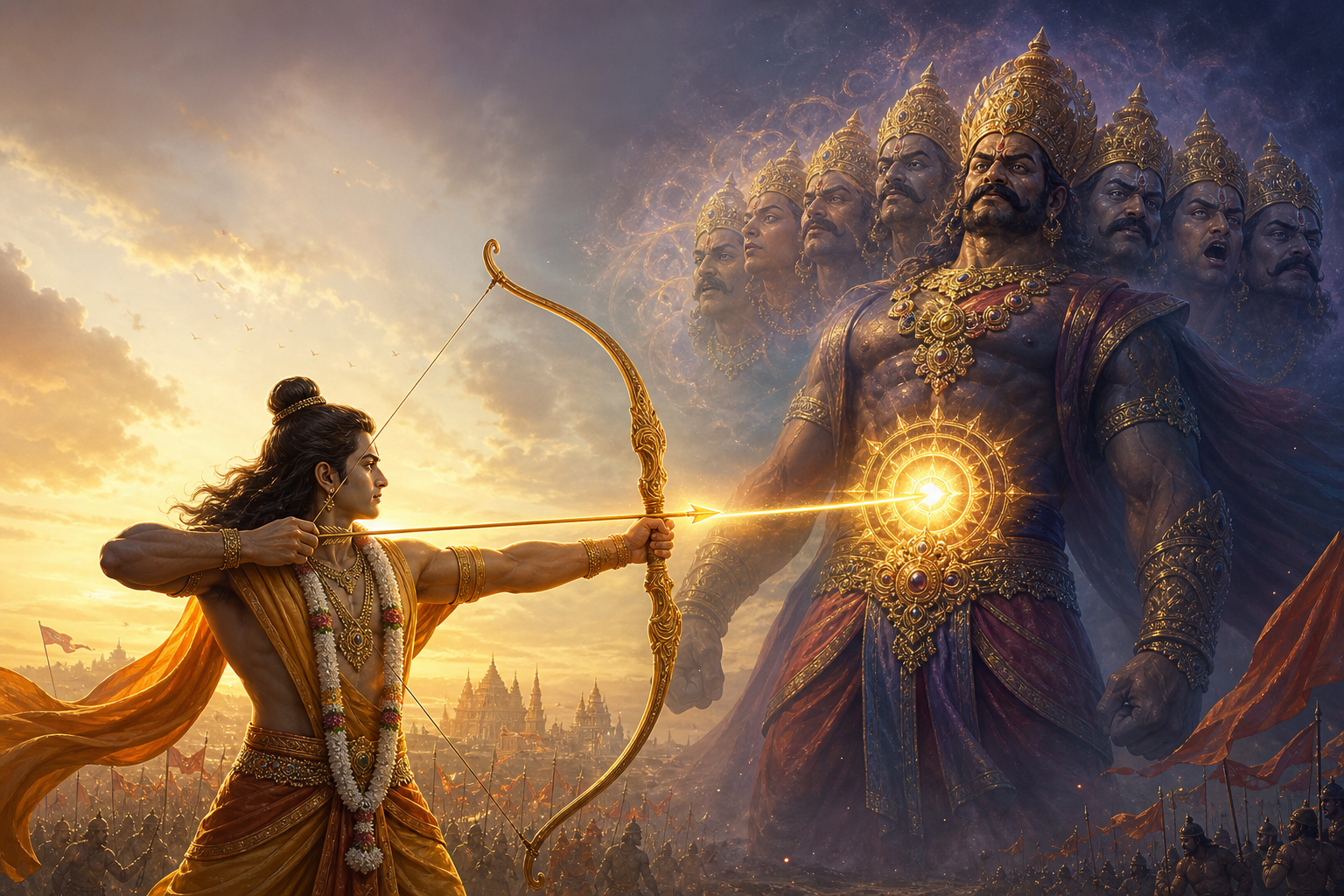
The episode of Bhagavan Rama’s final encounter with Ravana in the Ramayana is often remembered as a dramatic battlefield climax, but its deeper force lies in the philosophical architecture behind the image. Ravana, the ten-headed ruler of Lanka, is not presented merely as a physical enemy. He is a complex figure: a formidable king, a learned scholar, a master of austerities, a devotee of Lord Shiva, and yet a being ruined by adharma, arrogance, and unrestrained desire. That complexity is precisely what makes his fall so instructive.
In many popular retellings of the Ramayana, Rama repeatedly severs Ravana’s heads, only to see them reappear. The image is memorable because it speaks to a truth that extends beyond the battlefield of Lanka. A problem rooted in ego cannot be solved by cutting away its visible expressions alone. Anger, pride, obsession, cleverness without ethics, and power without restraint may be attacked one by one, yet they return if the deeper source remains intact.
It is important to distinguish between textual layers. In the Valmiki Ramayana, Rama ultimately kills Ravana through a divinely empowered missile, often understood as the Brahmastra, aimed at the vital center of the enemy. In several later, regional, devotional, and folk traditions, the emphasis shifts toward Ravana’s navel or abdominal region, where the secret of his resilience is said to lie. These traditions do not merely add spectacle; they interpret the battle symbolically, asking why the head, the seat of intellect and status, was not the final point of conquest.
The answer is profound. Ravana’s heads represent more than anatomy. They symbolize multiplied intellect without inner integration, knowledge without humility, and brilliance without surrender to dharma. His ten heads can be read as the many directions of uncontrolled thought, the many faces of ego, or the outward expansion of power that has lost contact with moral restraint. Rama’s victory, therefore, is not anti-intellectual. It is a correction of intellect that has been severed from righteousness.
Ravana’s tragedy is that he knows much but does not become wise. This distinction is central to Hindu philosophy and is equally resonant across Dharmic traditions. Knowledge, when purified by humility, becomes wisdom. Knowledge, when inflamed by possession, becomes bondage. Ravana can debate, rule, perform tapas, command armies, and understand sacred learning, yet he cannot govern the impulse that leads him to abduct Sita and defy repeated counsel. His defeat begins long before Rama’s arrow flies.
The regenerating heads are therefore a precise metaphor for the human tendency to treat symptoms while preserving causes. A person may suppress anger for a day, only to have it return through wounded pride. A society may punish visible wrongdoing, yet leave intact the deeper culture of entitlement that produced it. A leader may lose one argument and grow another head of justification. In this sense, Ravana is not only a mythological antagonist; he is a study in the resilience of adharma when its root remains untouched.
The “gut” or navel-centered reading of Ravana’s fall becomes meaningful in this context. In Indic thought, the abdominal region is not merely physical. It is associated with hunger, vitality, will, digestion, and the fire that transforms experience into energy. In yogic vocabulary, the region of manipura is linked with power, assertion, ambition, and personal force. When that force serves dharma, it becomes courage and disciplined action. When it serves ego, it becomes domination.
Rama’s final aim, as interpreted through this symbolic tradition, is directed not at Ravana’s crown but at the seat of his sustaining force. The crown may display authority, scholarship, and royal identity, but the deeper fuel lies elsewhere. Ravana’s downfall required the destruction of the internal engine that kept regenerating pride, appetite, and defiance. The lesson is clear: dharma does not merely defeat appearances; it reaches the root.
This is why the episode remains spiritually powerful. Many readers experience Ravana’s heads as familiar patterns within the self. One head argues, another desires, another remembers humiliation, another seeks admiration, another rationalizes harm, and another insists that power itself is proof of correctness. The Ramayana’s genius lies in showing that these heads cannot be permanently mastered by external force alone. They must be deprived of the inner nourishment that sustains them.
Rama, as Maryada Purushottama, represents the disciplined alignment of power with rightful conduct. His strength is not impulsive violence; it is governed force. He does not fight Ravana out of personal insecurity or rage. He fights because adharma has crossed the limits that protect family, society, sovereignty, and sacred order. This distinction matters because the Ramayana does not glorify aggression. It teaches that force becomes righteous only when it is subordinated to dharma.
Ravana’s crown symbolizes sovereignty, but sovereignty alone is not sacred. A ruler may possess wealth, armies, scholarship, architecture, and administrative brilliance, yet still become destructive if inner discipline collapses. Lanka is prosperous, but prosperity does not absolve injustice. Ravana is learned, but learning does not excuse violation. He is powerful, but power does not create moral authority. The Ramayana repeatedly insists that greatness without dharma is unstable.
The symbolism also cautions against reducing Ravana to a caricature. His greatness makes his fall more serious, not less. If he were merely foolish, the lesson would be simple. Instead, he embodies the frightening possibility that learning, devotion, and accomplishment can coexist with moral blindness. This is why Vibhishana’s counsel matters, why Mandodari’s grief matters, and why Ravana’s refusal to return Sita becomes the defining evidence of his inner disorder.
Across Hindu, Buddhist, Jain, and Sikh ethical traditions, a shared emphasis appears: conquest of the outer world is incomplete without conquest of the inner self. Hindu Dharma speaks of mastery over kama, krodha, lobha, moha, mada, and matsarya. Buddhist teachings analyze craving and ignorance as roots of suffering. Jain philosophy emphasizes self-restraint, non-attachment, and purification of karma. Sikh wisdom condemns haumai, the ego-centered condition that separates the being from truth. Ravana’s regenerating heads can be read within this broader Dharmic grammar of inner discipline.
This unity of Dharmic insight is essential. The Ramayana is a Hindu sacred narrative, but its moral psychology speaks in a language recognizable to all traditions that value self-mastery, compassion, humility, and truth. Ravana falls because he cannot restrain himself. Rama prevails because he acts from alignment, not appetite. The battlefield becomes a mirror of the inner life.
The image of severed heads returning again and again also has social relevance. Institutions often remove individual wrongdoers while leaving corrupt incentives untouched. Families may address arguments without addressing resentment. Communities may condemn visible conflict without healing pride, fear, and mistrust. The Ramayana’s symbolism suggests that durable transformation requires attention to causes, not only consequences.
In spiritual practice, this means that one cannot merely cut off a thought and assume liberation has been achieved. A deeper inquiry is needed: what feeds the thought? Is it insecurity, craving, jealousy, fear, or the need to dominate? Ravana’s heads return because their nourishment remains. Rama’s final act represents the discriminating wisdom that identifies the hidden source and ends the cycle.
There is also a subtle teaching about the limits of intellectual pride. The head is the visible seat of reasoning, language, planning, and identity. Ravana has too much head and too little surrender. His intellect is not absent; it is excessive, fragmented, and self-serving. Rama does not reject intellect; he restores its proper place beneath dharma. The crown must serve truth, not replace it.
The abdominal symbolism adds another layer. The gut is the region of appetite, instinct, will, and embodied drive. Ravana’s problem is not that he thinks; it is that his thinking serves an unpurified appetite. His scholarship becomes an instrument of self-justification. His courage becomes stubbornness. His kingship becomes possession. His devotion becomes selective, lacking the humility that true devotion requires.
Rama’s arrow, then, is not merely a weapon. It is a symbol of viveka, discriminating wisdom. It does not wander among endless branches. It goes to the root. This is the practical teaching that makes the episode enduring: when facing recurring patterns, one must ask where they are being fed. Without that inquiry, every severed head grows back.
The fall of Ravana is therefore not simply the defeat of a villain. It is the collapse of brilliance without restraint, devotion without humility, and sovereignty without justice. Rama’s victory is not only martial; it is metaphysical and ethical. Dharma prevails because it knows where to aim. It does not confuse the crown with the core, or the symptom with the source.
For modern readers, this interpretation offers a disciplined way to engage the Ramayana beyond spectacle. The question is not only how Rama defeated Ravana, but what within Ravana made defeat inevitable. The answer lies in the gap between knowledge and wisdom, power and righteousness, desire and duty. That gap is the true battlefield.
Ravana’s regenerating heads remain a powerful symbol because they describe the persistence of unresolved inner tendencies. Rama’s final aim remains equally powerful because it teaches that transformation requires depth. The Ramayana does not ask readers merely to admire divine victory from a distance. It invites them to examine the heads that keep returning in their own lives and to seek the root from which they arise.
In that sense, the hidden wisdom of Ravana’s fall is timeless. The crown may dazzle, the heads may argue, and the world may be impressed by display. Yet dharma looks deeper. Rama’s victory teaches that the real conquest is not the destruction of intelligence, ambition, or strength, but their purification. Only when power is joined to restraint, knowledge to humility, and action to dharma does the cycle of regeneration end.
Inspired by this post on Hindu Blog.
