
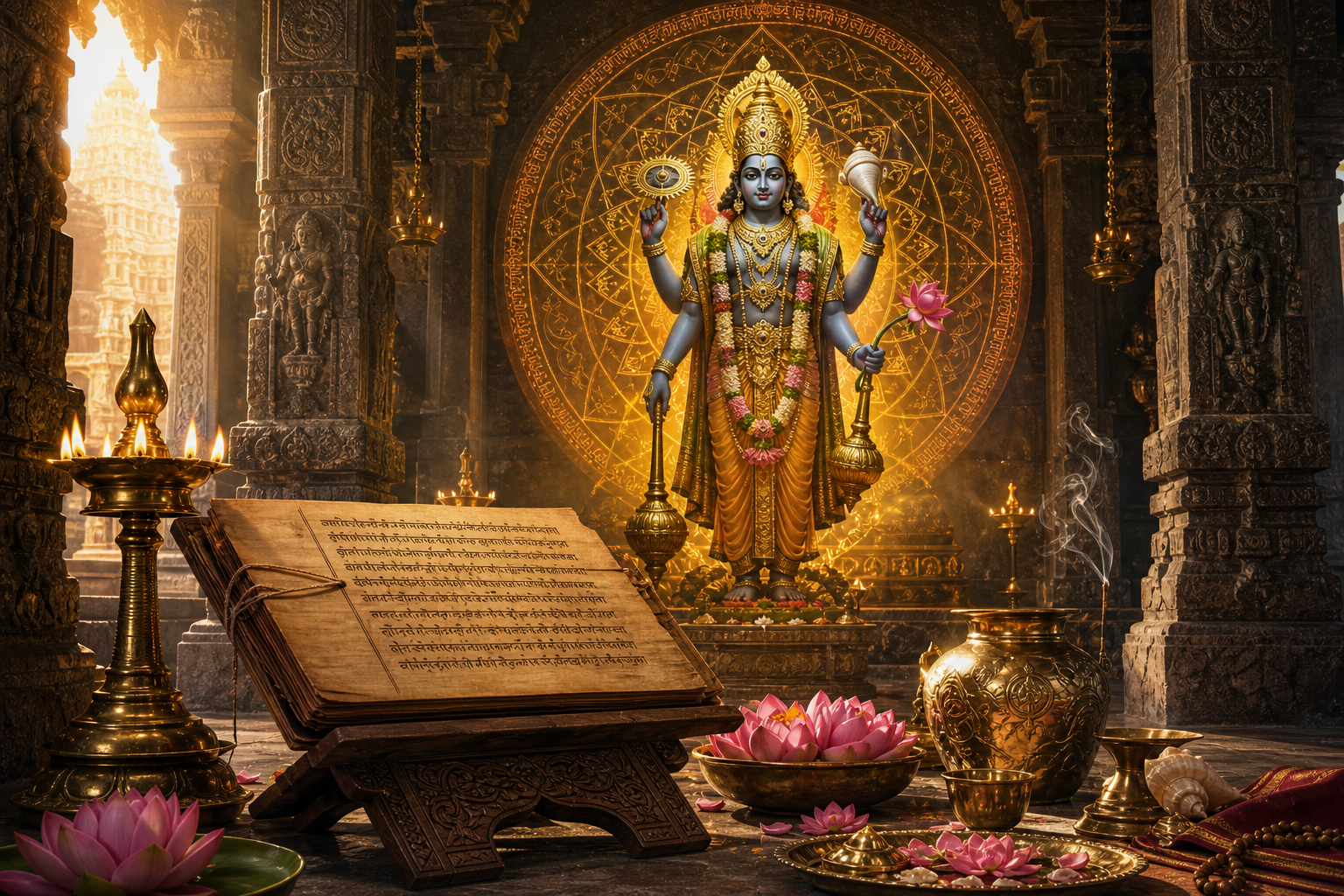
The Paushkara Samhita occupies a distinguished place within the Pancharatra tradition, one of the most influential Vaishnava Agama streams of Hindu scriptures. It is remembered as a sacred manual in which theology, temple ritual, iconography, mantra, devotion, and disciplined spiritual life are brought into a coherent framework. Rather than treating worship as a merely external performance, the text presents divine worship as a complete path: the body is disciplined, the senses are refined, the mind is focused, and the devotee is gradually oriented toward Vishnu-Narayana as the supreme reality.
Within the larger world of ancient texts, the Paushkara Samhita is especially significant because it belongs to the Pancharatra Samhitas, a body of Vaishnava literature associated with Narayana, Vishnu, Vasudeva, and the devotional forms through which the Divine becomes accessible to human beings. Pancharatra literature is not limited to abstract philosophy. It also addresses temple construction, consecration, daily worship, festivals, personal discipline, mantra practice, and the sacred relationship between the deity, the priest, the devotee, and the community.
The available tradition describes the Paushkara Samhita as a work of forty-three chapters. This structure suggests a text designed not as a brief devotional reflection but as a comprehensive ritual and theological guide. Its scope reflects a classical Indian understanding of sacred knowledge: true knowledge is not separated from practice, and true practice is not separated from metaphysical insight. The Paushkara Samhita therefore serves both as scripture and as a working manual for those who seek to understand how worship becomes a disciplined means of spiritual transformation.
The word Pancharatra is commonly interpreted as “five nights,” though traditional and scholarly explanations vary. In religious usage, the term came to designate a Vaishnava system centered on the revelation of Narayana and the orderly worship of the Divine through mantra, image, ritual, meditation, and devotion. This tradition later became deeply important to several Vaishnava sampradayas, including Sri Vaishnavism, Madhva traditions, and other devotional lineages that gave central importance to Vishnu and his manifestations.
One reason the Paushkara Samhita remains important is that it reveals the technical depth of Hindu ritual culture. In many modern discussions, ritual is misunderstood as repetition without reflection. The Pancharatra approach offers a very different vision. Ritual is treated as an embodied philosophy. Every gesture, offering, mantra, image, direction, purification, and sequence is connected to a larger understanding of reality. Worship is not random emotion; it is devotion organized through knowledge.
The Paushkara Samhita also reflects the theological richness of Vaishnava Agama literature. Pancharatra texts commonly speak of the Divine through categories such as Para, Vyuha, Vibhava, Antaryamin, and Archa. These categories allow the devotee to understand how the Supreme can be transcendent and yet present, formless in essence and yet approachable through consecrated form. The Archa form, the visible and ritually established deity, becomes especially important in temple worship because it allows devotion to take shape through sight, offering, sound, fragrance, touch, and disciplined service.
This vision gives the Paushkara Samhita a distinctive spiritual character. The text does not reduce the deity to stone, metal, wood, or artistic form. Instead, it teaches that properly consecrated iconography becomes a sacred focus through which divine presence is invoked, honored, and experienced. The image is not treated as an idol in the crude sense often imposed by outsiders; it is understood as a ritually awakened center of relationship between the devotee and the Divine.
In this framework, temple worship becomes a public expression of inner theology. The sanctum is not merely an architectural chamber. It is a symbolic center of the cosmos. The deity is not merely an object of reverence. The deity is the living axis around which daily time, community identity, ethical obligation, and spiritual aspiration are arranged. The Paushkara Samhita belongs to that civilizational world in which temples were not only places of prayer but also centers of learning, music, art, ritual discipline, charity, social continuity, and cultural memory.
The text is especially associated with iconography and worship. This makes it valuable for understanding how sacred form is created, interpreted, and served in Vaishnava practice. Iconography in the Hindu tradition is never merely decorative. The posture of the deity, the number of arms, the weapons, the ornaments, the mudras, the attendants, the pedestal, and the surrounding symbols all communicate theological meaning. In a Pancharatra context, these visual details help the devotee contemplate the nature of Vishnu as protector, sustainer, inner ruler, cosmic source, and compassionate refuge.
The Paushkara Samhita also helps explain why temple worship requires discipline. A ritual sequence is not performed casually because it is meant to reorder human attention. Purification prepares the body. Mantra prepares the speech. Meditation prepares the mind. Offering prepares the heart. Circumambulation, prostration, lamps, incense, flowers, food offerings, and sacred recitation create a rhythm in which ordinary life is redirected toward sacred awareness. In this way, ritual becomes a pedagogy of devotion.
The Pancharatra tradition commonly emphasizes a daily rhythm of worship known through categories such as abhigamana, upadana, ijya, svadhyaya, and yoga. These terms point to approaching the Divine, gathering materials for worship, performing offering, studying sacred knowledge, and engaging in contemplative discipline. Whether or not every practitioner follows these in a formal manner, the spiritual logic is clear: devotion must touch the whole day, not only a brief moment of prayer.
This is one of the most relatable aspects of the Paushkara Samhita for contemporary readers. The text comes from an ancient ritual world, yet its deeper concern remains immediate. Human beings still struggle with distraction, restlessness, ego, insecurity, and forgetfulness of higher purpose. A structured sacred routine offers more than religious formality; it offers a way to gather scattered attention and place life under the discipline of meaning.
The emotional power of such a text lies in its confidence that divine presence can be approached through care. The devotee does not need to abandon the world in order to live spiritually. Flowers, water, lamps, food, fragrance, music, architecture, learning, and community can all become vehicles of worship. The Paushkara Samhita therefore reflects a deeply Hindu understanding of sacred life: the material world is not rejected as worthless; it is refined, consecrated, and offered back to its divine source.
Philosophically, the Paushkara Samhita belongs to a tradition that sees Narayana or Vishnu as supreme while also allowing a sophisticated account of manifestation. The Divine is beyond ordinary perception, yet becomes accessible through ordered forms. This idea preserves both transcendence and intimacy. The Supreme is not diminished by appearing in forms of worship; rather, divine compassion is expressed through accessibility. The temple deity, the mantra, and the ritual sequence become bridges between the finite and the infinite.
The text also contributes to the broader Hindu conversation on unity in diversity. Hindu Dharma has never depended on a single uniform ritual model. Shaiva, Shakta, Vaishnava, Smarta, Ganapatya, Saura, Buddhist, Jain, Sikh, and other dharmic traditions have all developed distinct disciplines while sharing concern for liberation, ethical refinement, sacred knowledge, and transformation of the human being. The Paushkara Samhita should therefore be read not as a sectarian weapon but as one luminous expression of a wider dharmic civilization.
This point is essential for modern engagement. The Paushkara Samhita is a Vaishnava text, and its devotional center is Vishnu-Narayana. Yet its method reveals values that resonate across dharmic traditions: reverence for disciplined practice, respect for lineage, the sanctity of sound, the importance of right conduct, the refinement of perception, and the transformation of ordinary life into a path of awakening. Such shared principles help build unity without erasing difference.
As a sacred text, the Paushkara Samhita also preserves the intellectual seriousness of temple culture. Temples were not built only through artistic inspiration; they were shaped by textual traditions, ritual expertise, mathematical proportion, architectural symbolism, and inherited systems of consecration. The Agama literature gave communities a way to maintain continuity across generations. It ensured that worship was not reinvented casually but transmitted with care, responsibility, and fidelity to sacred memory.
The ritual sections of Pancharatra literature show that devotion requires training. The priest is not merely a functionary, and the devotee is not merely an observer. Both participate in a sacred order. The priest maintains the liturgical body of the temple; the devotee brings faith, humility, and offering; the community sustains the institution; and the deity stands at the center as the living object of love and surrender. This integrated model explains why temple worship has endured across centuries of political change, migration, social transformation, and cultural disruption.
The Paushkara Samhita is also important for the study of bhakti. In many devotional settings, bhakti is described as love, surrender, longing, remembrance, and service. The Pancharatra tradition adds a technical dimension to this devotion. Love must be expressed through proper attention. Surrender must be embodied through disciplined action. Remembrance must be sustained by daily rhythm. Service must be performed with purity of intention and clarity of method. In this way, the text brings together emotion and order.
Such a balance is valuable because spiritual life often declines when either side is neglected. Ritual without devotion can become mechanical. Emotion without discipline can become unstable. The Paushkara Samhita represents the classical attempt to unite both: the heart is softened by devotion, and devotion is protected by structure. This is why Pancharatra wisdom continues to speak to those who seek both spiritual intimacy and theological depth.
The text also invites reflection on the role of sacred sound. Pancharatra worship gives importance to mantra, recitation, invocation, and the verbal precision of ritual. In Hindu traditions, sound is not merely a communication tool; it is a subtle force that shapes consciousness. Mantra disciplines speech and mind, creating a field of attention in which the devotee is no longer scattered across ordinary concerns. When sound, form, gesture, and intention are aligned, worship becomes a complete contemplative act.
From a historical perspective, the Paushkara Samhita belongs to a larger development in which Vaishnava worship became increasingly systematized. The growth of temple institutions, the elaboration of iconography, the rise of devotional theology, and the transmission of ritual manuals all contributed to the durability of Vaishnava practice. Pancharatra texts helped communities preserve worship across regions while allowing local temple cultures to develop their own beauty and personality.
The Paushkara Samhita is sometimes mentioned alongside other major Pancharatra works such as the Sattvata Samhita and Jayakhya Samhita. Together, these texts are often treated as especially important witnesses to early and classical Vaishnava Agama thought. Their importance lies not only in age but in their ability to show how doctrine, ritual, and devotional experience were woven together into a durable sacred system.
For students of Hindu philosophy, the Paushkara Samhita demonstrates that Indian thought cannot be limited to the well-known darshanas alone. Philosophical insight also lives in ritual manuals, temple texts, hymns, Puranas, Agamas, and commentarial traditions. A text concerned with worship may also contain a profound view of reality. In the dharmic world, philosophy is not always presented as abstract argument; it is often enacted through sacred time, sacred space, and sacred discipline.
For students of Hindu art and temple architecture, the Paushkara Samhita is equally valuable. It shows that sacred images are governed by meaning. The form of Vishnu, the arrangement of attributes such as shankha, chakra, gada, and padma, and the ritual care given to the deity all belong to a system in which beauty is theological. Art is not separated from worship; it becomes a visual scripture.
For spiritual practitioners, the text offers a reminder that sacred life depends on continuity. A lamp lit daily, a mantra repeated with attention, a deity served with care, and a scripture studied with humility can reshape the inner life over time. The Paushkara Samhita may be ancient, technical, and specialized, but its underlying discipline speaks to a universal human need: the need to turn habit into worship and time into remembrance.
The text also has contemporary relevance because many modern Hindus are seeking to reconnect with temple traditions beyond surface-level familiarity. A festival may be attended, a darshan may be received, and a mantra may be heard, yet the deeper structure behind these practices often remains unexplored. The Paushkara Samhita helps restore that missing depth. It shows that temple worship is not a collection of isolated customs but a carefully organized sacred science.
This sacred science is not opposed to reason. It operates through a different kind of reasoning: symbolic, contemplative, liturgical, and experiential. The devotee learns through repetition, attention, offering, and participation. The meaning of worship is not exhausted by explanation; it is gradually understood by being practiced. This is why Agama traditions have endured even when they are not widely read by the general public. They live through temples, priests, festivals, family memory, and the quiet devotion of communities.
The Paushkara Samhita also teaches respect for inherited knowledge. In an age that often values novelty more than continuity, such texts remind society that civilization survives through transmission. Sacred traditions must be studied, preserved, translated, taught, and practiced responsibly. Manuscripts, ritual lineages, temple customs, and oral instruction together form a living archive of Hindu heritage.
At the same time, responsible study requires care. The Paushkara Samhita should not be reduced to a slogan or treated as a simple handbook detached from lineage. Agama texts often require traditional guidance because their ritual details are technical and context-sensitive. Academic study can clarify history and structure, while living tradition preserves practice and meaning. Both forms of engagement can enrich understanding when approached with humility.
The broader dharmic lesson of the Paushkara Samhita is that worship is a path of integration. Knowledge, action, devotion, art, community, body, speech, and mind are brought together around the Divine. This integration is one of the great strengths of Hindu spirituality. It allows a temple ritual to become philosophy in motion, and it allows philosophy to become something lived, seen, heard, touched, and offered.
In this sense, the Paushkara Samhita remains more than an ancient Vaishnava scripture. It is a witness to a refined civilization of worship. It preserves a world in which divine presence is approached with beauty, precision, humility, and love. It reminds modern readers that Sanatana Dharma is not only a set of beliefs but a disciplined way of sanctifying life. Through the Paushkara Samhita, Pancharatra wisdom continues to affirm that the path to the Divine can be intellectual, ritual, emotional, artistic, and deeply communal at the same time.
Reference note: accessible orientation on Pancharatra literature may be found at https://en.wikipedia.org/wiki/Pancharatra and on the Sattvata Samhita at https://en.wikipedia.org/wiki/Sattvata_Samhita. These references are useful starting points, while traditional study of the Paushkara Samhita is best approached through Sanskrit editions, qualified teachers, and the living Vaishnava Agama tradition.
Inspired by this post on Hindu Blog.
