
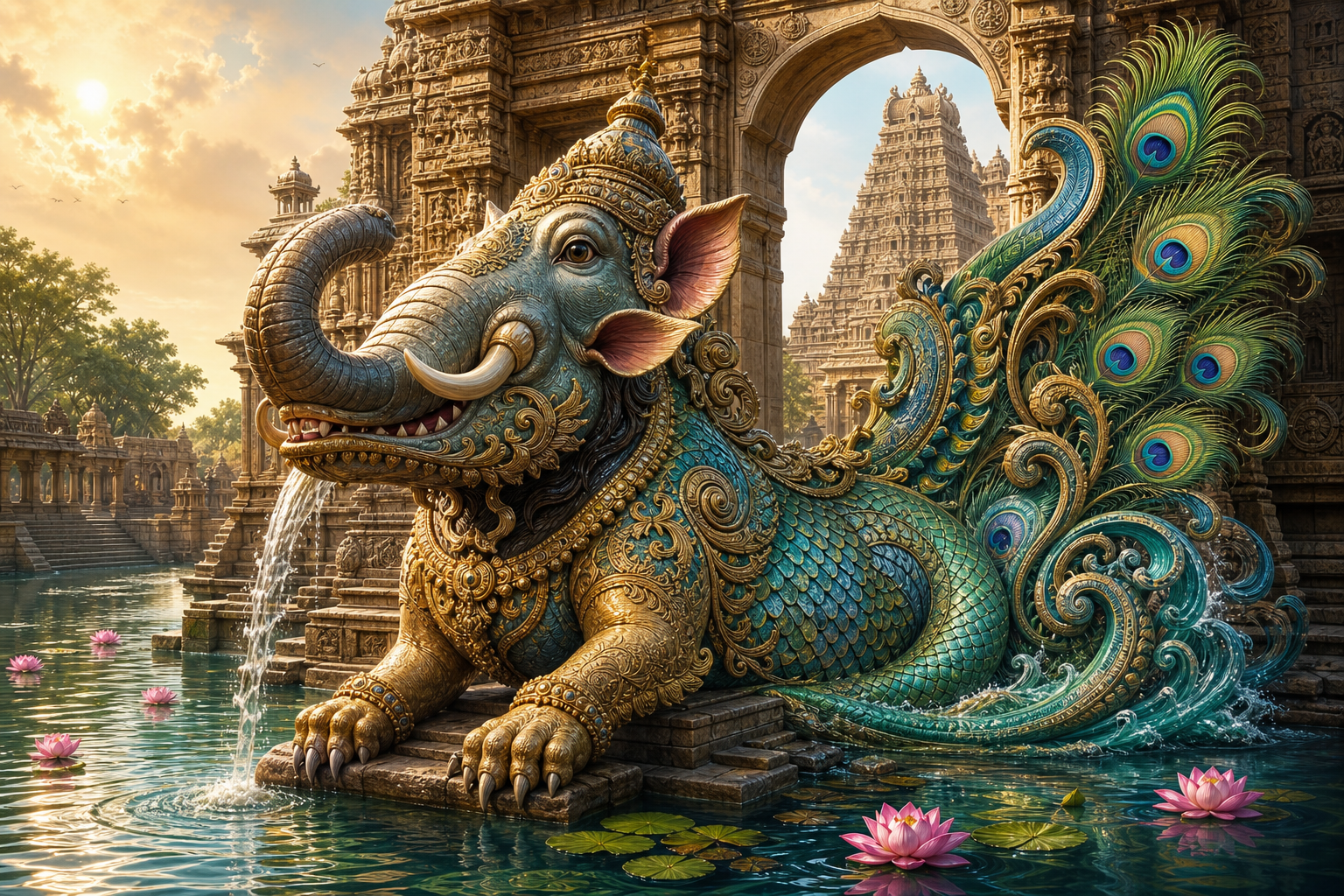
Makara occupies a distinctive place in Hindu scriptures, temple architecture, sacred art, and dharmic symbolism. It is usually described as a powerful aquatic or semi-aquatic being, yet its importance goes far beyond zoological curiosity. In the Hindu imagination, Makara is not merely a crocodile, fish, or sea monster. It is a composite divine creature whose body gathers the strengths of several animals into one symbolic form, presenting a visual theology of abundance, protection, fertility, movement, and cosmic interdependence.
The seven-animal form of Makara is especially meaningful because it shows how Hindu symbolism often works through synthesis rather than reduction. Traditional descriptions vary by region, artistic school, and textual lineage, but a widely cited iconographic formulation presents Makara as composed of the trunk of an elephant, the jaws or lower jaw of a crocodile, the tusks and ears of a wild boar, the darting eyes of a monkey, the scales and flexible body of a fish, the feet of a lion, and the tail feathers of a peacock. This is not a random combination. Each animal contributes a quality that deepens the symbolic personality of Makara.
The elephant element suggests strength, memory, royal dignity, and the power to clear obstacles. The crocodile element connects Makara with rivers, marshes, danger, depth, and the mysterious threshold between visible and hidden worlds. The boar element evokes earth-force, penetration, survival, and rescue from submerged conditions, recalling broader dharmic associations of the boar with restoration. The monkey eyes imply alertness, quick perception, and restless intelligence. The fish body marks Makara as a creature of water, fertility, and movement through the unseen. The lion feet give it majesty and guardianship. The peacock tail adds beauty, radiance, and auspicious display.
This composite form helps explain why Makara became one of the most enduring motifs in Hindu art and architecture. It appears at temple entrances, on archways, near water outlets, on stair rails, around sacred thrones, and in ornamental designs. In many temples, Makara functions as a guardian of thresholds. It stands between ordinary space and consecrated space, between the outer world of movement and the inner world of darshana. The devotee may not always name the creature while walking past it, yet its presence quietly shapes the emotional atmosphere of the temple: protection, transition, and entry into a more refined order of experience.
In Hindu scriptures and sacred traditions, Makara is closely associated with water deities and river goddesses. It is famously known as the vahana of Varuna, the deity connected with cosmic waters, moral order, and the vastness of the oceanic realm. Makara is also associated with Ganga and Narmada in iconography, where it represents the force, sanctity, and life-giving power of sacred rivers. This connection is significant because water in Hindu thought is not simply a physical element. It is purifying, generative, dangerous, and spiritually transformative.
The Sanskrit word Makara is often connected with crocodile-like or sea-creature meanings, but its iconographic development is richer than any single biological identification. In some contexts it resembles a crocodile; in others it has the face of an elephant and the body of a fish; elsewhere it appears as a fabulous aquatic being with a curling tail, floral extensions, or dragon-like qualities. Such variation should not be treated as confusion. It reflects the ability of Hindu sacred art to preserve a symbolic core while allowing regional creativity and ritual imagination to flourish.
The relationship between Makara and Varuna is especially important for understanding its theological function. Varuna is linked with the encompassing waters and with rta, the moral and cosmic order that sustains existence. A creature associated with Varuna therefore becomes more than a decorative aquatic animal. Makara becomes an emblem of the deep structure of life itself: hidden, powerful, fertile, unpredictable, and governed by a cosmic law that human beings must learn to respect.
Makara also appears in relation to Kamadeva, the deity of desire, who is known by the epithet Makaradhvaja, meaning one whose banner bears the Makara. This connection expands the meaning of Makara from water and guardianship into the domain of longing, creativity, attraction, and generative energy. Desire, in dharmic thought, is not treated simplistically. It can bind, distract, and disturb, but it can also generate household life, beauty, affection, poetry, and continuity. Makara on the banner of Kamadeva therefore carries the symbolism of deep, instinctive, life-affirming force.
In the broader Vaishnava context, Makara is also connected with Pradyumna, the son of Sri Krishna, who is associated in several traditions with Kamadeva. This strengthens the link between Makara and the refined symbolism of love, attraction, and royal charisma. The creature is therefore not limited to fearsome aquatic power. It also participates in the aesthetics of beauty, relationship, and auspicious vitality.
Makara-kundala, the Makara-shaped earring, is another important expression of this symbolism. Deities such as Vishnu, Shiva, Surya, and Devi forms are often shown wearing ornate earrings that echo the Makara form. In sacred iconography, ornaments are not superficial embellishments. They communicate metaphysical status, divine qualities, and cosmic functions. Makara-kundala suggests that the divine hears and contains the depth of waters, the power of life, and the complex energies of creation.
The architectural use of Makara is equally profound. On temple gateways and toranas, paired Makaras often appear at the ends of arches from which vegetal scrolls, mythical beings, or divine forms emerge. This design suggests that the waters of creation give rise to life, order, and sacred manifestation. In some temples, Makara-shaped spouts release consecrated water, visually joining the mythic creature with the practical ritual movement of water. The image becomes functional theology: sacred water passes through a being that already symbolizes the hidden power of water.
For many temple visitors, Makara creates a subtle but memorable experience. It is strange enough to pause the mind, beautiful enough to invite admiration, and familiar enough through its animal elements to feel connected to the natural world. This is one of the strengths of Hindu sacred art. It does not always explain itself through direct verbal instruction. Instead, it allows form, repetition, placement, and ritual setting to educate perception over time.
The seven-animal composition of Makara also supports a deeper philosophical reading. Hindu thought frequently recognizes unity within diversity. The human body, the cosmos, society, ritual, and spiritual practice are often understood as layered wholes made of many interacting parts. Makara expresses this idea visually. It is one creature, but it is not uniform. Its unity is achieved through coordinated diversity. The elephant does not erase the fish, the crocodile does not cancel the peacock, and the lion does not dominate the monkey. Each contributes to a greater symbolic organism.
This makes Makara an especially useful symbol for understanding dharmic civilization itself. Hinduism, Buddhism, Jainism, and Sikhism developed distinct philosophies, practices, disciplines, and sacred vocabularies, yet they also share civilizational concerns with dharma, self-cultivation, ethical life, liberation, compassion, restraint, and reverence for the sacred. Makara’s composite form can be read as a reminder that unity need not require sameness. A living tradition can hold many forms without losing its center.
Makara’s presence in Buddhist and wider South Asian art further demonstrates the shared visual language of dharmic cultures. It appears in protective and ornamental settings across regions, adapting to local religious and artistic needs while retaining its association with water, guardianship, and liminal power. This continuity is important because it shows that sacred symbols often travel through culture as bridges rather than barriers. They help communities recognize related patterns of meaning even when doctrines and ritual forms differ.
In Hindu cosmology, water is one of the most powerful symbols of origin. Creation narratives, pilgrimage practices, purification rites, temple tanks, rivers, and sacred bathing all reveal the centrality of water. Makara belongs naturally to this world. It inhabits the depth from which life emerges and into which form dissolves. Its frightening aspects are not separate from its auspicious aspects. Like the river in flood or the ocean in storm, Makara represents a power that nourishes and overwhelms, protects and tests, conceals and reveals.
This duality explains why Makara is an ideal guardian. A guardian in Hindu sacred architecture is rarely a soft or passive figure. The guardian must possess force. It must be capable of protecting sacred space from disorder, impurity, and hostile intention. Makara’s crocodile jaws, lion feet, and aquatic body make it a fitting symbol of protective energy. At the same time, its peacock tail and ornamental beauty prevent it from becoming merely terrifying. It guards through magnificence as much as through strength.
The Makara also has astrological importance. Makara is the Sanskrit name for the zodiac sign Capricorn, and Makara Sankranti marks the solar transition into Makara rashi in the traditional calendar. While the calendrical and iconographic meanings are not identical in every context, both show the symbolic weight of Makara as a marker of transition. Makara Sankranti is associated with movement, auspicious beginnings, harvest rhythms, and the northward course of the sun. The creature of thresholds thus also belongs to a wider symbolic field of passage and renewal.
The technical study of Makara requires attention to textual, ritual, and artistic layers. Scriptural references establish its divine associations; Puranic and epic traditions connect it with gods, rivers, and mythic events; Shilpa Shastra and temple-building traditions shape its visual grammar; regional art gives it distinctive local expression. A single rigid description cannot exhaust the creature. Its meaning emerges from the interaction of literature, sculpture, ritual use, and lived devotion.
It is also necessary to distinguish between the biological crocodile and the symbolic Makara. The crocodile may be one of its prototypes, and the Sanskrit term often carries that association. Yet the Makara of sacred art is not simply a natural animal copied into stone. It is a mythic compression of animal powers. Its body teaches that the sacred imagination can use nature as a vocabulary for metaphysical insight. Animal forms become philosophical statements.
The seven elements of Makara may be read as a symbolic map of capacities. Elephant strength, crocodile depth, boar endurance, monkey alertness, fish fluidity, lion authority, and peacock beauty together form an integrated ideal. This integration is not only external. It can be understood inwardly as well. Human life also requires strength, depth, endurance, alertness, adaptability, courage, and grace. Makara therefore speaks not only to temple walls and sacred rivers, but also to the inner discipline of becoming whole.
Such a reading remains consistent with the broader dharmic habit of seeing the outer world as a mirror of inner realities. Mountains, rivers, trees, animals, planets, and mythical beings are not treated as inert objects alone. They become carriers of insight. Makara, in this sense, is an educational image. It trains the eye to recognize that complexity can be sacred, that power can be beautiful, and that difference can become harmony when ordered by dharma.
The emotional appeal of Makara lies in this fusion of mystery and recognition. A viewer may see the elephant trunk first, then the fish body, then the crocodile mouth, then the peacock tail. The mind assembles the image gradually. That process is itself meaningful. It mirrors the way spiritual understanding often develops: not by grasping the whole at once, but by recognizing one aspect, then another, until a larger pattern becomes visible.
Makara also challenges modern assumptions about mythology. It is easy to dismiss composite beings as fantasy, but that misses their intellectual function. In traditional art, a composite creature can express layered truth more effectively than a naturalistic figure. Makara is not meant to be a zoological report. It is a symbolic technology, a disciplined artistic device for communicating ideas about water, desire, danger, fertility, guardianship, beauty, and cosmic unity.
When studied carefully, Makara reveals the sophistication of Hindu symbolism. It links the temple to the river, the river to creation, creation to desire, desire to discipline, and discipline to sacred order. Its body gathers the animal world into a single form, just as Hindu sacred culture gathers ritual, philosophy, art, music, architecture, and devotion into an integrated path of meaning. This is why Makara remains one of the most powerful composite creatures in Hindu scriptures and temple tradition.
Makara’s enduring relevance lies in its message of integrated diversity. In an age often tempted to flatten traditions into slogans, Makara preserves a more refined lesson. The sacred is not always simple, and unity is not always uniform. A civilization can be many-bodied and still coherent. A symbol can be ancient and still speak to modern minds. A creature made of seven animals can become a profound teacher of water, wisdom, protection, beauty, and dharmic harmony.
Inspired by this post on Hindu Blog.
