
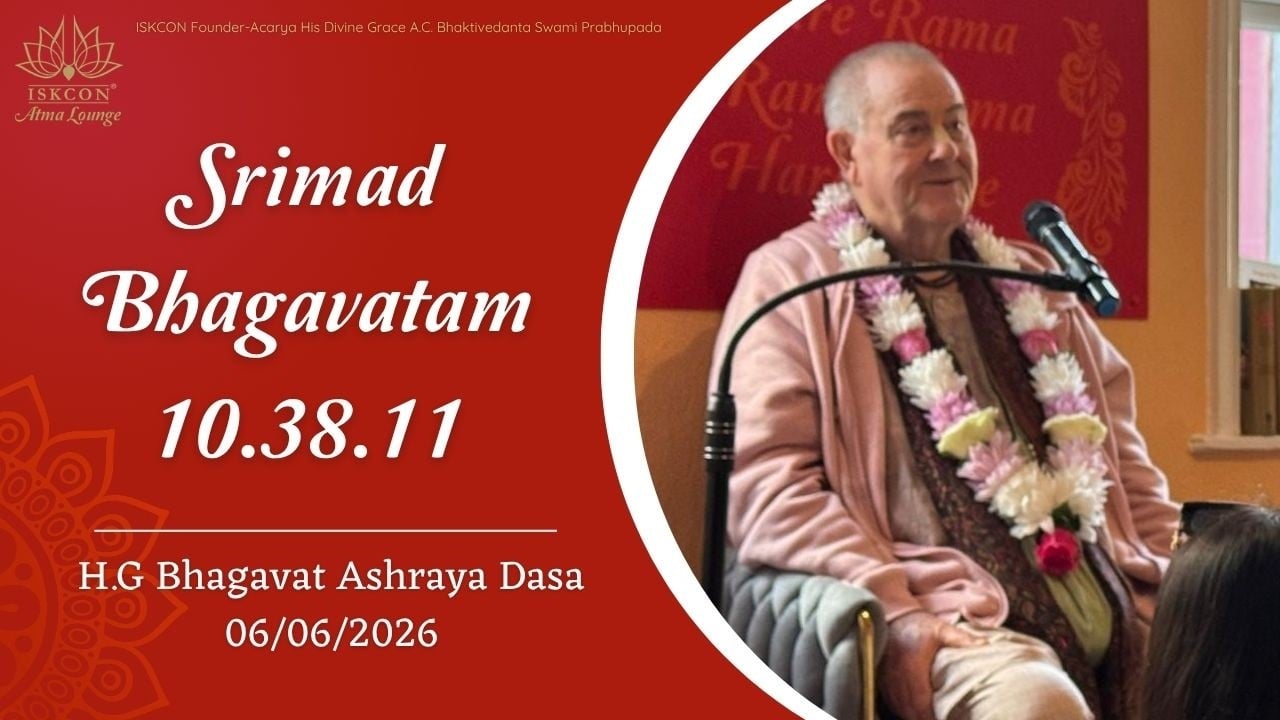
On 06.06.2026, Atma Lounge Folkestone hosted a Srimad Bhagavatam session centered on SB 10.38.11, delivered by HG Bhagavat Ashraya Das. Set within the Tenth Canto of the Bhagavata Purana, the verse captures the inner world of Akrūra as he journeys toward Vraja, carrying the weight of political obligation and the light of uncompromising devotion. The discussion below situates the verse within its narrative arc, explores its theological and philosophical implications, and distills practical applications for contemporary spiritual practice across the dharmic familyHinduism, Buddhism, Jainism, and Sikhism.
The Tenth Canto presents Sri Krishna’s līlā as an integrated revelation of ontology, ethics, and aesthetics. Chapter 38 focuses on Akrūra’s journey to Vraja at the command of Kaṁsa, a tyrant whose summons forces Akrūra into a morally liminal space. Within this tension, verse 11 appears early in the chapter and distills Akrūra’s devotional psychology: anticipatory joy, reverential fear, and unwavering theological confidence that Kṛṣṇa’s darśana is the apex of spiritual life. Without reproducing the Sanskrit of the verse, it can be said that its thematic center is longinga refined devotion (bhakti) that transforms travel into pilgrimage and perception (dṛṣṭi) into sacred seeing (darśana).
Akrūra’s interior monologue exemplifies a classic Bhakti Tradition insight: darśana is not merely the eye seeing the divine but the heart being seen by the divine. In Vedic wisdom, this reciprocity reframes spiritual epistemology. Śabda (scriptural testimony) shapes expectation; smaraṇa (devotional remembrance) refines attention; and at the moment of darśana, pratyakṣa (direct perception) is elevated by grace (anugraha). The result is not only an event of sight but a transformation of being.
The narrative context is equally significant. Akrūra travels under state orders while privately aligned with dharma. The Bhagavata Purana often stages such contrasts to probe how inner allegiance to Bhagavān can be maintained amid compromised outer roles. SB 10.38.11, by dramatizing longing on the road to Vraja, turns ordinary motion into a soteriological movement: geography yields to inner topology, and the landscape of Vraja becomes a cartography of the heart.
A theological thread running through the Tenth Canto is the Bhagavān–Paramātman complementarity. Akrūra’s anticipation assumes both the personal immediacy of Sri Krishna (Bhagavān) and the all-pervading witness (Paramātman). The longing to meet Kṛṣṇa face-to-face coexists with awareness that the same divinity pervades the cosmos. This simultaneously intimate and universal orientation reflects a hallmark of the Bhagavata’s theism: a love-anchored ontology that fulfills metaphysics through relationship.
Traditional commentaries illuminate this verse’s inner grammar of devotion. The medieval exegetical lineagerepresented by figures such as Śrīdhara Svāmī, Jīva Gosvāmi, and Viśvanātha Cakravartīconsistently highlights how kṛpā (grace) meets sādhana (disciplined practice) at the moment of darśana. Akrūra’s meditations exemplify śravaṇa (hearing), kīrtana (glorification), and smaraṇa (remembrance) converging into sākṣātkāra (realization). In Gaudīya Vaiṣṇava theologyembraced widely in ISKCONthe verse’s emotive charge aligns with acintya-bhedābheda-tattva, the doctrine of inconceivable oneness and difference, making devotion both ontologically coherent and existentially satisfying.
From the standpoint of literary aesthetics (rasa), the verse models a bhakti-rasa of expectancyakin to the refined joy felt before a temple’s sanctum opens or when a familiar kīrtana begins. Many practitioners relate to this quiet intensity: the breath subsides, the mind steadies, and a subtle inner warmth signals meaningful encounter. Akrūra’s longing universalizes that experience, demonstrating how attention, love, and philosophy cohere at the threshold of darśana.
An ethical dimension surfaces through Akrūra’s predicament: working under a despotic regime while nurturing unwavering devotion. The Bhagavata does not romanticize political duty; rather, it shows how conscience operates within constraint. SB 10.38.11 suggests a template for modern dilemmas: inner alignment to dharma, careful discernment (viveka), and readiness to turn any journeycommute, service, or studyinto a pilgrimage of awareness. This is not escapism but ethical presence: remaining fully engaged while allowing devotion to refine motive and method.
Philosophically, the verse invites a broader reflection on vision itself. In classical Indian thought, dṛṣṭi is never value-neutral; it is filtered through saṁskāras (impressions) and saṅkalpas (intentions). By saturating vision with bhakti, the Bhagavata claims that perception can be morally and metaphysically rehabilitated. Akrūra’s expectancy performs this rehabilitation: the eyes learn to love, and love learns to see truly.
Across the wider Akrūra narrative in adjacent chapters, pilgrimage, bathing, and revelation interweave, reinforcing a sacred geography in which the Yamunā, the paths of Vraja, and the dust of Vrindavan function as catalysts of remembrance. The arc underscores a critical soteriological claim: sacred space is most potent when met by sacred intention. SB 10.38.11 stands at this arc’s threshold, condensing intent into a luminous expectancy.
Comparative dharmic perspectives deepen the verse’s relevance. In Buddhism, cultivated attention (smṛti) and right view (samyak-dṛṣṭi) re-educate perception toward compassion and clarity; Akrūra’s expectancy mirrors this disciplined, loving awareness. Jain practice emphasizes samayik (meditative equanimity) and purification of darśana-mohanīya karma (delusion affecting right vision); Akrūra’s longing embodies a rectified view ordered toward the highest good. Sikh tradition honors darshan of the Guru Granth Sahib and kirtan within the sangat; Akrūra’s state exemplifies the heart’s readiness for grace-enabled seeing and seva-inspired living. These resonances foster unity in spiritual diversity without flattening doctrinal distinctiveness.
Hermeneutically, SB 10.38.11 benefits from classical interpretive canons: upakrama–upasaṁhāra (opening–closing coherence), abhyāsa (repetition), and arthavāda (elevating statements). The Tenth Canto repeatedly establishes Kṛṣṇa as the ontological center and love as the epistemic method; Akrūra’s verse aligns with that through-line. It functions as a hinge: narrative momentum meets devotional interiority, preparing readers and listeners for theophany through the pedagogy of longing.
For practice, three pathways emerge. First, integrate śravaṇa and kīrtana into daily rhythm so that remembrance becomes ambient rather than episodic. Second, treat movementwalking, commuting, travelingas pilgrimage by silently invoking the holy names within the Hare Krishna tradition or one’s own dharmic mantra, allowing breath to anchor attention. Third, cultivate ethical clarity in complex roles: let devotion illuminate decision-making without abandoning responsibility. These disciplines operationalize the verse’s psychology of expectancy.
In educational settings, SB 10.38.11 offers a model for interdisciplinary learning. Literature students encounter a masterclass in narrative interiority; philosophers meet a living dialogue on perception, testimony, and realization; practitioners receive a sādhanā map where aesthetics refine ethics and metaphysics. The verse thus functions as scripture (śāstra), art (kāvya), and guide (nirdesha) simultaneously.
The setting of Atma Lounge Folkestone underscores another feature of the Bhagavata Purana: its portability across times and places. A community gathers, a scripture is heard, memory is stirred, and the present becomes charged with purposeful attention. Listeners often report that the quiet before a class, the cadence of recitation, or a single well-placed insight recreates Akrūra’s expectancy within their own hearts.
For those engaging this verse through the ISKCON educational stream, the Gaudīya emphasis on acintya-bhedābheda harmonizes transcendence and immanence in a manner that keeps practice grounded and relational. Sri Krishna is both the heart’s most intimate companion and the source of the cosmos; longing for darśana therefore becomes a longing to live truthfully, lovingly, and courageously in every spherehome, work, community.
Ultimately, SB 10.38.11 portrays longing as a disciplined joy. It shows that anticipation, rightly formed by Scripture (Scriptures) and stabilized by devotion (Bhakti Tradition), becomes a pramāṇa-like mode of knowingone that readies the practitioner for what grace intends to give. In this way, the verse serves seekers across Hindu Dharma, Buddhism, Jainism, and Sikhism: it invites a shared confidence that love-ordered attention transforms vision, and transformed vision reorders life.
In contemporary terms, the verse encourages a practical vow: approach each day as Akrūra approached Vrajaeyes soft with reverence, mind steady with remembrance, and conduct guided by compassion. Such a posture unifies the inner and outer journeys, turning ordinary hours into sacred thresholds. Through this union of insight and practice, SB 10.38.11 continues to illuminate the path of devotion and the promise of darśana for all who seek with sincerity.
Inspired by this post on Dandavats.
