
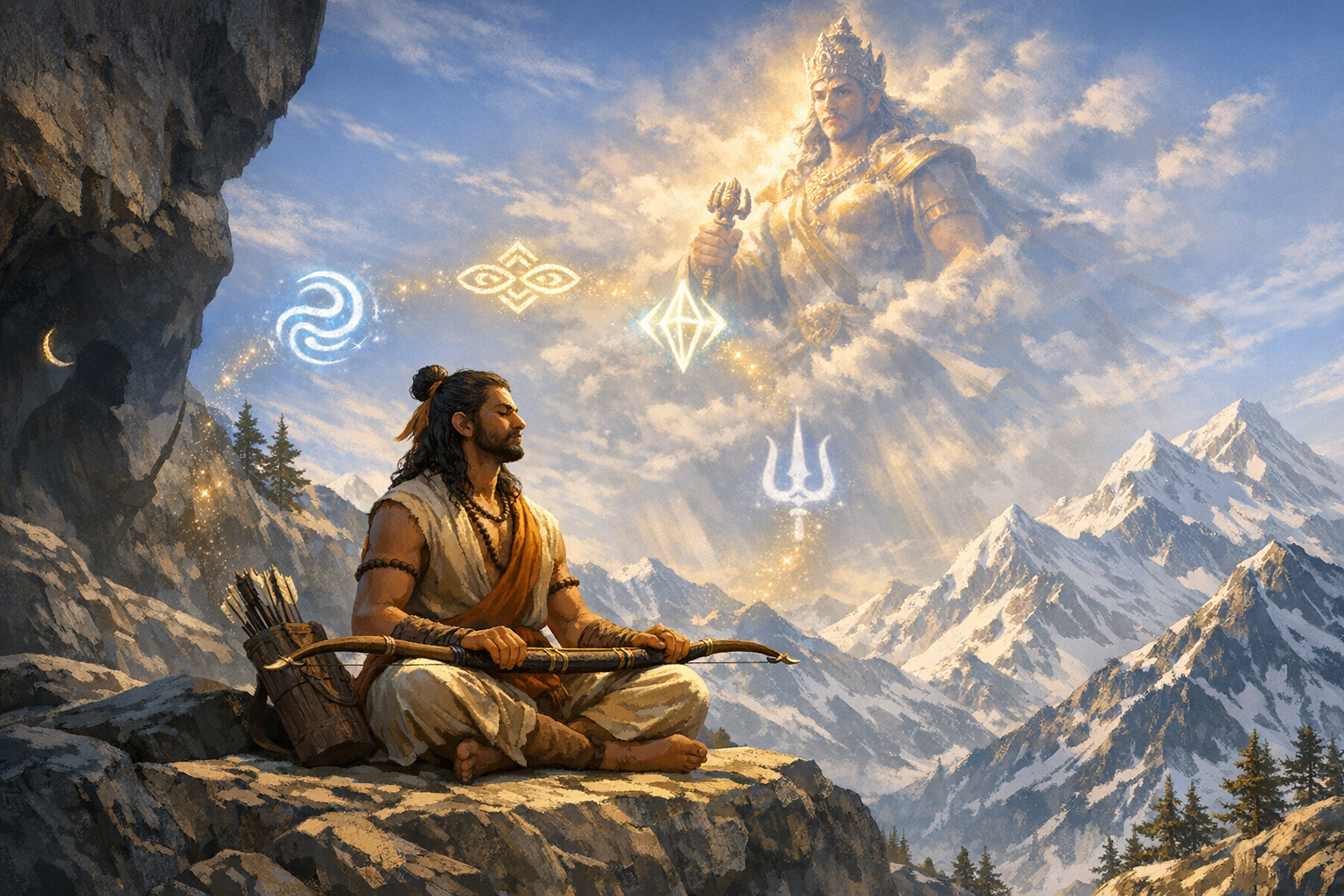
Among the many transformative passages in the Mahabharata, Arjuna’s solitary ascent to Indrakeel (Indrakila) Mountain during the forest exile (vanvas) is singular in charting his integrated evolutionspiritual, ethical, and martial. Guided by Vyasa to cultivate inner strength equal to outer skill, Arjuna enters the Himalayan wilderness not merely to gain celestial weapons (divyāstras) but to refine the very foundations of Kshatra Dharma. This episode culminates in a decisive darshan of Indra, his divine father, and initiates a sequence of teachings and trials that shape the Pandava archer into the exemplar of disciplined power subordinated to dharma.
Textually, the episode belongs to the Vana Parva, with its core motifs elaborated in the Kirata Parva, and celebrated in classical Sanskrit literaturemost notably Bharavi’s Kirātārjunīya. While regional memory often locates Indrakeel at different sacred geographies (for example, traditions around Indrakiladri in Andhra), the epic situates Arjuna in the Himalayan expanse, where isolation, elemental austerity (tapas), and the counsel of rishis converge. This multiplicity of place-names points less to contradiction than to a pan-Indic pattern of sacred remembrance, where the geography becomes a mirror of the mind’s ascent from restlessness to single-pointed resolve.
Vyasa’s instruction frames Arjuna’s quest: the coming Dharma-Yuddha requires more than prowess; it requires inner mastery and the rare sanction to wield extraordinary force only in the service of justice. Thus Arjuna undertakes vows (vratas), curtails sensory indulgence (indriya-nigraha), and directs his life-breath toward tapas. The goal, explicitly, is not personal glory but lokasangrahathe safeguarding of social orderthrough the acquisition and right application of knowledge and power. This shift from ambition to responsibility is the quiet ground on which the later audience with Indra becomes both possible and meaningful.
Indrakeel’s slopes supply a stage as pedagogical as it is physical. The terrain’s starkness enforces simplicity; its silences invite attention; its dangers demand composure. Arjuna’s regimen blends dhyana, mantra-japa dedicated to Mahadeva (Rudra), and bodily austerities that steady the bow-hand by steadying the mind. The Himalayan setting is no mere backdrop; it is a living discipline that aligns breath, sight, and will. Observers of yogic psychology will recognize the movement from distraction toward ekāgratā (one-pointedness), without which the swift perception, ethical reflex, and precise release of the kshatriya cannot mature.
In the epic’s arc, Indra first approaches Arjuna in ascetic guise, probing intention and redirecting method. The counsel is clear: to bear the greatest responsibility, first seek the sanction of the greatest power; therefore, propitiate Shiva. This is not sectarian preference but civilizational pedagogyan insistence that those who would wield force must first subordinate themselves to a higher, impersonal order. Indra’s intervention exemplifies the dharmic principle that even divinity cooperates in layered ways: father, teacher, and guardian roles are harmonized for the aspirant’s growth. Arjuna internalizes the lesson; the ascent deepens.
The famed encounter with Shiva as the Kirata follows: a wild boar (Muka in asura-form) appears; two hunters’ arrows strike; a quarrel escalates into a grueling trial. Arjuna’s combat with the Kirata, fought at the very threshold of exhaustion, becomes a crucible of humility and insight. Recognizing divinity behind the hunter’s majesty, he surrenders pride and gains the Pashupatastrathe terrifying, tightly regulated missile of Mahadevatogether with stern injunctions governing its ethical use. The devas then appear in radiance; among them, Indra affirms the path and confers additional astras, making explicit the compact that power must remain yoked to restraint.
Arjuna’s audience with Indra on Indrakeel seals the apprenticeship in clarity. No longer disguised, Indra addresses him as both son and claimant to a larger trust. Two entwined themes dominate the exchange: capacity and character. Capacity, in the form of celestial weapons, can be transmitted; character, in the form of discrimination (viveka), must be forged. Indra promises further training in svargatechnical mastery, strategic acumen, and arts that refine perceptionwhile reiterating the golden rule of Kshatra Dharma: force is legitimate only as the last, proportionate instrument to restore balance, never as an indulgence of anger or vanity.
The subsequent sojourn in Indra’s realm completes what Indrakeel begins. Under Matali’s guidance, Arjuna learns celestial charioteering, command under pressure, and the dynamic calculus of battlefield dharma. With Chitrasena, he studies music and dance, training attention, rhythm, and gracefaculties as vital for a warrior’s timing as for an artist’s poise. The episode with Urvashi and her śāpa (eunuchhood for a year) secures, paradoxically, Arjuna’s future honor as Brihannala during the incognito exile (ajñātavāsa). In combating the Nivātakavachas, he rehearses the ethical use of superior means against asymmetrical threats, guided by Indra’s constant oversight.
Viewed through the lens of the Mahabharata’s ethical architecture, Indrakeel tests whether brahma-tejas (the radiance of knowledge) can govern kshatra-tejas (the radiance of force). Arjuna’s austerity disciplines desire; Shiva’s mandate disciplines technique; Indra’s counsel disciplines purpose. The synthesis yields a rule-of-engagement recognizable across dharmic thought: use minimum necessary force, seek de-escalation where possible, and subordinate victory to justice. This anticipates the epic’s later insistence that a kshatriya’s worth is measured not only by what he can do, but by what he refrains from doingeven under extreme provocation.
The astras themselvesVaruna’s for waters, Yama’s for restraint, Indra’s for thunderous precision, and the Pashupatastra under the severest interdictionsencode a jurisprudence of power. Each is effective, yet each is hedged by dharma. The Mahabharata’s pedagogy is thus technical and moral: know the means, master the controls, heed the limits. In contemporary ethical language, Indra’s instruction and Shiva’s injunctions articulate a principle of minimum violence for the preservation of order, anticipating later reflections on just war and proportionality within Sanatana Dharma’s own terms.
Indrakeel, read symbolically, is the “stake” (kīla) that anchors the mind against the storm of impulsesIndra here evoking the luminous intelligence that governs the senses (indriyas). The mountain stands as the inner citadel; tapas is the fortification; darshan is the charter to act. Arjuna’s ascent maps a psychological geography: pratyāhāra (withdrawal), dhāraṇā (concentration), and dhyāna (meditative absorption) align with the archer’s praxis of sighting, stilling, and releasing. The episode’s enduring appeal springs from this dual readability: it is literal history within an epic frame and a manual of interior architecture for those who seek mastery without domination.
A comparative dharmic lens underscores shared civilizational values. Buddhist literature similarly venerates disciplined attention; even Śakra (Indra) appears in the Nikāyas as a deva who reveres the Buddha’s teaching, signaling a universe ordered by ethical law rather than divine caprice. Jain thought exemplifies tapas and radical ahiṁsā, offering a demanding ideal of restraint that reframes power as self-conquest. Sikh tradition articulates the sant-sipahi (saint-soldier) idealNirbhau, Nirvairechoing Indrakeel’s synthesis of courage without hatred. Across these traditions, the moral of the mountain endures: spiritual clarity must govern strength, and diversity of sādhanā is a civilizational asset, not a liability.
For contemporary readers, the Indrakeel narrative offers practical counsel. Mentorship matters: Vyasa’s guidance initiates, Indra’s instruction calibrates, and Shiva’s test authenticates. So does environment: periods of intentional solitude recalibrate attention in an age of overload. Techniques that train rhythm, breath, and poisewhether through yoga, music, or martial disciplinetransfer directly to decision-making under stress. Above all, the story models how to hold authority lightly, deploy it justly, and return to stillness swiftlyhabits as valuable in civic leadership and public service as on a mythic battlefield.
A brief philological note is warranted. The critical edition of the Mahabharata preserves the Himalayan setting for Arjuna’s tapas, though later regional retellings enrich the tradition with local identifications such as Indrakiladri. Such plurality illustrates the epic’s capaciousness: it is a pan-Indic text inhabiting many landscapes without surrendering its thematic core. The essentials remain constanttapas, testing, sanction, and service to dharmawhile the living geography of devotion situates the ascent within familiar horizons.
In sum, Arjuna’s meeting with Indra on Indrakeel is not a spectacle of divine favoritism; it is a syllabus in responsibility. Tapas grounds power; Shiva’s boon binds power to law; Indra’s grace aligns power with purpose. The result is the Arjuna who will later hear the Bhagavad-Gita, prepared not only to act, but to discriminate rightly before acting. Read this way, Indrakeel becomes less a remote peak than a perennial pathopen to all who seek unity of insight, character, and action across the diverse, harmonizing streams of India’s dharmic traditions.
Inspired by this post on Hindu Blog.
