
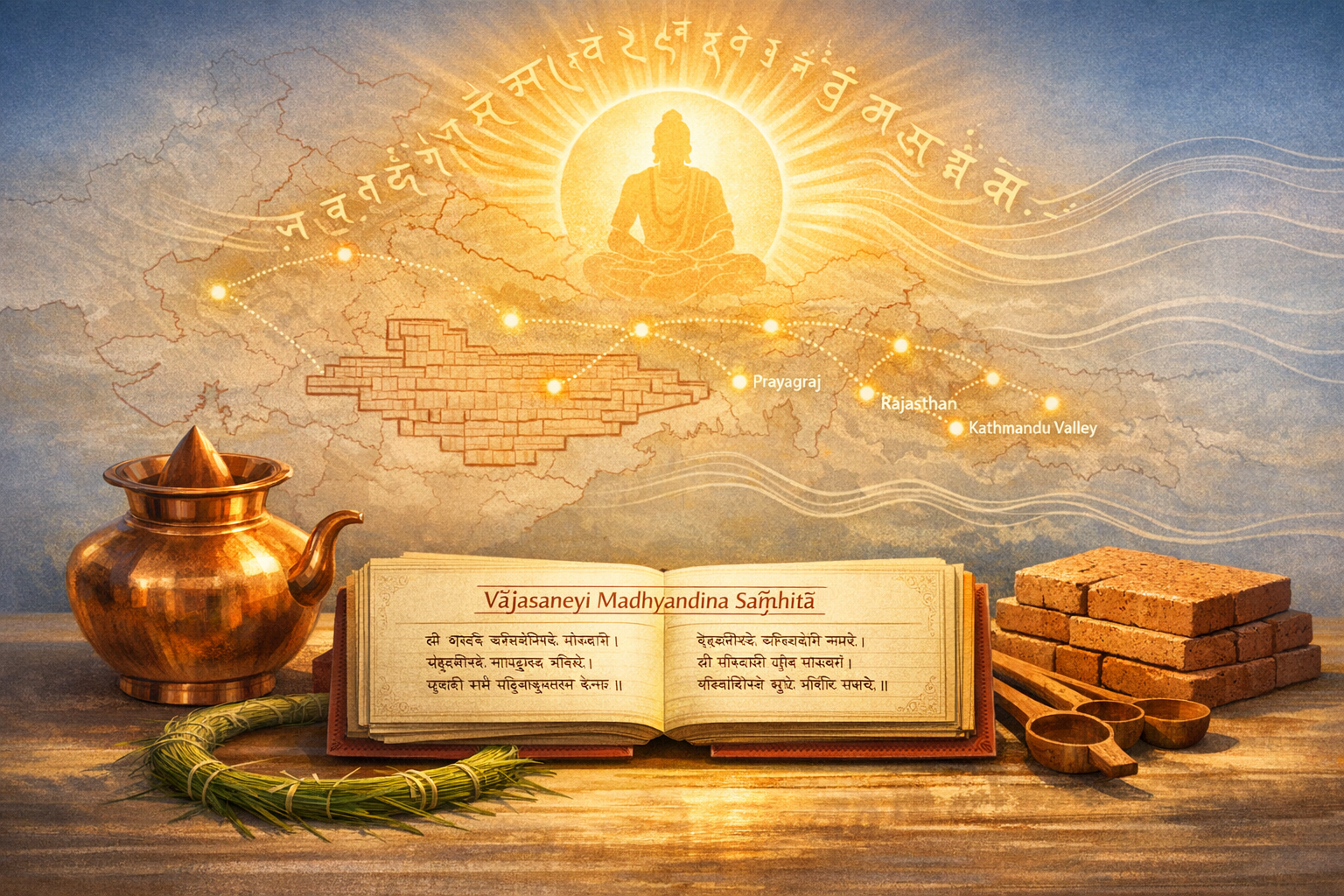
Madhyandina Shakha is one of the two authoritative recensions (shakhas) of the Shukla Yajurveda, the other being the Kanva Shakha. As part of the Yajurvedathe body of Vedic knowledge that articulates sacrificial formulas (yajus) and ritual procedure (vidhi)the Madhyandina tradition preserves both the precision of Vedic liturgy and a profound philosophical vision. Its lineage is traditionally traced to Yajnavalkya, a revered sage and disciple of Vaishampayana, whose role in receiving and transmitting the Vājasaneyi corpus made the Shukla (“White”) Yajurveda a distinct, tightly organized textual stream within the larger Vedic literature.
According to Vedic tradition, a schism in the teaching lineage led Yajnavalkya to relinquish what he had learned from Vaishampayana and obtain a purified, re-ordered body of mantras directly from Surya (the Sun). This narrative underlies the defining difference between the Krishna (“Black”) and Shukla (“White”) Yajurveda: the former intermixes mantras with explanatory prose, while the latter cleanly separates a mantra Samhita from its associated Brāhmaṇa exposition. Within this Shukla stream, the Madhyandina Shakha preserves a distinct recension that is both liturgically rigorous and philosophically fertile.
The textual core of the Madhyandina tradition consists of the Vājasaneyi Madhyandina Saṁhitā (VMS) and the Śatapatha Brāhmaṇa (Madhyandina recension). The VMS, arranged into forty adhyāyas (chapters), provides mantras for a wide spectrum of śrauta rituals (such as new- and full-moon offerings, soma rites, and major royal consecrations) as well as formulations that ground domestic observances. The fortieth chapter of this Samhita transmits the Isha Upanishad, a concise yet far-reaching meditation on action, renunciation, and the all-pervading Self. The Śatapatha Brāhmaṇa (in the Madhyandina recension of fourteen kāṇḍas) is among the most detailed Brāhmaṇa texts, illuminating altar construction, offering sequences, cosmological symbolism, and the inner meanings of sacrifice; it also includes the Brihadaranyaka Upanishad, a monumental work of inquiry into ātman, knowledge, and liberation.
Complementing Samhita and Brāhmaṇa are the auxiliary texts that anchor pedagogy and practice. The Kātyāyana Śrauta Sūtra systematizes grand ritual sequences in meticulous procedural detail, while the Pāraskara Gṛhya Sūtra prescribes household rites (saṁskāras) such as marriage, initiation, and ancestral offerings as preserved in the Madhyandina Shakha. Phonetic and recitational standards are codified in the Vājasaneyi Prātiśākhya, which sets rules for accent (svara), euphonic combination (sandhi), and delivery, thereby safeguarding the oral precision essential to Vedic transmission.
In comparison with the Kanva Shakha, the Madhyandina exhibits differences in mantra ordering, a number of lexical and phonetic variants, and a distinct alignment of passages between corresponding chapters. Notably, the Śatapatha Brāhmaṇa survives in two recensionsfourteen kāṇḍas in Madhyandina and seventeen in Kanvareflecting parallel yet closely related streams of ritual hermeneutics. Despite these variants, the two recensions share the same ritual grammar and theological architecture, and together they demonstrate the Vedic commitment to preserving both continuity and legitimate diversity of expression.
Historically and sociogeographically, the Madhyandina Shakha has been especially prominent in North India and Nepal. Centers of learning and practice flourished in Mithila, Kāśi (Varanasi), Prayāga (Prayagraj), parts of Rajasthan and Gujarat, and in the Nepali Tarai and Kathmandu Valley. Manuscript and oral lineages from these regions exhibit a robust continuity, with local pedagogical lineages (paramparās) sustaining both daily recitation and advanced liturgical performance.
The oral pedagogy of the Madhyandina tradition, consistent with Vedic norms, proceeds through layered recitation modes: saṁhitā-pāṭha (continuous), pada-pāṭha (word-by-word), krama-pāṭha (ordered pairs), jaṭā, and ghanā, each increasing in mnemonic complexity and precision. Instruction emphasizes the three Vedic accentsudātta, anudātta, and svaritaso that tonal contours and phonetic integrity remain unbroken. This training is anchored by śikṣā and prātiśākhya guidance, ensuring fidelity to sound values that are as vital to meaning as the semantic content of the mantras themselves.
In ritual life, the Madhyandina Shakha furnishes mantras and procedures for core śrauta offerings such as Agnihotra, Darśa-Pūrṇamāsa, Cāturmāsya, and soma sacrifices, as well as for grand consecrations including Vājapeya, Rājasūya, and Aśvamedha. The Śatapatha Brāhmaṇa (Madhyandina) is a major source for the agnicayana tradition of layered altar construction, including the famed hawk-shaped altar (śyena-citi), where geometry, number, and cosmology converge to map the sacrificial space. In domestic practice, the Pāraskara Gṛhya Sūtra guides saṁskāras from upanayana (initiation) to vivāha (marriage), and many Yajurvedic mantras known from weddings across North India and Nepal reflect the Madhyandina liturgical stream. The recurring ritual refrainssuch as svāhā, vaṣaṭ, and idam na mamaencode both action and renunciation, binding intent, offering, and ethical restraint into a single liturgical arc.
Philosophically, the Madhyandina corpus frames yajña not only as outward rite but as an inner discipline that refines intention and knowledge. Yajnavalkya’s dialogues in the Brihadaranyaka Upanishadespecially the profound exchanges with Gārgī and Maitreyīinterrogate the nature of the imperishable Self (ātman), the limits of language, and the layered negation of conceptual predicates (neti neti). The Isha Upanishad, transmitted as the VMS’s closing chapter, harmonizes action and insight, affirming the possibility of living in the world while seeing it as pervaded by the divine. These ideas nourished the intellectual soil from which diverse dharmic traditionsHinduism, Buddhism, Jainism, and Sikhismdrew shared ethical sensibilities (discipline, non-attachment, truthful conduct) and a recognition of plural spiritual pathways within a common civilizational space.
Textual scholarship within the Madhyandina lineage is anchored by traditional commentaries, notably those of Uvata (c. 11th century) and Mahīdhara (c. 16th century), which elucidate mantra usage, accentuation, and ritual context. Critical editions and modern translationssuch as Julius Eggeling’s multi-volume Śatapatha Brāhmaṇa (Madhyandina) and Arthur Berriedale Keith’s rendering of the Vajasaneyi Saṁhitāhave offered researchers a stable textual base, while ongoing manuscript studies continue to refine readings and recensional relationships. These resources, alongside living oral instruction, sustain a dialogue between transmitted authority and contemporary philology.
Linguistically, the Vājasaneyi Prātiśākhya standardizes the accentual and sandhi regimes that define the recognizable cadence of Madhyandina recitation. Characteristic phraseology within the Samhitaconcise offering formulas, precise vocatives, and ritual verbs aligned with gestureallow officiants to synchronize speech, mind, and act in the sacrificial arena. The controlled economy of the Madhyandina mantras, paired with the Śatapatha’s expansive exegesis, creates a pedagogical sequence in which liturgical exactness flowers into symbolic and philosophical understanding.
In the present, the Madhyandina Shakha remains a living tradition. Families, priests, and scholars in North India and Nepal continue daily recitation, observance of saṁskāras, and performance of seasonal rites. Digital archives, conservatories of oral chanting, and university programs in Sanskrit and Vedic studies now collaborate with traditional pathaśālās, widening access while honoring lineage-based rigor. This reciprocity of oral and textual methods strengthens a dharmic ethos of unity-in-diversity: distinct lineages and practices are respected as complementary avenues to shared wisdom.
Viewed in full, the Madhyandina Shakha exemplifies the Vedic synthesis of precision and profundity. It safeguards the sacrificial science of the Shukla Yajurveda, advances a philosophical vision through the Isha and Brihadaranyaka Upanishads, and sustains a refined oral art that is both disciplined and luminous. By illuminating how outer rite and inner realization correspond, the Madhyandina tradition continues to nurture a civilizational dialogue across Hinduism, Buddhism, Jainism, and Sikhismrooted in reverence for knowledge, ethical cultivation, and a generous recognition of multiple valid paths.
Inspired by this post on Hindu Blog.
