

If you serve as a trustee, manage a Dharmic institution, or simply want its sacred property protected, the immediate question is not whether one disputed proposal has been defeated. The question is what will happen to the institution’s land, income, worship, and community service when a revised law returns.
In June 2026, Maharashtra’s Mahayuti government paused the proposed Maharashtra Devasthan Inam Abolition Act, 2026 after sustained representations from Hindu Janajagruti Samiti, Vishwa Hindu Parishad, trustees, devotees, legal experts, and bodies connected with Hindu, Buddhist, Jain, and Sikh institutions. That pause creates a working window. It should be used to establish facts parcel by parcel, identify the safeguards a future bill must contain, and replace broad political claims with precise legal demands.
Key takeaways
- A paused draft is not an enacted abolition, but it is not a final withdrawal either. Do not change possession, concede title, or sign away institutional rights because of political rumours.
- Inam classification, ownership, possession, tenancy, trust administration, and the use of income are related but separate questions. A sound reform must answer each one expressly.
- Articles 25 and 26 protect religious freedom and denominational autonomy, while still allowing the State to regulate secular administration under law.
- The strongest response is a verified property and income record for every institution, not a general assertion that all reform is hostile.
- A workable replacement law should preserve legitimate institutional interests, ring-fence endowment income, protect religious decision-making, provide due process, and impose strict exit conditions on temporary government intervention.
The word “abolition” hides four different legal questions

Devasthan Inam lands originated as revenue-free or concessional grants intended to provide continuing support for religious and associated social functions. Over time, those grants became entangled with land records, tenancy reforms, possession disputes, and the Bombay Public Trusts Act, 1950. That history is why a single declaration abolishing a tenure category cannot safely settle every right attached to the land.
When you assess any future proposal, separate these four questions:
- Tenure classification: What does the existing inam entry do, and what revenue treatment would replace it? Reclassifying a tenure is not automatically the same thing as resolving ownership.
- Title or beneficial interest: In whose name is each parcel recorded, and what legal interest is claimed by the deity, trust, matha, vihara, derasar, gurdwara, or other institution? The bill must say whether reclassification preserves, confirms, transfers, or extinguishes that interest.
- Possession and third-party rights: Who occupies the land? Is that occupation based on a tenancy, lease, institutional arrangement, pending dispute, or alleged encroachment? A change in terminology does not make these conflicts disappear.
- Administration and income: Who collects revenue, who approves expenditure, and which religious or charitable functions depend on it? A parcel can be distant from a shrine yet remain essential to puja, monastic life, annadanam, langar, education, healthcare, or conservation.
The draft’s reported aims included standardizing records, rationalizing tenure categories, and addressing disputes and encroachments. Those are legitimate public objectives. The controversy arose because stakeholders feared that an across-the-board approach could also blur institutional title, centralize control, weaken trustee discretion, or interrupt long-standing income. These are risks to test against the exact clauses of a future bill, not consequences that should be assumed under every possible reform.
For each property, make a one-page matrix with six fields: the current classification, recorded holder, institutional claimant, person in possession, present use, and destination of income. Mark every entry as documented, disputed, or unknown. That simple distinction will show whether the real problem is missing records, an adverse entry, an occupation dispute, weak internal governance, or the proposed law itself.
Constitutional protection is real, but it is not blanket immunity
Article 25 protects freedom of conscience and religion. Article 26 recognizes the rights of religious denominations to manage their affairs in matters of religion, own and acquire property, and administer that property in accordance with law. Because charitable and religious endowments fall within the Concurrent List, Maharashtra has room to legislate on administration, accountability, and land protection. It does not have an unlimited power to replace community stewardship with permanent state management.
The Supreme Court’s Shirur Mutt decision of 1954 established the central distinction: secular administration may be regulated, but the State cannot use administrative regulation to erase protected religious autonomy. Seshammal v. State of Tamil Nadu in 1972 preserved space for reasonable regulation without treating every institutional custom as immune from law. Subramanian Swamy v. State of Tamil Nadu in 2014 reinforced the danger of government control continuing after the reason for intervention has ended.
This constitutional boundary becomes useful only when you apply it clause by clause. Ask three questions about every proposed power:
- What is the stated problem? Correcting a land record, auditing accounts, removing an encroachment, and responding to proven mismanagement are different objectives. A power drafted for one should not become a general power over the institution.
- Does the remedy reach religious affairs? Financial reporting may concern secular administration. Selecting a ritual, altering a traditional seva, or displacing denominational authority raises a different constitutional issue.
- When does control end? An intervention triggered by proven mismanagement should be limited, non-renewable as a routine measure, and tied to clear restoration conditions. Without an exit clause, temporary oversight can become a de facto takeover.
Autonomy and accountability should not be presented as opposites. Weak accounts, informal leases, and unclear boundaries make sacred property easier to capture. At the same time, an audit power does not justify diversion of income or control over worship. A Dharmic position can defend both institutional independence and disciplined stewardship.
Use the pause to build evidence that no slogan can replace
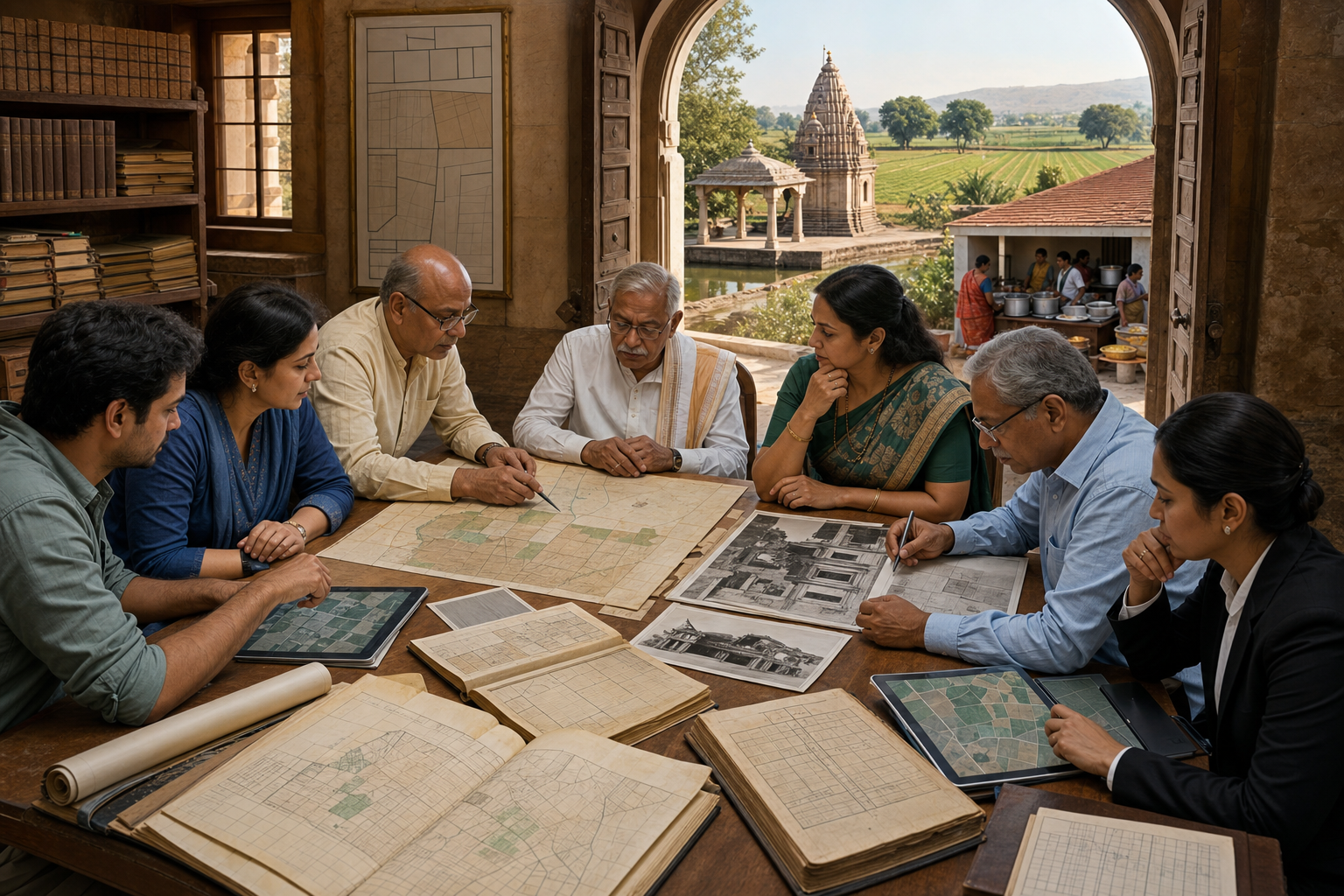
Build a parcel-level property register
Begin with each parcel, not with the institution as a single undivided entry. Assemble current land extracts, historical grant material, survey maps, boundary records, tenancy or lease documents, trust registration records, governing schemes, court or tribunal orders, and files from any pending dispute. Keep certified copies where available and record where every original is held.
- Identify the parcel exactly as it appears in the relevant records.
- Record its location, area, boundaries, current classification, and institutional connection without silently correcting inconsistencies.
- Name the person or body in actual possession and identify the document, if any, supporting that possession.
- Describe the present use: worship, residence, cultivation, rental, community service, heritage protection, or another recorded purpose.
- List every adverse claim, encroachment allegation, tenancy issue, pending case, and conflicting record.
- Assign a trustee, officer, or authorized custodian to maintain the file and log every later change.
Where boundaries are uncertain, cadastral mapping and GIS verification can expose overlaps before litigation or reclassification makes them harder to resolve. Preserve dated survey material and photographs as part of the administrative record, but do not assume that a map or photograph alone proves legal title.
Connect every asset to the function it sustains
A property list explains what the institution has. It does not explain why the asset matters. Build a second schedule showing the income from each relevant asset and the work supported by that income. Separate expenditure for rites and daily seva from allied charitable expenditure such as food service, education, health activity, pilgrim support, or heritage conservation.
This income trail serves two purposes. It gives devotees a basis for demanding honest administration, and it shows lawmakers what would stop if revenue were diverted or interrupted. Use audited figures and traceable payment records. Do not inflate a claim by assigning the same rupee of income to several activities.
If you are a devotee rather than a trustee
You may not control the records, but you can ask questions that improve the institution’s position:
- Has the trust completed a parcel-by-parcel inventory?
- Which properties have disputed title, possession, tenancy, or boundaries?
- Which religious and charitable functions depend on land-derived income?
- Are annual accounts professionally audited and explained to the community in a usable form?
- Who is authorized to submit the institution’s objections when a consultation or revised bill appears?
Ask in writing and seek a recorded response. Public accountability is more useful than circulating an unverified list of “lost temple lands” that mixes documented encroachments with lawful occupations or unresolved claims.
Land concessions, consent terms, title acknowledgements, surrender documents, and classification changes can create serious legal and financial exposure. Before an institution signs or files any such instrument, its trustees should obtain advice from a Maharashtra lawyer who can examine the actual grant, land record, trust scheme, tenancy history, and pending proceedings. A general constitutional argument is not a substitute for parcel-specific legal advice.
Judge the next draft by seven concrete safeguards

The next political debate may again be framed as abolition versus obstruction. You can judge the text more reliably by looking for seven safeguards.
- Precise scope and definitions: The law should identify the grants, institutions, land classes, and legal interests it covers. Terms such as abolition, vesting, reclassification, possession, and beneficiary must not be left to administrative improvisation.
- An express saving for legitimate institutional interests: If the object is record modernization or tenure rationalization, the statute should state what happens to existing title, beneficial interest, possession, and income rights. Silence here invites avoidable disputes.
- Ring-fenced income: Revenue attached to a religious endowment should remain dedicated to the institution’s religious and allied charitable purposes. The law should permit transparent expenditure on worship, traditional seva, community food, education, healthcare, and heritage protection without turning those funds into general state revenue.
- A religious-secular boundary: Audit, procurement, investment, and recordkeeping rules can govern secular administration. The statute should expressly protect rites, rituals, spiritual offices, denominational decisions, and other religious matters from administrative intrusion.
- Due process for land action: Correction of records, boundary adjudication, removal of alleged encroachments, and decisions affecting possession should require notice, access to the evidence, a hearing, a reasoned order, and an effective route of appeal.
- Limited intervention for proven mismanagement: Any external control should follow recorded findings, address a defined administrative failure, last only for a specified remedial purpose, and end when published restoration conditions are met. Repeated renewal should not become the normal method of governing an institution.
- Independent, faith-neutral review: A quasi-judicial mechanism should include appropriate Hindu, Buddhist, Jain, and Sikh institutional knowledge while remaining bound by consistent legal standards. Public consultation, district-level hearings, professional audits, geospatial verification, and tamper-evident land records should feed that mechanism rather than replace adjudication.
Trustees should convert these safeguards into proposed clauses, not merely resolutions opposing abolition. Devotees should ask whether institutional representatives have submitted property evidence and replacement language. The government, in turn, should publish a consultation paper and a consolidated explanation of how the revised proposal complies with Articles 25 and 26.
The pause will matter only if it produces a better evidentiary record and a narrower, clearer law. Start with one institution, one verified parcel register, and one documented income trail. When a revised proposal appears, you will then be able to identify the exact clause that protects sacred property – or the exact clause that threatens it.
References
