
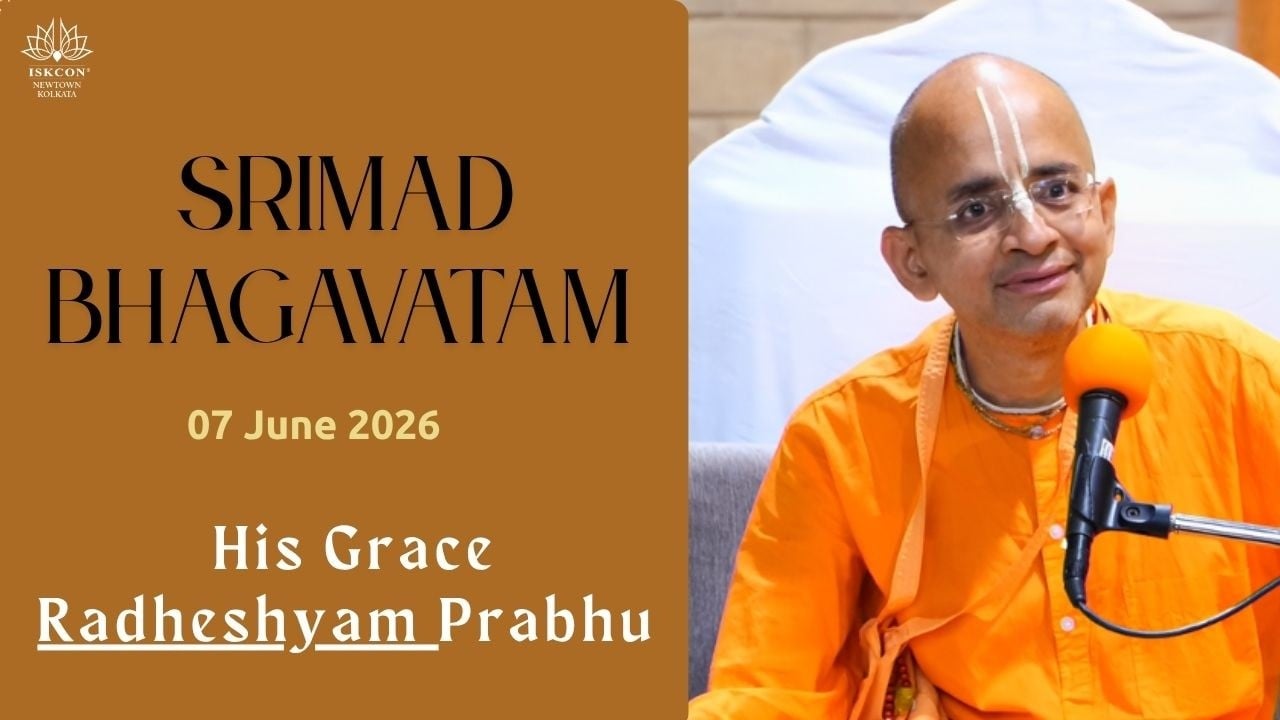
Hosted by ISKCON New Town, Kolkata, the Srimad Bhagavatam class by His Grace Radheshyam Prabhu offers a rigorous yet accessible engagement with one of the most revered Sanskrit scriptures in the Hindu tradition. The session situates the Bhagavata Purana (Srimad Bhagavatam) within both its classical commentarial lineage and its contemporary relevance, presenting bhakti-yoga as a disciplined path that integrates philosophical clarity, ethical refinement, and contemplative practice. Listeners consistently find a synthesis of textual fidelity and lived spiritualityan approach that strengthens devotion while encouraging thoughtful dialogue with the wider family of dharmic traditions, including Buddhism, Jainism, and Sikhism.
Srimad Bhagavatam is a monumental work comprising twelve cantos and 335 chapters. Traditional accounts attribute its composition to Veda Vyasa at the dawn of Kali-yuga, while academic scholarship generally places its compilation between the early and late first millennium CE. Across these perspectives, consensus holds that the text culminates in a theology and practice of pure devotion (bhakti) centered on Krishna, with the Tenth Canto’s narratives providing a theological and aesthetic pinnacle. The overarching message advances devotion as life’s highest goal, transcending the conventional purusharthas (dharma, artha, kama, and even moksha) by orienting the practitioner toward loving service (prema-bhakti).
Within the Gaudiya Vaishnava tradition, the Bhagavatam is read through a robust hermeneutic that relies on parampara (disciplic succession) and contextual interpretation. Classical exegesis by figures such as Sridhara Svami, Jiva Gosvami, and Visvanatha Cakravarti Thakura set a standard later made globally accessible by A. C. Bhaktivedanta Swami Prabhupada’s translation and purports. Radheshyam Prabhu’s classes follow this line, engaging Sanskrit terms, anvaya (syntactic flow), and commentarial insight while translating doctrine into actionable, compassionate living. This balance of śabda-pramana (scriptural testimony) with reasoned explanation helps participants connect ancient wisdom to modern dilemmas with intellectual confidence and devotional integrity.
A hallmark of the pedagogy is methodological clarity. Texts are introduced contextuallywho speaks, to whom, and whybefore moving to word-for-word meanings and the philosophical thrust of each passage. Relevance follows naturally: what the verse implies for daily decisions, relationships, and inner life. The rhythm of the class mirrors the traditional pathway of learning: attentive hearing (sravana), thoughtful reflection (manana), and steady assimilation (nididhyasana), strengthened by communal discourse (sanga) and service (seva). This cadence allows beginners and experienced seekers alike to follow the narrative arc while deepening practical understanding.
The nine processes of bhaktisravanam (hearing), kirtanam (chanting), smaranam (remembrance), pada-sevanam (service to the divine feet), arcanam (worship), vandanam (prayer), dasyam (servitude), sakhyam (friendship), and atma-nivedanam (self-surrender)frequently surface as a matrix for spiritual development. Drawing from texts including the Bhagavatam and Rupa Gosvami’s Bhakti-rasamrita-sindhu, classes describe sadhana-bhakti as a progressive refinement: from anartha-nivritti (clearing impediments) through nistha (steadiness), ruci (taste), asakti (deep attachment), bhava (ecstatic emotion), and, ultimately, prema (divine love). This map provides a psychologically intuitive and technically precise framework, allowing practitioners to locate their present stage and adopt balanced expectations for growth.
Ethical formation is treated as integral to spiritual practice rather than an optional accessory. Cultivating sattva (clarity and harmony) alongside timeless disciplinestruthfulness, compassion, self-restraint, and care for all beingsanchors the mind for contemplative work. Food ethics (ahimsa-aligned diet), mindful speech, and upright livelihood are presented not as sectarian badges but as universal virtues that sustain both personal well-being and social trust. In this framing, the Bhagavatam’s teachings harmonize naturally with the wider dharmic ethos that honors life, dignity, and responsibility.
Comparative insights are employed to foster unity across dharmic paths. The Bhagavatam’s emphasis on karuna (compassion) resonates with Buddhism’s central virtue of karuna and the cultivation of mindful awareness; Jainism’s ahiṃsā and aparigraha find close affinity with the Bhagavatam’s stress on nonviolence and simplicity; Sikhism’s naam-simran and seva echo the Bhagavata call for constant remembrance and service. While each tradition preserves its distinct revelations and methods, the class underscores a shared moral and contemplative grammarencouraging mutual respect, collaborative service, and the celebration of spiritual diversity within the subcontinent’s civilizational tapestry.
Hermeneutically, the triad of sambandha–abhidheya–prayojana (reality–practice–goal) offers a powerful lens. Sambandha clarifies the ontological relationship between the divine, the self, and the world. Abhidheya prescribes the methodhere, bhakti-yoga, informed by hearing, chanting, remembrance, and service. Prayojana names the end: awakened love (prema) that transforms perception and action. Radheshyam Prabhu’s exposition shows how this triad threads through narrative, philosophy, and practice, preventing atomized reading and encouraging holistic comprehension of the Bhagavatam’s structure and purpose.
The class also bridges faith and reason by articulating pramana (means of knowledge) in a way that welcomes critical engagement. While sabda (authoritative testimony) anchors the tradition, reason (anumana) and experience (pratyaksha) are not sidelined; rather, they are oriented and tested against a coherent metaphysical picture. This alignment neither dilutes devotion nor discourages inquiry. Instead, it recognizes that durable faith matures through thoughtful questions, lived experience, and a willingness to expand moral imagination in light of scriptural wisdom.
Contemporary research on contemplative practice provides additional illumination for traditional disciplines. Repetitive mantra meditationsuch as the maha-mantra “Hare Krishna Hare Krishna Krishna Krishna Hare Hare Hare Rama Hare Rama Rama Rama Hare Hare”has been associated in studies with improved attentional control, emotional regulation, and reductions in perceived stress. Practices like regulated breathing (aligned with pranayama principles) and kirtan (devotional music) can engage parasympathetic pathways and support well-being. These findings are not presented as replacements for scriptural authority but as complementary observations that help modern listeners appreciate the Bhagavatam’s sophisticated psychology of devotion.
For learners seeking structure, the class outlines a practical, research-informed study routine. Before each session, a brief sankalpa (intent-setting) refines focus. During the talk, annotated note-takingmarking key Sanskrit terms, thematic clusters, and applied insightsbuilds a durable archive. Afterward, a short period of silent reflection (5–10 minutes) consolidates retention, followed by a concise written synthesis in one’s own words. Weekly satsangwhether in person or onlineanchors accountability and offers peer learning, while a measured daily japa regimen and periodic kirtan nourish affective resilience. Over time, this loop of study, reflection, dialogue, and practice converts information into transformation.
The Kolkata setting adds a vivid communal dimension. Urban pace often fragments attention; public classes and digital broadcasts counteract this by creating predictable, welcoming spaces for contemplation. ISKCON New Town, Kolkata, has increasingly leveraged accessible formats so seekers across schedules and geographies can participate. Such initiatives do more than disseminate content; they nurture sangha, reduce isolation, and model how shared spiritual inquiry can repair the social fabric. In an era of polarized discourse, the Bhagavatam’s emphasis on humility, service, and good will functions as civic medicine.
Misconceptions are addressed with care. The Bhagavatam’s devotional core does not require erasure of difference; rather, it encourages honorable engagement across schools and faiths while remaining true to its own theological heart. Collaborative serviceenvironmental stewardship, education, healthcare outreach, and anna-daanbecomes a natural meeting ground for Hindus, Buddhists, Jains, and Sikhs who share commitments to compassion, truthfulness, and disciplined living. These bridges do not blur identity; they cultivate the deeper unity of shared values that the subcontinent’s traditions have long affirmed.
Ultimately, the class frames the Srimad Bhagavatam as living literaturephilosophically rigorous, emotionally elevating, and eminently practical. It invites steady, respectful study; wholehearted chanting; mindful conduct; and service that uplifts others. By connecting classical commentary with modern experience, and devotion with dialogue, the presentation by His Grace Radheshyam Prabhu exemplifies how scriptural wisdom can inform a mature, inclusive spirituality. In doing so, it strengthens not only individual practice but also the broader project of unity across dharmic traditions, where diversity is a strength and shared ethics point to common ground.
Inspired by this post on Dandavats.
