
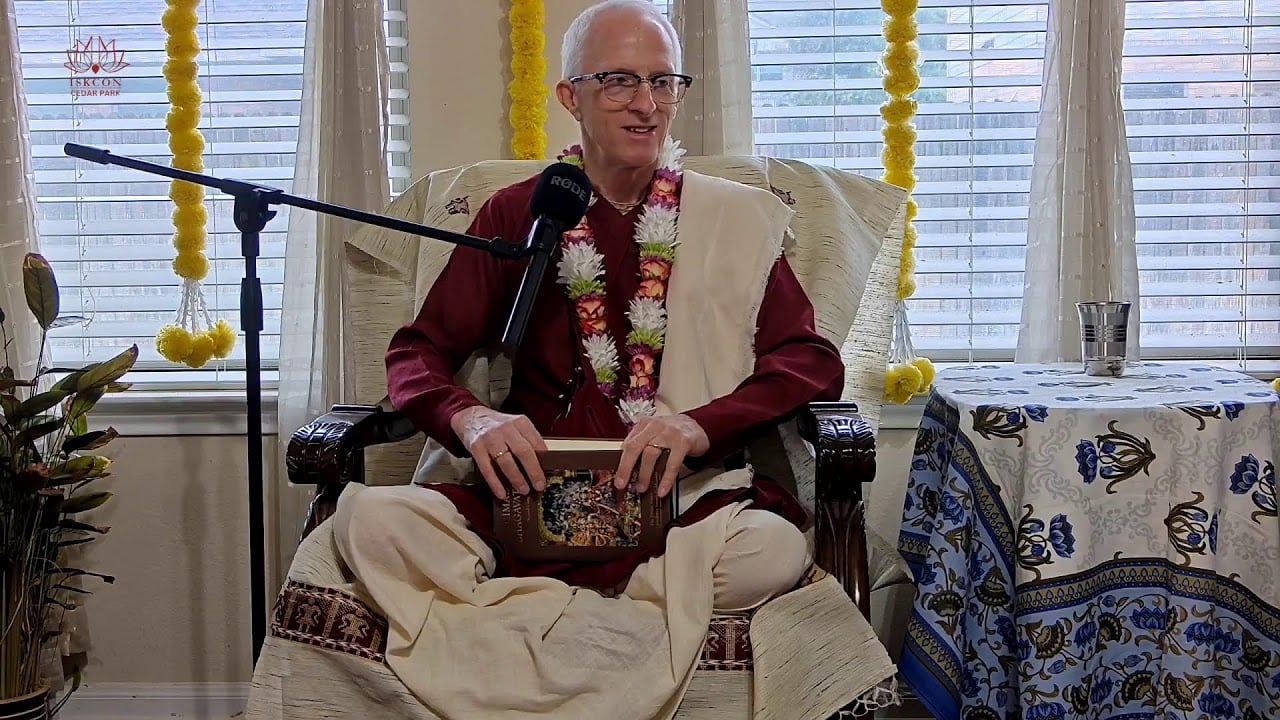
On June 5, 2026, a Srimad Bhagavatam class delivered by HG Mukunda Datta Prabhu at the Hare Krishna Temple of Austin (ISKCON Cedar Park) examined SB 2.5.11 in depth, situating the verse within the Bhagavata Purana’s systematic account of origins and first principles. The session emphasized how this concise passage integrates theology, metaphysics, and practice by asserting that the Supreme Person is the cause of all causes who activates, guides, and sustains the transformations of material nature.
Set within Canto 2’s sustained meditation on the cosmic manifestation, Chapter 5 develops a carefully layered narrative of how creation proceeds from the Absolute Truth through ordered stages. In this chapter, Nārada addresses Vyāsa’s existential despondency by redirecting attention from fragmented historical accounts to the unified source of reality. SB 2.5.11 stands as a pivotal node in this discourse, where cosmology is not an abstract speculation but a pathway to spiritual clarity and devotion.
Philosophically, SB 2.5.11 affirms two interlocking propositions. First, all categories that constitute the cosmoselements, senses, mind, governing deities, and the conditions for embodied experiencearise through the will and energies of the Supreme. Second, these categories remain dependent at every stage; they never operate as autonomous, self-sufficient principles. The verse thereby rejects both strict material reductionism and disengaged deism, presenting the Absolute as simultaneously immanent (pervading and sustaining) and transcendent (the independent origin and regulator).
The verse’s implications are best understood through the Bhagavatam’s Sankhya-informed map of manifestation. In its broad outline: pradhana (the equilibrium of the three gunas) is stirred by kala (time), whereupon the mahat-tattva (cosmic intelligence) manifests. From mahat arises ahankara (the individuating principle) in three modalitiessattvika, rajasika, and tamasika. The tamasika modification yields the tanmatras (subtle sound, touch, form, taste, smell), which in turn produce the five gross elements (ether, air, fire, water, earth). The rajasika modification empowers the organs of action and perception (ten senses), while the sattvika modification gives rise to the presiding devatas and refines mental faculties, including manas (mind) and buddhi (discernment). SB 2.5.11, in essence, anchors this cascade in the agency of the Supreme.
Three auxiliary factorskala (time), karma (the aggregated momentum of prior actions), and svabhava (inherent disposition)mediate the conversion of potential into manifest structures. In Vaishnava cosmology, the glance of the Purusha upon prakriti activates these co-factors, imbuing inert potentiality with directed purpose. The world thus emerges neither randomly nor mechanistically; it unfolds teleologically with lawfulness, intelligibility, and moral contour.
In Vedantic terms, SB 2.5.11 points to the Supreme as both the nimitta-karana (efficient cause) and the remote ground behind the upadana-karana (material cause), while recognizing that material nature acts as the proximate substance of formation. Gaudiya Vaishnavism articulates this relation through achintya-bheda-abhedaan inconceivable, simultaneous oneness and difference between the Lord and His energies. The cosmos is real and meaningful, yet perpetually dependent; its autonomy is apparent, not absolute.
The Bhagavatam also distinguishes sarga (primary creation) and visarga (secondary creation). Sarga denotes the origination of fundamental categories (elements, senses, mind) by the Supreme, whereas visarga refers to the subsequent assembling and diversification, classically attributed to Brahma under divine guidance. SB 2.5.11 contributes to the sarga framework by establishing that the foundational building blocks themselves are sourced and supervised by the Supreme Person.
SB 2.5.11 resonates across dharmic traditions committed to a non-coercive, plural search for truth. Buddhism’s pratityasamutpada (dependent origination) stresses the conditioned co-arising of phenomenaan insight that parallels the Bhagavatam’s insistence on interdependence while differing in metaphysical commitments. Jain philosophy’s dravya taxonomy (jiva, pudgala, dharma-dravya, adharma-dravya, akasha, kala) offers a rigorous structure of reality that, like the Bhagavatam, unifies ontology and ethics through karma and responsibility. Sikh teaching on Ik Onkar and hukam underscores a singular, creative sovereignty that grounds both cosmic order and moral life. Read in conversation, these streams converge on a shared intuition: reality is intelligible, ordered, and ethically significant; human flourishing follows from aligning with that order through disciplined practice and compassionate action.
For practitioners, the verse carries immediate ethical and existential implications. If all faculties and elements are sourced and sustained by the Supreme, humility becomes rational, gratitude becomes natural, and stewardship of the body, society, and environment becomes a sacred obligation. Such an outlook fortifies ahimsa (non-violence), truthfulness, and self-regulation as more than moral preferencesthey become responses appropriate to the structure of reality.
In bhakti-yoga, SB 2.5.11 refines three core practices. Sravana (hearing) acquires focus by contemplating the Supreme as the integrator of causes. Kirtana (chanting) becomes an affirmation of dependence on the cause of all causes, aligning speech with truth. Smarana (remembering) shifts from episodic recollection to steady awareness that every sensory and mental function operates within divine sustainment. Complementary disciplinessuch as breath awareness from Yoga and mindful attention from Buddhismcan be harmonized with bhakti to cultivate one-pointedness without compromising theological clarity.
Methodologically, the verse encourages a triadic epistemologypratyaksha (sense observation), anumana (inference), and sabda (revelation). The Bhagavatam privileges sabda as a reliable guide to transcendent truths while welcoming reasoned analysis and empirical observation for proximate understanding. In this way, the verse models a non-adversarial integration of scriptural authority, rational reflection, and lived experience.
Contemporary readers often ask how this framework relates to modern science. The Bhagavatam’s categories function as metaphysical and phenomenological principles rather than as laboratory variables. The gunas can be read as a qualitative grammar of change, kala as an active principle structuring becoming, and karma as a law of moral causation. These do not compete with physics or cosmology; they operate at a different, complementary explanatory layer, integrating meaning, value, and purpose into any account of what is.
Participants in the June 5, 2026 class noted how SB 2.5.11 clarifies both the grandeur and intimacy of the Absolute: grandeur, in that the Supreme orchestrates cosmic architecture; intimacy, in that every breath, thought, and sense impression is sustained by benevolent oversight. This blend of metaphysical scope and personal nearness is characteristic of the Bhagavata Purana and explains its enduring appeal across diverse audiences.
Three takeaways crystallize the verse’s enduring relevance. First, ontology and ethics are inseparable: understanding the world’s sourced dependence engenders responsibility and compassion. Second, devotion and discernment mature together: devotion without understanding risks sentimentality, while understanding without devotion risks sterility. Third, dharmic unity is practical and principled: traditions can converse fruitfully where humility, non-violence, and disciplined practice are shared commitments.
In sum, SB 2.5.11 offers a compact but comprehensive key to Vaishnava cosmology and spiritual life. It reveals a cosmos that is lawful yet loving, ordered yet open to grace. Read alongside complementary insights from Hinduism, Buddhism, Jainism, and Sikhism, the verse invites a culture of dialogue, mutual respect, and shared aspirationa unity in spiritual diversity grounded in the quest for truth and the practice of dharma.
Inspired by this post on Dandavats.
