
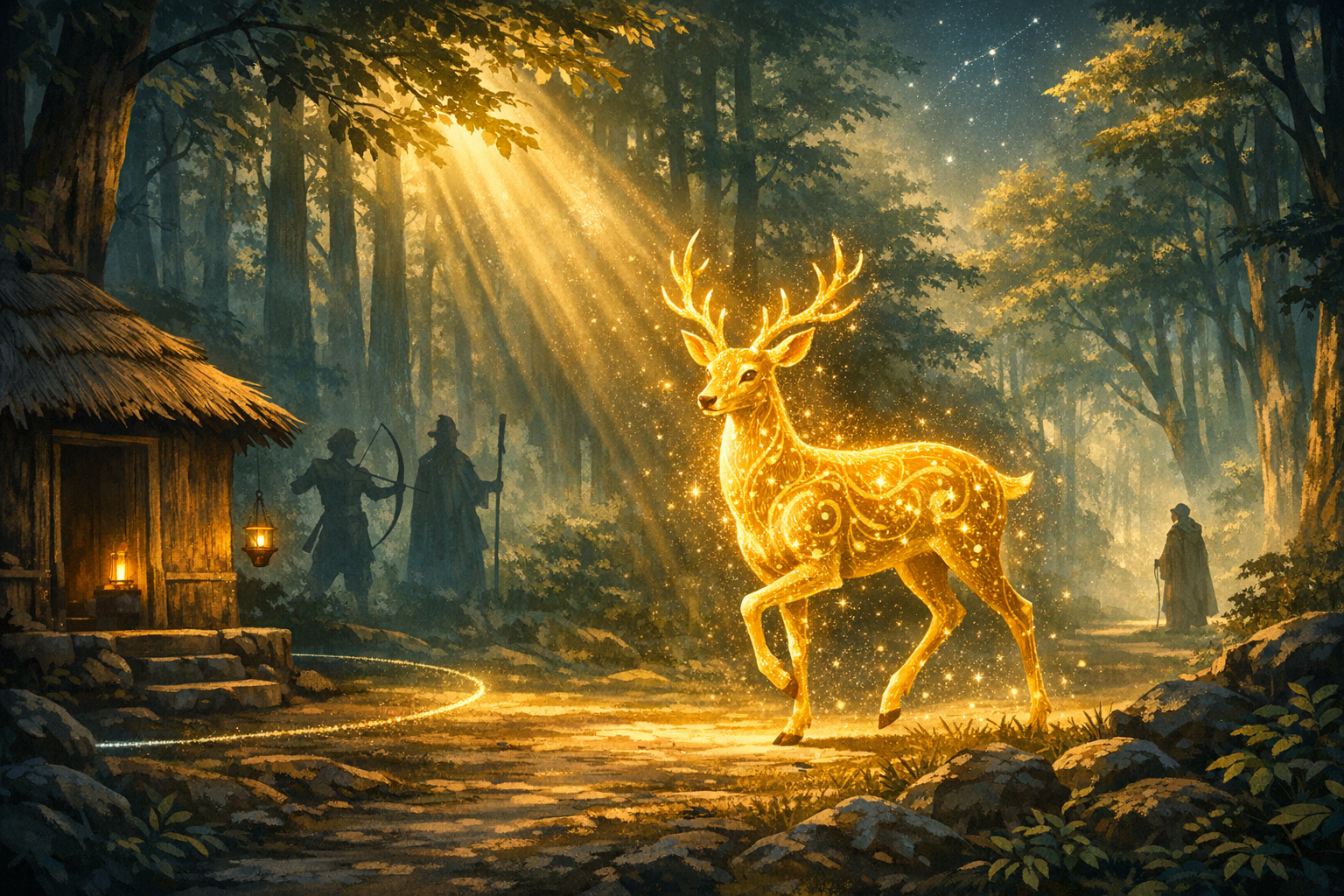
Destiny in the Ramayana often takes unanticipated forms. For Sita and Rama, it arrived as a resplendent Golden Deerhiranyamrgawhose beauty refracted duty, desire, and fate into a single luminous test. Far from incidental ornament, this apparition serves as the narrative hinge upon which Aranya Kanda turns, inaugurating the sequence that leads from exile to confrontation and, ultimately, to the restoration of dharma.
Within Valmiki’s Ramayana (Aranya Kanda), the rakshasa Maricha assumes the form of the Golden Deer to draw Rama away. Sita beholds the creature’s ethereal grace and requests it as a keepsake; Rama entrusts her safety to Lakshmana and pursues. Mortally struck, Maricha mimics Rama’s cry, agitating Sita’s concern and prompting Lakshmana to step away. In the ensuing solitude, Ravanadisguised as a mendicantabducts Sita, setting in motion the Dharma-Yuddha that will define the epic’s moral landscape.
Textual traditions corroborate and elaborate this arc across centuries. The Valmiki critical edition focuses on Maricha’s deception and Sita’s request; later vernacular retellingssuch as Kampaṉ’s Iramavataram, the Adhyatma Ramayana, and regional Rama-kathasretain the deer as a catalytic lure while diversifying tone, dialogue, and theological emphasis. The coherence of the episode across traditions underscores its interpretive weight in Hindu epic literature.
From the vantage of narrative theory, the Golden Deer functions as a catalyst-object: a seemingly desirable form that triggers separation, trial, and transformation. In terms familiar to folklore morphology, the lure instigates absentation, transgression of a threshold, and the eventual ordeal; in the Ramayana, this sequence forges the path toward alliance, reconnaissance, and righteous war.
Symbolically, “gold” (hiranya) connotes radiance, prosperity, and tejas, yet, in ethical discourse, also marks the snares of lobha and maya. The Golden Deer interlaces these valences: beauty appears as blessing while concealing an instrument of delusion. This doubleness is central to the scene’s philosophical force.
The deer itself is a classical emblem of the restive mind and wandering senses (indriyas). Yogic psychology often likens attention to a fleet-footed mrigá, susceptible to shimmer and movement. Reading the deer as mind-object frames the episode as a meditation on vigilance: how quickly perception, if unexamined, is captured by sheen.
Interpretations that fault Sita overlook both textual nuance and theological grammar. As the embodiment of Śrīauspiciousness and refined sensibilitySita’s attraction to uncommon beauty reflects not caprice but aesthetic discernment consonant with dharmic life. The episode invites reflection on how even noble desires, if untested, can be leveraged by adharma.
For Rama, the moment becomes a lesson in kshatra-dharma under uncertainty. As Maryada Purushottama, he balances the imperative to protect sages and sustain vows with the proximate duty of guarding the household in forest-exile. Delegation to Lakshmana indicates reasoned risk distribution; the ensuing breach illustrates how adversaries exploit even prudent plans.
The widely cited “Lakshmana Rekha” motifan inviolable line guarding Sitais not present in the Valmiki critical edition and gains prominence in later North Indian tellings. Its modern metaphorical life, however, remains instructive: boundaries, once set, require shared understanding and disciplined adherence if they are to secure what they promise.
Ravana’s stratagem highlights a perennial ethical danger: the masquerade of malevolence as sanctity. By appearing as a bhikshu, he weaponizes hospitality norms and ashrama etiquette, violating the civility he feigns. The episode warns against naive universalism while affirming compassionate vigilance as the mark of dharma.
Aranyathe forestserves as a liminal pedagogy. Removed from courtly predictability, it intensifies ambiguity: ascetics and rakshasas, rites and ruses, healing herbs and poisonous blooms co-exist. In such terrains, discernment (viveka) must steady the traveler more than protocol alone.
Philosophically, the deer dramatizes the interplay of daiva and puruṣakāradestiny and human effort. Destiny does not negate agency; rather, it recruits choices. Sita’s appeal, Rama’s pursuit, Lakshmana’s departure, and Ravana’s deceit weave a causal fabric through which karma matures and dharma reasserts itself.
Across Dharmic traditions, complementary lenses refine this insight. In Buddhist literature, deer often signify compassion and moral instructionthe Ruru (or Golden Deer) Jataka extols truth and selfless care. By contrast, the Ramayana’s Golden Deer is a decoy, reminding readers that virtue and delusion can wear similar shine; only discernment separates them.
Jain thought, with its emphasis on aparigraha (non-possessiveness) and anekāntavāda (many-sidedness), reads the lure as a case study in attachments and partial views. The episode recommends careful testing of appearances, truth-speaking (satya), and gentle restraint to avoid bondage born of momentary fascinations.
Sikh teachings on maya and hukam further illuminate the scene. Worldly glitter frequently distracts from remembrance, yet alignment with hukam and practice of nimrata and seva re-center conduct. The Ramayana’s warning complements this ethos: cultivate clarity before consent, and compassion without credulity.
Modern cognitive science converges with these readings. Salience bias, novelty bias, and the affect heuristic predispose attention toward the glittering and rare. The Golden Deer thus becomes a parable of perception: without structured checkspause, verification, and second opinionsthe mind overweights dazzle at the expense of duty.
In leadership and security studies, the episode offers a proto–threat-model. Adversaries stage diversions, imitate trusted signals, and strike during role-switches. Countermeasuresclear protocols, layered guardianship, and worst-case drillstranslate the “Lakshmana Rekha” into contemporary governance.
Equally vital is the ethical correction the narrative enforces: neither suspicion of beauty nor suspicion of women is warranted. The text censures deception, not desire; it upholds shared accountability within relationships rather than scapegoating. Sita’s fortitude across captivity reaffirms this balance.
Aesthetically, the scene carries adbhuta (wonder) shaded by bhaya (fear), while foreshadowing vira (heroic) rasa. The contrastgolden sheen against forest shadowheightens symbolic tension, preparing the sensibility for the epic’s moral chiaroscuro.
Comparative philology enriches the picture. Kampaṉ heightens poetic luminosity and moral introspection; the Adhyatma Ramayana infuses Advaitic allegory; regional Rama-kathas add dialogue that cultures the “protective boundary” trope. Across these, Maricha’s final cry remains the hinge that actuates Ravana’s plot.
Cosmologically, later commentators occasionally link the deer’s lure to Mrigashira Nakshatra, emblematic of seeking and curiosity. While not a determinative source-text cue, the association deepens the allegory: quest is salutary when yoked to viveka; perilous when untethered.
In sum, the Golden Deer condenses the Ramayana’s grand dialectic: dharma must steer desire; vigilance must temper generosity; unity across paths must rest on clarity, not credulity. Read through Hindu, Buddhist, Jain, and Sikh sensibilities, the episode invites a shared resolutionhonor beauty, test appearances, act righteously, and allow destiny to unfold through disciplined, compassionate choice.
Inspired by this post on Hindu Blog.
