
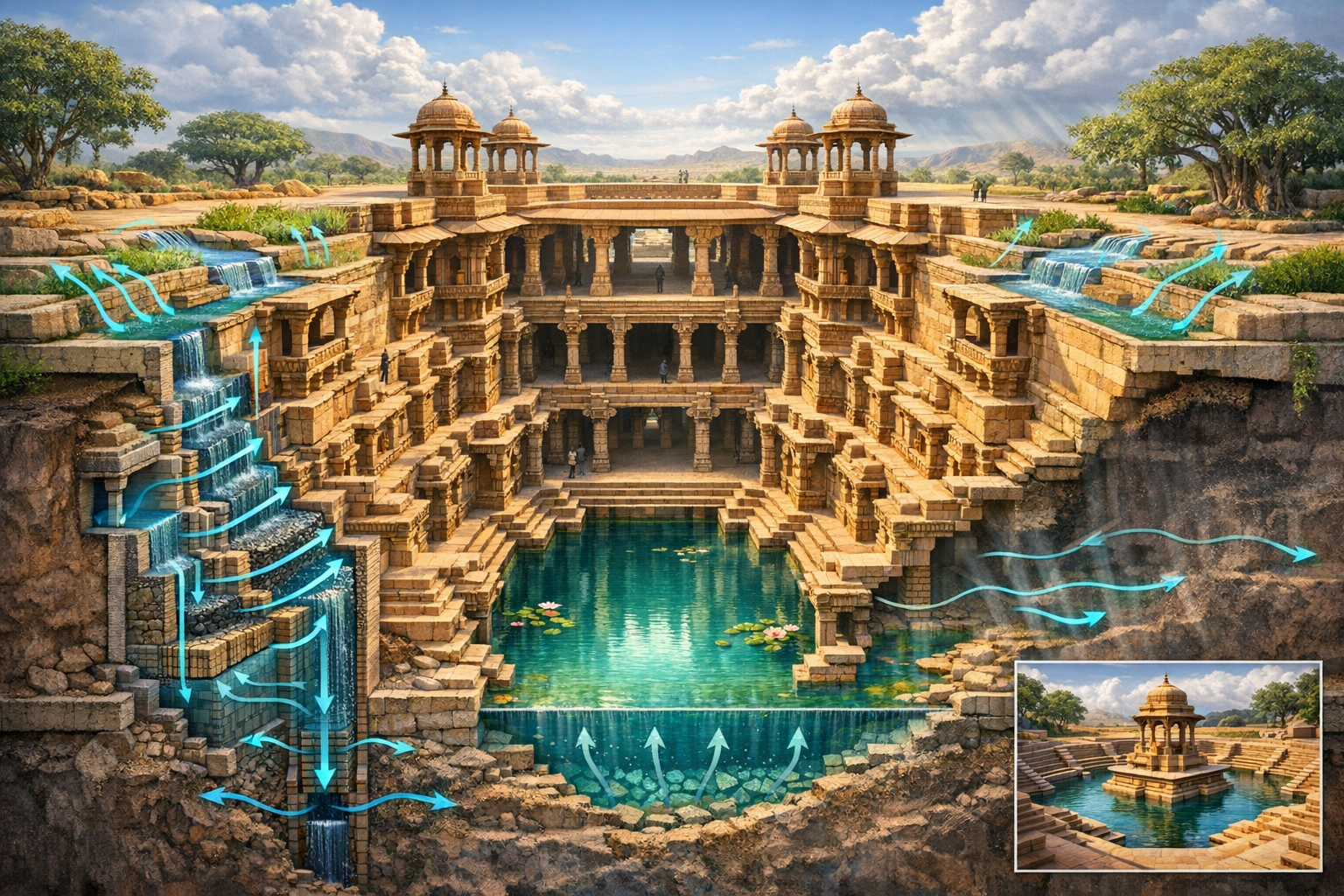
Stepwellsknown regionally as vav or vavdi (Gujarat), baoli or baori (North India), and as kalyani or pushkarini (South India)are among South Asia’s most remarkable achievements in ancient architecture, environmental engineering, and cultural heritage. They embody a sophisticated synthesis of hydrogeology, structural ingenuity, and dharmic ethics of water stewardship, functioning as living monuments where science and spirituality converge.
Distributed across Gujarat, Rajasthan, Madhya Pradesh, Delhi, and parts of Karnataka, Telangana, and Tamil Nadu, stepwells evolved as precise responses to monsoon-driven hydrology and semi-arid climates. Their stepped profiles enabled communities to access declining water tables seasonally, while their shaded depths created cool microclimates. As multifunctional nodesplaces of gathering, ritual, rest, and exchangethese works of Hindu architecture also served Jain, Buddhist, and Sikh communities, underscoring a civilizational ethos of shared water and shared spaces.
Historically, textual and epigraphic clues indicate widespread construction from the early first millennium CE, with a flourishing between the 7th and 19th centuries. References to wells, tanks, irrigation, and water gifts appear in works such as the Arthashastra and the Puranas, while later inscriptions document patronage by queens, merchant guilds, and temple institutions. The philanthropic ideal of udapāna-dāna (the gift of water) framed stepwell building as a meritorious public good, inseparable from dharma and civic responsibility.
Patronage patterns reveal a striking social breadth. Royal womenUdayamati at Patan (Rani ki Vav) and Rudabai at Adalajcommissioned celebrated vavs, merchant communities endowed baolis along trade corridors, and monastic institutions curated temple tanks (pushkarinis) for ritual and daily use. The result is a networked water infrastructure that remained inclusive by design, welcoming pilgrims, traders, farmers, and travelers across the dharmic spectrum.
Hydrologically, stepwells tap shallow aquifers through a masonry-lined shaft. Seasonal runoff from the catchment is guided via inlets and filter bedsoften gravel and limeto settle silt before percolation. The extensive stone surfaces of terraces and steps increase the wetted perimeter, enhancing infiltration and recharge. By recessing water into shaded, narrow shafts, stepwells also reduce direct insolation, thereby curbing evaporation in hot, dry winds.
A simple water balance illustrates the logic: Annual storage potential ≈ Rainfall × Catchment Area × Runoff Coefficient − Losses (evaporation, seepage beyond the aquifer, and draw-off). For a modest 10,000 m² catchment in a 600 mm rainfall regime with a runoff coefficient of 0.30, gross inflow can approach 1,800 m³ per monsoon. Multiplied across neighborhood-scale stepwells, this yields community resilience during dry spells without reliance on long-distance conveyance.
Climatic performance is equally notable. The high thermal mass of stone, limited sky view factor at depth, and persistent evaporative cooling from the water surface create interior temperatures commonly 5–7°C below ambient summer highs. Stepped geometries interrupt convective currents and promote gentle air movement, while deep shadows reduce radiant heat gain. These passive cooling effects turn stepwells into natural refuges during extreme heat, centuries before mechanical ventilation.
Structurally, stepwells balance vertical loads from terraced galleries with lateral earth pressures using thick retaining walls, corbelled courses, and closely spaced pillars. Stone-on-stone construction with lime-based mortars provides both compressive strength and permeability control. Brackets, lintels, and transverse beams distribute load to prevent local failure, while periodic landings act as buttresses against soil thrust. Site selection on stable stratasandstone, laterite, or metamorphic bedrockfurther secures foundation performance.
Materials science reveals careful craftsmanship: dressed sandstone blocks, surkhi-lime mortars for hydraulic resistance, kankar-lime plasters for water tightness, and durable stone pavements for abrasion resistance. Inlet channels sometimes include stepped silt traps and charcoal-gravel layers, improving turbidity and taste while reducing organic load.
Water quality management operated through low-tech but intelligent meanssettling basins, periodic desilting, and the intrinsic filtration of percolating monsoon waters. The resulting groundwater recharge stabilizes local water tables and can improve well yields over contiguous areas, offering a distributed and decentralized complement to open tanks and lakes.
Rani ki Vav (Patan, Gujarat; 11th century), a UNESCO World Heritage Site, distills the apex of stepwell design. Measuring roughly 64 meters long and 20 meters wide, it descends in an intricate sequence of mandapa-like pavilions to a final well shaft. Sculptural programslargely Vaishnava but dialoguing with other dharmic motifsframe water as tirtha, a crossing between material sustenance and spiritual purification. Its geometry, ornamentation, and hydraulic clarity make it a canonical reference for conservation practice.
Chand Baori (Abhaneri, Rajasthan; c. 9th century) exemplifies an audacious, near-fractal stair geometry: about 3,500 steps in a rhythmic lattice drop more than 20 meters to the aquifer. The synchronicity of repeating stair flights optimizes movement, human access at varied water levels, and structural regularity. In arid Rajasthan’s wind and heat, the baori’s sunken court offers a calm, cool, and communal shelter.
Adalaj ni Vav (near Ahmedabad; late 15th century) integrates five storeys of carved galleries with an octagonal plan at the surface, allowing light and air to filter down without thermal overload. Alignments with prevailing winds and careful modulation of openings create a balanced microclimate. Inscriptions linking water endowment to public welfare reinforce the entwined ideals of engineering ingenuity and ethical duty.
Agrasen ki Baoli (present-day Delhi; current form likely 14th–15th century) demonstrates how stepwells fit dense urban fabrics. Its long, axial stairway descends through stratified microclimates, from bright upper landings to cool lower terraces. Adaptive reuse todayas a heritage site and public realmrecovers its original role as a social condenser while protecting its archaeological layers.
Temple tanks and pushkarinissuch as the mathematically precise stepped tank at Hampi (15th century)expand the typology. While not deep shafted like vavs, their tiered steps, inlet channels, and ritual platforms show similar attention to hydraulic clarity, thermal comfort, and civic access. They complete an ecosystem of wells, tanks, and canals that supported agrarian and ritual economies in South India.
Across dharmic traditions, the ethical and spiritual centrality of water is palpable. In Sikh heritage, the Baoli Sahib at Goindwal (16th century, associated with Guru Amar Das) with its 84 steps is a vivid exemplar of step-access water architecture devoted to practice and pilgrimage. Jain merchant guilds financed numerous vavs, and tirtha imagery appears in select stepwell iconography. Buddhist monastic universities like Nalanda maintained stepped tanks as integral parts of scholastic and daily life. These shared practices reflect a civilizational compact: jal is sacred, and access to it must be equitable and sustaining.
Socially, stepwells doubled as platforms for exchangegrain negotiations after the rains, craft markets in shaded landings, and community adjudication in liminal spaces where practical and sacred activities overlapped. Oral histories recall women’s groups coordinating seasonal cleaning and rationing, embedding governance into everyday water ethics rather than separating it as a distant bureaucratic function.
Trade routes and pilgrimage circuits often mapped themselves to water certainty. Wayfarers navigated from baori to baori, with rest pavilionschhatris and pillared hallsintegrated into the descent. The cosmopolitan character of many stepwells, welcoming diverse travelers and sects, reinforced a dharmic unity in practice: shared water, shared shelter, shared responsibility.
From a climate-science lens, stepwells qualify as nature-based solutions. Their operation relies on gravity, capillarity, and the thermal dynamics of stone and shadesystems that incur virtually no operational energy. Evaporation is intrinsically controlled by depth, narrow plan, and stacked shadow layers; field observations in semi-arid belts indicate markedly lower evaporative losses than in wide, shallow, fully exposed ponds.
In urban design, stepwells can be reinterpreted as blue–green infrastructure. Catchment reconnection through permeable pavements, bioswales, and roof-to-stepwell downpipes can transform storm surges into groundwater recharge. Paired with neighborhood parks, revived baolis become cool refuges during heatwaves, aligning with Sustainable Development Goals on water (SDG 6), resilient cities (SDG 11), and climate action (SDG 13).
Preliminary capacity checks for contemporary retrofits are straightforward. For example, a 2-hectare mixed-use block with 700 mm rainfall and a conservative runoff coefficient of 0.35 could yield ~4,900 m³/year of stormwater. Routed through silt traps and biofilters into a rehabilitated stepwell, this volume can stabilize community gardens, temper local microclimates, and enhance aquifer rechargewithout large conveyance infrastructure.
Design guidelines for new or revived stepwells emphasize: (1) site geotechnics and aquifer continuity; (2) catchment hydrology and non-erosive inlet velocities; (3) step geometry optimized for safe access at multiple drawdown levels; (4) robust stone masonry with lime mortars; (5) shading architecture that balances daylight with thermal comfort; (6) filtration forebays and maintenance landings; and (7) universal access and safety without compromising heritage character.
Conservation diagnostics typically encounter siltation, biological growth, mortar deterioration, displaced stones, and blocked inlets. Structural pathologies include lateral wall bulging from hydrostatic cycles and vegetation-induced cracking. Priorities include minimally invasive desilting, resetting of displaced stones with compatible mortars, root management, and staged re-watering to avoid shock loading of the masonry.
Digital heritage toolsphotogrammetry, LiDAR scans, and ground-penetrating radarsupport condition mapping and reveal buried channels. Archival research triangulates historic alignments and patronage. Community charters for everyday careseasonal cleaning, controlled access, and water-quality monitoringare as critical as technical repairs, ensuring living use rather than museumization.
Case-based revivals in the last two decades illustrate success. Toorji ka Jhalra (Jodhpur) demonstrates how careful desilting, stone conservation, and catchment reconnection can restore a stepwell’s social life and hydraulic purpose. Agrasen ki Baoli’s renewed public realm shows that urban heritage can be both contemplative and active. At Hampi, the stepped tank’s conservation doubled as pedagogy, teaching geometry, hydraulics, and history in one living classroom.
Policy frameworks can scale such efforts: integrating stepwell corridors into city master plans; recognizing water heritage as climate infrastructure; funding lime-craft training; and incentivizing rainwater redirection. Partnerships among municipalities, temple trusts, gurdwaras, Jain sanghs, and civil-society groups align with long-standing dharmic traditions of collective stewardship.
Comparatively, while other civilizations perfected aqueducts and cisterns, South Asia’s stepwells represent a distinct pathvertical access to groundwater coupled with shaded microclimates and ritual frameworks. This is not a claim of civilizational hierarchy but an affirmation of contextual ingenuity: architecture attuned to monsoon rhythms, geology, and a social contract of water sharing.
At their core, stepwells are blueprints for unity. They welcome the rituals of many, the needs of all, and the knowledge of artisans whose stonework makes science tangible. In an era of climate volatility, these stone-carved sciences offer a humane, low-energy, and culturally resonant model for resilienceone that binds Hindu, Buddhist, Jain, and Sikh practices to a common ethic: protect water, protect life.
Seen this way, stepwells are not ruins but resilient systemsliving examples of ancient wisdom and applied science that can still serve modern India. Their revival strengthens cultural heritage, advances sustainable water management, and re-centers communities around shared resources. Stone by stone and step by step, they teach that conservation, like water itself, flows best when it moves through everyone.
Inspired by this post on Hindu Blog.
